When every tap in the house feels weak at the same time, the problem is almost never the taps. Whole-house low water pressure comes down to one of a handful of things: a shutoff valve that is not fully open, a pressure-reducing valve that has failed, mineral scale or corrosion narrowing the pipes, a clogged whole-house filter, or a leak stealing water before it reaches the fixtures. Most of those are diagnosable in an afternoon without a wrench.
This guide walks through the checks in the order I would run them, what each one rules in or out, and the point where a homeowner should stop and pick up the phone.
Table of Contents
- What Counts as Low Water Pressure? Anything Sustained Below About 40 PSI
- What Are the Most Common Causes of Low Pressure? In the Order I Would Check Them
- 1. A main shutoff valve that is not fully open
- 2. A pressure-reducing valve that has failed
- 3. Mineral scale in aerators and showerheads
- 4. A clogged whole-house filter or a softener stuck mid-cycle
- 5. Corroded galvanized steel pipe
- 6. A leaking supply line you cannot see
- 7. The water heater on the hot side only
- 8. Something upstream of your meter
- How Can You Tell Whether the Problem Is Whole-House or Fixture-Specific?
- How Do You Check the Main Shutoff Valve and Pressure-Reducing Valve?
- What Plumbing Problems Can Reduce Pressure at Every Fixture?
- What Can You Safely Check Before Calling a Plumber?
- What Is the Difference Between Low Pressure and Low Water Flow?
- When Should You Call a Plumber for Low Whole-House Pressure?
- Frequently Asked Questions
- Is 40 PSI water pressure too low for a house?
- How can I increase the water pressure in my house?
- Why does my water pressure drop when I turn on a second faucet?
- Why is my water pressure low only at night?
- How do I check for a hidden leak with my water meter?
- Do I need a pressure booster pump for my house?
- Conclusion
What Counts as Low Water Pressure? Anything Sustained Below About 40 PSI
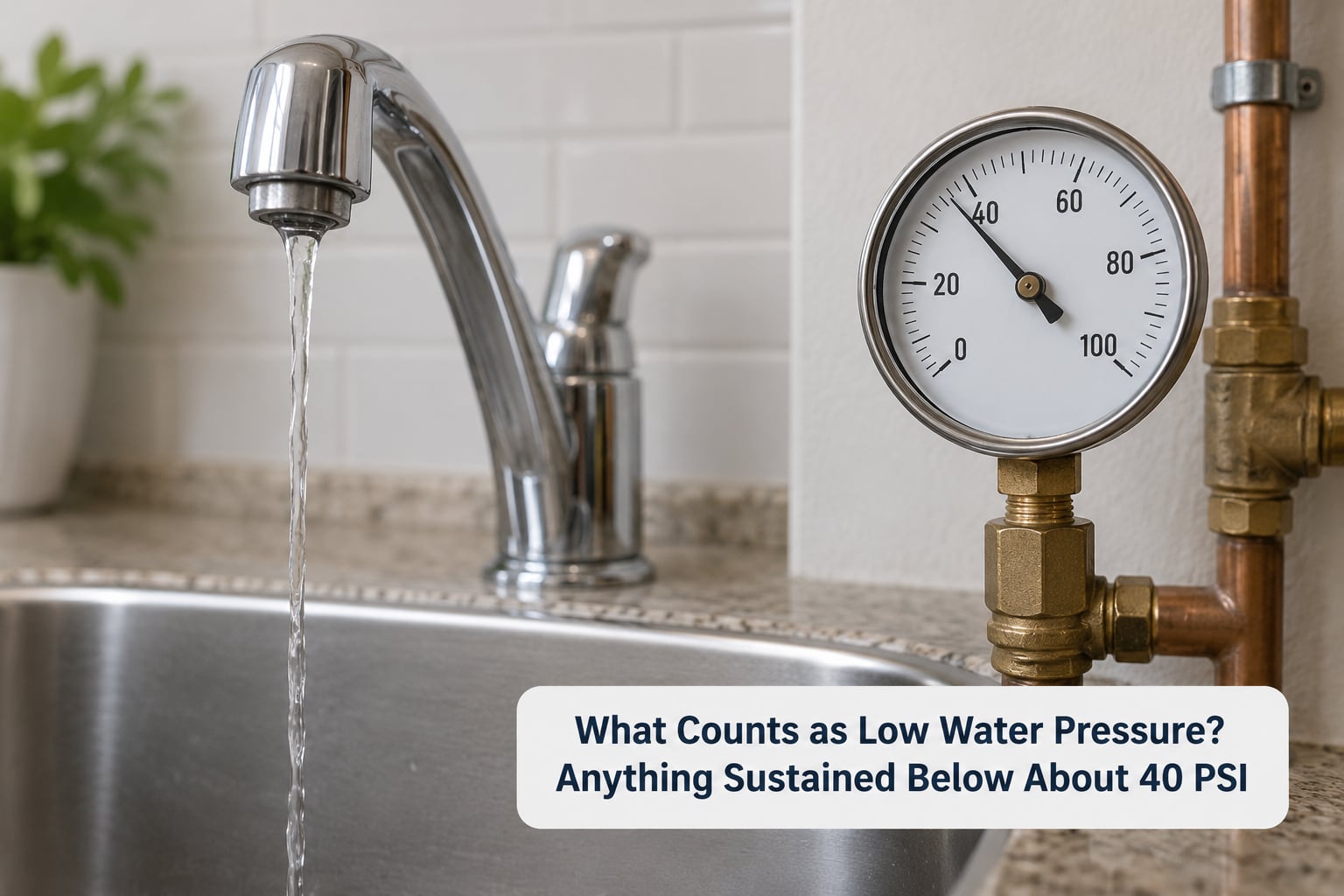
Normal residential pressure sits somewhere between 40 and 60 PSI. Below 40 PSI sustained across the house, you will notice it on the shower, the tub spout, and how long the washing machine and dishwasher take to fill. Above 80 PSI, the risk shifts: fixtures, supply lines, and appliance connections start taking damage they were never rated for.
One number alone will mislead you, which is why plumbers take two readings. Static pressure is measured with every fixture closed, and it tells you what the supply is delivering. Dynamic pressure is measured with a fixture running, and it tells you what you actually have available while using water. A static reading of 60 that falls to 25 the moment a shower runs points at a restriction somewhere in the house. A static of 25 with everything closed points upstream.
| What you read | What it usually means | Where to look first |
|---|---|---|
| Below 20 PSI | Supply is barely reaching the house | Municipal main, service line, well pump, main shutoff |
| 20 to 40 PSI static | Regulator set low, or a valve is throttling | Pressure-reducing valve, main shutoff |
| 40 to 60 PSI static, drops hard when a fixture opens | Restriction inside the house | Scale, corrosion, clogged filter, undersized pipe |
| 40 to 60 PSI static, holds steady under load | Supply is fine; the complaint is local | Aerators, showerheads, one fixture only |
| Above 80 PSI | Regulator failed open, or was adjusted too far | Pressure-reducing valve, expansion tank |
Fixtures can also feel different at the same time for reasons that have nothing to do with pressure. A pressure-reducing valve is usually installed on the cold inlet, so the cold side can read stronger than the hot. Water heaters add their own friction. And if pressure fluctuates with nothing you are doing inside the house, something upstream is changing.
What Are the Most Common Causes of Low Pressure? In the Order I Would Check Them
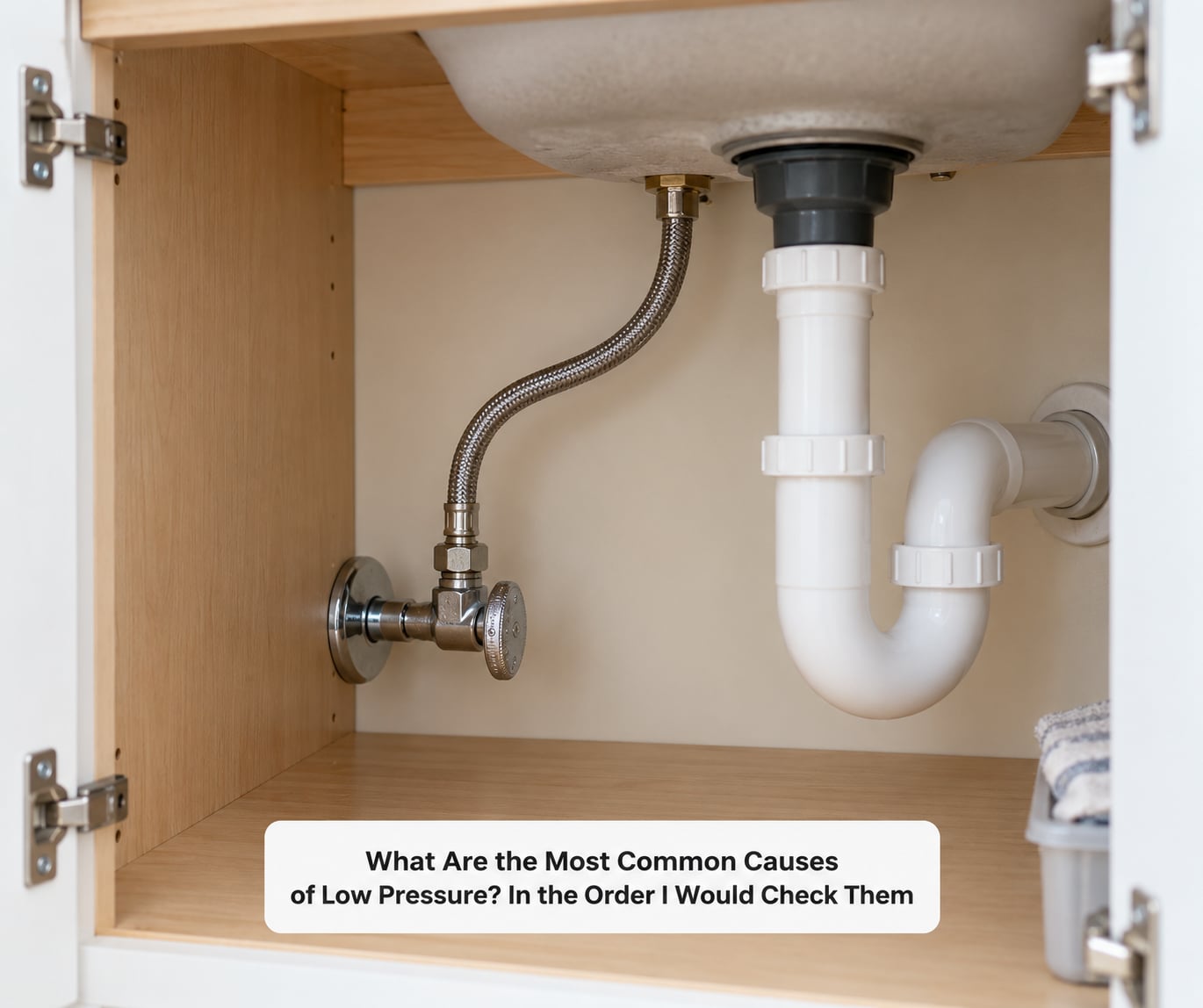
Here is the ranking. Every plumbing forum thread on this question converges on the same first three, which matches what I see in practice: a blockage on the main line, a shutoff that is off or partially closed, or a failed gate valve on that shutoff. Read the list top to bottom and stop when the symptom matches.
1. A main shutoff valve that is not fully open
The main shutoff sits just inside where the service line enters the house. A few degrees of rotation throttles the entire home, and many people never touch it again after a faucet swap or a hose bib replacement. Gate valves have no position indicator, so a valve that looks open can be a quarter turn shy of open. Mark the handle with a pencil or tape before you turn it, so you know where fully open is.
2. A pressure-reducing valve that has failed
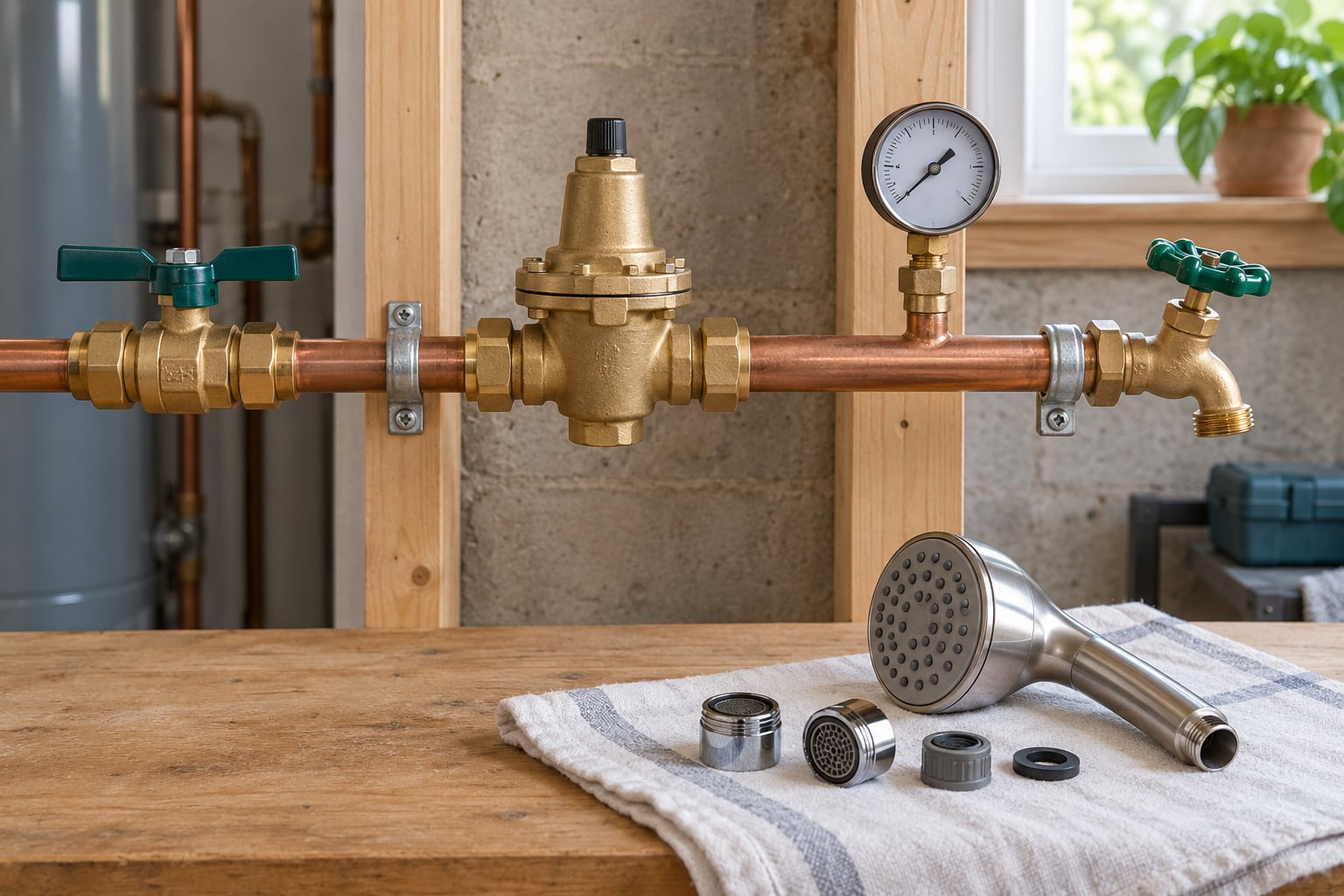
A pressure-reducing valve (PRV), also called a pressure regulator, takes street pressure and steps it down to a household-safe range. It is usually within a few feet of the meter on the cold line. When the diaphragm or spring goes bad, it either holds too little pressure or fails open and passes full main pressure straight through. There is a useful field test: turn the adjustment nut counterclockwise about a quarter turn while someone reads the gauge. If pressure jumps by more than 20 PSI, the regulator needs replacing. If nothing changes, the fault is supply-side, not the regulator.
3. Mineral scale in aerators and showerheads
The cheapest fix in the list, and the one that resolves far more cases than people expect. Aerators are the small screened inserts at the tip of a faucet. On hard water they clog with limescale, and a showerhead can go from satisfying to a trickle without changing shape. Fill a bowl with white vinegar, submerge the aerator for a few hours, and scrub it. If the showerhead threads off the arm, soak the whole head. Forum regulars report this fixing apparent whole-house problems more often than anyone expects, which tells you the problem was never whole-house.
4. A clogged whole-house filter or a softener stuck mid-cycle
If you have a whole-house sediment filter, carbon filter, or water softener installed at the meter, it is a prime suspect and completely invisible. A cartridge past its service interval narrows the flow for the entire house. A softener stuck in bypass, or caught in the middle of a regeneration cycle, does the same thing for as long as the cycle runs, which is exactly the kind of pattern people describe as pressure that comes and goes.
5. Corroded galvanized steel pipe
Galvanized pipe was standard in homes built before the 1970s. The zinc coating corrodes from the inside, rust scale builds on the bore, and the effective diameter shrinks over decades. Pressure at the hose bib can read fine while the far end of the house starves. If you have galvanized, expect a long game: descaling buys years, re-piping solves it, and a pressure booster pump masks the symptom without fixing the pipe.
6. A leaking supply line you cannot see
A weeping line, a loose angle stop, or a slab leak bleeds volume continuously, and pressure across the whole house drops with it. The tell is your meter. More on the test below.
7. The water heater on the hot side only
If cold is strong and hot is weak, the fault is between the tank and the tap. Sediment settled at the outlet, a heat-trap fitting that has failed open, or scale on a tankless heat exchanger each restrict the hot line. If pressure is weak on both sides, the water heater is not your problem.
8. Something upstream of your meter
A main break, hydrant flushing, or line work nearby drops pressure for every house on that block. You cannot fix it, but you can identify it, and it saves you from paying a plumber to look at your house. Check with neighbors or your utility before you start taking things apart.
How Can You Tell Whether the Problem Is Whole-House or Fixture-Specific?
This is the fork that determines everything else, so do it before you touch a single valve. Open the kitchen faucet, then a shower on a different floor, then a bathroom sink, and compare. Weak everywhere points at supply or a house-wide restriction. Strong in one spot and weak in another points at branch lines or a specific fixture.
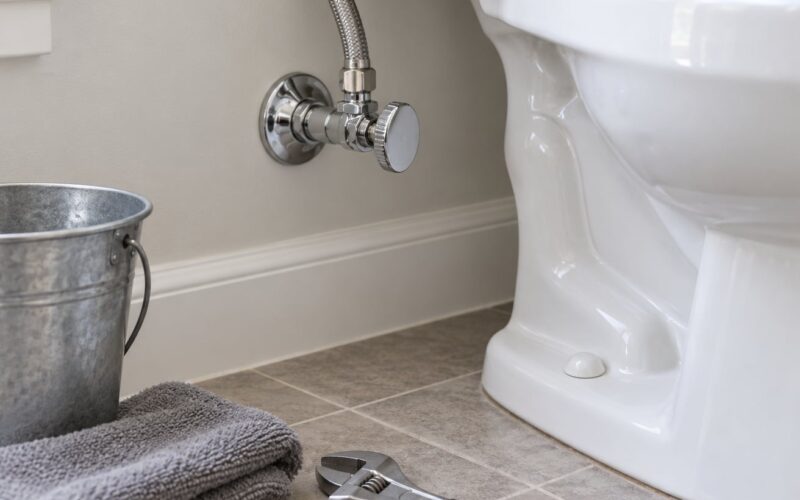
Then run the two-fixture test. Put a bucket under a sink, disconnect the flexible supply line, and open the faucet valve by hand. Water flowing full and free means the faucet and aerator were the restriction. Weak flow into the bucket means the problem is upstream, in the line feeding that sink. This is the isolation test people describe in plumbing forums, and it takes about five minutes with a wrench and a towel.
Next, watch what happens when demand increases. Open a second fixture while the first is running. If pressure collapses the moment a second fixture opens, you are seeing friction loss, which is a natural consequence of pushing water through a long, narrow, or scaled pipe run. It is not a broken supply. It does mean the house cannot deliver what the fixtures are asking for at the same time.
Finally, look at your appliances. Long fill cycles, a dishwasher that times out mid-cycle, and a toilet tank that refills slowly are all pressure and flow complaints in disguise. A washing machine drawing several gallons per minute will pull down anything that is already marginal.
| Symptom pattern | What it points to |
|---|---|
| Weak at every fixture in the house | Supply-side issue, main shutoff, PRV, main line, or house-wide restriction |
| Weak at one faucet only | Aerator, faucet cartridge, or that branch line |
| Weak in one bathroom or wing only | Local valve, branch restriction, or a leak on that side |
| Pressure drops as soon as a second fixture opens | Friction loss from long runs, undersized pipe, or scale and corrosion |
| Weak only at night, or only while the hose runs | Competing demand or municipal supply fluctuation |
| Weak only on the hot side | Water heater, heat-trap fitting, or tankless heat exchanger scale |
| Strong pressure, weak flow | Aerator or showerhead clog, not a pressure problem |
How Do You Check the Main Shutoff Valve and Pressure-Reducing Valve?
The main shutoff is the lever or wheel on the largest incoming line, usually on the main floor near the meter, in the garage, or in a crawl space. Open it fully and confirm the handle is perpendicular to the pipe on a gate valve, or counterclockwise until it stops on a ball valve. Never force a gate valve past its stop. Those stems are the original weak point in older homes and a stripped gate stem is an instant leak.
The pressure-reducing valve is a squat metal body with a capped adjustment nut on top, normally within a few feet of the meter where the service line enters. Signs of a failed PRV include pressure that is low at every fixture, pressure that jumps around, or pressure that is suddenly far too high because the valve failed open and is passing main pressure through. That last case is urgent, because fixtures and appliance connections are not built for 80-plus PSI.
Watch out for one forum complaint worth repeating: a plumber adjusted the regulator and now the house runs at 75 to 100 PSI. That is not an improvement, it is a new hazard. Ask what the setpoint is, and ask whether an expansion tank is present to absorb thermal expansion.
If you are on a private well, the same symptoms come from a different place. A pressure switch and a bladder tank set the cut-in and cut-out pressure, and cut-in is usually around 30 PSI. Read the pump gauge while nothing is running. If it sits near cut-in or lower, the tank has lost its air charge, the switch is out of spec, or the pump is short-cycling. Well owners also report low pressure after storms and electrical work, where a tripped breaker leaves the pump off entirely. If the pump runs and the gauge will not climb, shut the pump off so it does not overheat.
Stop and call a licensed plumber if the valve stem is corroded to the point it will not turn, if you find a leak at the PRV body, or if anything you are looking at is inside a wall or a concrete slab.
What Plumbing Problems Can Reduce Pressure at Every Fixture?
Mineral scale narrows the smallest openings first, which is why aerators and showerheads fail before anything else. Hard water accelerates it, and a whole-house filter set up without a softener upstream can make it worse because the filter is doing softening work it was never sized for.
Corrosion is the long game. Galvanized steel pipe flakes rust into the water and builds a rough inner wall. Copper develops interior pitting in hard water. Mixed systems, where new PEX branches were tied into old galvanized runs, give you modern plumbing fed by a restricted main.
Leaks steal volume. A hidden leak behind a wall, under a slab, or in a crawl space can pull down pressure everywhere while staying invisible. Five clues: a water meter that keeps turning with every fixture closed, a water bill that climbs with nobody home, a hissing sound near a wall or inside a cabinet, a musty smell in the same area, and soggy ground along the service line.
Softener and filter restrictions are the most commonly missed. A cartridge past its service interval, a softener stuck in bypass, or a brine line that never flushes can throttle the entire home without any visible sign.
None of these are jobs for a homeowner working inside a wall, under a slab, or in a crawl space. Cutting into a supply line, replacing a section of concealed pipe, or repiping galvanized runs is licensed work, and the crawl space in a home with a slab is exactly where a small mistake turns into structural damage.
What Can You Safely Check Before Calling a Plumber?
Start here. Everything on this list is reversible, and none of it requires cutting pipe or opening a wall.
- Compare fixtures across the house. Kitchen, upstairs bath, downstairs bath, hose bib. Write down which are strong and which are weak.
- Clean the aerators. Vinegar soak, scrub, reinstall. Check the showerheads the same way.
- Check every angle stop. Under every sink and at every toilet. Make sure each one is fully open. Do not over-tighten them; the threads are thin and easy to strip.
- Confirm the main shutoff position. Mark it with tape before you turn it, and turn it slowly until it reaches its natural stop.
- Note the filter and softener service dates. A whole-house cartridge past its interval is a very cheap cause to rule out.
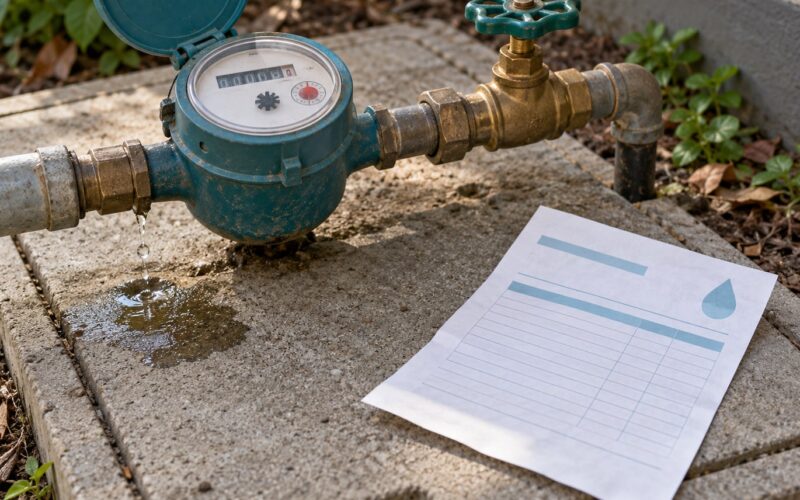
- Run the water meter leak test. Turn off every fixture, including the dishwasher and washing machine, and watch the meter for fifteen minutes. If it moves, you have a leak. Many meters have a small triangular or diamond leak indicator that spins or flips when flow is detected.
- Take two pressure readings. One at an outdoor hose bib with everything off, one with a fixture running. A hose bib gauge screws onto the spigot in place of the hose.
- Ask the neighbors. If pressure is weak on your whole block at the same hour, that is a supply issue, not a house issue.
What not to do: do not open a valve you cannot identify, do not force a stuck gate valve, do not replace parts blindly, and do not ignore hissing or a running meter. Do not crank a regulator up to chase a weak shower, either. Raising pressure against a restriction does not add flow, it just pushes harder on whatever weak link is downstream.
What Is the Difference Between Low Pressure and Low Water Flow?
Pressure is the force pushing water through the plumbing. Flow is how much water a fixture actually delivers, measured in gallons per minute. People use the words interchangeably, and the distinction matters because the fixes are completely different.
A clogged aerator gives you strong pressure at the wall and almost no flow at the spout. Turn the flow on slowly and it stays strong, which tells you the supply is fine. A supply-side problem gives you weak pressure everywhere, and it stays weak no matter how slowly you open the faucet.
Restrictive valves sit in between. A partially closed valve reduces both, because it limits the pressure reaching the fixture and the volume that can pass. A pressure-reducing valve does the same thing on purpose, and when it fails it stops doing it correctly in one direction or the other.
You can feel the difference without any tools. Weak pressure shows up in the way the stream behaves when you open the faucet gradually, and it stays weak in the shower. Low flow from one fixture shows up as a spray that is narrow and slow regardless of how wide you set the handle.
When Should You Call a Plumber for Low Whole-House Pressure?
Call a licensed plumber when any of these are true, and stop troubleshooting at that point.
- Pressure is weak at every fixture and it stays weak after you have cleaned aerators and confirmed the valves are open.
- Static pressure reads above 80 PSI, or it swings wildly over a few minutes.
- You see, hear, or smell a leak: a running meter with everything off, hissing, a wet cabinet floor, a slab leak, or water pooling outside.
- There is visible corrosion, rust-colored water, or a main shutoff or PRV that will not turn.
- The water heater is leaking, venting, or making the hot side weak across the house.
- You notice a sewage odor near a fixture, which points to a drain-side problem that can affect flow.
- Your home is on a well and the pump gauge will not climb, the pump short-cycles, or the pump runs continuously.
- Anything you suspect is behind a wall, under a slab, or in a crawl space.
Before you call, write down what you found. The static and dynamic readings, which fixtures are affected, whether the meter moved during the leak test, the filter and softener service dates, and when the problem started. Plumbers who arrive with that information diagnose faster, and it saves you from paying for a visit that ends in a guess.
Get more than one quote for anything involving concealed plumbing, re-piping, or a meter-side repair. And ask whether the work includes a pressure reading afterward, written down, so you have a baseline for next time.
Frequently Asked Questions
Is 40 PSI water pressure too low for a house?
Forty PSI is the practical floor, not a comfortable target. Below 40, showers feel weak and appliance fill cycles stretch out noticeably. The healthy residential range is 40 to 60 PSI, and above 80 PSI starts damaging fixtures and supply lines. If you measure 40 static but it collapses to 25 while a shower runs, the real problem is a restriction inside the house, not the supply.
How can I increase the water pressure in my house?
Fix the cause in this order: fully open the main shutoff and every angle stop, soak and scrub aerators and showerheads, replace a whole-house filter or softener cartridge that is past its interval, replace a failed pressure-reducing valve, then address scale and corrosion in the piping. A pressure booster pump is a last resort and it will not fix a restriction, it only pushes harder against it.
Why does my water pressure drop when I turn on a second faucet?
That is friction loss, and it is how a marginal system behaves. Every extra fixture opened means more water has to move through the same pipe run, and pressure at the far end falls as a result. On a healthy system the drop is barely noticeable. A large drop points at long runs, undersized pipe, or scale and corrosion narrowing the bore, especially in older galvanized plumbing.
Why is my water pressure low only at night?
A time-based pattern almost always points outside your walls. Neighborhood demand peaks in the evening when everyone is showering and running appliances, and a softener stuck mid-regeneration throttles the house on a timer you cannot see. If the meter moves with every fixture closed, you have a leak instead. Check whether neighbors see the same drop at the same hour, and check the softener cycle schedule.
How do I check for a hidden leak with my water meter?
Close every fixture including the dishwasher and washing machine, then watch the meter. Most meters have a small triangular or diamond leak indicator that moves when water is flowing. If it moves with everything off, a leak is somewhere between the meter and the fixtures. You can also read the dial and compare it fifteen minutes later, which tells you the volume loss over that window. Either result means calling a plumber.
Do I need a pressure booster pump for my house?
Usually not, and certainly not as a first move. A booster pump adds pressure but does not remove a restriction, so it pushes harder on weak supply lines, angle stops, and appliance connections. It makes sense on a long service line, a steep lot, or a well system that genuinely cannot deliver enough. Fix restrictions and valves first, then ask a plumber whether the remaining shortfall is in the supply or in the pipes.
Conclusion
Start with the fork, not the toolbox. Compare fixtures across the house, soak the aerators in vinegar, confirm the main shutoff and every angle stop are fully open, and take a static and a dynamic reading at the hose bib. That afternoon rules out the majority of causes and tells you which one you are actually looking at.
If the whole-house low pressure survives those checks, or if you find a running meter, a leak, a valve that will not turn, or a reading above 80 PSI, that is licensed plumber work. Write down what you measured before you call. It makes the diagnosis faster and the conversation more useful.