Heat pump water heater pros and cons come down to one trade: you get roughly 65% to 75% less electricity use than a standard electric resistance tank, and you give up fast recovery, cheap equipment, and a simple appliance. Most homeowners in mild and moderate climates with a suitable installation space land on the right side of that trade.
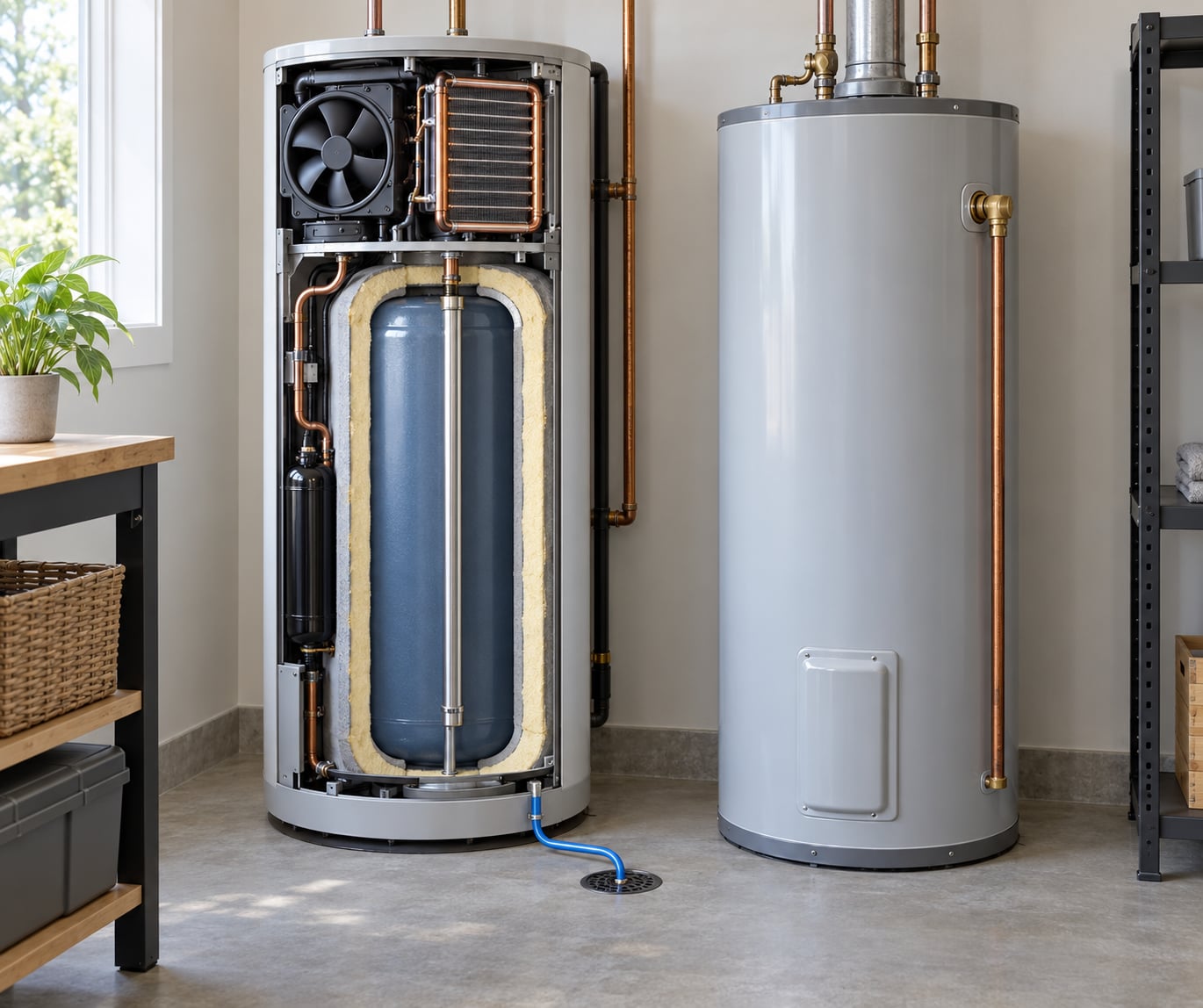
The appliance itself is not exotic. A fan pulls room air across a refrigerant coil, a compressor moves that heat into an insulated tank, and backup resistance elements fill the gaps during heavy demand. What changed over the last decade is price, rebates, and the number of installers who have done enough of them to get the details right.
Below is what the efficiency data says, what real owners report after five years, and the failure modes that show up in service calls. I’ve kept it water-heater only. Whole-home HVAC heat pumps are a different product, and most of the confusion on this topic comes from mixing them up.
Table of Contents
- Heat Pump Water Heater Pros and Cons at a Glance
- What Is a Heat Pump Water Heater?
- How a heat pump water heater makes hot water
- Standard and hybrid models
- Reading the numbers
- What Are the Main Heat Pump Water Heater Pros?
- How Much Can a Heat Pump Water Heater Save?
- What Are the Main Heat Pump Water Heater Cons?
- 1. Higher purchase and installed cost
- 2. Slower recovery than gas
- 3. Performance depends on ambient temperature
- 4. Installation space and clearance
- 5. Condensate drainage
- 6. Noise
- 7. Repairs and parts are less standardized
- 8. Warranty terms that may exclude labor
- Will It Make Enough Hot Water for Your Household?
- A practical sizing checklist
- Where Can a Heat Pump Water Heater Be Installed?
- How Noisy and Maintenance-Heavy Is It?
- What normal noise sounds like
- Routine maintenance
- Lifespan and the parts question
- Heat Pump vs. Gas vs. Electric Water Heater
- Is a Heat Pump Water Heater Right for Your Home?
- Questions to Ask Before You Buy
- Get the installed total when weighing heat pump water heater pros and cons
- Frequently Asked Questions
- Are heat pump water heaters worth the cost?
- How long does a heat pump water heater take to recover?
- Do heat pump water heaters work in cold garages?
- Can a heat pump water heater replace a gas water heater?
- What maintenance does a heat pump water heater need?
- Conclusion
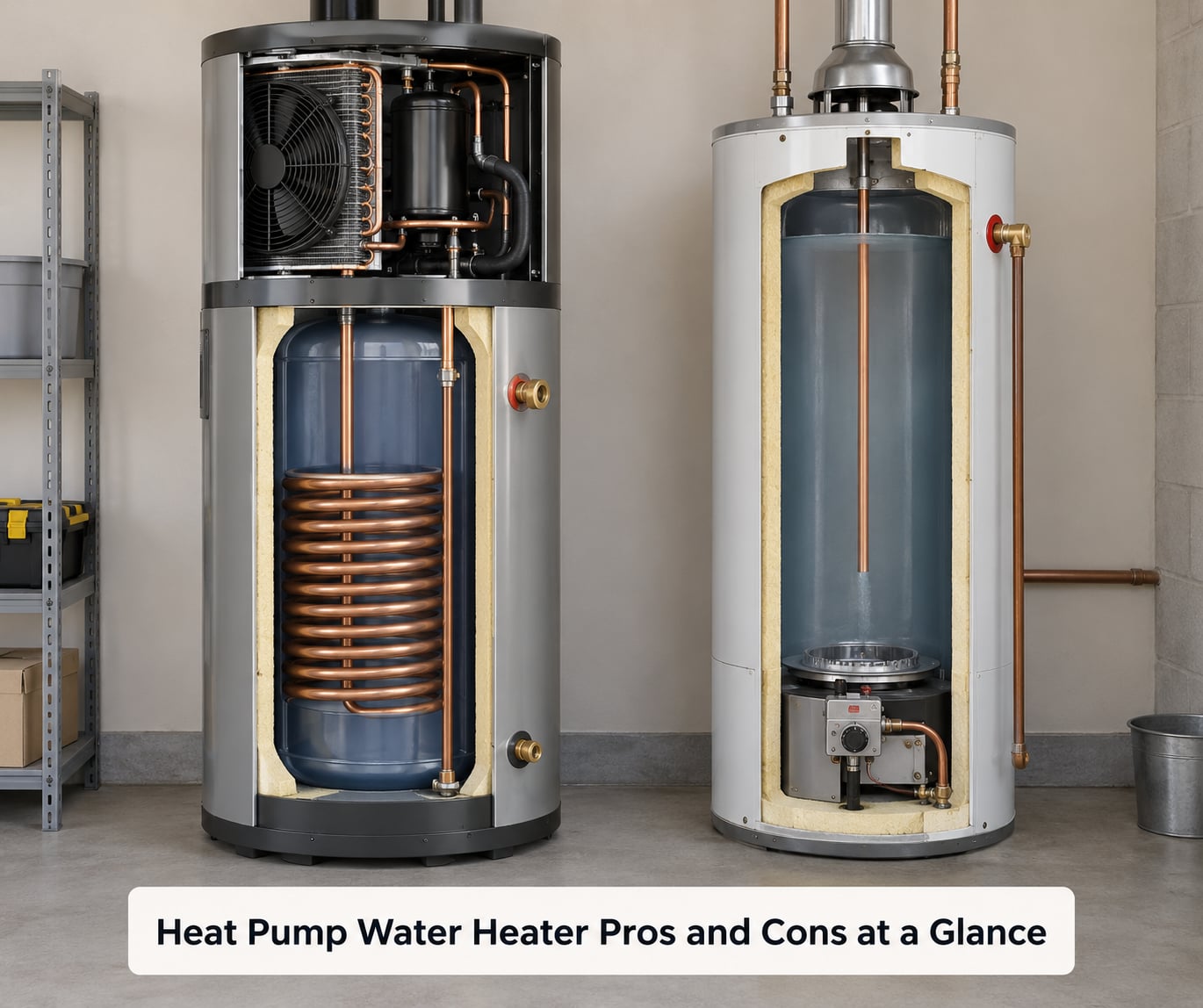
Heat Pump Water Heater Pros and Cons at a Glance
If you want the short version: heat pump water heaters cost more to buy and install, recover more slowly than gas, and depend on a space with plenty of free air. In exchange they use a fraction of the electricity of an electric tank, need no flue or gas line, and cool the room they sit in.
| Factor | What to expect from a heat pump water heater |
|---|---|
| Operating cost | Lowest of the tank options on electricity; typical families report the largest drop when replacing an electric resistance tank |
| Energy use | Uses about a quarter to a third of the electricity of a resistance tank for the same hot water |
| Efficiency rating | Uniform energy factor commonly lands in the 2.0 to 3.0 range versus roughly 0.90 to 0.95 for an electric tank |
| Recovery speed | Slower than gas; rated recovery is lower, so more household use leans on the backup element |
| Upfront and installed cost | Higher equipment cost plus a more involved install than a like-for-like tank swap |
| Installation space | Needs generous clearance and free air exchange; roughly 450 cubic feet is the commonly cited rule of thumb |
| Placement requirements | Ambient air should ideally stay above the low end of the manufacturer’s cold-weather operating range; unheated garages are the problem spot |
| New connections | Condensate drain line, plus no flue or gas line |
| Noise | A low compressor hum and fan whoosh, audible in a quiet room next to it but modest in a utility area |
| Maintenance | Air filter or pad cleaning, condensate flushing, periodic anode and drain valve checks |
| Lifespan | Often quoted at 13 to 15 years, with the steel tank itself capable of lasting much longer |
| Best fit | Households with a heated or moderate-temperature space, a 200 amp panel or better, and steady hot water use |
| Poor fit | Cold garage installs, very large families wanting gas-like recovery, tight closets, and homes with undersized electrical service |
What Is a Heat Pump Water Heater?
A heat pump water heater is an electric water heater that uses a refrigerant-based heat pump to pull warmth from the surrounding air instead of generating heat with resistance elements. That single design change is why it uses roughly 65% to 75% less electricity than a standard electric tank. It is still a tank, still plumbed the same way, and still stores hot water. What changes is where the heat comes from.
How a heat pump water heater makes hot water
A fan draws ambient air across a refrigerant evaporator coil. The compressor compresses that refrigerant, which raises its temperature well above the room temperature, and a condenser coil transfers that heat into the tank water. Meanwhile the fan exhausts the now-cold air back into the room.
That exhaust is why a heat pump water heater cools and dehumidifies whatever space it sits in. Owners who install one in a garage often notice the humidity drop first, before the water bill changes at all.
Standard and hybrid models
Retailers and older articles often call these hybrid water heaters. The term is fuzzy. In most current models the heat pump is the primary heat source and the resistance elements are backup, used during heavy demand or cold ambient air. Some manufacturers add a dedicated hybrid mode that lets you bias the balance between the two.
Either way, the tank holds ordinary water. If the compressor fails, the unit does not become useless. The resistance elements still produce hot water, which is the single most important fact for anyone worried about reliability, and no competitor article explains it.
Reading the numbers
Two numbers do most of the work in a spec sheet. The uniform energy factor, or UEF, is the annual efficiency including standby losses; for these units a good number is roughly 2.0 to 3.0 or higher. The first-hour rating, or FHR, is how many gallons of hot water the unit delivers in the first hour of operation, and it matters more here than it does for a gas tank.
What Are the Main Heat Pump Water Heater Pros?
1. A large cut in electricity for hot water. This is the core advantage and the reason most people make the switch. The unit extracts heat from air that is already paid for, so for the same hot water you consume roughly a quarter to a third of the electricity a resistance tank would use. The U.S. Department of Energy has recommended heat pump water heaters for years for exactly this reason.
2. Lower utility bills in practice, not just on paper. Owner reports are more convincing than spec sheets. One forum owner with five years on a Rheem unit describes paying about 25 to 30% of what the previous resistance tank cost per month for electricity. A Minnesota owner on a home energy monitor measured 10.65 kWh for a week and called it pennies per day. Individual results vary with rates, household demand, climate, and unit efficiency, but the direction is consistent.
3. Rebates and tax credits that change the math. Federal tax credits and state or utility rebate programs have covered a large share of installed cost for eligible systems in recent years. One homeowner in a California forum thread described a roughly 4,000 dollar local rebate and estimated break-even around year five; another in a different forum noted an installed figure of about 6,000 after rebates and credits. Program terms, eligible equipment requirements, and amounts change by location and program year, so verify current details before you rely on them.
4. A drier, cooler utility room. The exhaust air is cool and dry. In basements, garages, and laundry rooms that is a genuine bonus, not a gimmick. One garage forum thread frames it simply: the appliance is basically an air conditioning unit pointed at your garage.
5. Good fit for all-electric and solar homes. With no burner, there is no gas line, no flue, and no combustion air requirement. One solar forum owner describes pairing a heat pump water heater ahead of a propane tank as one of the best decisions for their setup, since the load fits typical battery and inverter capacity far better than a resistance element does.
6. A long-lived tank. A commonly quoted lifespan is 13 to 15 years, but the vessel itself can go much longer when a water softener keeps sediment in check. Owners report units still running well past the tenth year.
7. Positive owner sentiment on running cost. In an analysis of roughly 2,000 owner reviews and forum posts from Australia and New Zealand, running cost and efficiency were the most discussed topic and about 86% of mentions were positive. US figures differ, but the direction matches what US owners post. That same analysis carries an important caveat worth repeating: online reviewers tend to come from the extremes, the evangelists and the complainers, so treat review sentiment as a signal rather than a measurement.
How Much Can a Heat Pump Water Heater Save?
Savings are real but they are not a fixed number, and anyone quoting you one without asking about your household is guessing. Here is how the three tank types compare on efficiency, then the variables that actually move your bill.
| Type | Typical UEF | How it makes hot water | Where the money goes |
|---|---|---|---|
| Electric resistance | About 0.90 to 0.95 | Resistance elements heat the tank directly | All of it becomes electricity on your bill |
| Gas | About 0.60 to 0.65 | Burner heats the tank, faster recovery | Cheap per unit of heat, plus flue and venting |
| Heat pump | About 2.0 to 3.0+ | Refrigerant cycle pulls heat from room air | Small compressor and fan load, mostly electricity |
| Tankless (gas) | About 0.82 to 0.98 | On-demand burner, no storage | Efficiency depends on flow and how often you run it |
Six variables decide the outcome. Your utility rate per kilowatt-hour matters more than the unit’s UEF in many cases, especially where electricity is expensive and gas is cheap. Household hot water volume sets the load; a family of five showers several times a day will spend more in total either way, so the percentage saving grows with usage but so does the absolute figure. Climate sets the ambient temperature the heat pump works against. Equipment efficiency is the spec sheet number. Household usage patterns decide how often the backup element runs, which is where the savings quietly leak. And the condition of the rest of your water system, including a softener and insulating blankets, shifts the baseline.
One useful note on the electricity side: a heat pump water heater still runs on electricity, but the load is a small compressor rather than a large resistance element. If your panel is marginal, an electrician should check it before you commit, because some upgrades cost more than the appliance.
What Are the Main Heat Pump Water Heater Cons?
Search the heat pump water heater pros and cons and the disadvantages always outnumber the advantages, mostly because the costs are front-loaded and concentrated while the benefits are small and spread over a decade. These are the ones worth planning around.
1. Higher purchase and installed cost
The equipment costs more than a conventional tank, and the install is more involved than a straight swap. Most owners who were surprised report it at the install line rather than the equipment line. Get an apples-to-apples total installed quote, not just a fixture price, and compare it against the cost of replacing your existing tank with the same capacity.
2. Slower recovery than gas
A gas burner heats a full tank quickly. A heat pump unit moves heat slowly, which is exactly why the efficiency gain exists. On a first-hour rating basis it delivers less hot water in the first hour, and once demand exceeds the compressor’s output the resistance elements kick in and your savings shrink for that period. High-demand households feel this first.
3. Performance depends on ambient temperature
The unit needs warm-enough air to work with. Below roughly 37 to 45 degrees the efficiency and capacity fall off sharply, and forum discussion among owners of single-stage units notes capacity dropping quickly below 40 degrees. That range is where the backup resistance element carries the load, and at that point you are back to electric resistance economics for a stretch of the year.
4. Installation space and clearance
These units pull in a lot of air and push it back out, so they need clearance on more than the tank footprint. Roughly 450 cubic feet of free space is the commonly cited rule of thumb, with the manufacturer’s specification taking precedence. A tight closet or a small boxed-in alcove can rule the appliance out entirely.
5. Condensate drainage
Cooling air sheds water, so the unit produces condensate that needs somewhere to go. Most installs add a drain line. It is a small detail, but it is one more thing that has to be done correctly, and skipping it causes water on the floor.
6. Noise
Expect a low hum from the compressor and a steady whoosh from the fan, plus occasional brief cycling. Manufacturer specifications vary widely, so compare noise ratings when you shop. It is rarely objectionable in a utility room and occasionally noticeable in a small mechanical closet next to a bedroom wall.
7. Repairs and parts are less standardized
Service on the refrigeration side requires a technician comfortable with refrigerant circuits, which narrows the pool of repair shops compared with a plain electric tank. Replacement compressors, fans, and control boards are also more model-specific. The tank, elements, and drain valve remain conventional parts, so most of the appliance is still serviceable.
8. Warranty terms that may exclude labor
This is the objection that shows up most often in owner forums and it is worth taking seriously. Many warranties cover parts for a long period and labor for a much shorter one, or not at all. The top-ranked discussion thread on this topic is largely a homeowner weighing a large local rebate against reliability reviews and a labor-exclusion warranty. Read the warranty document, not the marketing summary, and price the labor terms separately.
Will It Make Enough Hot Water for Your Household?
Almost always, if you size it correctly. Running short of hot water on a heat pump water heater is nearly always a sizing or control-setting problem rather than a design flaw. The categories of capacity matters here are different from what you might expect with a gas tank.
Tank capacity is the stored gallons. The first-hour rating, or FHR, is the better number to shop by, because it tells you how much hot water comes out in the first hour including what the unit heats during that hour. The rated recovery rate is how fast it puts heat back in after that. For a heat pump unit, FHR matters more than raw gallon capacity, because a bigger tank full of lukewarm water is not useful to anyone.
Larger households, and anyone adding a larger tub or a laundry-heavy routine, can pair a heat pump unit with a separate backup storage tank. The two tanks in series give you the heat pump’s efficiency for daily use and reserve the backup for showers. It costs more and needs a little more space, but it removes the recovery objection for good.
A practical sizing checklist
Count your household members and multiply by roughly 50 gallons of first-hour capacity for one to two people, 60 to 80 gallons for three to four, and more for five or more. Then add up the fixtures you actually use: a shower is the biggest single draw, a tub is larger, laundry competes with showers in the evening, and a dishwasher adds to the evening peak. Check the first-hour rating on the spec sheet, not the tank size in gallons. Confirm the recovery rate against the time of day you use the most hot water, and ask the installer what the unit does when demand exceeds its capacity.
Where Can a Heat Pump Water Heater Be Installed?
Location is where most heat pump water heater projects succeed or fail. The preferred spots are a heated basement utility room, a first-floor laundry or utility area, a conditioned garage, or an approved outdoor-rated location with the manufacturer’s required clearances. An unheated garage in a cold climate is the one to think hard about, and it is common enough that the efficiency drop deserves a real conversation rather than a shrug.
There are eight requirements to work through. Air exchange volume is first, with the roughly 450 cubic feet rule of thumb as a starting point and the manufacturer specification as the authority. Clearance on every side for airflow follows. Ambient temperature minimums come next, meaning you should confirm the unit’s rated cold-weather operating range against your garage or basement’s winter temperature. Electrical service needs checking, since these are 240-volt appliances and a marginal panel may need an upgrade. Condensate drainage has to be planned to a drain, a floor drain, or a pump. Floor loading is rarely an issue for a tank on a slab or standard joists, but confirm. Permits and code requirements vary by locality and are handled by your installer. And if you are near a bedroom wall, check the rated sound level before you commit.
Use a licensed plumber or a qualified water-heater installer, and follow the manufacturer’s installation manual. In practice the difference between a good install and a bad one comes down to four things: correct clearances, a real condensate route, a thermostat or controller set sensibly, and a tank full of hot water before handover. Owner groups are blunt about this. The install and the controller configuration, not the spec sheet, decide whether you end up satisfied.
How Noisy and Maintenance-Heavy Is It?
Noise and maintenance are the two questions homeowners ask most, and both are manageable once you know what normal is.
What normal noise sounds like
A running heat pump water heater is not silent. Expect a low compressor hum, a steady fan whoosh, and a soft click when the fan changes speed or the backup element engages. Compare it to a refrigerator, not to silence. The usual sources of excessive sound are a fan blade rubbing its housing, a tank rattling because the installer skipped the anti-condensate or damping pads, a unit boxed in too tightly so the fan is fighting for air, or hard water scale on the coil loading the fan.
Simple fixes cover most of it. Isolation pads between the tank base and the floor kill transmitted vibration, which is the noise neighbors actually hear through the wall. Screwed-down or properly seated mounting stops rattle. Leaving the documented clearances open stops fan strain. If it is loud in a lived-in space, relocating the unit is more effective than anything you do to the appliance itself.
Routine maintenance
The schedule is short. Clean the air filter or removable pad every one to three months, more often if you have pets or a dusty location. Flush the condensate drain line annually, because that is the line most likely to back up. Check the drain valve for sediment every few years. Have the anode rod inspected periodically, which matters more on a softener-fed system than on a hard-water one. And keep the documented clearances free of stored items.
Lifespan and the parts question
Quoted lifespan is 13 to 15 years, though tanks often outlast that with softener water and reasonable upkeep. The honest reliability concern is not the tank, it is the refrigeration side. In the roughly 2,000-review analysis from Australia and New Zealand, reliability was the only net-negative topic, at 46% negative against 39% positive, while warranty and support sat only marginally positive at 53% against 34%. US figures differ, but the pattern matches what US owners post. The practical takeaway is to buy the tank knowing the compressor is a serviceable component with a shorter supply chain, and to read the labor terms before you sign.
Heat Pump vs. Gas vs. Electric Water Heater
There is no universal winner, because the best choice depends on your household demand, your energy prices, the space you have, and what incentives your utility offers. This is the comparison most readers actually need.
| Factor | Heat pump | Gas | Electric resistance | Tankless |
|---|---|---|---|---|
| Upfront equipment cost | Highest of the tank options | Low | Low | Moderate |
| Installed cost | Highest; more complex install | Moderate; needs flue work on a replacement | Low; often the simplest swap | Moderate to high |
| Operating cost | Lowest per unit of heat on electricity rates | Low, and often lower where gas is cheap | Highest | Good, best when hot water use is low and steady |
| Typical UEF | 2.0 to 3.0+ | 0.60 to 0.65 | 0.90 to 0.95 | 0.82 to 0.98 |
| Recovery speed | Slowest of the storage options | Fast | Moderate | Instant, unlimited |
| Emissions at home | Very low, and lower still on a cleaner grid | Direct combustion emissions | Varies with the grid | Direct combustion emissions |
| Noise | Compressor hum and fan | Mostly quiet; burner roar during recovery | Quiet | Quiet |
| Installation needs | Clearance, air exchange, condensate drain, 240V | Flue or direct vent, gas line | 240V circuit only | Flue, gas or electric, higher flow demand |
| Lifespan | 13 to 15 years quoted, tank can last longer | 10 to 15 years | 10 to 15 years | 15 to 20 years, with annual service |
| Cold climate behavior | Efficiency falls off below the rated ambient floor | Unaffected by air temperature | Unaffected by air temperature | Unaffected by air temperature, minor in-unit drop |
| Resale appeal | Increasingly mainstream; pairs with electrification | Widely understood | Widely understood | Common in newer builds |
Two points on the electrification context, since people ask why gas appliances are in the spotlight. Utilities and regulators in several states have adopted or are moving toward all-electric new construction, and indoor combustion appliances are losing ground on local air-quality rules. That does not remove gas water heaters from the market, but it does mean the value of an all-electric house has gone up, and a heat pump water heater is the natural fit in one.
On tankless, the honest summary: tankless wins on endless supply and small footprints, heat pump tanks win on efficiency when usage is high and steady, and a hybrid pairing is common when a household wants both. If your hot water use is light and intermittent, tankless may run less total energy. If a family of four runs showers and laundry daily, a heat pump tank usually wins.
Is a Heat Pump Water Heater Right for Your Home?
Work through these eight questions honestly and you will have your answer without needing anyone’s sales pitch.
Yes, it likely fits if: you are replacing an electric resistance tank that has reached the end of its life; you have a heated or moderate-temperature space with roughly 450 cubic feet of clearance; your electrical service is 200 amps or better and has capacity for a 240-volt circuit; your household uses hot water steadily rather than rarely; your utility or state offers an incentive that applies to your unit; and you are comfortable trading recovery speed for lower bills.
No, it probably does not fit if: your only installation space is an unheated garage in a climate with cold winters; your household has five or more people with several full bathrooms and heavy laundry use and you refuse backup capacity; your electrical panel cannot carry the load without an upgrade that approaches the cost of the appliance; your space is a closet or a boxed-in alcove; or you need tankless-style endless supply with no storage at all.
On incentives, be careful. Federal tax credit amounts, state program funding, and utility rebate terms vary by location, eligibility, equipment requirements, and program year, and they change. Ask your installer and your utility for the current figures in writing, and confirm your specific model qualifies. Do not let a rebate figure be the entire reason for the decision, since it is the least predictable part of the calculation.
Questions to Ask Before You Buy
Ten questions cover almost everything that separates a good heat pump water heater purchase from an expensive one. Work through them before you commit to anything.
- What is the first-hour rating, and how does it compare with the FHR of the tank you already have?
- What is the rated recovery rate in gallons per hour?
- What is the uniform energy factor, and is there a higher-efficiency model in the same product line?
- What is the manufacturer’s rated sound level in decibels?
- Does the warranty cover labor, and for how many years, separate from parts?
- What cold-ambient operating range has the manufacturer tested and published?
- Are replacement compressors, fans, and control boards readily available in your area?
- Where does the condensate drain, and who installs it?
- What clearance and air exchange volume does the manual require, and does my space meet it?
- What is the total installed price, net of every incentive I qualify for, compared with a same-capacity conventional tank?
Get the installed total when weighing heat pump water heater pros and cons
That last question is the one that decides most purchases, and it is where the heat pump water heater pros and cons become real money rather than theory. Ask for a written quote that includes the appliance, any electrical work, the condensate drain, venting changes, removal of the old unit, and the incentives applied. Then put that number next to a same-capacity conventional tank with the same electrical work, and look at the difference against your realistic annual savings. That comparison, not the spec sheet, tells you whether payback lands in five years or fifteen.
Frequently Asked Questions
Are heat pump water heaters worth the cost?
They are worth it for most households replacing an electric resistance tank who have a suitable space with good clearance and at least a moderate ambient temperature. The equipment and install cost more, and incentives often cover a large share of that gap. Judge it on your own installed total minus incentives against realistic annual savings, and verify current incentive terms before you count on them.
How long does a heat pump water heater take to recover?
Recovery is slower than gas because the appliance moves heat rather than generating it, and it depends on ambient temperature and tank size. Shop by the first-hour rating, the gallons delivered in the first hour, and the rated recovery rate in gallons per hour. Households that regularly exceed either number end up leaning on the backup resistance element, which is when the efficiency gain shrinks.
Do heat pump water heaters work in cold garages?
They run in a cold garage, but capacity and efficiency fall off sharply as ambient air drops, with the drop becoming steep below roughly 40 degrees and the cited efficient range starting around 37 to 45 degrees. In that band the backup resistance element carries more of the load and your savings shrink. If a garage is your only option, check the manufacturer’s published cold-weather operating range and consider a heated room instead.
Can a heat pump water heater replace a gas water heater?
Yes, and it is the usual reason people switch. You remove the gas line and flue requirements and run on a 240-volt electric circuit instead. Expect a different hot water pattern, since recovery is slower, and a different bill line item, since the energy moves from gas to electricity. Compare your gas rate per unit of heat against your electricity rate before deciding, especially in areas where gas is cheap.
What maintenance does a heat pump water heater need?
Clean the air filter or pad every one to three months, more often in dusty rooms or homes with pets. Flush the condensate drain line annually, since that is the line most likely to back up. Periodically check the drain valve for sediment and have the anode rod inspected, which matters most on a softener-fed system. Keep the documented air clearances clear so the fan is not fighting for air.
Conclusion
The heat pump water heater pros and cons come down to front-loaded cost and back-loaded savings. It suits households that want lower energy use and are willing to plan for it, who have the space and clearance, adequate electrical capacity, and steady hot water demand. It suits them best when the unit goes in a heated room rather than a freezing garage, and when the installer sizes it properly.
Start with two things. Write down your household’s peak hot water demand so you can shop by first-hour rating instead of tank size. Then ask a licensed installer for a written, apples-to-apples installed total for a heat pump unit and a same-capacity conventional tank, with every incentive you qualify for applied to both. That single document will tell you more than any pros and cons list, including this one.