To reduce humidity in a basement, find where the moisture is coming from first, then control the air with a correctly sized dehumidifier set to 40-50% relative humidity. Most jobs take an afternoon to diagnose and a weekend to fix.
Basements are cool by nature, and cool surfaces make warm air condense. That is why a reading of 60% or higher in a finished basement is worth acting on, and why a dehumidifier alone sometimes disappoints: it pulls water out of the air but leaves the source running.
The order below matters. Diagnose, remove wet materials, stop the water, then size the machine.
Table of Contents
- What You Need
- Step-by-Step: How to Reduce Humidity in a Basement
- 1. Check the Basement Humidity and Look for the Source
- 2. Remove Wet Materials and Improve Ventilation
- 3. Stop Water Leaks and Prevent Moisture Entry
- 4. Choose the Right Dehumidifier
- 5. Set and Position the Dehumidifier Correctly
- 6. Keep Reducing Humidity in a Basement Year-Round
- Common Mistakes
- Frequently Asked Questions
- What humidity level should I aim for in a basement?
- How long does it take to reduce humidity in a basement?
- What size dehumidifier do I need for my basement?
- Should I run a dehumidifier or use the basement exhaust fan?
- Can a dehumidifier remove a basement leak or eliminate mold?
- What to Do First
What You Need
You can start with almost nothing, and add gear once you know what you are dealing with. A short list covers most basements.
- A hygrometer or hygrostat. A digital unit that shows current relative humidity is the single most useful tool in the room. A cheap mechanical dial works, though it lags and is less accurate in cold conditions.
- A flashlight and work gloves. Basements are dark and full of rust, splinters, standing water, and things nobody has moved in a decade.
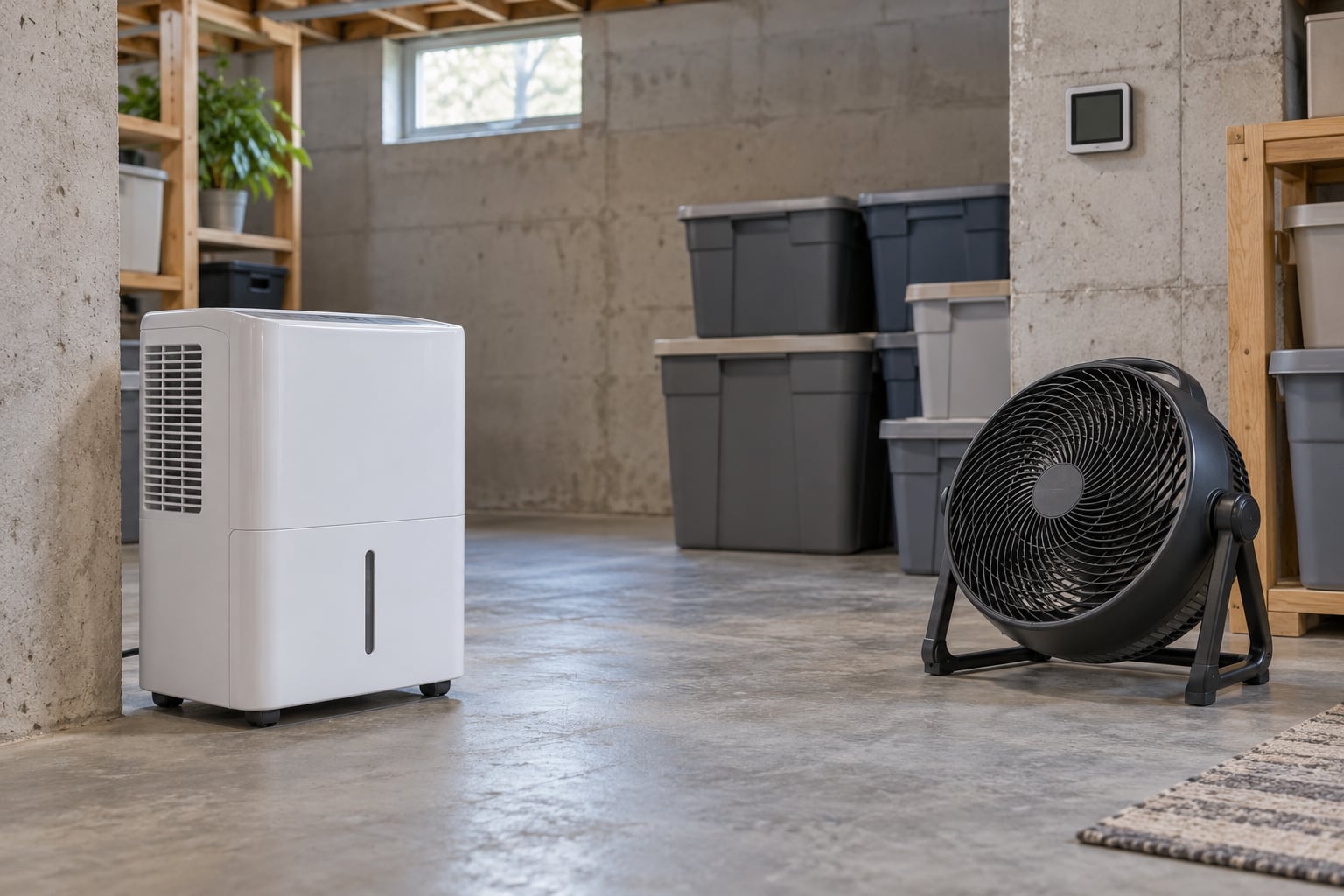
- A box fan or air circulator. Moving air across surfaces and out of corners makes a dehumidifier work faster. Fans do not remove moisture themselves.
- A dehumidifier with a continuous drain. A unit that can hose to a floor drain or sump pump saves you from carrying a bucket downstairs twice a week.
- Moisture-resistant storage. Plastic bins with lids, metal shelving, and pallets keep cardboard, paper, fabric, and wood off the damp concrete floor.
- A moisture meter for wood and drywall. Optional, but it settles arguments about whether stored furniture is dry enough to bring back upstairs.
Step-by-Step: How to Reduce Humidity in a Basement
1. Check the Basement Humidity and Look for the Source
Start by measuring, not guessing. Put the hygrometer at about waist height, a few inches off the wall and away from a window or door, and leave it for 24 to 48 hours. A reading taken during your first ten minutes in the room tells you almost nothing, because damp air is lighter and settles low while dry air from upstairs sinks down.
Use the reading to set your expectation:
- Below 50% — no action needed. Leave the dehumidifier off and check again after a rainstorm.
- 50-60% — normal for a basement. Watch it seasonally and keep stored items off the floor.
- 60-70% — act now. Mold can begin on drywall, cardboard, and wood in this range.
- 70% and above — treat it as a source problem first, and get the water out before you buy anything.
Then look for where the water is coming from. Condensation beading on windows, pipes, or the back wall of a finished basement is an air problem. White chalky efflorescence along a crack, a damp ring at the base of a wall, or a musty smell that appears within a day of heavy rain is a water problem.
That distinction decides the whole job. Air problems respond to a dehumidifier. Water problems respond to drainage, and no machine fixes them.
2. Remove Wet Materials and Improve Ventilation
Pull everything off the floor and out of the corners before you turn any machine on. Wet cardboard, insulation, ceiling tiles, and upholstery hold moisture against concrete and give mold and mildew something to eat long after the air dries.
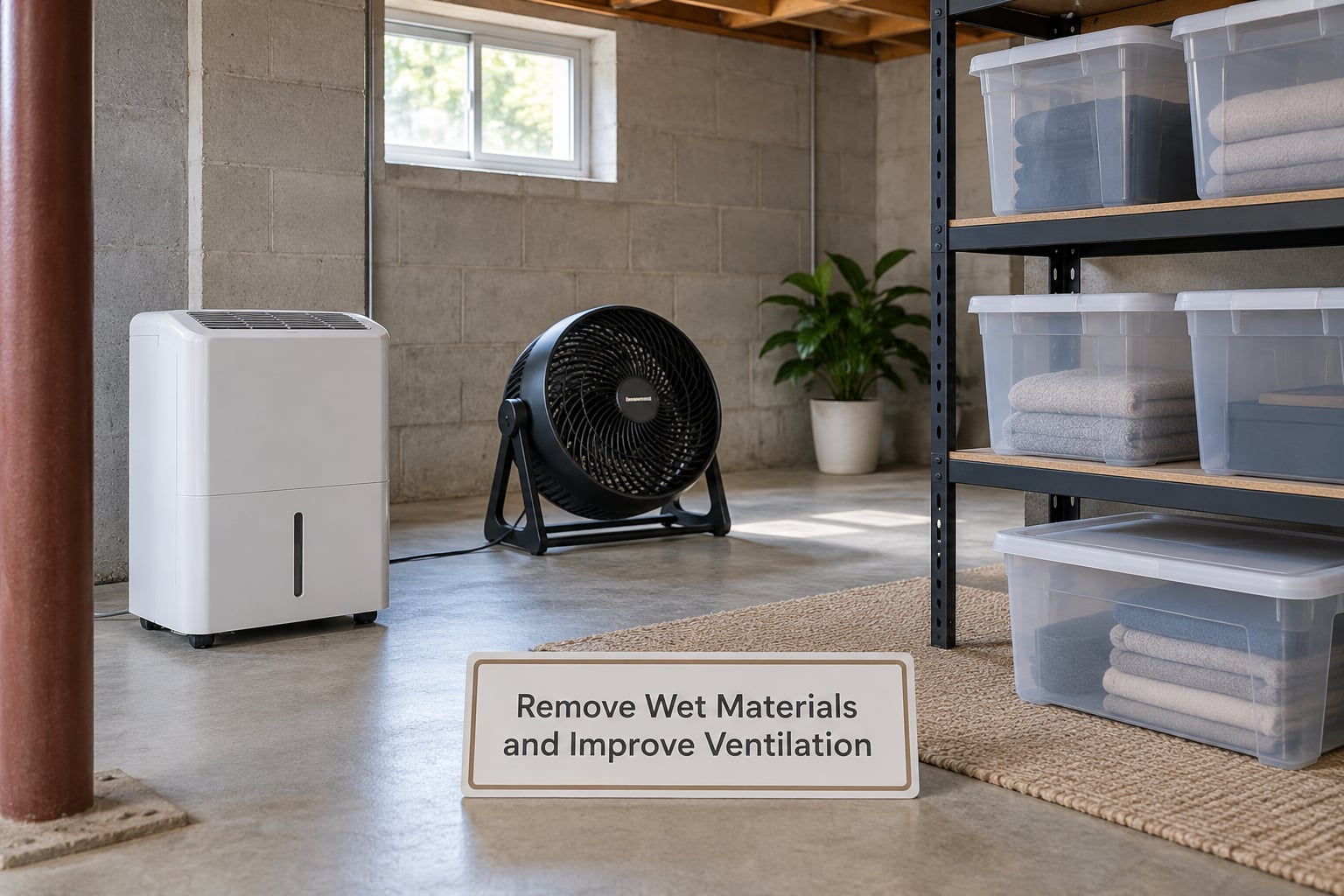
Discard what you cannot clean. Bleach on porous material pushes spores deeper in rather than removing them, and a musty smell that survives a wash is usually a sign to throw the item out. Clean what stays: scrub bare walls and the floor with a mold-killing solution, leave it to dry fully, and let the surface dry between coats.
Then get air moving. Set the box fan in the middle of the floor on low and aim it across the room, or run a second fan at the doorway to push air toward whatever exhaust route you have. Stagnant pockets behind stored furniture and in wall corners never dry out, no matter how good the dehumidifier is.
Open basement windows only when the outdoor air is genuinely drier than the air inside, which on a dry winter afternoon is often true and on a muggy summer day is not. Bringing 75% humidity air into a 55% basement adds water while you are trying to remove it.
3. Stop Water Leaks and Prevent Moisture Entry
Close off the source before you size a machine. Walk the perimeter of the room and look at the walls, the window wells, the floor, and everything that enters the basement from outside or above.
- Water stains and damp patches usually trace to gutters, downspouts that dump six inches from the foundation, or soil graded toward the house instead of away from it.
- Vertical cracks in a poured wall allow water in. Get a crack that moves, bulges, or is wider than a pencil line evaluated by a structural contractor before you fill it.
- Failed window seals let rain and humid air straight into the room. Resealing or replacing basement window sash is cheap compared with any repair you would do after the drywall is soaked.
- Plumbing leaks behind a utility sink, near a washing machine, or under a water heater add water steadily and quietly. Any plumbing work is a plumber’s job.
- Water entering under the slab when the water table rises, or after a failed sump pump, needs a drainage system rather than a bucket.
Hire a plumber for anything behind a finished wall, and a waterproofing contractor when water comes through the foundation itself, when a sump pump is missing or has failed, or when you see salt deposits, spalling concrete, or a foundation wall that bows inward. Those repairs are structural and outside what a dehumidifier or a homeowner should attempt.
4. Choose the Right Dehumidifier
Match the machine to the room, not to the price tag. Capacity is rated in pints of water removed per day under test conditions, and an undersized unit runs constantly without ever reaching your target. This is the mistake that shows up again and again in homeowner discussions: a unit rated for a smaller space left running day and night in a bigger basement, still sitting at 70%.
| Basement floor area | Compressor capacity to look for | Notes |
|---|---|---|
| Up to 800 sq ft | 20-25 pints per day | Enough for a dry crawl space or small storage room |
| 800-1,200 sq ft | 25-40 pints per day | Typical unfinished basement in an older house |
| 1,200-1,600 sq ft | 40-50 pints per day | The range most homeowners need after a wet spring |
| 1,600-2,000 sq ft | 50-70 pints per day | Finishes, bedrooms, or a second cold-air return adding load |
| Over 2,000 sq ft | 70 pints per day and up | Consider a whole-home or installed system instead |
Size up if the basement is finished with drywall and carpet, sits below grade on all sides, or takes on water after storms. Those surfaces add load, and a cold coil running below about 65°F loses efficiency fast, which is why crawl spaces and unheated garages sometimes do better with a desiccant unit that needs no cold coil.
Before you buy, weigh four things:
- Drainage. A continuous drain line to a floor drain or sump pump is the feature people ask about most, because emptying a bucket gets old fast.
- Energy use. Look at the wattage on the nameplate. A 700-watt unit running 12 hours a day uses roughly 250 kWh a month, so check your utility rate and look for a unit with an energy or efficiency mode before worrying about the noise level.
- Noise. Larger compressors cycle louder. If someone sleeps nearby, sit near the far wall so the unit is not against a bedroom wall.
- Portability. Casters and a hose that reaches a floor drain matter more in a finished basement than a sleek control panel.
Big-box units sold for a whole house are fine in open spaces, but purpose-built basement units are easier to live with: larger tanks, stronger continuous drain fittings, and casters for stairs. Homeowners who have run both tend to come back to the basement-specific machine.
5. Set and Position the Dehumidifier Correctly
Placement does more for performance than most people expect. Set the unit in the middle of the room or along a wall with six to twelve inches of clearance, not flat against concrete, and keep it away from a cold window or an exterior wall where the intake air is already the coldest in the room.
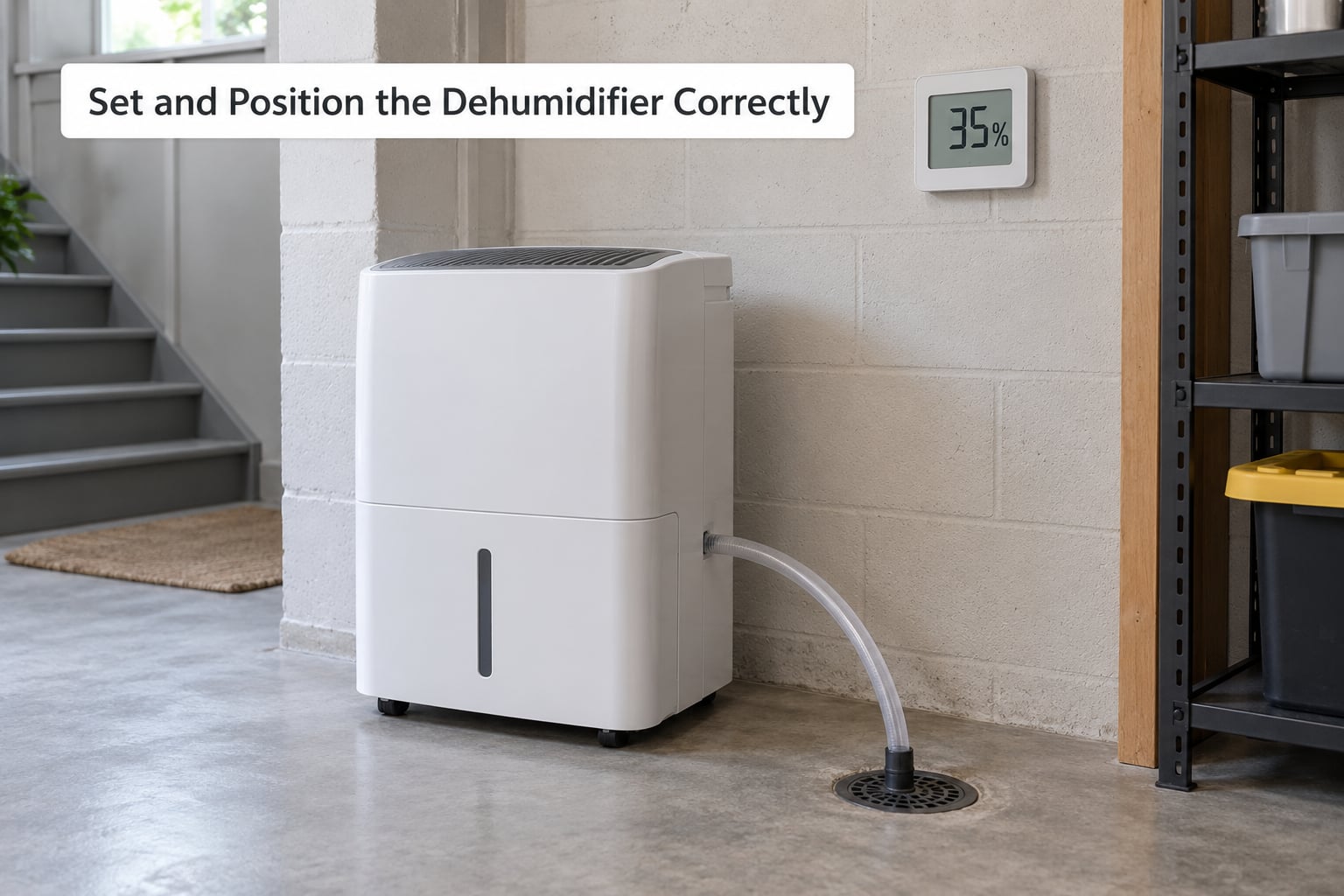
Set the humidistat to 45%, which sits in the middle of the recommended 40-50% band. Set it to 60% and the room may never look or smell different. Set it below 40% and you are over-drying, which costs electricity, can shrink wood and crack trim, and makes a finished room uncomfortable.
Give it time. A damp basement does not drop from 75% to 50% in a day, and a unit running around the clock in a cold basement may collect a gallon or two a day rather than the twenty-plus pints on the label. That gap between rated capacity and actual output is normal, and it is also the reason a unit that cannot hold below 60% after a month of steady running points at a water problem.
Hook up the continuous drain line if you can. Run the hose to a floor drain or sump pump discharge, secure it so it cannot kink, and check the line every month or two. An unverified drain hose can put a small flood on the floor at the worst possible moment.
6. Keep Reducing Humidity in a Basement Year-Round
Once the space is dry, keeping it dry takes minutes a week. Check the hygrometer monthly and after heavy rain, and run the dehumidifier whenever readings climb back above 55%.
Clean the filter on the schedule in the manual, usually every one to three months in a dusty basement, and more often if the unit is near a workbench or a furnace. A clogged coil drops output and can freeze the unit on a cold night.
Keep stored items on pallets or shelving at least four inches off the floor, six inches off foundation walls, and away from any known damp spot. Stacking cardboard against a wall is the most reliable way to reintroduce musty odor into a dry basement.
Run the fan whenever the dehumidifier runs so air circulates instead of pooling. Once a year, re-inspect the downspouts, window seals, and sump pump before the wet season starts, and check the drain line and hose connections for cracks.
Common Mistakes
Almost every long, expensive basement humidity problem I have seen traces back to one of these.
- Running a dehumidifier with an unfixed leak. Dehumidification lowers the vapor pressure inside the room, and that pressure gradient pulls more soil moisture through the foundation. On a wall with active infiltration you can end up with fresh efflorescence and spalling where there was a dry spot before.
- Setting the humidistat too low. Chasing 30% relative humidity in a basement is over-drying. It costs electricity, dries out wood, and can crack hardwood, trim, and some cabinetry.
- Treating a box fan as a dehumidifier. Air circulators move air and evaporate surface moisture. They do not remove a single pint from the room.
- Blocking the airflow. A unit stuffed behind shelving, or one blasting air into a corner, runs hotter and drier where it stands while the rest of the room stays damp.
- Leaving windows open in humid weather. On a muggy summer day, opening basement windows adds water faster than the dehumidifier can take it out.
- Operating appliances near moisture and leaving vents indoors. A dryer vented into the basement adds several pints of water a load. Route it outdoors, and give a dehumidifier and any electrical equipment clearance from a damp wall.
- Ignoring the sump pump. If a basement floods, the failure is usually a pump that died, a float switch stuck, or a discharge line blocked. Test it by pouring water into the pit.
Frequently Asked Questions
What humidity level should I aim for in a basement?
Aim for 40-50% relative humidity, and treat 30-50% as the safe overall band. Below 40% you are over-drying, which wastes electricity and can shrink wood and crack trim. Readings above 60% are where mold, musty odors, and dust mites start to become real problems, so a basement that sits above 60% year-round needs a source fix, not just a machine.
How long does it take to reduce humidity in a basement?
Expect two to three weeks for a normally damp basement brought down from 65-70% with a correctly sized unit running continuously. A space that has been wet for months, or one with a carpeted finished floor and framed walls, can take a month or more. A sharp drop in the first 24 hours is normal, then progress slows as the unit shifts from removing bulk moisture to holding a target.
What size dehumidifier do I need for my basement?
Use floor area plus a margin. Up to 800 square feet needs roughly 20-25 pints per day, 800-1,200 square feet needs 25-40, 1,200-1,600 needs 40-50, and 1,600-2,000 needs 50-70 pints per day. Size up for finished basements, extra cold-air returns, or any room that takes on water after storms.
Should I run a dehumidifier or use the basement exhaust fan?
Run the dehumidifier. An exhaust fan moves air, and it only helps when the outdoor air is drier than the air inside, which is common on a dry winter afternoon and rare on a humid summer day. The exception is a short burst of ventilation after a shower or while drying out wet materials, when the outdoor dew point is low enough to help.
Can a dehumidifier remove a basement leak or eliminate mold?
No. A dehumidifier removes water from the air, not water that is flowing through a foundation wall, a failed window seal, or a plumbing line. It also does not remove mold that has already grown, and it can push harder against a wall with active infiltration. Stop the water first, then dry the space, then remove porous material that stayed wet too long.
What to Do First
If you do nothing else this weekend, put a hygrometer in the basement for two days and take one honest look at the walls. That single number tells you which path you are on.
Then, in order: remove anything wet or porous from the floor, fix the leak, the drain, the downspout, or the window seal you found, and only then size a dehumidifier for the space and set it to 45%. Once the source is under control, a correctly sized unit holds the whole room in the healthy band and stops working as hard as it did before.