If you want a countertop that wipes clean and looks the same in every room, pick quartz. If you want real stone that shrugs off a hot pan and looks different in every slab, pick granite. Everything else follows from that one trade-off.
This is quartz vs granite countertops compared on the things that show up years later: staining, heat damage, maintenance, repairs, and resale. Both are premium surfaces sold by the same fabricators at similar price tiers, and both look excellent in a well-built kitchen. The difference is how each behaves in a house that gets used.
Quartz wins on maintenance and consistency. Granite wins on heat tolerance and natural variation. Which one wins for you depends on how much you cook and how much effort you want to put into upkeep.
Table of Contents
- Quartz vs Granite Countertops Compared at a Glance
- How Do Quartz and Granite Look Different?
- Uniformity Versus Natural Variation
- Which Material Is More Durable?
- Scratches, Chips and Impact Damage
- Which Countertop Handles Heat Better?
- Which Material Is Easier to Maintain?
- How Do Stains and Porosity Compare?
- Cleaning and Spill Response
- How Do Installation and Repairs Differ?
- Which Is Easier or Cheaper to Repair?
- How Do Quartz and Granite Affect Resale Value?
- What Are the Main Drawbacks of Each Material?
- Which Should You Choose?
- Frequently Asked Questions
- Is quartz or granite better for a busy family kitchen?
- Does quartz or granite withstand hot pans better?
- Does granite need to be sealed, and does quartz?
- Can damaged quartz or granite countertops be repaired?
- Which countertop material looks best in a small kitchen?
- Conclusion
Quartz vs Granite Countertops Compared at a Glance
Quartz is an engineered surface made from roughly 90 to 94 percent ground quartz crystals bound with polymer resin and pigment. Granite is a natural igneous rock, a mix of quartz, feldspar and mica, quarried in one piece and cut from the earth.
| Factor | Quartz | Granite |
|---|---|---|
| Appearance | Controlled and repeatable, with marble-look and concrete-look patterns | One of a kind, with natural veining and mineral movement in every slab |
| Scratch resistance | Higher, the whole slab shares one consistent hardness | Very good, though mica-heavy dark stones mark more easily |
| Heat resistance | Resin binder discolors or scorches around 300 to 400 degrees Fahrenheit | Tolerates brief contact far better, roughly 1200 degrees Fahrenheit before damage |
| Stain resistance | Non-porous, so coffee, wine and oil sit on the surface | Porous stone protected by a sealer that wears down over time |
| Maintenance | Daily wipe-down, no sealing routine | Daily wipe-down plus sealing every 1 to 3 years |
| Repairing a chip | Possible, but rarely invisible on a veined pattern | Possible on small chips, repair reads as a darker spot |
| Installation | Factory-made and consistent, seams visible on high-contrast patterns | Cut and finished per job, seams can match the veining well |
| Outdoor use | Not recommended in most cases, resin yellows in strong UV | Workable outdoors, still wants a cover in winter |
| Best for | Busy families, rentals, uniform modern styling, low upkeep | Heavy cooking, natural-look kitchens, buyers who want genuine stone |
| Main drawback | Heat sensitivity and harder-to-match repairs | Sealing upkeep and more uncertainty between slabs |
One claim deserves correcting early, because it confuses almost every first-time buyer. People say quartz is harder than granite, and in mineral terms that is roughly right: quartz sits near 7 on the Mohs scale while granite, a mix of softer and harder minerals, lands lower. But your countertop is not pure quartz. It is quartz suspended in resin, and the resin is the soft component. That is why a sharp knife can mark a quartz surface that a fork would never touch.
How Do Quartz and Granite Look Different?
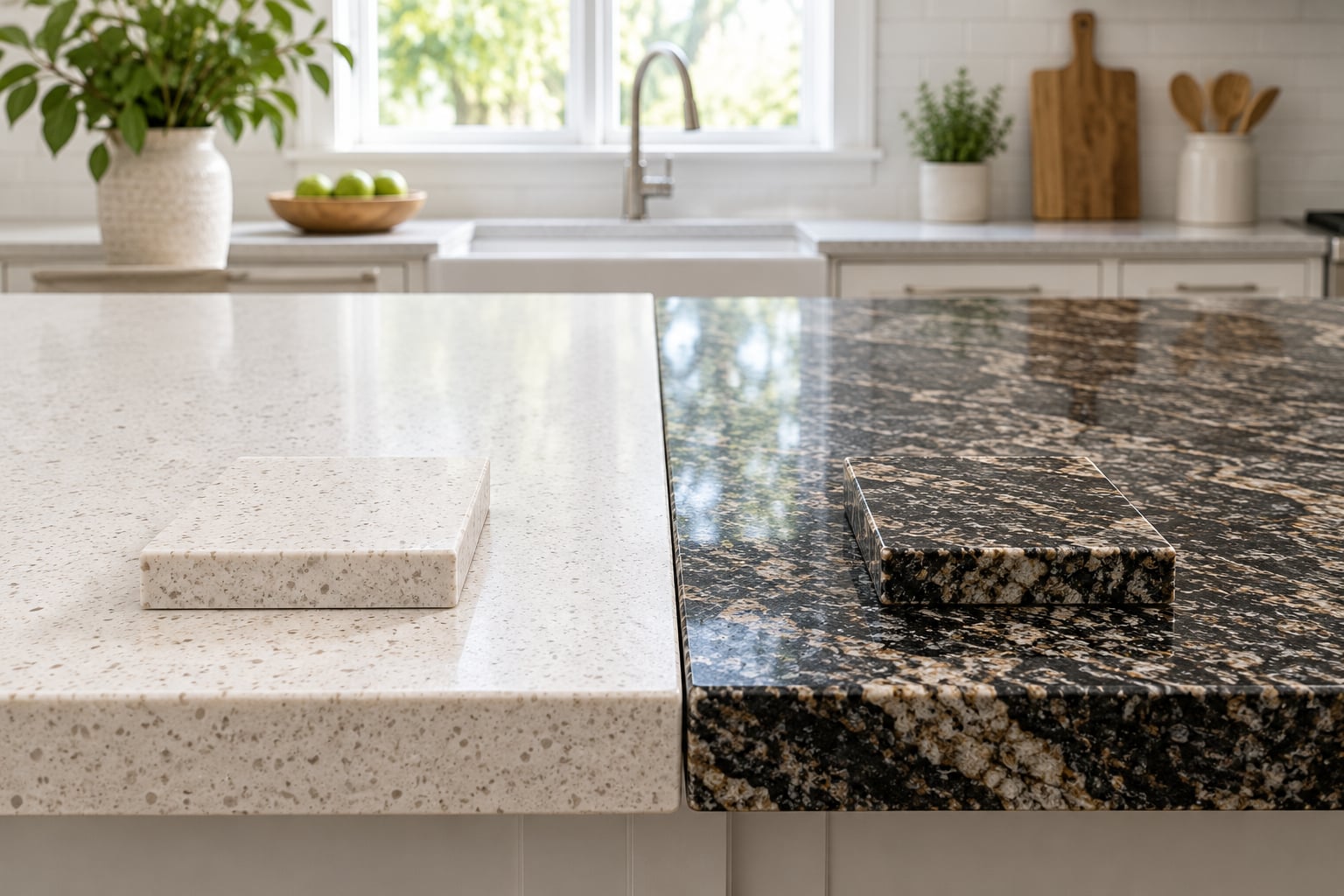
Quartz looks controlled and granite looks found. That one sentence covers most of the aesthetic difference in quartz vs granite countertops compared, and it decides which material suits which house.
Uniformity Versus Natural Variation
Engineered quartz is pressed under vacuum, so the pattern repeats across slabs and across batches from the same factory. Brands like Cambria, Silestone and Caesarstone produce hundreds of named patterns that look nearly identical from one kitchen to the next. That predictability is exactly what many buyers want when the counters are visible from a living room or carry into an open-plan space.
Granite is mined in one piece and cut by hand. A slab of Uba Tuba, Baltic Brown or Brazilian Blue carries irregular mineral movement that shifts as your eye travels along the run, and lighter stones in the Taj Mahal family show veining that reads like a distant coastline. You are buying a piece of geology, and nobody can reproduce it.
Finishes change the whole impression. Honed or leathered granite takes on a matte texture that hides fingerprints and water spots and tends to disguise small marks rather than magnify them. Polished granite is glossier and shows residue more readily. On the quartz side, polished surfaces show more of the pattern contrast, while matte and concrete-look finishes disguise stains but can hold a greasy film if you use the wrong cleaner.
Edge profiles matter too. A square eased edge reads utilitarian, a bullnose reads softer, and a mitred edge that pretends to be thick slab has become common in quartz installations. Whatever the profile, hold your samples against the cabinet color and the flooring before you sign anything.
Which Material Is More Durable?
Both are extremely durable in normal kitchen use, and the honest answer is that fabrication quality matters more than the material label. A well-cut slab from a careful fabricator outlasts a badly installed one of either kind.
Quartz is the more consistent surface. Because there is no natural variation in hardness, a scratch in one spot behaves the same as a scratch in another. It also carries slightly better flexural strength, meaning it resists snapping along a sink or cooktop cutout when properly supported.
Do not treat either material as indestructible. Drop a cast-iron pan on an unrounded corner and both surfaces lose a piece, which is exactly why rounded and eased edges exist.
Scratches, Chips and Impact Damage
Chipping is where most homeowners first notice a difference, and it usually happens at an edge, a sink cutout or a cooktop corner. Both materials can chip. Granite tends to forgive small nicks because its patterning camouflages them, and a honed granite edge can be re-honed to smooth a rough spot in ways quartz cannot.
On granite, light surface scratches on a polished finish can often be refinished out. On quartz, a deep score usually cannot be polished back to a uniform gloss, because you would have to work through the whole slab. Where granite hides wear in its pattern, quartz shows it as a dull line across a flat field.
Which Countertop Handles Heat Better?
Granite handles heat better by a wide margin, and this is the clearest single difference in the whole comparison.
Quartz loses thermal headroom because of the resin binder. Once a surface reaches roughly 300 to 400 degrees Fahrenheit, the resin can discolor, scorch or craze, and that damage is baked permanently into the slab. Granite is stone all the way through and tolerates brief contact with a hot pan, which is why it has long been the default around a working cooktop.
A warm mug of coffee is a much smaller risk than a skillet straight off the burner, but the repeated version of that small risk is what gets people in trouble. Use a trivet or hot pad on quartz every time, and keep a pot of cold milk away from a scorch mark because lifting the resin turns a cosmetic blemish into a real one.
If you cook heavily, run a cooktop, or plan an outdoor kitchen, this temperature difference alone should settle the question for you.
Which Material Is Easier to Maintain?
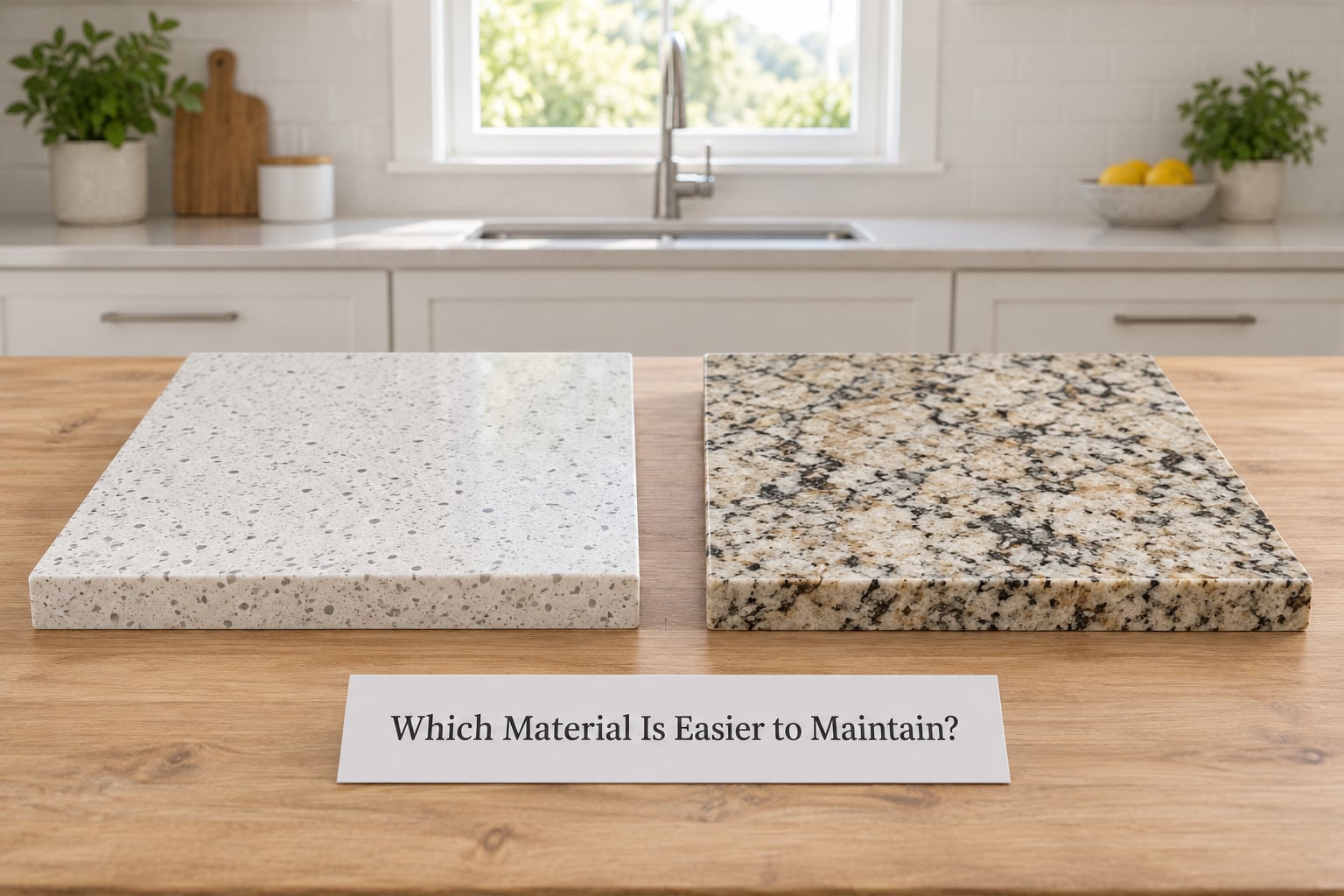
Quartz is easier because it never needs sealing. Warm water and a drop of dish soap handles nearly everything, and coffee, red wine, turmeric and cooking oil sit on a non-porous surface instead of soaking in.
Granite is easy too, once it is properly sealed. The sealer fills the microscopic pores in the stone and buys a window of protection, typically one to three years in a home kitchen. The interval depends on the specific stone: lighter and more porous varieties need sealing sooner, dense dark stones can go longer, and a honed finish absorbs more than a polished one.
There is a simple test when shopping. Pour water on the slab and let it sit. If it beads, the sealer is working. If it darkens the stone, that surface needs more protection than its current owner is giving it.
Cleaning products deserve specifics because the wrong one causes real damage. Bleach, ammonia and window cleaners such as Windex will not destroy either surface in occasional use, but a daily disinfecting-wipe habit can strip a granite sealer and haze a quartz finish over time. Abrasive pads and scouring powder permanently dull a polish. Soap film is the more common everyday complaint, leaving a cloudy ring that reads as a dull spot. A stone-safe cleaner and a soft cloth clears it.
How Do Stains and Porosity Compare?
Non-porous quartz resists stains more consistently, and that difference is structural rather than a matter of workmanship. There is simply nowhere for a liquid to go.
Granite is a natural rock with genuine porosity. When its sealer is fresh, wine, coffee and salad oil bead up and wipe away. When the sealer wears thin, or when someone used a harsh cleaner and stripped it, those same spills penetrate the surface and leave a dark mark that no amount of surface scrubbing will remove.
Neither material tolerates standing acidic liquids. Citrus, wine and vinegar will etch marble-look quartz because the pattern is printed on or the surface includes filler that acid attacks. Real marble behaves the same way, which is a fair argument for the material if your design leans that direction.
Cleaning and Spill Response
Blot first, on both surfaces, so the liquid does not have time to soak. On quartz, warm soapy water and a non-abrasive cloth is almost always enough, and a manufacturer-approved stone cleaner handles stubborn grease film. On granite, blot, then clean with mild soap. If the sealer has failed and a stain has set, a penetrating sealer treatment from a stone care company can lift some of it, but that is a professional job rather than a weekend project.
Stain resistance is where quartz vs granite countertops compared earns its keep in a real kitchen. For either material, check with the slab supplier before using a specialty cleaner, because pigmented or resin-heavy patterns can react differently from the plain surface.
How Do Installation and Repairs Differ?
Both materials are cut and fabricated by professionals, and neither is a good candidate for a weekend install. Quartz slabs arrive factory-made and consistent, so a fabricator templates your layout and installs. Granite arrives as a quarry product that gets cut, polished or honed for the job, and the layout must be planned around the vein direction so the pattern reads as continuous.
That planning shows up in the seam. Quartz seams are visible on high-contrast patterns, and in a marble-look design the veining will not line up across the joint. Granite seams can be remarkably well hidden when the fabricator matches the movement across them, or they can be the first thing you notice when they are placed carelessly. Ask how the seam will land before you approve the layout, and check any condo or building rules about slab size before the order goes in.
Sink and cooktop cutouts matter too. Both need generous support around the opening. Ask what your fabricator does to prevent a crack there, and check whether the written warranty covers the sink or cooktop area specifically, because that language varies widely.
One note on the sales process. Fabricators often earn more margin on one material than the other, so a recommendation is not automatically wrong but it is not automatically neutral either. Get at least three quotes and ask each one to itemize material, slab, fabrication and installation separately so the comparisons are real.
Which Is Easier or Cheaper to Repair?
A small chip is sometimes worth filling and sometimes not, and the deciding factor is color matching. On granite, a repair tech mixes epoxy to the stone and the result reads as a small darker spot, which works better on dark material. On quartz, matching a veined pattern with filler rarely succeeds, and a repaired area can look worse than the original chip did.
My advice is to assume any meaningful damage means partial or full replacement, and price that risk into the decision rather than treating repairs as routine maintenance. A single long slab across a kitchen makes that failure expensive on either material.
How Do Quartz and Granite Affect Resale Value?
Neither material guarantees a premium. What moves value is the condition of the kitchen as a whole, not the countertop label on its own.
Third-party homeowner surveys tend to rank both materials at the very top, and the gap between them is narrow. A widely cited Houzz survey put quartz at 84 and granite at 81 in homeowner satisfaction, which tells you more about how familiar buyers are with each material than about resale return. Agents still report that granite carries weight in luxury and traditional listings because it reads as the real thing, while quartz reads as the easy, modern choice.
In practice a well-maintained surface in a neutral color does more for a sale than the material does. So does a surface that needs no explanation to the next owner.
What Are the Main Drawbacks of Each Material?
Quartz has real drawbacks. The resin binder sets your heat ceiling. Strong UV exposure can yellow that binder over time, which matters for an outdoor kitchen or a sun-washed breakfast bar. Repair color matching is genuinely hard on veined patterns. Some marble-look designs read flat and repetitive across a full kitchen run, and a small showroom chip tells you almost nothing about how a pattern behaves at eight feet. Harsh chemicals and abrasive pads will dull a polished finish permanently.
Granite has its own list. It needs sealing, and somebody has to remember to do it. Between slabs there is more uncertainty, so the stone you loved in the showroom may look different in your own kitchen light. Porosity means stains are possible when the sealer fails. Dark mica-heavy stones can show water spots and marks. And the exotic end of the granite market can cost more than premium quartz, which surprises people who assumed stone is always the cheaper option.
Is granite outdated? No. What changed is design preference toward cleaner, more uniform surfaces, and granite answers a different desire than quartz does. If you want natural movement and character, granite is arguably more current than it has been in years.
Is quartz losing popularity? The growth story has cooled as buyers chase more natural-looking surfaces and new materials like sintered stone and porcelain enter the conversation. That is a shift in what people talk about, not evidence that quartz is being ripped out of houses.
Which Should You Choose?
Choose quartz if daily cleaning is your main concern, if kids or pets make spills a constant event, if you want the pattern you picked in the showroom to arrive exactly that way, or if your kitchen gets strong low-angle light and you prefer a low-sheen surface.
Choose granite if you cook a lot and want a surface that tolerates heat, if you want genuine natural stone with slab-unique movement, if you are building outdoors, or if you would rather maintain the surface once a year than think about maintaining it.
If you are still torn after reading quartz vs granite countertops compared end to end, take home samples of both and hold them in your own kitchen light. The most common regret homeowners describe is a finish that looked perfect under showroom lights and disappointing at four in the afternoon in a west-facing kitchen. A day and a half with real samples in your house settles questions a showroom cannot.
Frequently Asked Questions
Is quartz or granite better for a busy family kitchen?
Quartz usually wins for a busy family kitchen because it is non-porous, needs no sealing, and shrugs off coffee, juice and snack stains without absorbing them. Granite works fine too as long as its sealer stays maintained, which means resealing every 1 to 3 years. If you do heavy cooking with hot pans, granite has the advantage on heat. For most households with kids and pets, the deciding factor is how much you mind the sealing routine.
Does quartz or granite withstand hot pans better?
Granite handles hot pans better. As a pure mineral it tolerates brief contact at temperatures far above what damages a quartz surface. Quartz is bound with polymer resin, and that resin begins to discolor, scorch or craze somewhere around 300 to 400 degrees Fahrenheit, with the damage baked permanently into the slab. A trivet on quartz every time is not optional caution, it is the rule.
Does granite need to be sealed, and does quartz?
Granite typically needs sealing every 1 to 3 years in a home kitchen, though the interval depends on the stone. Some lighter stones are more porous and need it sooner, while dense dark stones can go longer. Honed finishes seal faster than polished ones. Quartz needs no sealer at all, because the resin binder makes the finished surface non-porous.
Can damaged quartz or granite countertops be repaired?
Small chips can sometimes be filled on both materials, but the outcome depends on color matching. Granite repairs read as a small darker spot, which works reasonably well on dark stone. Quartz repairs rarely match a veined pattern invisibly. Polished granite scratches can often be refinished. Deep damage to quartz usually means replacing the slab, so treat that replacement cost as a real risk when you choose it.
Which countertop material looks best in a small kitchen?
A small kitchen is where quartz pattern consistency genuinely helps, because the eye reads a short run and repetition shows up fast in a busy veined design. Choose a quiet or lightly patterned color and it makes the room feel larger and calmer. Granite works too if you pick a stone with soft movement rather than a dramatic one. The deciding factor is how much visual busyness the room can carry.
Conclusion
Choose quartz when low maintenance and a consistent look matter most, and you are willing to use a trivet every time. Choose granite when you want natural variation you cannot get anywhere else and you want a surface that tolerates the heat of serious cooking.
Before you sign, compare live samples in your own light, ask for itemized quotes that separate material, slab, fabrication and installation, and read the fabricator warranty. Those three checks prevent nearly every regret people report with this decision.