Why does my dishwasher leave spots on dishes? Almost always because water evaporated on your dishes and left something behind — dissolved calcium and magnesium from hard water, a film of excess detergent, or a low level of rinse aid that stopped water sheeting off and left beads instead.
In a hard-water kitchen I have run the full gauntlet: cutting detergent in half, refilling the rinse aid dispenser, picking baked-on food off the filter. Each fix helped for a while, which is exactly why spots come back every few days and feel unsolvable. Once you know which kind of spot you are looking at, the fix usually takes under fifteen minutes.
Table of Contents
- What Causes Dishwasher Spots on Dishes?
- Hard water minerals
- Too much detergent, or the wrong kind
- Low or empty rinse aid
- Cold water at the inlet
- Clogged spray arms or a dirty filter
- Loading and drying habits
- How to Tell What Kind of Spots You Have
- How to Fix Dishwasher Spots on Glassware and Silverware
- Dishwasher Cleaning and Maintenance That Prevents Spots
- Why Does My Dishwasher Leave Spots on Dishes After Cleaning?
- Why does my dishwasher leave spots on dishes even after a clean filter?
- When to Call a Dishwasher Repair Professional
- Frequently Asked Questions
- Does hard water cause spots on dishes?
- How do I remove hard water spots from dishes?
- Why does my dishwasher leave brown spots on my silverware?
- How do I remove mold spots from dishes in the dishwasher?
- Is it normal for a dishwasher to leave water spots?
- Do I need a water softener for my dishwasher?
- What Should You Try First?
What Causes Dishwasher Spots on Dishes?
Hard water minerals
Calcium and magnesium dissolved in the water cannot evaporate, so they stay behind as the water disappears. That is the whole mechanism behind white spots, cloudy streaks and a dull film on stemware. Households above roughly 15 grains per gallon (about 250 ppm) notice it constantly; below 7 grains per gallon it is rare.
Too much detergent, or the wrong kind
Modern machines need far less detergent than older ones. Most pourers hold two to three times what a load actually requires, and the extra surfactant never rinses away — it dries as a whitish film that looks exactly like limescale. One pod for a full load, or one tablespoon of powder, is usually right.
Low or empty rinse aid
Rinse aid is not a cleaning product. It makes water spread into a thin sheet instead of clinging in droplets, so it runs off during the final rinse rather than evaporating on the dish. When the dispenser runs dry, spots on glasses and stainless flatware come back within a few loads.
Cold water at the inlet
Most machines heat their own water, but they start with whatever comes out of the supply line. Hot water washes better and dries faster, and a slow heating element means a cycle that runs cool for most of its length. Dishes that stay wet at the end are drying from the air, and whatever was dissolved in them settles on the surface.
Clogged spray arms or a dirty filter
Food debris and mineral scale block the jets and strain water out of the spray, so parts of the load get a weak rinse and everything dries onto them. Blocked upper jets show up as spots on the underside of glasses and bowls; a blocked lower arm means plates come out filmy. Both are easy to check once the machine is empty.
Loading and drying habits
Faces angled inward, nesting bowls, and plastic lids trapping water all create pockets where water sits instead of draining. Condensation drying needs the vent path open, and a new machine installed inside a tight cabinet can re-moisten dishes as the cycle ends.
How to Tell What Kind of Spots You Have
- White spots or streaks on glasses and stainless flatware. Almost always hard water mineral deposit. Fill the rinse aid dispenser, run a vinegar cycle, and test your water hardness.
- A uniform cloudy film, worst on plates. That is detergent overdosing rather than scale. Cut the dose roughly in half for the next load.
- Droplet-shaped marks on glasses, mugs and bowls. Water beads instead of sheeting because the rinse aid is empty or dried up. Refill it and set the dispenser dial to a numbered setting.
- Orange or rust-colored spots on steel knives, forks and can lids. Chloride corrosion on plain carbon steel. Hand-wash the flatware, dry it fully, and load it low.
- Black specks around rack hinges, the gasket and tub walls. Mold growing in a warm, damp tub. Clean the gasket and racks, then run a sanitizing cycle.
- A dull haze that will not wipe off, on one glass only. Glass etching, which is permanent chemical damage to the glass itself. No cleaner reverses it, so stop the source of the damage.
Here is the difference that trips people up. Mineral film sits on top of the glass and rubs off with your thumb when you wet it and rub. Etching is chemical damage to the glass itself, so the haze stays put, and it usually shows on a single glass — the one that gets loaded facing the center, where spray hits hardest.
Another tell is location. If plates and bowls look clean while only glasses and flatware spot, water chemistry is the likely culprit, because thin, smooth surfaces show deposits most. If the whole load looks hazy, suspect detergent or a filter problem.
How to Fix Dishwasher Spots on Glassware and Silverware

Start with the glasses. Fill a bowl with one part plain white vinegar to two parts warm water, set the glasses upside down in it, and leave them 15 to 30 minutes. The acid dissolves calcium deposits on contact, so a light rub with a soft brush clears the rest. Rinse by hand with plain water — never soap, which leaves its own film.
On the next load, run the machine empty and hot with about one cup of white vinegar sitting in a bowl on the bottom rack, and skip the detergent. Vinegar does nothing for grease, so this is a descaling cycle, not a cleaning one. A dishwasher cleaner built for machines works on the same principle with more active strength.
For rust-colored spots on steel flatware, the deposit is a corrosion product, not a scale. Wash those pieces by hand, dry them completely, and stop putting steel knives in the machine or point them away from the center of the rack. Stainless that is actually stainless is fine; plain carbon steel is what rusts.
Mold and black specks live in the gasket, on the rack coating, and in the corners of the tub. Wipe them with a dilute bleach solution — one part household bleach to ten parts water — using gloves and ventilation, then run a sanitizing or extended cycle. Never mix bleach with vinegar or with any other cleaner; the combination releases gas.
Dishwasher Cleaning and Maintenance That Prevents Spots
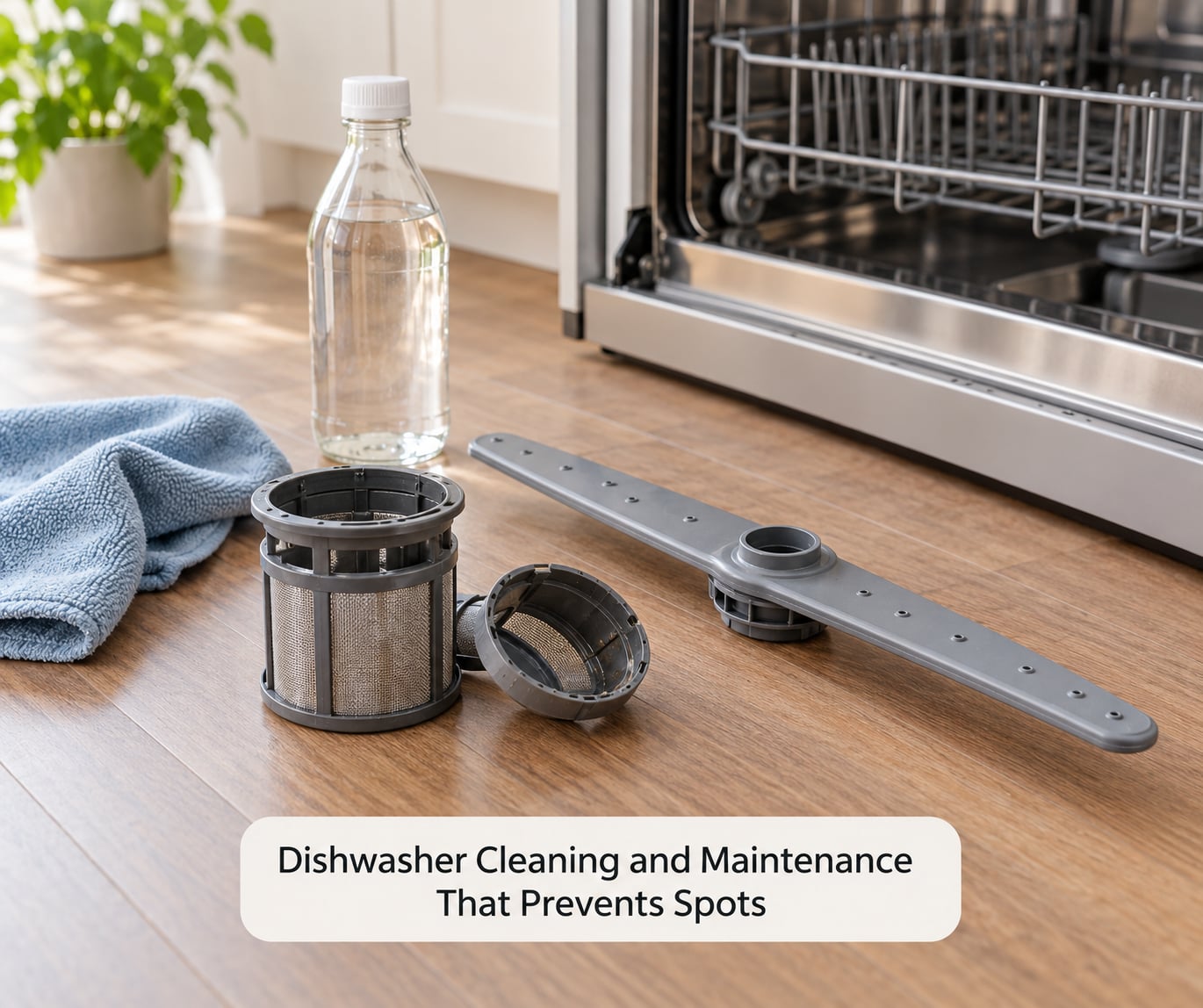
Monthly, take the filter out and rinse it under hot water, working a soft brush through the mesh until nothing comes off. Many people have never removed it, and a quarter of an inch of scrambled egg and rice is enough to starve the whole spray system.
Then clear the spray arms. Lift the lower arm off the hub and hold it under the tap while you push a toothpick through each jet, or wash the arms in a dishwasher on their own. Turn the upper arm by hand too, since it only spins with pressure from below. Spots reappearing in the same ring pattern every load point almost straight at a specific blocked jet.
Check the rinse aid dial. It should land on a numbered setting, not on zero or the letter for heavy rinse, and the cup should be full of a clear or blue liquid. Never put vinegar or any homemade liquid in the dispenser — the foam control depends on the exact chemistry.
Keep the detergent dose honest. The measured line on the door is for fully soiled dishes, so most lightly loaded cycles need less. And let the hot tap run for a minute before starting a load, which is the cheapest way to raise inlet temperature in a house with a long run to the kitchen.
Everything above assumes you have the manual for your machine. Cycle names, filter locations and cleaning modes differ between manufacturers, and some built-in models hide the filter under the lower rack.
Why Does My Dishwasher Leave Spots on Dishes After Cleaning?
Because a cleaning cycle treats the inside of the machine, not the minerals already bonded to your glassware, and because it does nothing about the water supply. That is why film can come back within days of a thorough clean and why the same routine starts feeling like a treadmill.
Why does my dishwasher leave spots on dishes even after a clean filter?
A clean filter only fixes one variable. If your water is hard, every load redeposits the same minerals the minute the water evaporates. Homeowners on plumbing forums in hard-water areas report the same pattern: a vinegar cycle removes the film, then it returns until either the rinse aid is kept filled or the water itself is treated.
So decide which of these four paths fits your situation:
- Repeat the cycle if you used too little detergent or the load was small and the water never got hot.
- Adjust the chemistry if the film is uniform across the load — halve the detergent, fill the rinse aid, and hold back on pre-rinsing with soap.
- Inspect the internals if spots appear in a fixed pattern, such as a ring on the same shelf every time, which points to one blocked jet.
- Call a technician if cleaning changes nothing at all across several loads.
When to Call a Dishwasher Repair Professional
Stop with cleaning and get a qualified appliance repair professional involved when the symptom reaches the machine rather than the dishes. A puddle of standing water in the bottom of the tub after a cycle, water that never drains, or a burning smell during heating all point to a failed drain pump, heating element or control board.
A door that will not latch, an inlet valve that will not shut off, or a float sensor that stops the fill can also mean water damage or a leak you cannot see. Check the supply line and the hose behind the machine for drips before anything else, and shut off the water valve under the sink if you find one.
Do not open the panels yourself. Heating elements and control boards sit behind the tub liner, and work on them involves live terminals and sharp edges. This is the same advice appliance manufacturers give on their own support pages.
Frequently Asked Questions
Does hard water cause spots on dishes?
Yes, and it is the most common cause. Calcium and magnesium dissolved in the water stay behind as the water evaporates and dries, leaving white spots or a cloudy film on glasses and flatware. Homes above roughly 15 grains per gallon see it most often. Fill the rinse aid dispenser and run a vinegar descaling cycle to manage it; a softener is the only thing that changes the underlying water.
How do I remove hard water spots from dishes?
Soak the glasses for 15 to 30 minutes in one part white vinegar to two parts warm water, then rub lightly with a soft brush and rinse in plain water without soap. For the machine, run an empty hot cycle with one cup of vinegar in a bowl on the bottom rack and no detergent. Existing spots come off this way; etched glass haze does not.
Why does my dishwasher leave brown spots on my silverware?
That is rust, and it happens when plain carbon steel flatware sits in standing water or gets damp and air dries. Salt accelerates it. Wash steel knives and forks by hand, dry them completely, and load them low with points facing the center. Stainless pieces will not rust, so spots on stainless usually mean dried food or grease rather than corrosion.
How do I remove mold spots from dishes in the dishwasher?
Black specks around the door gasket, rack hinges, and tub corners are mold from standing moisture and food residue. Wipe those areas with one part bleach to ten parts water, rinse the machine, and run a sanitizing or extended hot cycle. Never mix bleach with vinegar or another cleaner. Old sponges and towels can reintroduce spores, so replace them afterward.
Is it normal for a dishwasher to leave water spots?
A few marks on glasses are common in hard-water areas, but a dishwasher should not leave a cloudy film across every plate. Check the rinse aid first, then halve the detergent, then pull and clean the filter. If nothing changes across several loads, the cause is likely inside the machine or in your water supply rather than in how you load it.
Do I need a water softener for my dishwasher?
Usually not as a first step. If your hardness is under roughly 10 grains per gallon, keeping the rinse aid dispenser full and running a vinegar cycle monthly is enough. Above that, a point-of-use filter or cartridge on the supply line can help. A whole-house softener is the thorough fix, and owners who installed one often report spotting largely disappearing.
What Should You Try First?
Work through this in order, one step per load, so you can tell what actually changed the result.
- Identify the spot. Wet a spot and rub with your thumb. It comes off, it is mineral film and you have a water problem. It stays, it is etched glass.
- Clean the filter. Pull it out, rinse it under hot water, scrub the mesh with a soft brush.
- Clear the spray arms. Run a toothpick through every jet on both arms while water runs over them.
- Fix the chemistry. Fill the rinse aid dispenser and set the dial, and cut your detergent to about half of what you have been using.
- Run it properly. Flush the hot tap first, load lightly with faces angled inward, and use the hottest cycle.
- Descale once a month. One cup of vinegar in a bowl on the bottom rack, no detergent, hottest cycle.
If the whole load is still hazy after three or four of those loads, stop treating it as a cleaning problem. At that point you are looking at inlet temperature, a detergent type that does not suit your water, or hardware inside the machine, and the manual plus a qualified technician is the right next step.