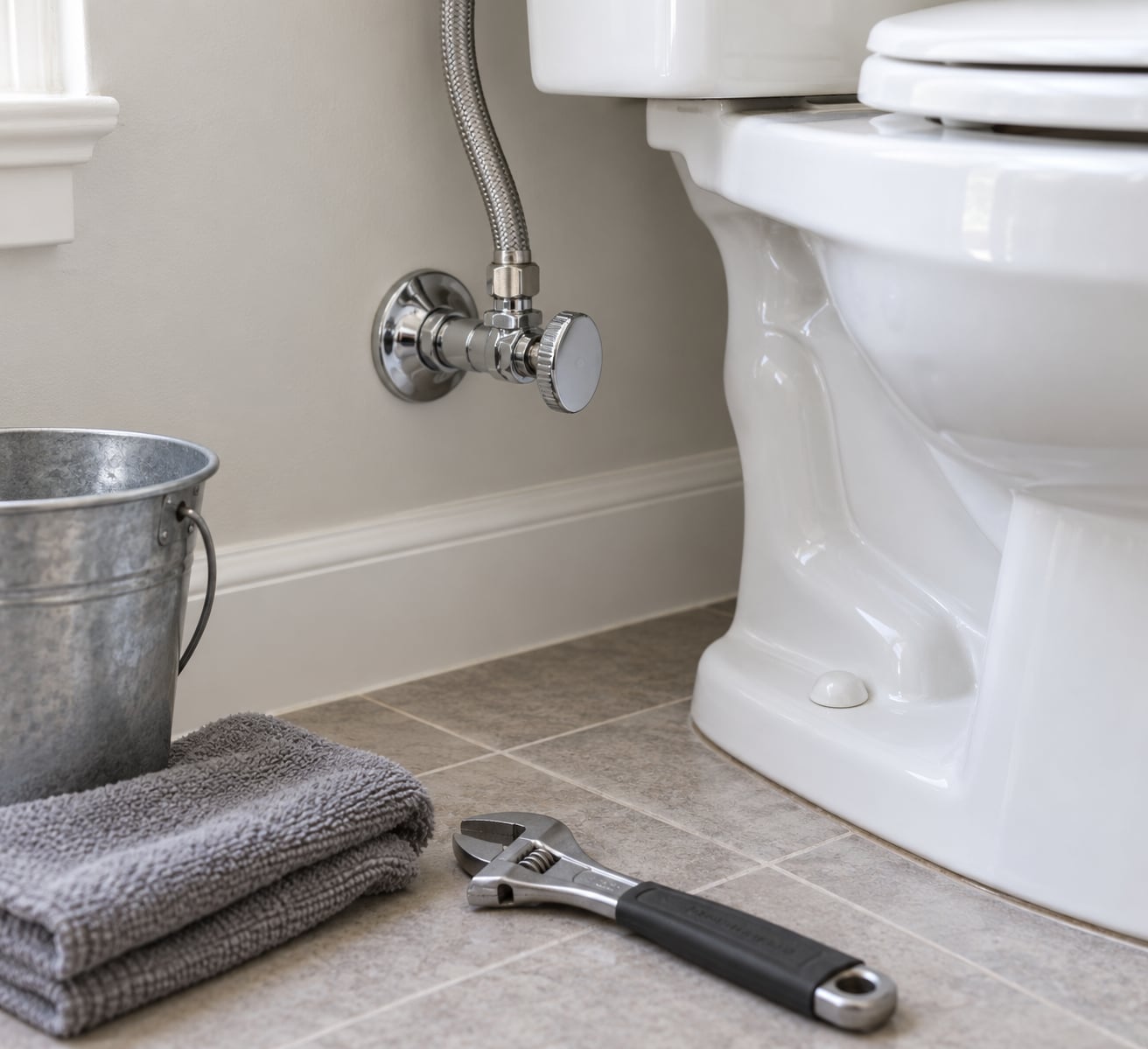
To turn off water to a toilet, find the small shutoff valve behind or beside the base where the braided supply hose meets the wall, turn it clockwise or a quarter turn until it stops, then flush to test. The whole job takes under a minute with a towel and a bucket.
That valve is called an angle stop, and it isolates the toilet from the rest of the house. Everything else keeps running while it’s closed.
You’ll reach for it when a toilet keeps running, when the bowl is overflowing, before swapping a fill valve or flapper, or when you are removing the toilet altogether. Renters in older units may find there is no valve at all, and I cover that fallback below.
Table of Contents
- What You Need
- Step-by-Step: How to Turn Off Water to a Toilet
- 1. Find the toilet’s shutoff valve
- 2. Turn the valve until it stops
- 3. Flush the toilet to confirm the water is off
- 4. Turn off the water if the handle or fill valve is stuck
- 5. Drain the tank and bowl if you are making a repair
- Valve Types and Which Way to Turn Them
- What to Do When the Valve Won’t Move
- Common Mistakes
- Frequently Asked Questions
- Can I flush the toilet when the water is shut off?
- Do all toilets have a water shut-off valve?
- How do I turn off water to a toilet that doesn’t have a shut-off valve?
- Why is the toilet still running if I shut off the valve?
- My toilet shut off valve is stuck and won’t turn. What can I do to fix it?
- How do I shut off water to a trailer?
- Conclusion
What You Need
Grab these before you start so you are not crawling around a wet floor with wet hands mid-job.
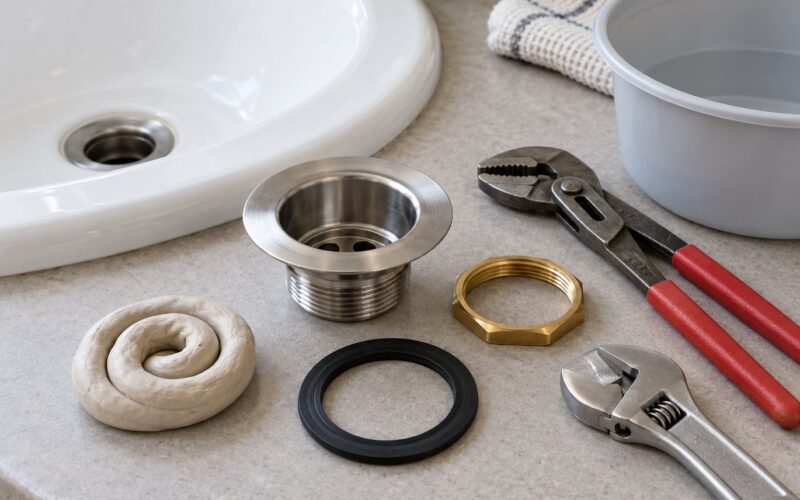
- A towel or old T-shirt to lay on the floor, since a little water always escapes when you crack a fitting.
- A small bucket or bowl for the tank water and any drips from the valve stem.
- An adjustable wrench for the supply line nut, if you plan to disconnect the hose.
- Locking pliers for a valve handle that spins or a stuck packing nut.
- Penetrating oil and a rag, in case the valve has not been touched in ten years.
- Gloves, because angle stops in older homes are often brass with sharp corrosion edges.
Knowing which parts you are dealing with helps too. The supply hose runs from the wall or floor stub-out to the tank or bowl inlet. The shutoff valve sits at the wall end of that run. The fill valve and flapper live inside the tank, and a stuck flapper is the most common cause of a toilet that runs after you shut the water off.
Step-by-Step: How to Turn Off Water to a Toilet
1. Find the toilet’s shutoff valve
The angle stop is on the wall or floor behind the bowl, usually a little higher than the base, where the supply line enters the wall. On a modern install it is a small chrome or brass valve with a round knob or a short lever handle; in older homes it is a squat brass fitting with a winged or cross handle.
Trace the hose with your hand and follow it back until it disappears into a fitting. If what you find is a fat lever on the wall a foot away, that is the whole-house valve, not the toilet valve.
2. Turn the valve until it stops
Turn a round knob clockwise, to the right, until it will not go any further. On a lever handle, rotate it a quarter turn until the handle sits perpendicular to the pipe running out of the wall.
Use firm, steady pressure and no more. Do not force it. Those plastic-handle angle stops snap off at the stem, and a broken stem can mean a flood rather than a ten-minute fix.
3. Flush the toilet to confirm the water is off
Set the towel down, tuck the bucket under the tank, and flush. With the supply closed, the tank drains and stays empty. If the bowl refills or the tank refills, the valve is not fully closed and you go back to step 2.
Water in the tank always drains into the bowl, so expect one last bowl-full after the flush. That is normal and it means your shutoff worked.
4. Turn off the water if the handle or fill valve is stuck
If there is no accessible shutoff valve, or the angle stop refuses to move, your next lever is inside the tank. Lift the tank lid off and set it on a towel somewhere dry, then close the fill valve under the float. It has a round knob for older models or a lever on newer ones, and you turn the same directions.
If the fill valve will not close either, shut off the main water supply valve, drain the tank with a cup and sponge, and treat the tank as your isolation point for the repair.
5. Drain the tank and bowl if you are making a repair
Turn off the water, then flush to empty as much as you can. For the rest, close the flapper by lifting the chain off the flush lever, or hold the flapper down and pull the lever handle so the flush valve seal stays shut.
Sponge out the tank, then bail the bowl with a cup. A few cups of water in the bowl is fine and often traps sewer gas. Get it dry enough to work on the flapper, fill valve or wax ring without the bowl spilling across the floor every time you move it.
Valve Types and Which Way to Turn Them
| Valve type | Where you find it | Direction to close | Difficulty |
|---|---|---|---|
| Round knob angle stop | Standard home toilet, behind the bowl | Clockwise until it stops | Easy unless seized |
| Quarter-turn lever | Newer installs and remodels | Quarter turn until perpendicular to the pipe | Easy |
| Push-pull gate valve | Mobile homes, trailers, many RVs | Push the handle in toward the pipe | Moderate, needs care |
| Fixture stop on a riser | Older homes with a vertical pipe run | Clockwise with a wrench, gently | Often corroded |
Push-pull valves on an RV, trailer or mobile home do not behave like a quarter-turn stop. The handle pulls straight out to open and pushes straight in to close, and many of them are gate valves that take several slow turns. Push firmly rather than twisting, or you can snap the stem.
What to Do When the Valve Won’t Move
A seized angle stop is the single most common complaint from people trying this job. Work through it in this order and stop as soon as something gives, because the failure mode here is a split handle and a wet floor.
- Loosen the packing nut behind the handle about a quarter turn with a wrench. This takes pressure off the stem seal, which is often what is actually seizing.
- Tap the valve body firmly with a rubber mallet or the handle of a screwdriver. A few sharp taps on a stuck stem often free it.
- Spray penetrating oil on the stem and around the handle, then wait ten minutes and try again. Heat from a hot wet rag or a hair dryer held nearby loosens corrosion faster.
- Grip the handle with locking pliers if it is too small or plastic. If the handle spins freely on the stem, unscrew the handle, remove the nut underneath and clamp the stem itself.
- Stop and shut off the main. If the stem still will not move after all of that, the body is corroded through. That is a plumber job, not a wrench job.
If you break the handle mid-turn, close the main water supply valve immediately, then open a faucet or two to relieve pressure in the lines before you start loosening anything.
Common Mistakes
Turning the wrong valve. The first thing that moved was probably a riser or the main. Trace the actual hose back to the wall and confirm the valve you are holding is the one feeding the tank before you assume it is closed.
Forcing a stiff valve. Force is how plastic handles snap. Firm and steady gets you there; a ratchet on a stuck stem just breaks something you now have to replace.
Expecting the toilet to be instantly dry. The supply line still holds water under pressure, and the tank holds a full bowl worth. Drain both, and put the towel down before you disconnect anything.
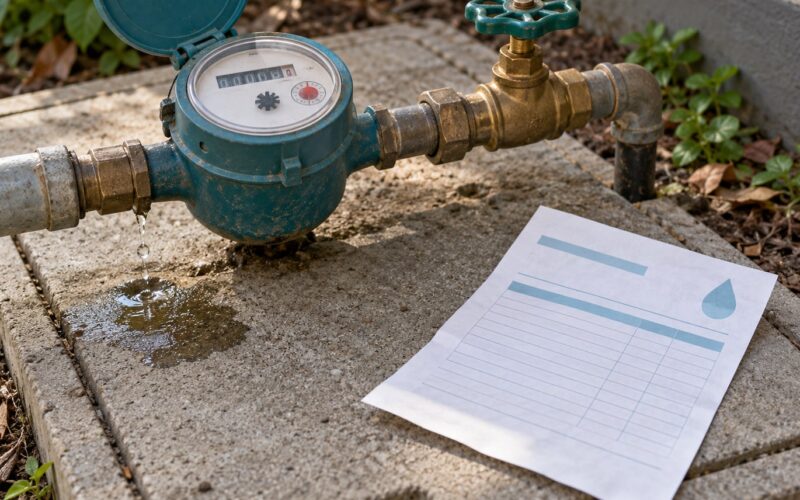
Confusing a tank shutoff with the home’s main. The main is usually a large gate or ball valve near the water meter, often in a basement, crawl space or garage. Turning it off means no water anywhere, including the faucet you are using to clean up.
Leaving the supply on overnight. It is fine to leave a fixture valve closed for a repair or a night away. Do not leave a broken or weeping valve closed overnight without the main off, since the seal that failed once can fail again.
Frequently Asked Questions
Can I flush the toilet when the water is shut off?
You can flush once, but only once. With the supply valve closed, the tank still holds enough water for a single flush, and that flush will not refill the tank. After that the bowl empties and stays empty until you turn the water back on. Pouring a bucket of clean water into the bowl is a workable stopgap, but it will not refill the tank, so there is no flush left after that either.
Do all toilets have a water shut-off valve?
No. Plenty of apartments, condos and older homes were plumbed with a stub-out and no fixture valve, or with a valve that was removed and never replaced. Look behind the bowl where the hose enters the wall, and if there is only a capped stub or bare pipe, you are in that group. The workaround is the fill valve inside the tank for a fill valve or flapper job, or the main shut-off for anything bigger.
How do I turn off water to a toilet that doesn’t have a shut-off valve?
Two options. For a fill valve, flapper or other tank work, lift the lid off and close the fill valve under the float, the same way you would close a fixture stop. For leaks at the bowl or a full toilet removal, find the main water supply valve near the water meter, turn it clockwise until it stops, and open a faucet to relieve pressure. Expect no water anywhere in the house while it is closed.
Why is the toilet still running if I shut off the valve?
Two usual reasons. The tank still held water when you flushed, so the flapper and fill valve kept working until that water was gone, which can take a few minutes. Or the flapper itself is worn and never sealed, letting water from the tank leak into the bowl even with the supply closed. Drain the tank and watch: if the bowl rises with an empty tank, the flapper needs replacing.
My toilet shut off valve is stuck and won’t turn. What can I do to fix it?
Loosen the packing nut behind the handle a quarter turn to release pressure on the stem, tap the valve body firmly with a rubber mallet, then spray penetrating oil on the stem and wait ten minutes. A hot wet rag helps with corrosion. Grip the handle with locking pliers if it spins. If the stem still will not move, shut off the main and call a plumber rather than keep forcing it.
How do I shut off water to a trailer?
RV, trailer and mobile-home toilets usually have a push-pull valve rather than an angle stop, often mounted on the wall behind the toilet or inside a cabinet below it. Pull the handle straight out to open, push it straight in to close, and do not twist it. Many are gate valves that close over several slow turns. If the push-pull valve will not seat, use the fresh-water tank fill switch or the main water switch on the outside of the unit.
Conclusion
Start at the wall end of the supply hose, turn the valve clockwise or a quarter turn, and flush to prove it worked. That test takes five seconds and it is the step people skip.
Use firm pressure and stop if the valve resists, because a snapped handle turns a small job into a wet bathroom. When there is no valve at all, close the fill valve inside the tank or fall back to the main. A stuck, weeping or missing valve that will not come free is plumber territory, and so is anything you would rather not do over a wet floor at midnight.