If you’re searching why is my water bill suddenly so high, the answer is almost always one of four things: a leak you cannot see (most often a running toilet), a genuine change in household water use, a billing or meter-reading error, or a rate and sewer charge increase from your utility. Only one of those requires a plumber.
That last part is worth sitting with. Plumbers who answer high-bill calls say running toilets are behind most of them, and r/Plumbing regularly repeats the same line: a high water bill call is nearly always a running toilet. But plenty of households open the envelope, find an unwelcome total, and assume the worst. The faster you sort the four causes against each other, the less water you waste and the less you argue with a billing department that was never wrong.
Table of Contents
- Why Is My Water Bill Suddenly So High?
- Check the Water Bill for Clues
- 9 Common Causes of a Sudden Increase
- Why Is My Water Bill Suddenly So High From a Leak?
- Usage Changes That Can Make the Bill Jump
- How to Find a Hidden Water Leak
- Meter, Billing, and Rate Problems
- What to Do First When Your Bill Is Too High
- When to Contact the Utility or a Plumber
- Frequently Asked Questions
- Can a running toilet really make a water bill jump?
- Why is my water bill so high with no leaks?
- What should I do first if my water bill is unexpectedly high?
- How much does a hidden plumbing leak increase a water bill?
- Does hot weather or lawn watering cause a higher water bill?
- Can you dispute a high water bill?
- Conclusion
Why Is My Water Bill Suddenly So High?
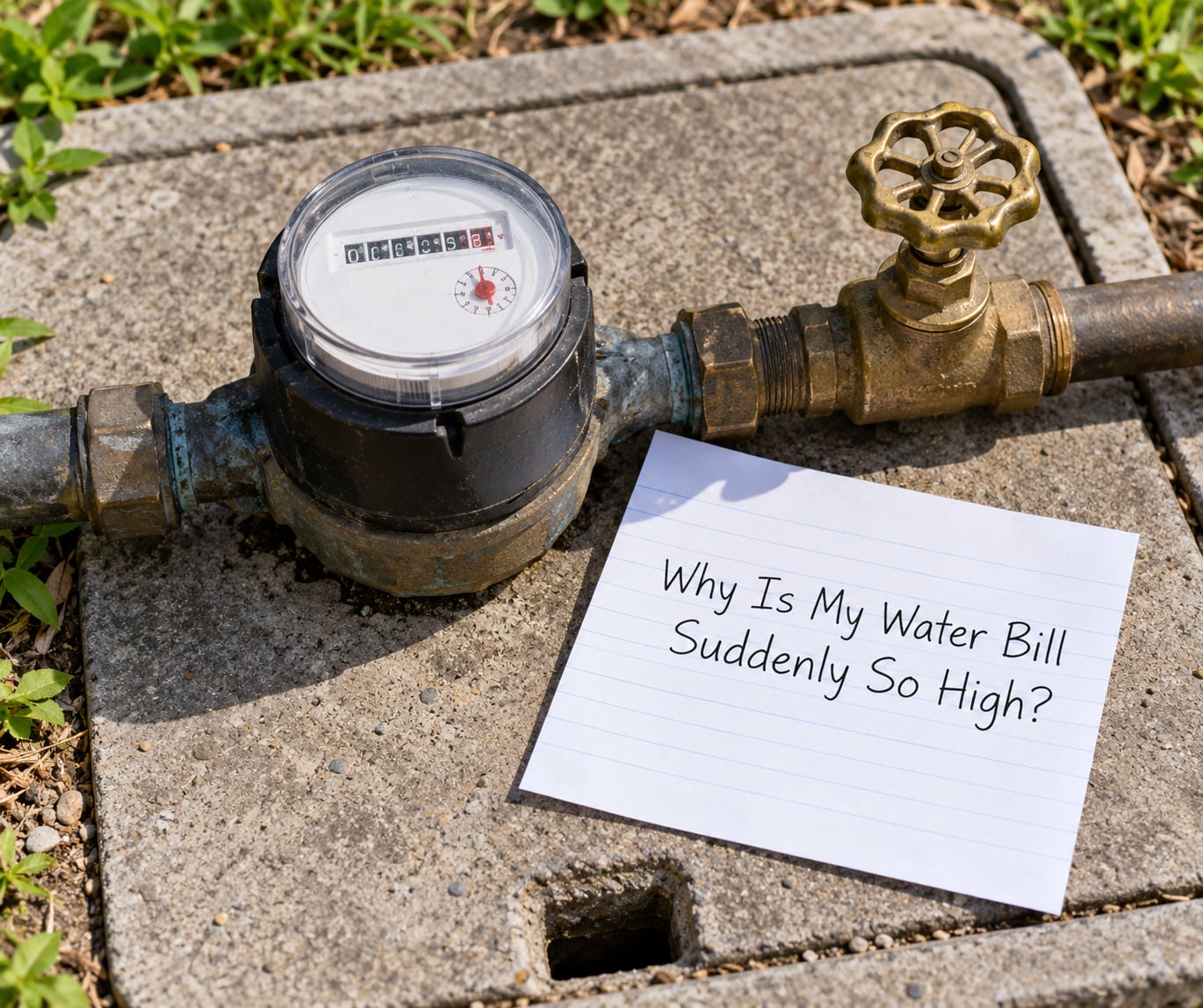
An unexplained jump in your water bill comes from a leak, changed usage, a billing or meter error, or a rate change. Finding out which one takes about twenty minutes and a meter read.
Start by pulling out the last three or four bills and laying them side by side. Look at two columns: total gallons used and average daily consumption. Gallons tell you whether your home used more water. The dollar figure alone tells you nothing, because the same gallons cost different amounts from month to month once rates, sewer charges and billing-cycle length shift.
Then decide whether the jump was gradual or abrupt. A slow climb across four or five bills usually points at a leak that got worse, a growing household, or a rate increase compounding. A single cycle that is double or triple the normal figure usually points at one event: a fixture left running, a supply line or irrigation failure, an estimated read corrected by a real one, or a longer billing period.
Check the Water Bill for Clues
Most bills carry more than a single total, and the detail is where the answer hides. Look for total gallons consumed, average daily use, the fixed service charge, any separate sewer or wastewater charge, the rate per gallon, the billing period start and end dates, and whether the read was actual or estimated.
Four items on that bill explain most surprises on their own: a billing period longer than usual, a tiered rate that jumps your unit price once you cross a usage threshold, a sewer charge based on winter average rather than actual use, and a flat infrastructure or recovery charge added mid-year.
| What the bill shows | What it usually means | Where to start |
|---|---|---|
| Gallons roughly doubled, dollar total also doubled | A real usage increase | Meter leak test, then fixtures and outdoor lines |
| Gallons flat or slightly up, dollar total jumped hard | Rate change, tiered pricing, or a new sewer charge | Compare the per-gallon rate with your previous bill |
| Gallons far higher than any past month, no routine change | Leak, estimated read corrected, or an unauthorized adjustment | Check whether the read was estimated, then run the meter test |
| A fixed or flat charge is larger than before | Base rate adjustment or added fee | Compare the fixed charge line on both bills |
| Same usage, extra line item for water | Billing error or duplicate charge | Call the utility for an itemized billing history |
Photograph every bill you discuss with the utility. Dates and line items are much harder to argue about after the fact, and a dated meter photo is the single piece of evidence that settles most disputes.
9 Common Causes of a Sudden Increase
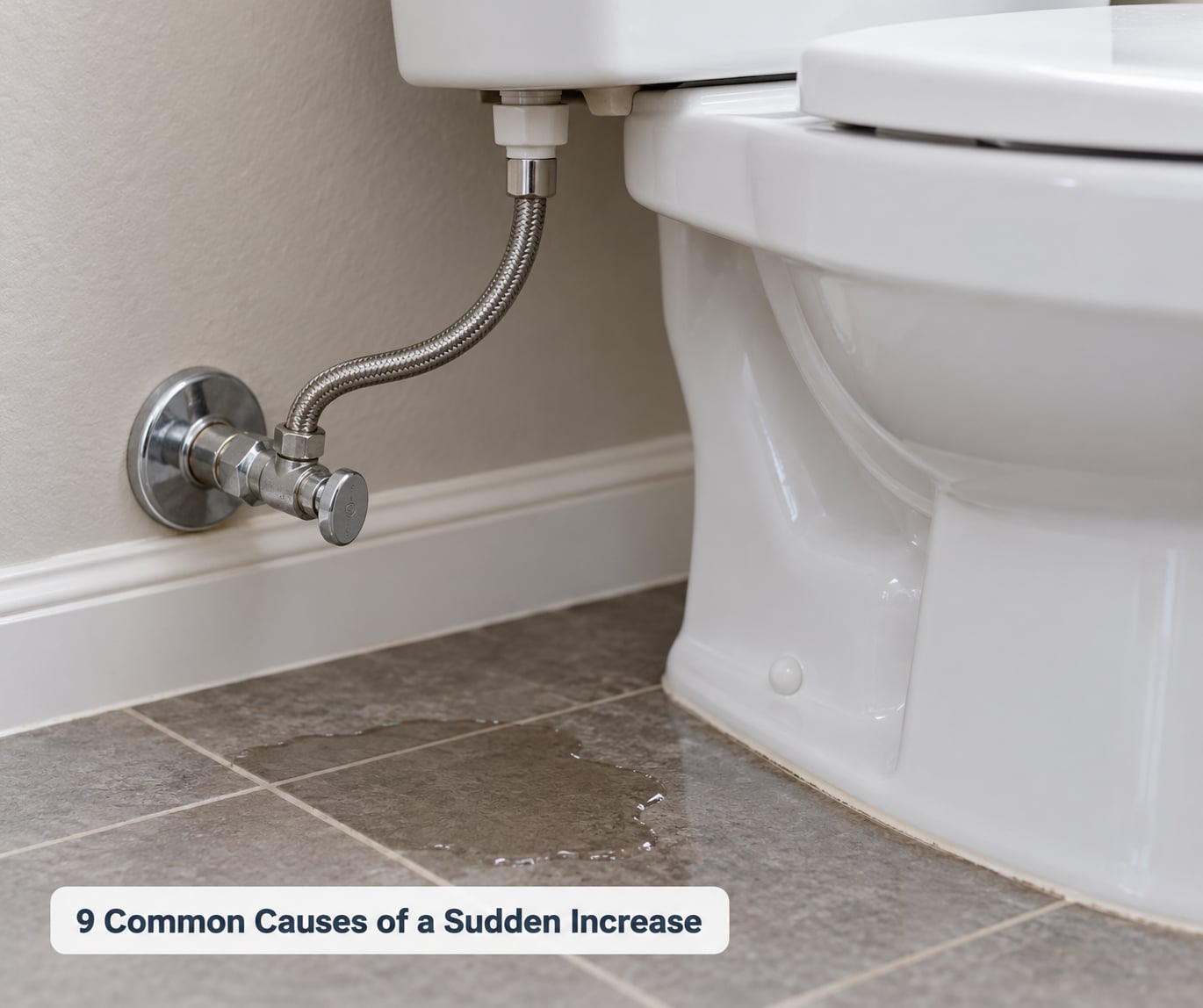
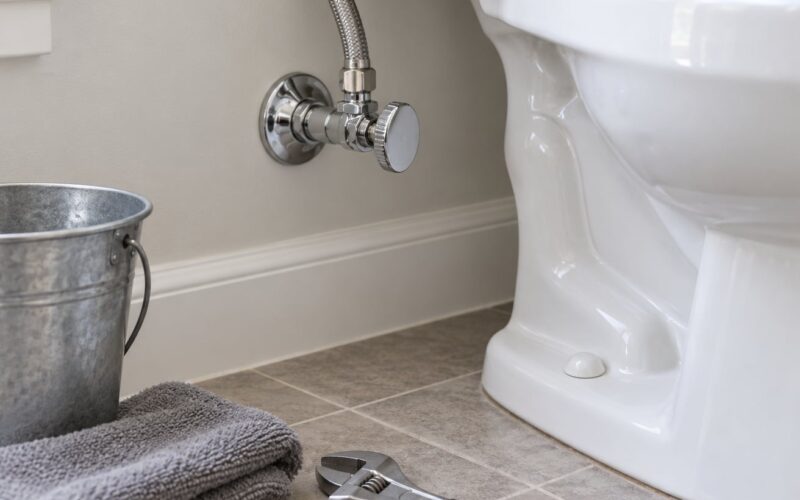
A running or silently leaking toilet. The flapper or fill valve can leak without ever turning the bowl visibly, and it is the most common single cause of a high bill. Detection: drop food coloring or a dye tablet in the tank, wait 15 to 20 minutes without flushing, and look for color in the bowl.
A dripping faucet or a showerhead that never fully closes. A faucet dripping once per second wastes more than 3,000 gallons a year; a showerhead dripping steadily wastes more than 500. Detection: put a mug or a piece of paper under the drip and check it after an hour.
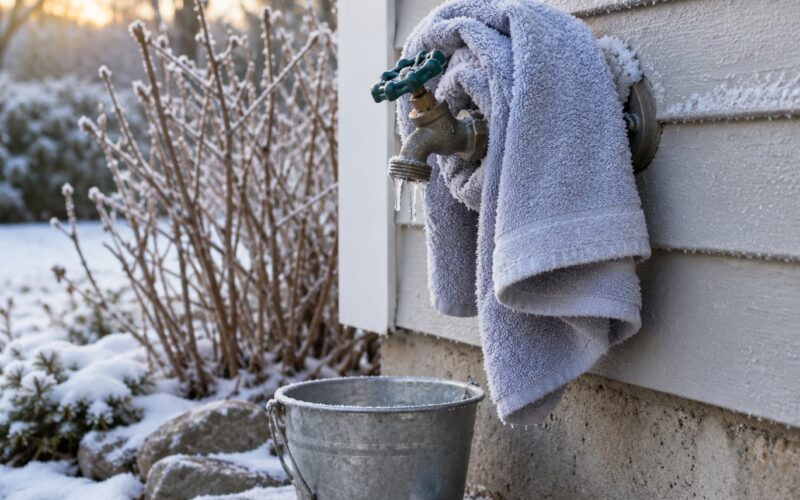
An outdoor hose, hose bib, or irrigation leak. A pipe losing water at just 1/32 of an inch can waste roughly 6,300 gallons in a month, and an unmaintained irrigation system can lose up to 25,000 gallons a year. Detection: walk the hose bibs with the house off, then run each irrigation zone one at a time and watch the meter.
A leaking supply line inside a wall, under a floor, or in a slab. Pinhole corrosion in older copper and a failed fitting or supply hose both do this. Detection: warm spots on tile, a musty smell, a soggy strip of yard, a drop in water pressure, or a meter that moves with everything off.
A washing machine or dishwasher supply hose. The braided stainless hoses on these appliances are a leading cause of water damage claims, and the failure is usually gradual. Detection: look for dampness or a stain in the cabinet and the floor beneath the appliance.
A water heater or pressure relief valve losing water. A dripping temperature and pressure relief valve sends water down the drain continuously. Detection: listen for the hiss near the heater, look for water in the pan or on the floor, and check the relief valve and discharge pipe for staining.
A seasonal or household usage change. Irrigation season, guests, a filled pool, washing vehicles, a new appliance, school breaks, or hot weather all raise real consumption. Detection: match the timing of the increase to your calendar and to your neighbors’ bills.
A meter problem or an estimated read. A bill built on an estimate followed by a real read can jump sharply without any change at your home. Residential meters are accurate to within a small tolerance when new and wear toward under-registration over time, so a meter rarely inflates a bill on its own. Detection: ask whether the read was estimated, and request a meter test if the numbers make no sense.
A rate increase or a new utility charge. Base rate adjustments, tiered pricing, and newly added infrastructure, conservation, or sewer fees raise the price of every gallon without changing how much you used. Detection: divide the dollar total by the gallons to get your actual per-gallon rate, then compare it with the previous bill.
Why Is My Water Bill Suddenly So High From a Leak?
Leaks matter more than the bill suggests, because the water that left through a failed fitting is not the only cost. A supply line that soaked a subfloor or wall brings drywall, flooring, and mold remediation with it, and that work routinely costs several times what the plumbing repair itself costs. A slow leak is a plumbing problem and a building problem at the same time.
Warning signs worth acting on: a meter that creeps with every fixture off, an unexplained increase in your average daily use, water stains near a toilet base, a toilet that needs a jiggle to stop running, a low-pressure shower that recovered when another tap closed, a warm patch on a tile floor, and a yard area that stays greener or spongier than the rest of the lawn.
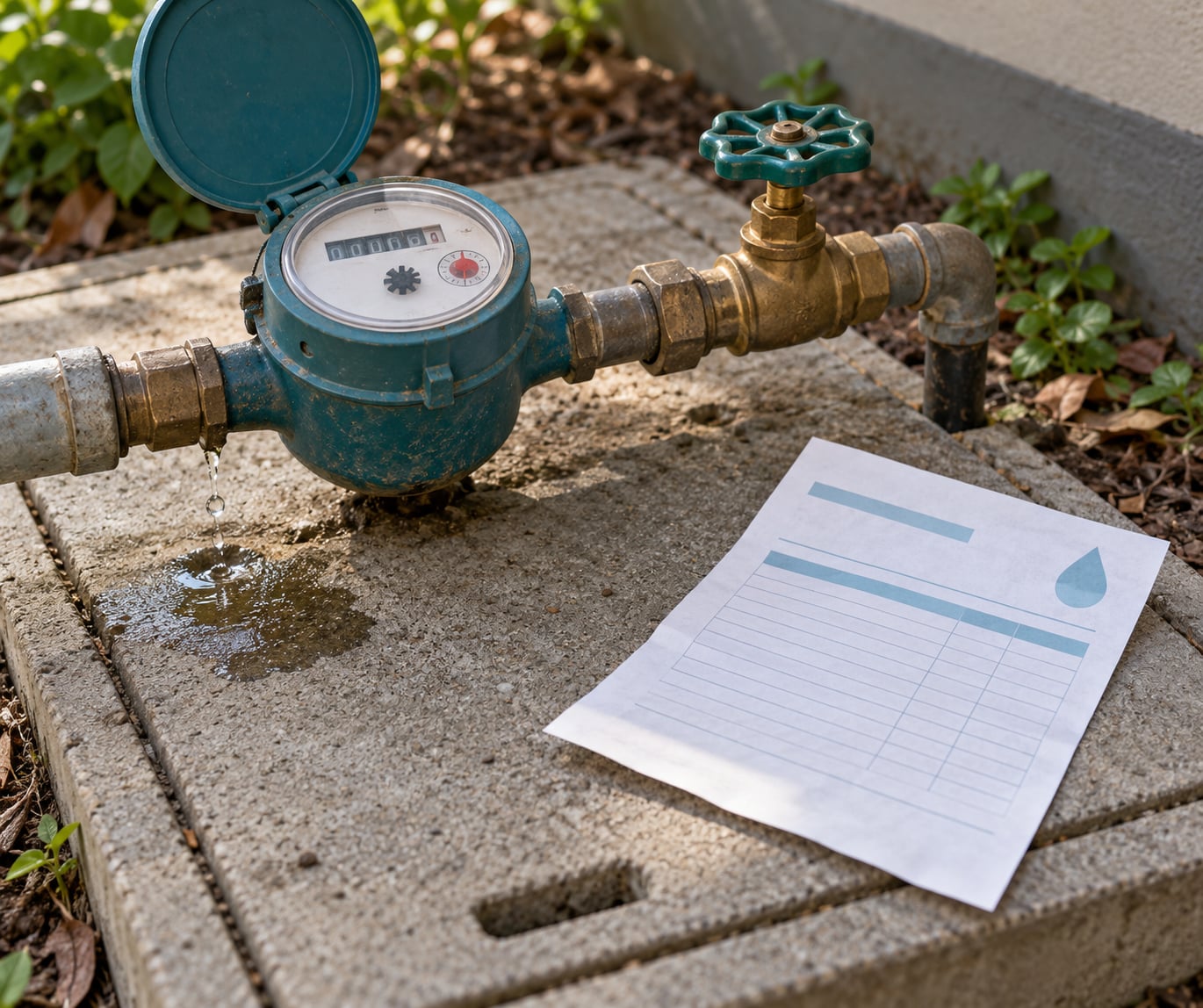
The meter test is the most reliable first move. Find the meter box at the curb or in the basement, note the main shutoff location first, shut off every fixture and appliance including the water heater’s cold inlet if you can do it safely, read the meter, then read it again after 30 to 60 minutes. A steady drip, a spinning flow indicator, or a number that moved even slightly all point the same way: water is leaving the system while nothing inside is drawing it.
You can get a rough gallons-per-minute estimate from the meter’s register by watching how fast the low-flow indicator moves and comparing it with the meter face marked for that flow rate. Use the result to estimate the daily loss, then multiply by your actual per-gallon rate to see whether the bill you received is consistent with the leak you found. If the number is close, you have your answer and your evidence in one step.
Shut off the main and call a licensed plumber when water is actively flowing, when the meter moves steadily with everything off, when you see standing water near a wall or appliance, or when the suspect leak is inside a wall, under a floor, or in a slab. Do not open a wall or a slab yourself, and do not work on a gas-fired water heater beyond switching off the water supply and calling a licensed technician.
Usage Changes That Can Make the Bill Jump
Not every high bill is a leak, and assuming it is sends you chasing a problem you do not have. Real usage changes are usually bigger than people expect for the length of time they last.
| Activity or change | How it shows up on the bill | How long it lasts |
|---|---|---|
| Guests or a temporary larger household | A steady lift in daily gallons across the whole cycle | The length of the visit |
| Filling a pool, hot tub, or pond | One large block of gallons, then normal use | A single cycle |
| Washing vehicles, a driveway, or siding | A spike on outdoor-use-heavy cycles | A weekend or a season |
| Starting or repairing an irrigation system | A jump that lines up with watering season | Warm months only |
| A new appliance, ice maker, or plant | A small permanent increase in the baseline | Ongoing |
| School break and no guests to offset it | Higher daily use for a few weeks | A few weeks |
| Hot weather | More outdoor use, more drinking water, more cooling-related use | Seasonal, varies by region |
The EPA’s WaterSense program estimates the average home loses more than 9,300 gallons a year to leaks, and about 9 percent of homes lose 50 gallons or more a day without noticing. Those figures are a useful baseline for judging whether your own numbers look normal.
How to Find a Hidden Water Leak
Work outside in. The cheapest hidden leaks are the ones you find before you call anyone, and plumbers charge for a trip even when the answer turns out to be nothing.
Outside first, then the meter. Read the meter, shut off the main, and walk every hose bib, outdoor spigot, and irrigation zone with the house off. Water that keeps running from a spigot or a spray head you cannot account for is your answer. If the meter is steady, go back inside and start at the fixtures.
Toilets first, always. Dye test every toilet in the house one at a time, and don’t skip the ones guests use. Then check faucet handles and supply connections under every sink, the shower and tub valve, and the hose bib behind the washer and dryer.
Appliances next. Pull the washing machine and dishwasher forward and inspect the supply hoses and the drain hoses for bulges, rust, or dampness. Look at the base of the water heater, the drain pan, and the relief valve discharge pipe.
Then look for building evidence rather than water. Check under sinks and inside cabinets for stains or soft flooring, look at ceiling and wall edges near bathrooms and kitchens, and run an infrared thermometer or a pinless moisture meter along suspect areas. A warm patch on a tile floor in one spot, with no heating source nearby, is a strong signal of a leak under the slab.
Skip open walls, slab work, and anything involving gas. Also note that finding water does not tell you where the leak is. Water travels through soil, concrete and framing along the path of least resistance, so a damp patch in a basement wall can originate from a supply line a long way away.
Meter, Billing, and Rate Problems
Once a leak is ruled out, the remaining explanation is on paper. Ask the utility directly whether your read was estimated or actual, and whether your account carried a rate change, a tiered pricing structure, or a new sewer charge during the period in question.
Estimated reads are the quiet ones. If the meter could not be read and the utility billed an estimate, the following bill can jump when the real read replaces it. That is a legitimate correction, not an error, and it is worth knowing before you call and accuse anyone of anything.
Meters themselves are unlikely culprits. Industry standards put residential meters within roughly 98.5 to 101.5 percent of actual flow when new, and they tend to wear toward under-registration rather than over. That is why plumber advice and utility advice agree on the same order: check the fixtures before you suspect the meter.
Real billing errors do exist: a duplicate charge, a wrong service period, a rate applied from the wrong tier, or a misapplied adjustment. Keep dated photographs of the meter, copies of several prior bills, and any plumber invoice. If the numbers do not reconcile, request an itemized billing history in writing and a meter test, and follow up in writing so there is a record.
Ask about a leak adjustment at the same time. Most utilities have a documented process for reducing or crediting charges caused by a leak, and it usually requires a written request, a plumber’s invoice or repair receipt, proof that the loss was a leak rather than consumption, and a submission deadline. Knowing that list before you start saves weeks of back-and-forth, and homeowners in utility forums consistently say the same thing: bring the receipt and the dates, and send it in writing.
What to Do First When Your Bill Is Too High
Follow the order below and you will usually find the cause before you spend money.
Compare the current bill with the previous two or three and separate gallons used from dollars paid. Check the meter and run the leak test with everything shut off. Inspect fixtures, toilets, appliance hoses, outdoor spigots, and irrigation zones. Confirm the billing dates, the read type, and the per-gallon rate. If the meter moves with everything off, shut off the main and call a licensed plumber. If it does not, call the utility about an estimate, a rate change, or a billing error, and ask in writing what a leak adjustment requires.
If you are a renter, send the landlord written notice the same day, with the bill, the meter photo, and the date. Renters usually are not the account holder and cannot dispute the utility account directly, so the documentation has to travel with the landlord instead of sitting in your inbox.
When to Contact the Utility or a Plumber
Call the utility for estimated reads, duplicate charges, rate and sewer charge questions, billing-cycle questions, a meter test request, a main break on your street, and a leak adjustment. Call a licensed plumber for a meter that moves with everything off, an active flow you cannot stop, a supply line failure, a leak inside a wall, floor, or slab, and appliance supply hoses that have already failed. Call your insurer promptly if water has reached drywall, flooring, cabinetry, or anything you would be upset to replace.
| Situation | Who handles it | First move |
|---|---|---|
| Meter moves with every fixture off | Licensed plumber | Shut off the main, photograph the meter |
| Outdoor or irrigation loss | Plumber or irrigation technician | Shut off the irrigation controller, note the date |
| Estimated read, wrong period, duplicate charge | Water utility | Request an itemized billing history in writing |
| Rate change or new sewer fee | Water utility | Ask for the effective date and the new unit rate |
| Main break or low pressure across the neighborhood | Water utility | Report the address and check whether neighbors see it too |
| Water damage to the building | Licensed plumber, then insurer | Stop the water first, notify the insurer the same day |
| Renter with a spike and no standing on the account | Landlord, with the utility for information | Written notice with photos and dates attached |
One diagnostic habit pays off every time: take a photo of the meter reading with the date whenever you travel or start a project, and again when the bill arrives. Users who photograph their meters settle most arguments quickly, because the dispute comes down to two numbers instead of two memories.
Frequently Asked Questions
Can a running toilet really make a water bill jump?
Yes. A leaking flapper or fill valve can waste 150 to 200 gallons a day without the bowl ever visibly running, which adds up fast over a billing cycle. Dye test it: put food coloring or a dye tablet in the tank, wait 15 to 20 minutes without flushing, and check for color in the bowl. If color appears, the flapper, handle, or overflow tube needs work.
Why is my water bill so high with no leaks?
Four explanations cover most cases: genuine usage change such as guests, pool filling, or irrigation season; a rate increase, tiered price, or new sewer charge; an estimated meter read replaced by an actual read on the next bill; or a billing error such as a duplicate charge or wrong service period. Divide your dollar total by gallons used on both bills. Flat gallons with a rising total means the price changed, not your water use.
What should I do first if my water bill is unexpectedly high?
Compare the current bill with the previous two or three and separate gallons used from dollars paid. Then read the meter, shut off every fixture, and wait 30 to 60 minutes to see whether it moves. A moving meter means a leak; a still meter means usage, billing, or rates. Photograph the meter reading with today’s date either way before you make a call.
How much does a hidden plumbing leak increase a water bill?
It depends on flow rate and duration. A faucet dripping once per second wastes more than 3,000 gallons a year, an irrigation line losing 1/32 inch can waste roughly 6,300 gallons a month, and a running toilet can run 150 to 200 gallons a day. Multiply your daily loss by your actual per-gallon rate for an estimate, then confirm the number matches what you were billed.
Does hot weather or lawn watering cause a higher water bill?
Yes. Hot weather raises outdoor irrigation, pool top-ups, and drinking water use, and some utilities add seasonal pricing on top. Check whether your increase matches last summer’s bills and whether your irrigation system is running longer than scheduled. A jump that appears every warm month is seasonal; one that appears in a single cycle usually points at something else entirely.
Can you dispute a high water bill?
Yes, and you will get further with writing than with a phone call. First ask the utility whether the read was estimated and whether any rate or sewer charge changed. Then send a written request with dated meter photos, several prior bills, and a plumber’s invoice if a leak was found and repaired. Ask specifically what their leak adjustment process requires, including the deadline, because policies and rules differ by provider and state.
Conclusion
Start with three things: compare the current bill against your previous ones, read the meter, and check the toilets and visible fixtures. If the meter moves with everything off, you have a leak, and a moving meter should send you to the main shutoff and a licensed plumber, especially when the suspect leak is behind a wall, under a floor, or in a slab.
If the meter stays still, the answer is on paper, not in the plumbing. Ask whether the read was estimated, whether a rate or sewer charge changed, and how many days the billing period covered. Document everything in writing with dated meter photos, and ask your utility exactly what their leak adjustment process requires. That single question resolves more high-bill frustration than any repair kit.