Knowing how to prepare a home for a wildfire season comes down to three jobs done before the hot, dry months: clear and harden the ground within 5 feet of the house, close up the openings embers can reach, and build an evacuation plan your household can actually execute in minutes. Most homes are not lost to a wall of flame. They are lost to embers that land in gutters, mulch beds, deck voids and fence lines minutes or hours before the fire front shows up, and the cheapest protection is work you do with a rake, a ladder and a free weekend.
This guide is general preparedness information, not fire engineering, electrical, gas or insurance advice. Requirements differ a lot between a fire district in Northern California, one in eastern Texas and one in the Upper Midwest, so treat your local fire district, fire marshal and state forestry agency as the authority on anything enforceable.
Updated for the 2026 fire season.
Table of Contents
- What You Need Before You Start
- Documents and contacts
- Tools and protective gear
- Help you may need to hire
- Step-by-Step: How to Prepare a Home for a Wildfire Season
- 1. Review Local Alerts, Evacuation Routes, and Fire Conditions
- 2. Create and Maintain a Defensible Space
- 3. Clear Roofs, Gutters, and Exterior Surfaces
- 4. Secure Windows, Doors, Vents, and Other Openings
- 5. Remove or Relocate Combustible Property
- 6. Prepare Utilities and an Emergency Supply Kit
- 7. Inspect the Property Before Peak Fire Risk
- Common Mistakes That Cost Homeowners the Most
- Frequently Asked Questions
- How early should I prepare my home for wildfire season?
- What is the safest defensible-space distance around a house?
- Should I put metal screens over my windows for wildfire protection?
- Can I safely remove branches or vegetation near power lines myself?
- What should I put in a wildfire evacuation checklist?
- Does cleaning my roof and gutters really reduce wildfire risk?
- Conclusion
What You Need Before You Start
Gather the paperwork and gear first. Scrambling for a phone number while a fire is two miles out wastes the hours you should be spending on the roof and the propane tank.
Documents and contacts
- Your local fire district, fire marshal and non-emergency line, plus the county emergency management office.
- Two mapped evacuation routes out of your neighborhood, printed on paper and stored in the go-bag.
- County emergency alert sign-up, usually free text or email alerts from the county or state emergency management agency.
- Insurance policy number, agent contact, and the mitigation documentation your insurer has asked for.
- Home inventory: room-by-room list with serial numbers and photos of major equipment.
- One out-of-area contact who is not in your evacuation path, with their phone number written down.
Tools and protective gear
- Work gloves, eye protection, a dust mask or N95 respirator, long sleeves, sturdy boots, and hearing protection for power tools.
- Hand pruner, loppers, pruning saw, rake, leaf blower, buckets, and a tarp for debris.
- Extension ladder with a proper ladder stabilizer if any roof or eave work is genuinely reachable, plus a spotter who stays at the base.
- Heavy gloves, a dust mask and eye protection for anyone who handles debris from burned structures — ash and dust are hazardous.
- Work lights if any inspection happens near dusk.
Help you may need to hire
Call a fuel-reduction or vegetation-management crew for anything over head height, a certified arborist for trees within 30 feet of the structure, a roofer or gutter service for multi-story or steep roofs, and a licensed plumber or electrician for any gas, panel, or meter work. Never touch a gas line, service panel, or meter yourself.
Step-by-Step: How to Prepare a Home for a Wildfire Season
1. Review Local Alerts, Evacuation Routes, and Fire Conditions
Start with information, because every physical task below depends on knowing when fire weather is dangerous. Sign up for your county or state emergency alert system, download the state fire hazard severity zone map or its local equivalent, and find the official evacuation level definitions used in your area.
Levels are usually staged. A fire weather warning or red flag warning means conditions are dangerous and a fire could start quickly, an evacuation warning means a fire is close and residents near the fire should be ready to leave, and an evacuation order means leave now. Know which agency issues them in your county and how you will hear it when cell towers and power are down: a battery-powered NOAA weather radio is the most reliable option.
Print two routes out of your neighborhood and mark a meeting point well away from the fire zone. Plan for the household members who move slowly: an older relative, a wheelchair user, an oxygen-dependent resident, small children, or a large dog that will not load on a signal. Call your county 211 line or local emergency office to ask what assistance registration exists for residents who may need a ride or an accessible shelter.
What to check afterward: you should be able to name your fire district, your two routes, your meeting point and your out-of-area contact without looking anything up.
2. Create and Maintain a Defensible Space
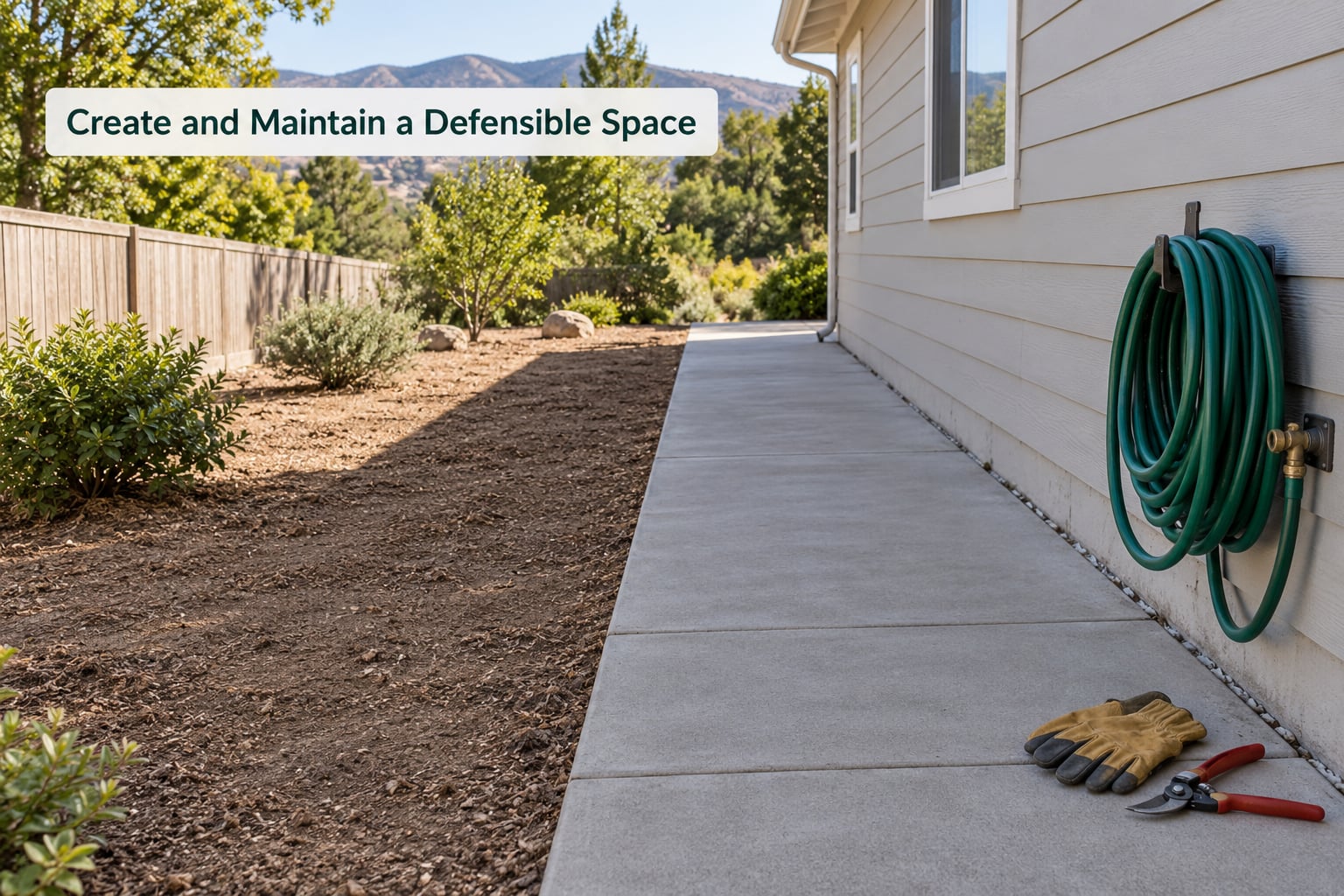
Defensible space is the maintained buffer of reduced vegetation and cleared combustibles between your home and the surrounding wildland. It is the single most effective thing a homeowner can do, and it is measured in three bands that agencies describe as Zone 0, Zone 1 and Zone 2.
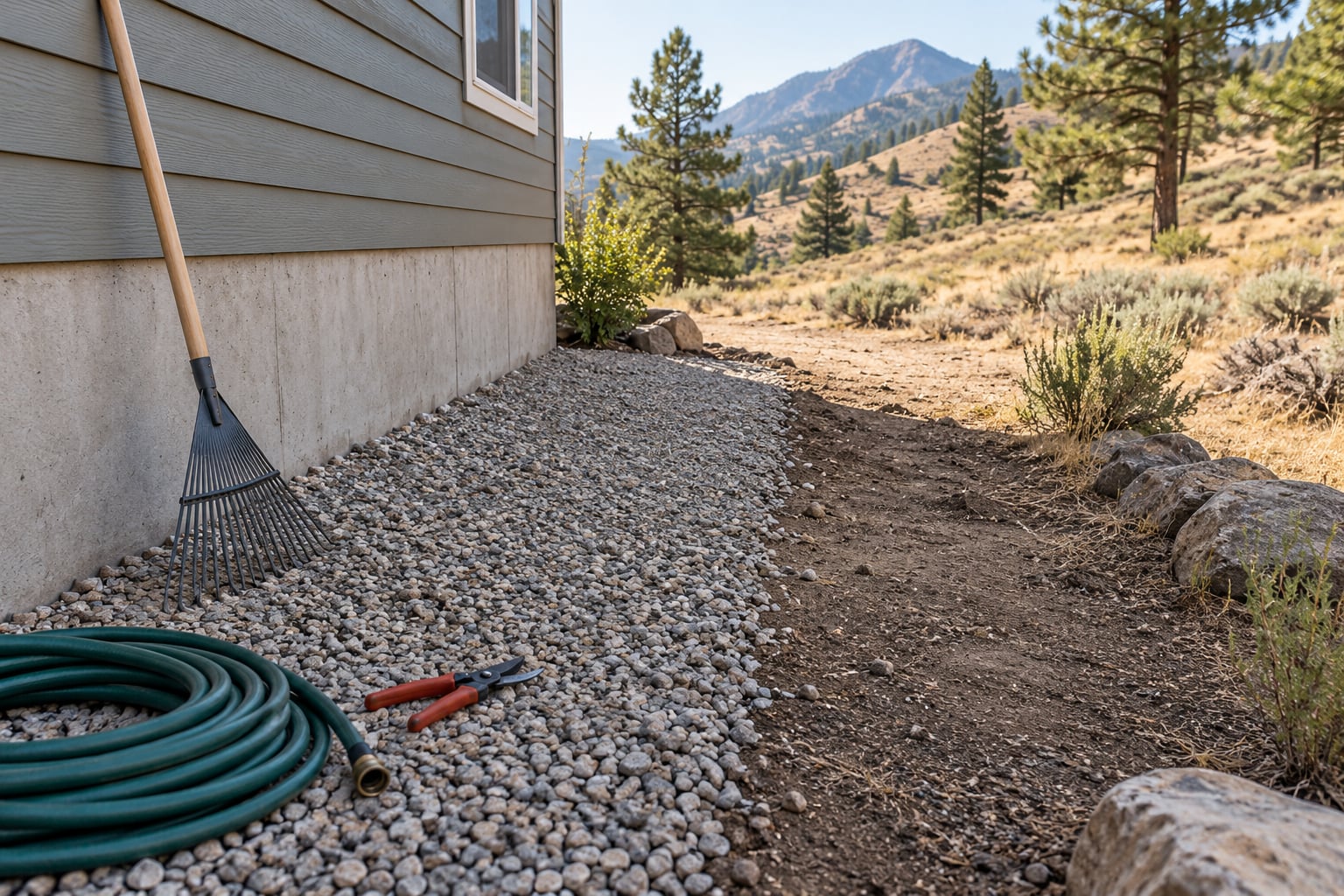
- Zone 0, the first 5 feet out from the house: remove combustible material entirely. This includes wood mulch, bark, pine needles, leaf litter, weeds, stored firewood, lumber, trash and recycling bins, boats, RVs, vehicles, propane tanks, deck furniture, planters and anything else that can hold heat. What remains should be gravel, pavers, bare soil, or a non-combustible surface.
- Zone 1, roughly 5 to 30 feet out: lean, clean and green. Remove dead wood and leaf litter, prune shrubs and lower branches, and thin trees so they are not touching each other or the roofline. Vertical clearance of about 10 feet above a roof and chimney is the commonly cited minimum, with more where the local rule requires it.
- Zone 2, roughly 30 to 100 feet out, as far as your parcel allows: reduce fuel. Remove dead trees, cut ladder fuels that let a ground fire climb into the canopy, and break up the horizontal connection between shrubs, trees and structures.
The “30/30/30 rule” that shows up in Firewise-style guidance is a loose memory aid for that middle band: about 30 feet of clearance around the structure, about 30 feet of vertical space between the canopy and the roof, and the work done well ahead of the season rather than during a fire event. The numbers are not standardized, so your fire district’s written standard wins.
If you are on a slope, uphill, in a canyon or on a wooded lot, push the Zone 1 and Zone 2 work further out. Fire runs uphill faster than it runs downhill, and wind-driven fires jump spot fires well past the tree line. A property with a 20-degree uphill grade needs more clearance behind the house than one on flat ground, not less.
Work outdoors only in the morning, on a cool and still day, and never during a red flag warning or when a fire is active nearby. Stop if smoke is visible anywhere in the canyon or on the ridge. If the trees within 30 feet need chainsaw work, ladder work, or removal of a leaning trunk near a power line, that is a contractor’s job.
3. Clear Roofs, Gutters, and Exterior Surfaces
Embers land in the least obvious places, and roof valleys and gutters are the classic starting points. Clean gutters, downspouts, roof valleys, and the channels behind skylights and satellite mounts, and sweep the roof surface of leaves and pine needles. Aim to do this twice a year: once after leaf drop and once in spring before fire season.
Most of this is ground-level work. If you cannot see the roof valley from the ground, or the pitch is steep, the house is more than one story tall, the shingles are brittle or the ladder would sit on the roof surface, call a roofer or gutter service. Nobody needs a fall to find out how far a ladder is from the ground.
Then check the rest of the exterior: clear the space under decks and balconies, remove stacked lumber and cardboard, move trash and recycling containers away from the house, and check that nothing flammable is stored against the siding or under a window. Look for dead vegetation in roof gutters on the neighbor’s side of a shared fence if you can reach it safely, and flag it to them rather than trimming over the line yourself.
Afterward, walk the perimeter and note anything you could not reach from the ground. That list is your roofer or contractor list.
4. Secure Windows, Doors, Vents, and Other Openings
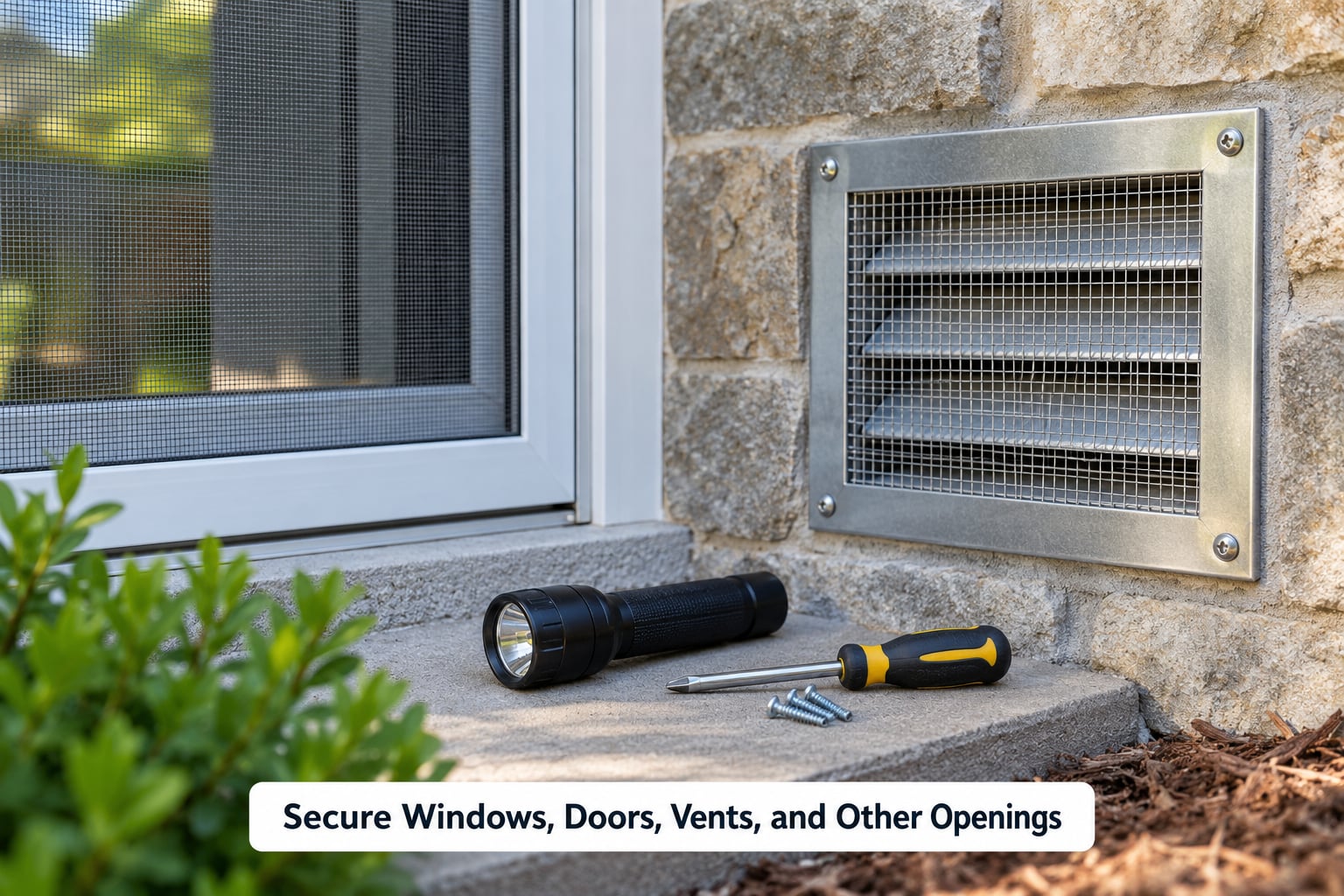
Small openings are where hardening matters most. An ember that enters a vent, a gap around a window, or a crack in a siding joint can ignite the framing behind it long before any flame reaches the house. Close all of them.
- Vents and soffits: cover attic, gable, eave, foundation and dryer vents with 1/8 inch metal mesh or an approved ember-resistant vent cover, secured so it cannot fall off in wind.
- Windows and sliding doors: close them on the day the order comes, and keep the glass clean so you can see an approaching fire through it.
- Doors and garage doors: close the garage door fully, since a gap under it is a path embers walk straight in through. A closed single garage door needs no more.
- Chimneys and roof penetrations: check the chimney cap and screen, the flashing around vents and skylights, and the weep holes in stucco and siding trim.
- Siding, trim and foundation gaps: close gaps larger than a quarter inch, and move ignition sources such as plastic siding, latticework, or a vinyl fence away from the wall.
Be honest about the limits. A metal screen keeps larger embers out; it is not fireproof, and it does nothing for direct flame. Anything that involves cutting into a wall, rewiring a vent, replacing a window, or working at roof height is work for a qualified contractor, and your fire marshal can tell you which retrofits your district expects.
5. Remove or Relocate Combustible Property
Walk the yard and list everything that stores heat. Wooden fences and gates, a deck box, a compost tumbler, a metal fuel tank, stacked pallets, a shed with a cedar-shingle roof, plastic play equipment, a mailbox post, and a car parked under a carport all sit in the first 30 feet and all conduct heat toward the house.
Relocate first, since most items can simply move. Store firewood and lumber well outside Zone 0, on a metal or concrete base. Move trash and recycling containers to the street only on collection day, not permanently. Keep propane and other flammable liquid tanks the clearance distance your fire district or manufacturer requires, usually tens of feet from the structure. Replace or move the car, boat, RV and trailer, and turn off propane appliances and generators before you store them.
For the rest, decide between replacement and disposal. A wooden fence on the property line is the hardest to move and the easiest to argue for replacing with a non-combustible or metal one, ideally in the same project as the deck. Dispose of debris through your local waste service, a green waste program, or a licensed hauler. Burning it on your own lot is only legal in a few places under permit, and it is a leading cause of escaped fires, so do not assume it is an option.
On a steep or densely vegetated lot, a fuel-reduction contractor can clear far more per day than a homeowner with a lopper, and many crews will take a whole-lot contract. Get two or three quotes and ask whether the work is documented for your insurer.
6. Prepare Utilities and an Emergency Supply Kit
Utility prep means planning for a shutoff you do not control, not improvising one you do. Utilities may de-energize a neighborhood in advance of a fire, and outages can last days. Ask your utility how shutoff notices are issued and how to re-energize safely. Never open a gas valve, remove a meter, or work inside an electrical panel yourself; a licensed plumber or electrician handles both.
Put together a kit that covers at least 72 hours for everyone in the house, and keep it where you can reach it while the car is already running — a closet by the front door beats a shelf in a garage.
- Three gallons of water per person per day, plus water for pets.
- Two weeks of prescription medication, a list of the prescriptions, and a copy of any pharmacy contact.
- Non-perishable food that needs no cooking, a manual can opener, and pet food.
- Battery-powered NOAA radio, flashlight, headlamp, power bank, and spare batteries.
- N95 respirators in adult and child sizes, and spare medication for anyone who uses an inhaler or oxygen concentrator.
- Paper copies of insurance documents, deeds, prescriptions, identification and the home inventory, kept in a bag you take with you rather than a safe in the house.
- Charged power banks, a car charger, warm layers, sturdy shoes, a flashlight per person, and a window cling for pets posted on a door.
Check the kit twice a year when you rotate the water and the batteries. A water container you filled last October is not a supply.
7. Inspect the Property Before Peak Fire Risk
Two months before your local season typically starts, walk the property with the checklist in hand and photograph everything: the cleared Zone 0, each vent screen, clean gutters, the cleared deck underside, the relocated firewood and vehicles, and the two evacuation routes on the map. Date those photos and keep the receipts for any contractor work.
That log does two things. It reminds you what to recheck after every storm, and it is the documentation your insurer asks for when a non-renewal notice or a mitigation survey comes in. Some carriers and state FAIR programs offer a premium credit in exchange for documented defensible space, and some will not renew at all without it.
Set a maintenance rhythm: gutters and roof valleys twice a year, a full defensible space walk every spring and again after any major windstorm or fire nearby, and an annual review of the go-bag, the route map and the alert sign-up.
Know who to call. A fire department answers fuel-reduction and defensible space questions. A certified arborist handles trees within 30 feet of the structure. A roofer or gutter service handles anything above one story. A licensed electrician or plumber handles anything involving utilities, and your fire marshal handles code and inspection questions.
Common Mistakes That Cost Homeowners the Most
- Working outdoors during a red flag warning. A windy, dry day is exactly when ladders, chainsaws, and a dry lawn go wrong. Stop. Pick a cool, still morning before the season, not the day you feel the pressure.
- Overreaching on a ladder or a chainsaw. Ground-level clearing is a homeowner job. Anything over head height, on a steep roof, or near a power line is a contractor’s job.
- Assuming screens make a home fireproof. Mesh stops embers, not flame. It is one part of a layered approach that starts with the cleared 5 feet.
- Blocking emergency access. A locked gate, a car across the driveway, or planters too close to the driveway can cost responders minutes you do not have. Keep the entry clear year round.
- Using open flames and improvised burn methods. Burn barrels, fire pits and debris burning are a leading cause of escaped fires and are illegal in many places. Check local rules or skip them entirely.
- Waiting for an official order to leave. On hillside lots, visible smoke can arrive after embers have already done damage. If you see smoke from your ridge, treat it as a go signal and do not go back inside for belongings or pets.
- Going back in a second time. The single most repeated warning in homeowner forums is that re-entering the house is what turns a warning into a casualty. Put the pet carrier by the door in advance and load the car once.
One more habit pays off: tell a neighbor what you are clearing. Shared fences, shared roofs and shared driveways are the gaps most people never address, and a five-minute conversation beats an argument in an evacuation.
Frequently Asked Questions
How early should I prepare my home for wildfire season?
Start your heaviest work two to three months before your local season, because vegetation and debris removal are often backlogged with contractors. Do light tasks year round: gutters twice a year, a defensible space walk in spring, and a fall cleanup after leaves drop. Do not do outdoor work during a red flag warning. Your local fire district publishes the season dates and any defensible space deadlines that apply in your area.
What is the safest defensible-space distance around a house?
The most widely used benchmark is a cleared non-combustible zone for the first 5 feet, lean, clean and green spacing from 5 to 30 feet, and fuel reduction from 30 to 100 feet where the parcel allows. Steep or uphill lots need more clearance, not less. Exact numbers are set by your fire district and state rules, and some jurisdictions require more, so confirm locally before you cut anything.
Should I put metal screens over my windows for wildfire protection?
Ember-resistant vents and 1/8 inch metal mesh on openings are worth doing, and they are the first retrofit most fire districts recommend. But screens are not fireproof, and they do nothing against direct flame or extreme heat. The bigger protection is a cleared 5 feet around the house, clean gutters, and closing windows and doors early. Check that any screen is rated and securely fastened so wind cannot strip it off.
Can I safely remove branches or vegetation near power lines myself?
No. Anything within the clearance a utility specifies, and any cutting, sawing or climbing near a line, belongs to the utility or a licensed tree service. A falling limb or a conductive tool in contact with a line is an electrocution risk that no amount of experience removes. Report encroaching vegetation to your utility and let them trim it, then handle the ground-level cleanup underneath on your own.
What should I put in a wildfire evacuation checklist?
Two mapped evacuation routes, a meeting point outside the fire zone, and one out-of-area contact. Then three days of water at a gallon per person per day, two weeks of medication, non-perishable food, pet supplies, a battery radio, flashlights, power banks, N95 masks, and paper copies of your insurance documents and prescriptions in a bag that leaves with you. Keep it by the front door and rotate it twice a year.
Does cleaning my roof and gutters really reduce wildfire risk?
Yes. Embers land in gutters, roof valleys and the channels behind skylights, and a pile of dry needles there is often what turns a spark into a roof loss. Clean them at least twice a year, and before fire season specifically. If you cannot safely reach a valley from the ground on a one-story section, hire a roofer or gutter service rather than walking the roof yourself.
Conclusion
Prep work is simple to describe and genuinely hard to fit into a weekend, which is why it slips a year and then gets done in a panic. Seven steps handle it: know your alerts and routes, clear and maintain defensible space, clean the roof and gutters, close every opening, relocate what stores heat, build a 72-hour kit, and do a documented walkthrough before the season starts.
Start with the highest-risk exterior work first. Check your current local fire conditions and evacuation guidance today, then clear the 5 feet directly around the house and clean the gutters. Those two jobs remove more ignition risk than anything else on this list, and both are within reach of a weekend and a ladder.