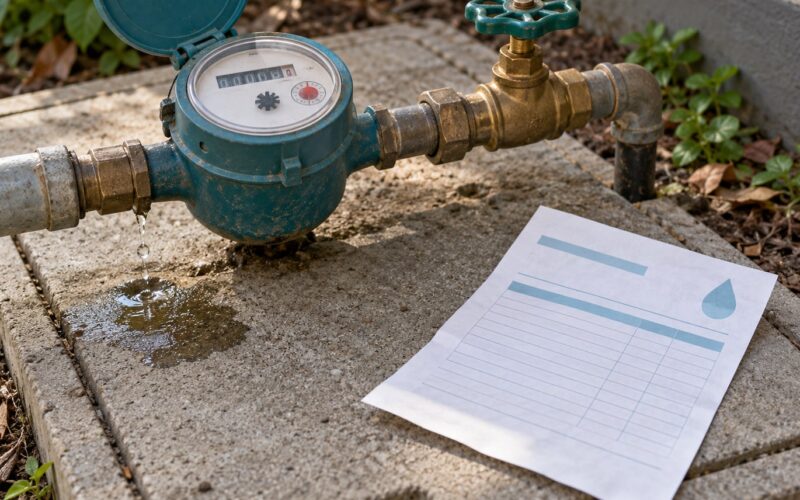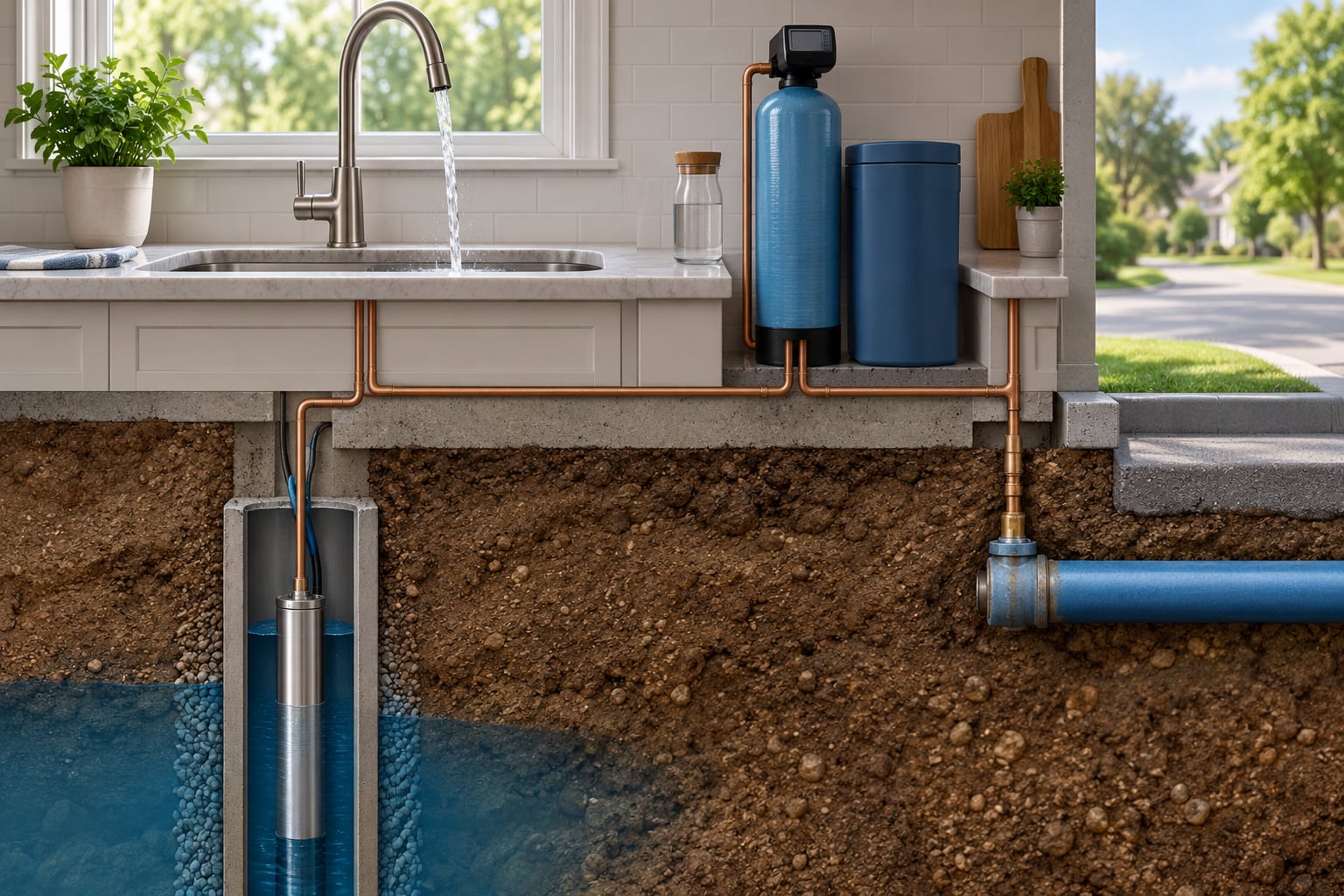
The well water vs city water differences come down to one thing: responsibility. City water is treated and monitored by a public utility that publishes an annual report, while well water is pumped straight from an aquifer and every bit of testing and treatment falls on the homeowner. That split drives everything else you notice, from taste and hardness to your water bill and what happens during a power outage.
I have talked this through with homeowners on both sides enough times to know where the arguments get muddy. The honest answer is that neither source is automatically safer or better. A properly maintained well in a clean aquifer can beat a municipal supply, and a neglected well next to a good utility connection can absolutely be worse.
Here is how the two actually differ, where the real differences live, and what to look at when you are deciding.
Table of Contents
- Well Water vs City Water Differences at a Glance
- Where the Water Comes From
- What does an aquifer actually mean?
- Water Safety and Contaminant Testing
- What to test for and when
- Taste, Odor, Color, and Household Use
- How to reduce city water taste at home
- Water Pressure, Flow, and Reliability
- Treatment and Maintenance Needs
- Shock Chlorination, in Brief
- Cost, Ownership, and Control
- Which Should You Choose?
- Frequently Asked Questions
- Is well water safer than city water?
- How often should private well water be tested?
- Does municipal water need testing if the utility treats it?
- Can well water cause plumbing problems?
- Is city water always softer than well water?
- What should a home buyer ask about an existing well?
- Conclusion
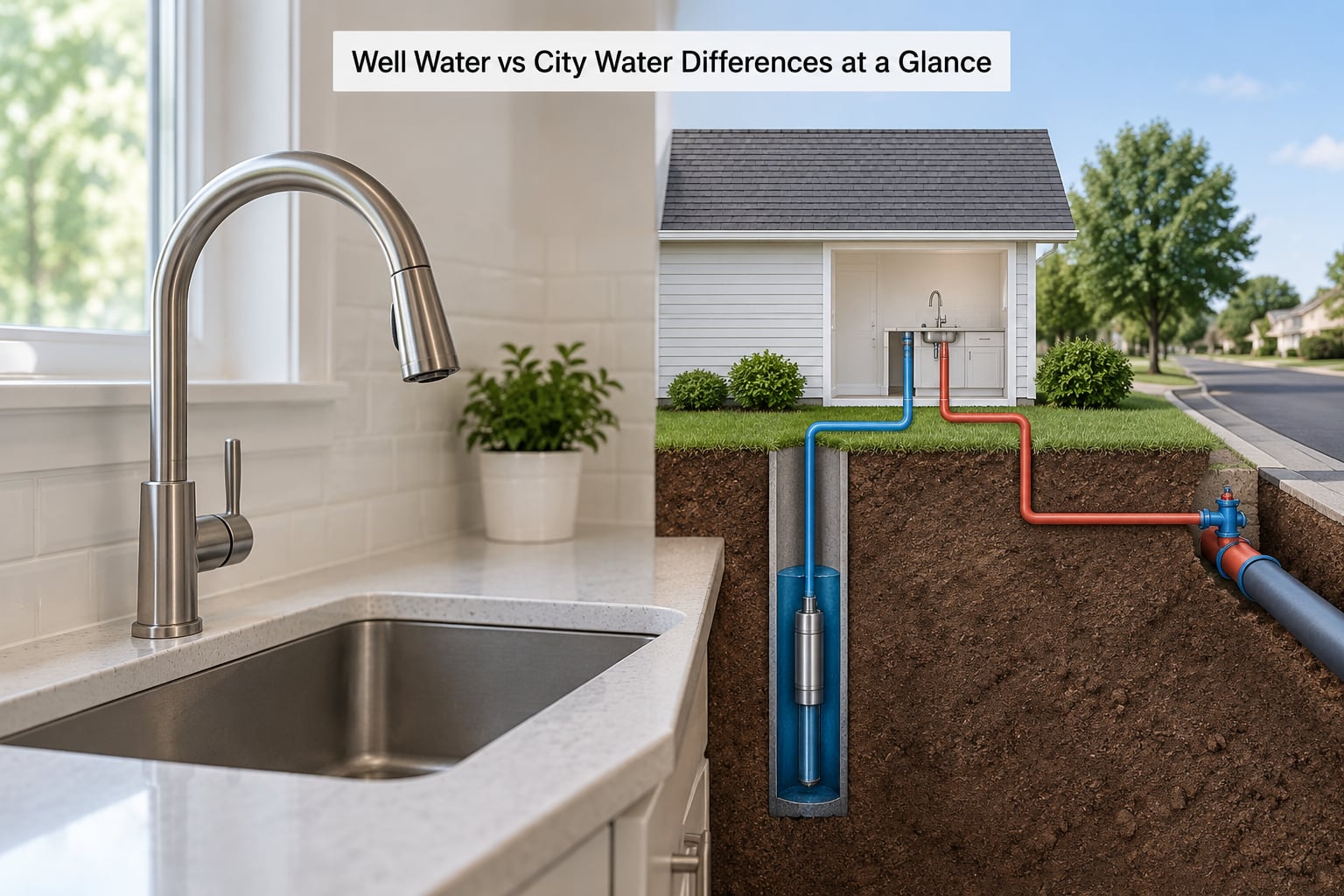
Well Water vs City Water Differences at a Glance
| Factor | Well Water | City Water |
|---|---|---|
| Where it comes from | An aquifer under your property, pumped to the house | Surface water or groundwater treated at a municipal plant, then delivered through public mains |
| Who owns the supply | You own the well, pump, casing and every treatment device | The utility owns the plant, mains and treatment equipment |
| Who monitors quality | You do, on your own schedule, through a certified lab | The utility, under federal rules, with a published annual report |
| Treatment responsibility | Entirely yours: filtration, disinfection, softening, testing | Centralized at the plant; households may add softening or a drinking filter |
| Hardness and minerals | Often hard, set by local geology; some aquifers are very soft | Varies by municipality; surface sources tend to be softer |
| Taste and odor | Rotten egg sulfur, metallic iron, or a flat mineral taste, depending on the well | Often a faint chlorine or swimming pool taste from the disinfectant residual |
| Testing | Recommended at least annually, and after floods, repairs or any change in taste | Routinely tested by the utility; individual testing is optional but allowed |
| Cost structure | Upfront drilling and equipment, then salt, filters, electricity and periodic testing | A predictable monthly utility charge plus any home treatment you choose |
| Reliability | Your pump and pressure tank decide; a power outage can stop your water | Utility-managed, though outages still happen and pressure varies by neighborhood |
| Plumbing impact | Scale, iron staining and sediment can reach every fixture and appliance | More consistent, with far less sediment; minerals still build up in hard areas |
Where the Water Comes From
Well water is groundwater. A drilled or dug well reaches down into an aquifer, and a pump lifts that water to the surface without much more than a strainer and some pipe in the way.
Because the water sits in rock and soil for years, it dissolves whatever that formation contains. Water moving through a limestone belt picks up calcium and magnesium. Water sitting near iron-rich deposits picks up iron and manganese. Water near certain granitic or uranium-bearing geology can pick up radon and uranium, and water near agricultural land can pick up nitrates from runoff.
City water starts as raw water too, either from a reservoir, river, lake or a utility well field, and then goes through a treatment plant. Coagulation, filtration, and disinfection happen there, with chlorine or chloramine added so that water stays protected all the way through the distribution system and into your glass.
Local geology decides hardness far more than well versus city does. Plenty of municipal systems in the limestone belt deliver very hard water, and plenty of rural wells in sandy coastal regions deliver soft water. If someone tells you city water is always softer, that is a generalization, not a rule.
What does an aquifer actually mean?
An aquifer is a body of permeable rock or sediment that holds and moves groundwater. It is the storage tank your well taps into, and its chemistry is set by the material the water has been filtering through for centuries.
Water Safety and Contaminant Testing
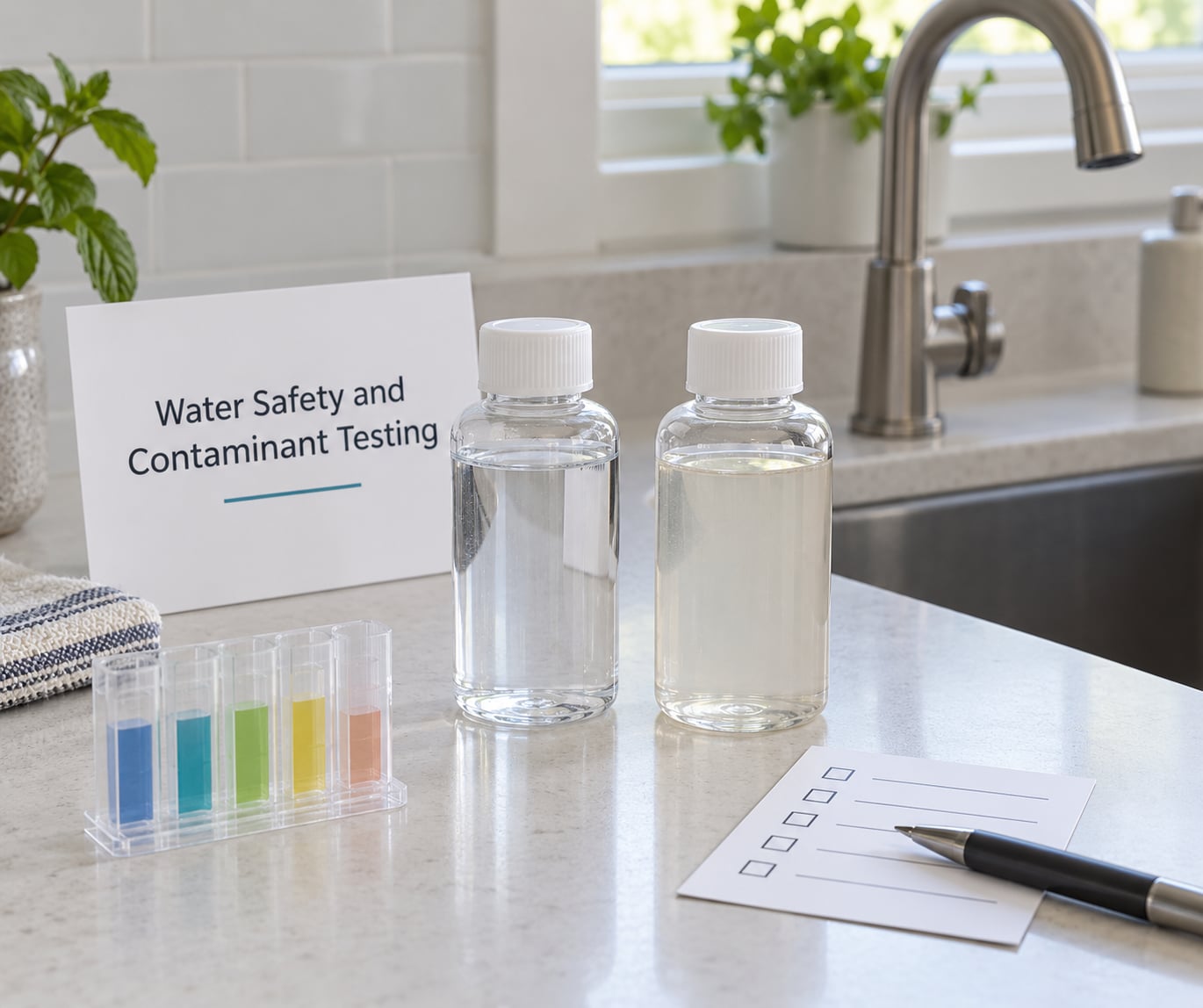
This is the largest genuine gap between the two sources. Public water systems operate under the federal Safe Drinking Water Act, which sets national standards for contaminants and requires monitoring on a schedule. Every community system must operate under state oversight, and each publishes a Consumer Confidence Report that lists what was tested and the results.
Private wells sit outside that system entirely. Roughly one in seven US households drinks water from a private well, and no federal or state agency tests it on the homeowner’s behalf. Recommendations generally point to testing at least once a year for total coliform and E. coli, with additional panels for nitrates, arsenic and locally relevant contaminants such as radon or PFAS.
Test more often than the yearly minimum when something changes. A flood, a nearby construction project, a septic system failure, a new farm field nearby, a well repair, or a sudden change in taste, odor or color all deserve a fresh sample.
What to test for and when
Coliform and E. coli screen for fecal contamination. An E. coli result is serious, and the standard response is shock chlorination of the well plus follow-up samples until clean.
Nitrates matter for infants and pregnant people. Current federal guidance treats nitrate above 10 milligrams per liter as a concern, and wells near agricultural runoff, fertilized lawns or septic fields are the usual suspects.
Arsenic has no smell, no taste and no color, which is exactly why it is tested for rather than noticed. Radon is a gas that comes off the water and can collect in basements, so ventilation matters when it shows up in a panel.
PFAS has moved to the center of groundwater discussion as federal monitoring requirements tightened. If your area has documented contamination, include it in the panel. Municipal customers can often track the utility’s PFAS numbers through the Consumer Confidence Report, while well owners find out only by testing their own water.
Use a state-certified laboratory. Household test strips and mail-in kits are useful as a screen, and homeowners on forums keep pointing out that a cheap strip cannot tell you whether arsenic is present at a concerning concentration.
Householders who moved into a well property told forum threads the same story: nothing was wrong until green stains appeared in the tub or the water started smelling like eggs. Testing in the first month answers those questions before they turn into plumbing bills.
Taste, Odor, Color, and Household Use
Taste is where most people notice the switch between the two, and taste is driven by what the water picked up underground. A rotten egg smell in well water is hydrogen sulfide, harmless at drinking concentrations in most cases but impossible to ignore. Sulfur bacteria that live in iron-rich well plumbing produce the same odor.
Orange or rust-colored stains point to dissolved iron, which oxidizes into rust the moment it hits air. Clear water that leaves rust-colored rings in a toilet or a shower is a classic private-well signature.
City water carries a different signature. The faint swimming pool taste most people describe is the disinfectant residual the utility leaves in the water on purpose so it stays protected through the pipes. It is a sign the system is working, not a sign something is wrong.
Hardness shows up in the house rather than the glass. On well water, laundry comes out stiff and faded, soap stops lathering until you add more, hair feels coated after a shower, and glasses come out of the dishwasher spotted. Softened well water users consistently report using noticeably less soap and getting better laundry results.
City water avoids most of that, though hard municipal supplies still produce scale inside the water heater and on fixtures.
How to reduce city water taste at home
Let a glass of tap water sit uncovered for a short time, which lets the volatile chlorine dissipate. A refrigerator-side carbon filter or a carbon-block filter at the tap takes more of it out. Boiling does the same thing for a kettle, and it is the cheapest fix available.
Water Pressure, Flow, and Reliability
Municipal systems deliver pressure from the utility’s pumps, and household pressure usually stays within a comfortable range. When pressure is low, the cause is usually a main, a meter, a pressure reducing valve, or a developer setback that limited the original line sizing.
A private well produces no pressure of its own. A submersible pump pushes water into a pressure tank, and that stored air pushes water back out when you open a tap. That means your flow rate depends on how deep the well is, how good the aquifer is, and whether the pump and tank are sized for the house.
The result is that well service stops when electricity stops, unless you have a generator. Owners also deal with pump replacement on a ten to fifteen year cycle and with tank pressure switches that fail. During a power outage, most well households have no water at all.
Municipal customers keep water during most outages because the water is already in the main, though a municipality can shut off supply during a treatment failure or a main break. Both sources have a failure mode; one needs a generator and the other needs a city.
Reliability also depends on the aquifer. Sustained drought can lower the water table in some areas and reduce well yield. Flooding near a well can let surface water, septic effluent or agricultural chemicals into the aquifer. Those risks belong to the property, not to the pipe material.
Treatment and Maintenance Needs
A public utility handles coagulation, filtration and disinfection for every customer at once. At the house, municipal customers typically add just two things: a softener if the local supply is hard, and possibly a drinking-water filter at the kitchen sink.
Private-well owners build the treatment chain themselves, and it usually starts with what the water actually contains. A whole-house sediment filter catches sand and grit. An oxidation filter handles dissolved iron. A softener swaps calcium and magnesium for sodium, which fixes scale, soap use and laundry problems in one move.
For drinking and cooking, reverse osmosis at the kitchen sink removes a broad range of dissolved solids including heavy metals. If bacteria are a concern, ultraviolet disinfection or an activated carbon filter handles that job instead. Chlorine injection is the utility approach, and well owners can shock chlorinate the well after a repair.
Shock Chlorination, in Brief
Shock chlorination means pouring household bleach into the well and running it through the plumbing, then flushing every tap until the chlorine smell fades and repeated tests come back clean. It is the standard fix after flood exposure, a failed E. coli result, or a repair that opened the well to the surface.
What municipal water usually does not need is any of this. The treatment happens once, at scale, and the household inherits the result.
Cost, Ownership, and Control
The cost comparison is more complicated than a water bill against nothing. Well owners avoid a monthly utility charge but pay for drilling or the well casing up front, plus softener salt, filter cartridges, pump electricity, annual lab testing and repairs over the life of the equipment. Prices vary widely by region, depth and geology, so the honest move is to get local quotes rather than trust a national average.
City water customers pay a predictable monthly charge that covers treatment, mains, monitoring and repairs. They may add a softener or a drinking filter, but they do not fund the plant.
Ownership is the other half of the ledger. Owning a well means owning the decisions: which filter, which media, which lab, and whether the pump gets serviced now or next season. That control is genuinely valuable to people who dislike drinking water someone else chose to treat, and it is genuinely heavy when something fails at 10pm.
Owners weighing the bill keep asking the same question on investor and DIY forums, whether the savings on the water bill survive the salt, the filters and the electricity. Sometimes they do, sometimes they do not, and the answer depends entirely on the aquifer and how much treatment that water needs.
Which Should You Choose?
Choose well water when the property has a proven, producing well in an area with a clean aquifer and you want control over what happens to your water. You accept the testing, the equipment upkeep and the fact that a power outage means no water.
Choose city water when reliable, consistent pressure and a treatment chain you do not have to maintain matter more than control. For most households, especially anyone without a drillable property or a maintenance budget, the utility handles a complicated job at a scale no homeowner can match.
Renters with well water have limited options. Installing a softener or a whole-house filter usually requires the landlord’s permission, so pitcher filters, boiling and a faucet mount are the realistic moves. It is worth raising the issue with the landlord in writing if the water has an odor, staining or a known contaminant history.
Buyers evaluating a home with a well should ask for the recent test results before the inspection period closes, the age of the well casing and pump, the size and condition of the pressure tank, whether a filter or softener is already installed, whether the well sits inside the required setback from the septic system, and how the property fared during recent flooding. A well that has gone untested for years is not automatically a problem, but it is a line item.
You can also run both. Properties near a municipal main can sometimes keep the well for irrigation, car washing or an outdoor spigot and connect to city water for everything indoors. Plumb it so a backflow-preventing device keeps the two supplies from mixing, and have a licensed plumber do the work. People who make this switch usually notice the difference in laundry and staining within a month.
Frequently Asked Questions
Is well water safer than city water?
Neither is automatically safer. Municipal water is treated and monitored against federal standards and reported publicly, while well water is only as good as the aquifer and the last test you ran. A well in a clean aquifer with annual coliform testing can be excellent; a neglected well next to a septic field can be worse than the city supply in the same county.
How often should private well water be tested?
At least once a year for total coliform and E. coli, with a fuller panel for nitrates, arsenic and anything relevant to your local geology. Test again after flooding, well repairs, nearby construction, a septic system failure, or any sudden change in taste, odor or color. Keep the printed reports so a buyer can see the history later.
Does municipal water need testing if the utility treats it?
Not usually. Public systems operate under the Safe Drinking Water Act, test on a required schedule and publish a Consumer Confidence Report each year showing what was checked and the results. Home testing is still reasonable if you have a specific concern, such as older plumbing, a private well on the same property, or lead service lines in an older neighborhood.
Can well water cause plumbing problems?
Yes, especially hard well water. Calcium and magnesium build scale inside water heaters, dishwashers, ice makers and showerheads, which shortens appliance life and raises energy use. Dissolved iron leaves orange stains on fixtures and laundry. A softener handles hardness, an oxidation filter handles iron, and a sediment filter catches grit.
Is city water always softer than well water?
No. Hardness depends on the geology the water passes through, not on whether it arrives by well or by main. Utilities in the limestone belt deliver hard water, and some rural wells in sandy regions deliver very soft water. Ask the utility for a hardness figure or run a hardness test strip on both sources before you decide anything.
What should a home buyer ask about an existing well?
Ask for recent lab results, the age of the casing and pump, the condition of the pressure tank, any filtration or softener already installed, the setback distance from the septic system, and how the property handled recent flooding or drought. A licensed plumber or well contractor can run a flow and pressure check during the inspection window.
Conclusion
Start by identifying what you actually have. Check the utility’s Consumer Confidence Report if you are on city water, or pull a state-certified panel on the well, then look at hardness, iron, bacteria and anything your local geology is known for. From there the decision is simple: take on the maintenance and the control if you want them, take the utility if you would rather not.
Either way, the well water vs city water differences only matter once you know what is in your water, and that is one lab test away.