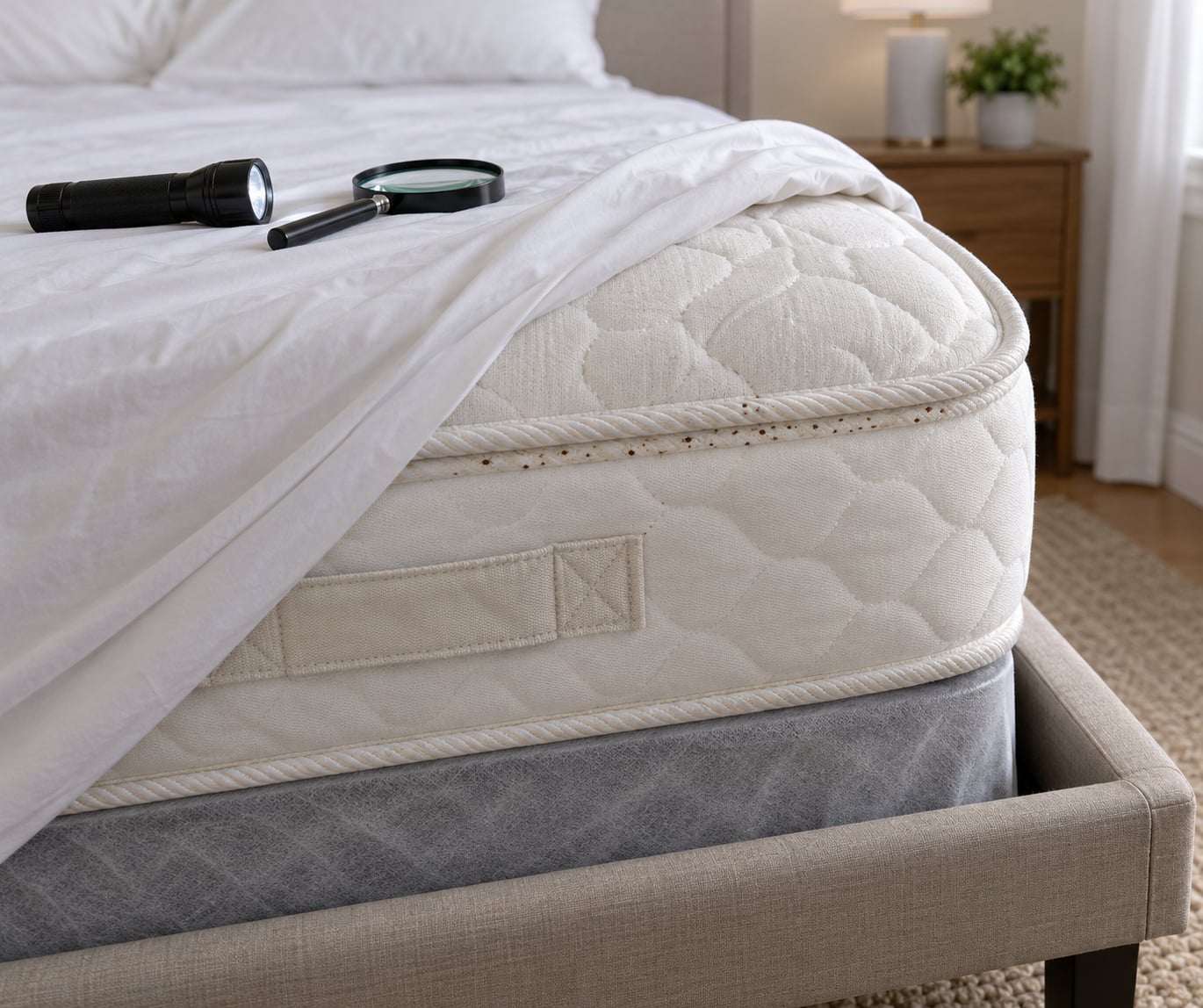
Bed bugs are nocturnal, so you rarely catch one in the act. What you find instead are the clues they leave behind on the fabric. The signs of bed bugs in a mattress usually show up as rusty or reddish blood stains, tiny black fecal spots that resemble marker ink, translucent shed skins, pale pearly eggs no bigger than a pinhead, and the reddish-brown insect itself, plus a faint sweet and musty odor once an infestation takes hold. A careful ten-minute inspection of the seams and box spring tells you far more than looking at your arms.
This guide walks through what each clue looks like, exactly where on the bed to search, how to rule out carpet beetles and dust mites, and when a phone call to a licensed pest control professional is the sensible next move. Nothing here diagnoses your skin or your home; it just tells you what to look at and how to judge what you find.
Table of Contents
- Signs of Bed Bugs in a Mattress at a Glance
- What Do Bed Bugs Look Like on a Mattress?
- Bed bug nymphs
- Bed bug eggs
- Shed skins and droppings
- Where to Look First on a Mattress
- 1. Piping, seams and tufting
- 2. Handles, tags and handles-side gaps
- 3. The underside and box spring
- 4. Bed frame, headboard and the wall gap
- 5. Nearby furniture
- What Signs Point to Bed Bugs Rather Than Dust or Dirt?
- Do Bed Bug Bites Mean the Mattress Has Bed Bugs?
- How to Check a Mattress Without Spreading Bed Bugs
- Before you start
- During the inspection
- After the inspection
- If you have been travelling
- When to Call a Pest Control Professional
- What to gather before the appointment
- What professional treatment usually involves
- Frequently Asked Questions
- How quickly would I know if I had bed bugs?
- Can a mattress with bed bugs be saved?
- How do I know if it’s bed bugs or carpet beetles?
- What if I slept in a bed with bed bugs?
- What kills bed bugs instantly?
- Conclusion
Signs of Bed Bugs in a Mattress at a Glance
Seven signs of bed bugs in a mattress matter most: rusty blood stains, black fecal spots, translucent shed skins, pale eggs and eggshells, live reddish-brown bugs, a musty odor, and unexplained bite marks on skin. Each one has a cause, and the causes stack. A crushed fed bug leaves a rust stain, its droppings dry to black dots, and its exoskeletons pile up in the same crevice it hid in during the day.
| Sign | Where it appears | What it looks like | What it means |
|---|---|---|---|
| Rusty or reddish stains | Sheet, mattress cover, along the head end | Dull rust or amber-colored smudges, sometimes a cluster | A fed bug was crushed or squashed while sleeping |
| Dark fecal spots | Seams, piping, mattress tags, box spring fabric | Black or dark brown dots like marker ink, sometimes ringed, smear when wet | Excrement from a feeding bug |
| Shed skins (exuviae) | Crevices in seams, tufting holes, under the box spring dust cover | Translucent pale yellow or brown flakes, empty and papery | Nymphs molted while growing |
| Eggs and eggshells | Seams, folds, mattress handle and tag area | Pearly white, about 1 mm, glued to fabric like a grain of salt | Active breeding nearby |
| Live bugs | Seams, folds, headboard joints, baseboards near the bed | Flat reddish-brown, about 4 to 5 mm, apple-seed sized, moves quickly | Confirmed, active infestation |
| Sweet musty odor | Close to the bed, worst near the head end | Faint coriander-like or stale sweaty smell | A larger population has been living and feeding there |
| Bite marks on skin | Arms, shoulders, neck, hands, sometimes lower legs | Red itchy bumps in a line or cluster of three to five | Possible bites, but not proof on their own |
One clue alone is weak. Two or three different clue types in the same area is a strong signal, and a live bug ends the debate entirely.
What Do Bed Bugs Look Like on a Mattress?
An adult bed bug (Cimex lectularius) is a flat, oval, reddish-brown insect roughly the size of an apple seed, usually 4 to 5 mm long, with no wings. Against light fabric its color shifts from tan to deep rust-brown as it digests a blood meal, which is why so many photos show a lighter and a darker bug side by side.
Bed bug nymphs
Nymphs are the juveniles, and they look like smaller, paler, more translucent versions of the adult. Because they are only 1.5 to 3 mm long, they slip into a seam without touching the surface, which is why a visual check of the mattress top tells you very little.
Bed bug eggs
Eggs are pearly white, roughly 1 mm, slightly oval, and laid upright in seams and folds with a drop of sticky residue gluing them to the fabric. A flashlight held at a low angle across the seam makes them flare white against dark cloth. Empty egg shells stay behind after a bug hatches, and they are pale, translucent, and often split open at one end.
Shed skins and droppings
The exuviae left behind by molting nymphs are hollow, pale amber, and about the same size as the nymph that shed them. They collapse into thin papery flakes that look like brown crumbs. Droppings start wet and dark, then dry into hard black dots with a faint halo, and they flake off easily.
Where to Look First on a Mattress

Bed bugs avoid light and prefer tight, sheltered gaps. Work from the bed outward, top to bottom, and let the beam of a flashlight travel along every seam so the shadow of a crack becomes visible. Ten focused minutes on the right surfaces beats an hour of staring at the mattress surface.
1. Piping, seams and tufting
Run the flashlight along the entire perimeter seam where the top panel meets the border. Check the two long seams, the two short seams, and the head and foot ends, then follow any tufting indentations, where buttons pull the fabric into a small pocket.
2. Handles, tags and handles-side gaps
The fabric handle on the side and the law tag sewn into the corner are classic hideouts. Look under the tag flap, along the handle stitching, and in the crease where the top panel tucks down over the border.
3. The underside and box spring
Flip or lift the mattress and check the dust cover, the corner support, and the underside of the box spring, including the fabric-covered frame. Forum readers on r/Bedbugs repeatedly name the box spring dust cover as the most-missed spot in a whole-room check, and on upholstered box springs you may have to cut the cover open to see inside.
4. Bed frame, headboard and the wall gap
Check screw holes, joints, slats and any gap between the headboard and the wall or baseboard. Bed bugs travel along seams and edges, so a bed that looks clean can still sit inside an infestation living in the frame.
5. Nearby furniture
Inspect the nightstand, dresser legs, electrical outlets, and any area within a few feet of the bed. If you find them there, the mattress is part of a room-wide problem, not a mattress-only problem.
What Signs Point to Bed Bugs Rather Than Dust or Dirt?
Most false alarms come from a brown speck nobody could identify. Dust, lint, fiber balls, dried food crumbs, rust from a water bottle or an old bolt, and carpet beetle debris all end up in mattress seams, so the test is not color alone but behavior, texture, and pattern. A black dot that smears wet brown is fecal spotting. A flake that crumbles into nothing is dust or lint. A translucent shell holds its shape and shows an outline of the bug that left it.
| Suspect | Size | Color and texture | Where you find it | Bites |
|---|---|---|---|---|
| Bed bug | Adult 4-5 mm, nymph under 3 mm | Flat reddish-brown, live bugs move fast | Seams, piping, box spring, headboard joints | Itchy red bumps in a line or cluster of three |
| Carpet beetle (Anthrenus scrophulariae) | Adult 2-3 mm, larva up to 8 mm | Brown mottled adult; hairy, bristly larva | Carpets, upholstery, baseboards, closet areas | Usually none; carpet beetles do not bite |
| Bat bug | Adult 3-5 mm | Very similar reddish-brown, flies quickly | Near bats, in the upper part of a room | Bites, and prefers exposed skin |
| Dust mite | Under 1 mm | Translucent, nearly invisible to the eye | Mattress interior and dust, not seams or bedding | No bites; feeds on shed skin |
| Flea | About 2-3 mm | Dark, sideways-compressed, jumps | Carpet near pets, lower legs | Itchy bites mostly on legs and ankles |
| Mosquito | About 4-6 mm | Grey and patterned, flies | Not a mattress sign; outdoors, standing water | Single scattered welts, outdoors or near open windows |
So can carpet beetles be mistaken for bed bugs? Yes, frequently, and the most common confusion is the larva. Carpet beetle larvae are covered in stiff bristles and are tan to brown, and unlike bed bugs they never hide tight against bedding seams. If you find bugs that are bristly and moving around open carpet, you are looking at carpet beetles. If you find a flattened, smooth, human-shaped bug pressed into a seam, you are most likely looking at a bed bug. When the evidence is ambiguous, seal the specimen in a sealed bag or tape it to a sheet of paper and let a pest professional or an extension entomology service identify it.
Do Bed Bug Bites Mean the Mattress Has Bed Bugs?
No. Bites are the least reliable of the seven signs. Bed bug bites are usually painless when they happen, and the reaction shows up hours later as itchy red bumps, often in a straight line of three or five, sometimes a scattered cluster on the shoulder, neck or hands. Some people react strongly and develop blisters, while most react mildly and a fair number notice nothing at all.
That variability is exactly why bites alone drive people into panic. Plenty of people who inspect their mattress and box spring thoroughly and find nothing still wake up with unexplained marks, and r/Bedbugs threads are full of that scenario. Environmental irritants, dust, detergent residue, other insects and dry skin all produce itchy bumps too.
There is also a timing delay. If you were exposed in a hotel a week ago, the bite you notice tonight may have happened last Tuesday. Bites typically appear within a few days to about two weeks of the original exposure, which means the room you slept in, not the bed you are inspecting tonight, is the place to investigate.
Waking with new bites is a reason to check the mattress, not a diagnosis. Judge the bed on physical evidence: stains, spots, skins, eggs, odor and live bugs.
How to Check a Mattress Without Spreading Bed Bugs
If there is any chance you have bed bugs, treat every surface you touch as contaminated until proven otherwise. You can move them between rooms on your clothes, your phone case and your luggage, and most new infestations start with exactly that kind of transfer.
Before you start
Put on disposable gloves or washable nitrile gloves, clear a path, and gather a bright flashlight, a magnifying glass, a credit card or stiff plastic tile for flexing seams, a white sheet or paper towel to catch debris, and clear tape in case you want to preserve a specimen. Do not move bedding, furniture or boxes out of the room first, because moving them is how a single-bed problem becomes a house-wide one.
During the inspection
Work from the least-infested area toward the bed, never the reverse. Avoid shaking, beating or vacuuming the mattress before you have photographed what is there, since a strong blast scatters evidence and can carry bugs into the air and onto nearby surfaces. Photograph each finding with something for scale, such as a coin, so a professional can judge size later.
After the inspection
Wash hands and any clothing you wore in hot water and dry on high heat, and leave shoes outside the room. Do not apply retail aerosol insecticides, foggers or DIY sprays to the mattress. In most states those products cannot be used for bed bugs, and they drive the population deeper into seams and into the frame, making the infestation harder and more expensive to treat.
If you have been travelling
Do the same inspection on the hotel or Airbnb bed before you leave the room, focusing on the head end and the underside of the mattress. When you get home, check your suitcase contents before unpacking clothes into a closet, and inspect a bag kept in the trunk before it goes inside. Travel is the single most common way an isolated bedroom infestation begins.
When to Call a Pest Control Professional
Call a licensed pest control company when the evidence reaches a confidence level you should not act on alone. One live bug, or two or more clue types found together in a seam, is enough to stop inspecting and start planning treatment. So is finding bugs on a frame, nightstand or baseboard, because that means the infestation is already in the room.
Here is a simple evidence ladder for deciding what to do next.
- One stain, one speck, or bites with no physical evidence: recheck in two weeks, wear long sleeves, and inspect the box spring dust cover properly.
- Shed skins plus black spotting, or eggs in a seam: take clear photos, then call a licensed pro for confirmation.
- Any live bug: contain the room today and book an inspection the same week.
- Signs in a second sleeping area or an adjacent apartment: call your building manager and a pest professional, because bed bugs move along shared walls and through floor and wall cavities.
What to gather before the appointment
Have photos with scale, the date you first noticed the signs, a travel or furniture-move timeline for the previous few months, and any specimen sealed in a bag or taped to paper. Tell the pro which beds, nightstands and adjoining rooms show signs. None of this replaces their inspection, but it makes it faster and more accurate.
What professional treatment usually involves
Most companies combine heat treatment, targeted non-repellent insecticide applied to seams and cracks, and an inspection schedule, often with two visits so they can recheck and treat newly hatched bugs. A mattress encasement is usually part of the plan rather than a standalone fix: left sealed on for about a year so the trapped bugs and eggs die of starvation, it can make the mattress usable again. Washing bedding at 60 degrees Celsius and running it through a hot dryer for 30 minutes kills bed bugs and eggs on fabric. U.S. Environmental Protection Agency guidance and university extension entomology services are the go-to references if you want the treatment details before you sign anything.
Frequently Asked Questions
How quickly would I know if I had bed bugs?
Bites usually appear within a few days to about two weeks of exposure, but some people never react at all. Physical signs show up sooner and last far longer: fecal spotting, rusty stains and shed skins accumulate as the bugs feed and molt, so they are still on the mattress months later. That is why an inspection is more reliable than how your skin feels the morning after a hotel stay.
Can a mattress with bed bugs be saved?
Often yes, especially if the infestation is caught early. A mattress encasement that seals completely traps bugs inside, where they cannot feed and eventually die, and it protects the new mattress you put on top. The encasement has to stay on long enough to cover a full lifecycle, roughly a year. Extensive staining, saturation or structural damage is the point where replacement makes more sense.
How do I know if it’s bed bugs or carpet beetles?
Carpet beetle larvae are bristly and tan, move around open carpet and upholstery, and do not bite. Bed bugs are smooth, flat, human-shaped and reddish-brown, and they hide pressed into mattress seams, piping, tags and box spring dust covers. If what you found is fuzzy or bristled, you are almost certainly looking at carpet beetles. If it is smooth and lives in a crack, get it identified before you treat anything.
What if I slept in a bed with bed bugs?
Wash or dry every item you took home on a high heat cycle, keep luggage out of closets until it has been inspected, and check the mattress, box spring and bed frame in the room you slept in. Bites you find in the morning usually came from the previous night or an earlier night, so treat the hotel or rental room as the likely source. Seal any specimen you find and pass it to a pest professional for confirmation.
What kills bed bugs instantly?
Nothing you can buy over the counter kills a whole infestation quickly, and this is where most DIY attempts go wrong. Aerosol sprays and foggers drive bugs deeper into seams and into the frame, and in most states they are not labeled for bed bugs. Heat treatment by a licensed professional, targeted non-repellent insecticide and a sealed mattress encasement are what actually remove the population. Skip the sprays and book the inspection.
Conclusion
Start with the seams: piping, tufting buttons, the handle and tag area, then the underside and the box spring dust cover, which is where people most often stop looking too early. Photograph anything you find next to a coin so size is readable, and keep that evidence. Do not move furniture or bedding out of the room, and stay away from aerosol sprays and foggers, which make things worse.
If you turn up a live bug, or you find two or more clue types together, contain the room and call a licensed pest control professional for an inspection. One confirmed bug in a seam is a very different job than a few stains, and catching it now is the cheapest fix available.