To dispute an HOA violation, work the process in order: read the notice, confirm the earliest deadline it sets, pull the exact rule from your governing documents, request the HOA’s evidence, then file a written appeal and request a hearing. Every step must be in writing and on time, because the deadline usually matters more than the argument.
Most homeowners lose an appeal they could have won. They reply by phone, argue about fairness instead of the rule, or wait for a friendly conversation that never comes. This guide walks through the sequence so nothing gets skipped, including what to gather before you respond.
The rules themselves come from your community’s declaration of restrictions, also called the CC&Rs, plus the bylaws and any recorded rules. Your state’s statute may add a mandatory mediation step the HOA never mentioned, and those requirements change from state to state.
Table of Contents
- What You Need
- How to Dispute an HOA Violation Step by Step
- Review the violation notice and deadline
- Check the governing documents and applicable laws
- Gather evidence and prepare a written response
- Request a hearing or formal review
- Escalate the dispute if the problem remains unresolved
- Common Mistakes
- Frequently Asked Questions
- How long do I have to dispute an HOA violation?
- Can I contest an HOA fine without appearing at a hearing?
- Should I send my HOA response by email or certified mail?
- What evidence is useful when disputing an HOA violation?
- Can an HOA retaliate because I challenged a violation?
- Do HOA fines have to follow the community’s written rules?
- Conclusion
What You Need
Gather these before you write a single sentence back. Rushed responses are the most common reason an appeal fails on procedure rather than merit.
- The notice itself, plus the envelope. Postmark dates and delivery confirmation often decide which deadline applies.
- The declaration (CC&Rs) and bylaws. Most associations post them on the resident portal or send them on request, and the recorded version is also available from the county recorder.
- The fine schedule or rulebook, if one exists. Not every association has one, and its absence is worth noting in your appeal.
- The appeal clause. This is the paragraph that tells you the deadline, the required delivery method, and who decides.
- Evidence of compliance: dated photos, contractor invoices, written opinions, measurements, prior approvals, repair records.
- A calendar, because the real deadline is often earlier than the one printed in bold.
- A contact log, so every call, email and certified letter is recorded with a date and a name.
How to Dispute an HOA Violation Step by Step
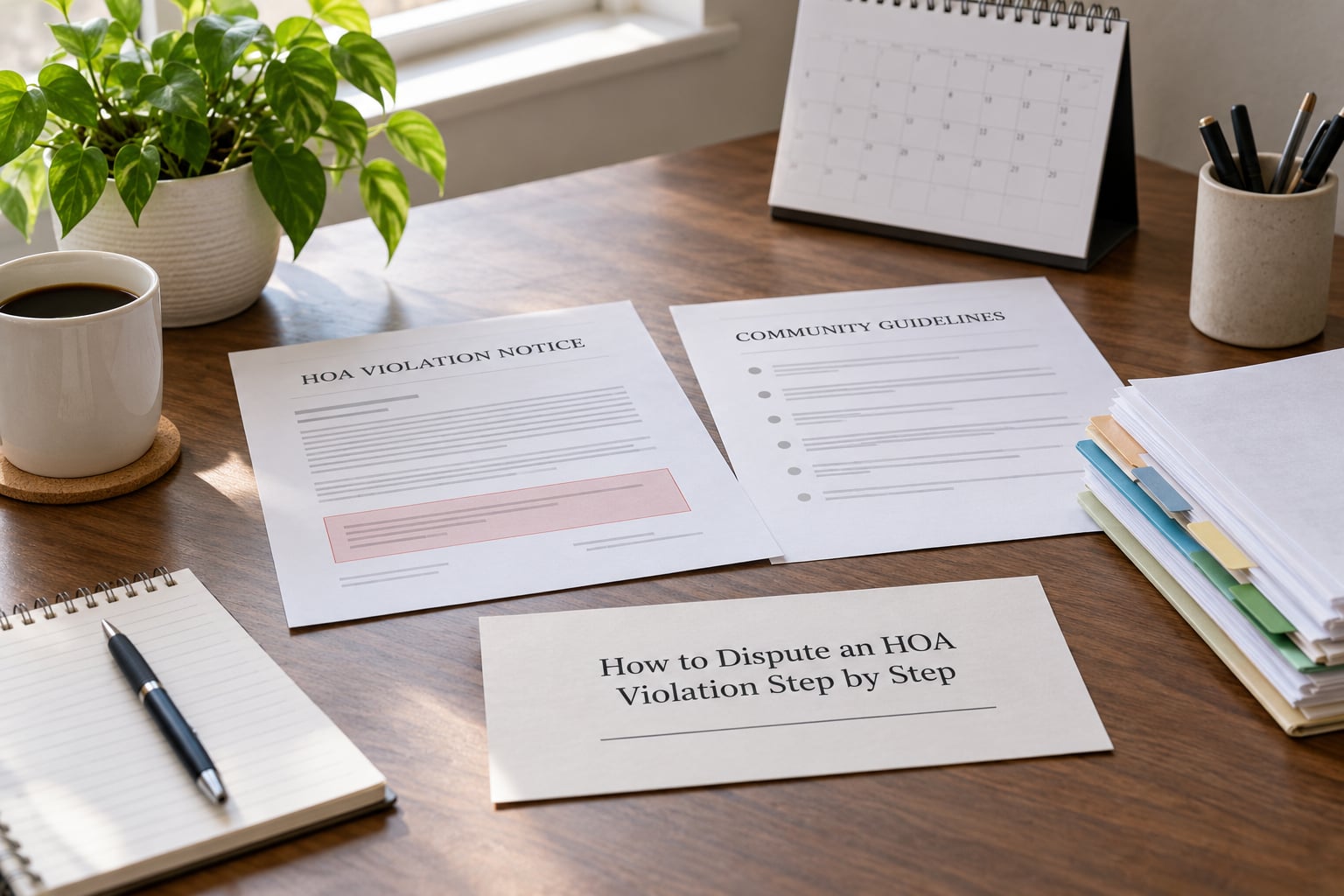
Homeowners who follow this order tend to resolve more disputes at the board level than homeowners who skip to arguing. Each step feeds the next.
Review the violation notice and deadline
Read the notice line by line and pull out five things: the specific rule cited, the date the notice was issued, the cure or compliance deadline, the deadline to request a hearing, and the required delivery method for any response.
Vague notices are the single most common complaint in homeowner forums. Letters arrive with no covenant section number, no photographs, and wording like “unapproved exterior condition.” If your notice does that, say so in your response in one sentence and ask for the missing specifics. Do not accuse anyone of bad faith; just request the information.
Your real deadline is the earliest of three dates: the date printed on the notice, the date in the appeal clause of your governing documents, and any date your state statute sets. When they conflict, use the earliest. Forum threads show homeowners routinely discovering a 14 or 30 day window only after it closed.
Check the governing documents and applicable laws
Now find the rule itself. Search the CC&Rs for the topic, not just the phrase in the notice. Landscape rules often live in a design guidelines document that only exists in the resident portal.
Write down the section number and the exact wording. That single citation does more work in an appeal than any argument about fairness. Then check four other things: whether a fine schedule sets a maximum amount, whether a cure period is required before a fine attaches, whether the appeal procedure names who hears it, and whether rules were changed after your purchase in a way that was not properly voted on.
Finally, check your state. Several states require the parties to attempt mediation or arbitration before anyone can file a lawsuit. California points to Civil Code Section 5930, Florida to Sections 720.311 and 718.1255 for different kinds of disputes, and Indiana’s Homeowners Association Act added its own requirement. If your state mandates a step you skip, your case can be dismissed.
Gather evidence and prepare a written response
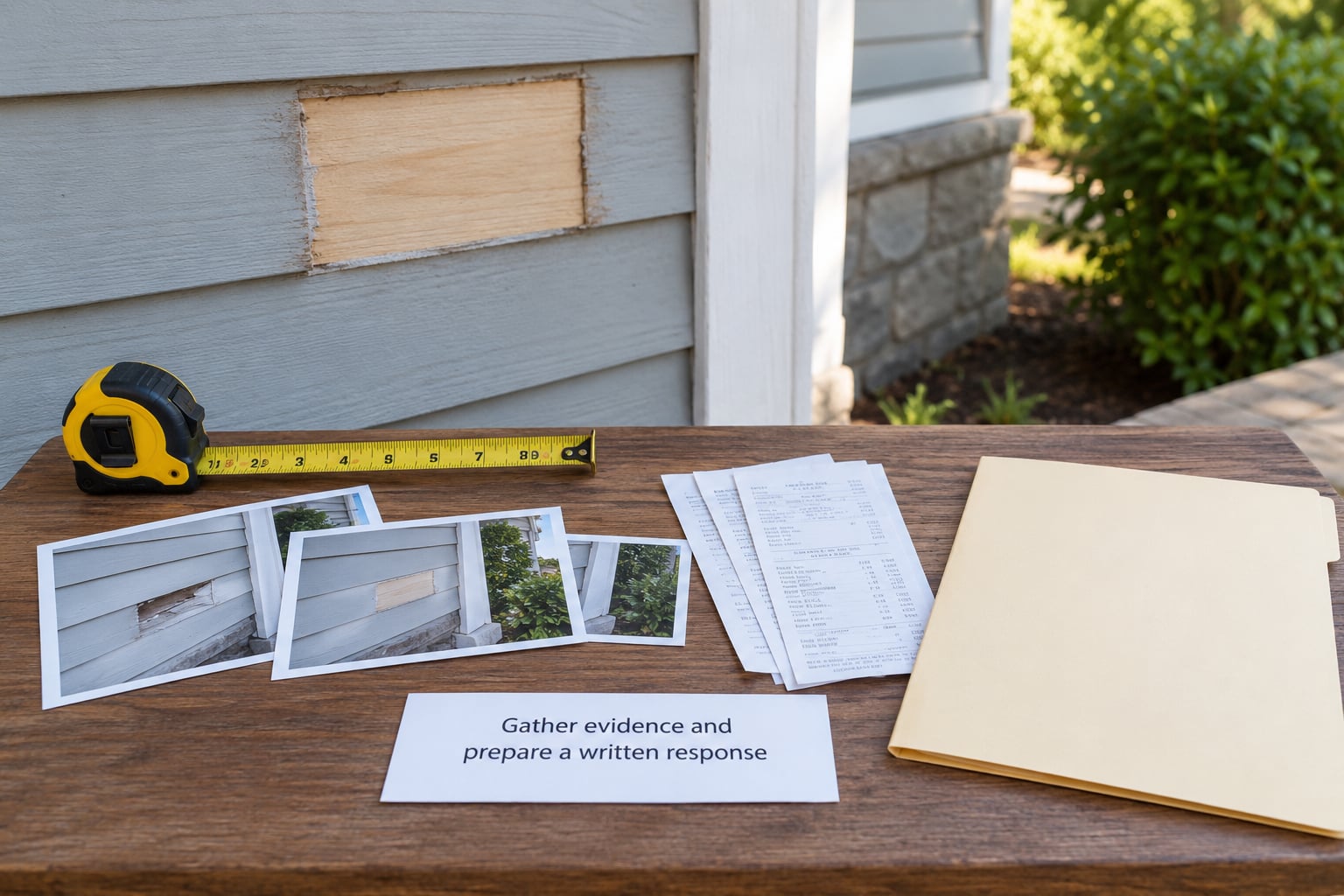
Build a single folder that travels with you to every meeting. Include dated photographs with the date visible, contractor invoices, written opinions from a qualified professional when the dispute is factual, and any prior architectural approval you were given. Homeowners who attach a contractor’s written opinion on factual questions like grass height, paint matching, or shed specifications tend to get faster resolutions.
Your written response should be short and flat in tone. A workable structure: identify yourself and your property, state the notice date, state that you dispute it, cite the section of the governing documents you rely on, describe the facts in two or three sentences, attach evidence, request a hearing by a specific date, and ask for written confirmation of receipt.
That last line matters more than people expect. Without proof of delivery, disputes turn into conversations about whether a letter existed. Send it by the method the documents require, keep the copy, and keep the delivery receipt.
Request a hearing or formal review
Requesting a hearing early, before anyone escalates tone, is the approach homeowners most often report working best. One r/HOA user described appealing a trash container violation in a calm written letter and having the board waive it.
Before the meeting, ask for the agenda and the packet. At the meeting, keep to three minutes: the rule, the facts, the relief you want. Relief can be a waiver, a reduced amount, an extension of the cure period, or removal from the record. Asking for a lesser remedy than a total win often gets you the lesser remedy.
Take notes and ask for the meeting minutes afterward. Ask whether you may record, and get the answer before anyone speaks. Recording rules, including whether all participants must consent, vary by state and your association’s own rules.
Escalate the dispute if the problem remains unresolved
If the board upholds the decision or the association goes silent, move up one rung at a time. Jumping straight to court usually fails and costs the most.
| Option | What it involves | Relative cost | Typical timing |
|---|---|---|---|
| Second-level written appeal | Written request to the board or to the full membership, citing the original record | Free | Weeks |
| Mediation with a neutral third party | A mediator facilitates a settlement; typically required before suit in several states | Moderate, split between the parties | A few weeks to a few months |
| Arbitration | A neutral decides the issue and the decision is usually binding; required in some states for certain disputes | Moderate to high | One to three months |
| Small claims court | For unpaid fines or assessments, subject to the amount limit in your state | Low, plus filing fees | Weeks to months |
| Civil lawsuit | For injunctions, specific performance, or damages; usually raises the risk of attorney fees shifting to you | High | Months to a year or more |
Two things to keep in mind here. If your state requires mediation or arbitration first, you usually cannot skip it. And check your governing documents for a prevailing party attorney fees clause, because it can mean that losing costs you more than the fine itself. Rules vary by state and by community, so treat this ladder as a map rather than advice.
Documentation matters most if you ever reach the top rungs. Board meeting minutes, the fine ledger, the notice photographs, the rule text, and your own dated correspondence form the record that decides most disputes without a judge.
Common Mistakes
Each of these shows up again and again, and each one is avoidable.
Ignoring the notice. Silence is the one response that guarantees the outcome. Even a short letter saying you request a hearing preserves your position.
Appealing by phone. Call conversations produce no record. An oral appeal simply disappears, and the association will treat the deadline as unmet.
Sending the response the wrong way. If the appeal clause requires certified mail, hand delivery, or a portal submission, email alone may not count. Follow the clause exactly and keep the receipt.
Attacking a board member personally. You will still live next to them. Argue about the rule and the record, never about a person’s motives.
Refusing to pay while arguing. Withholding a fine in the hope it disappears can escalate to a lien on the property. Where the documents allow, pay under written protest and keep the receipt, then continue the dispute. If they do not allow it, get local advice before doing anything.
Keeping nothing. No copies, no dates, no delivery receipts. Save everything the day you receive it.
Frequently Asked Questions
How long do I have to dispute an HOA violation?
Most associations give 14 to 30 days, and your appeal clause or state statute may set a different window. Treat the earliest of the three dates as your real deadline: the date printed on the notice, the date in your governing documents, and any statutory deadline. Miss it and your right to contest usually narrows sharply, even if the underlying complaint is weak.
Can I contest an HOA fine without appearing at a hearing?
Often, yes. A written appeal with supporting documents can be decided on the record by the board without a meeting, and many associations allow a hearing to be conducted in writing or by phone. Ask for the option explicitly in your response. If the governing documents require a hearing, request one and confirm that the association will confirm your appeal in writing instead.
Should I send my HOA response by email or certified mail?
Use whatever method your appeal clause requires, which is often certified mail or hand delivery. Email alone can fail to satisfy a clause that names a delivery method, so send it the required way even if you also email a copy. Keep the certified receipt or hand-delivery confirmation; it is your proof that you responded on time.
What evidence is useful when disputing an HOA violation?
Dated photographs showing the compliant condition, contractor invoices and written opinions for factual disputes, prior architectural approvals, repair records, and your own dated correspondence. Where the dispute turns on a measurable fact such as paint color, shed dimensions, or lawn height, a qualified contractor’s written opinion attached to the appeal tends to move a board more than argument does.
Can an HOA retaliate because I challenged a violation?
Retaliation for exercising your rights is generally prohibited, and several states have specific statutes covering it. Proof is the hard part, so keep a dated log of every interaction and note any change in treatment after you appealed. Report concerns in writing to the board or the management company, and raise retaliation as its own issue rather than mixing it into your original appeal.
Do HOA fines have to follow the community’s written rules?
They generally do. A fine usually has to trace back to a covenant, rule, or fine schedule that existed and was properly adopted before you were cited, and the amount usually has to fall within whatever limit those documents set. If the notice cites no rule, or the amount exceeds the written schedule, that is a real argument. Ask for the rule text and the fine schedule in your records request.
Conclusion
Start with the notice in front of you, not with the argument in your head. Write the deadline down, pull the exact rule from your governing documents, assemble your dated evidence in one folder, and send a calm written response through the delivery method the documents require.
That sequence is how to dispute an HOA violation without giving up the process. Ask for a hearing early, keep a copy of everything, and escalate one rung at a time only if the board declines to act.