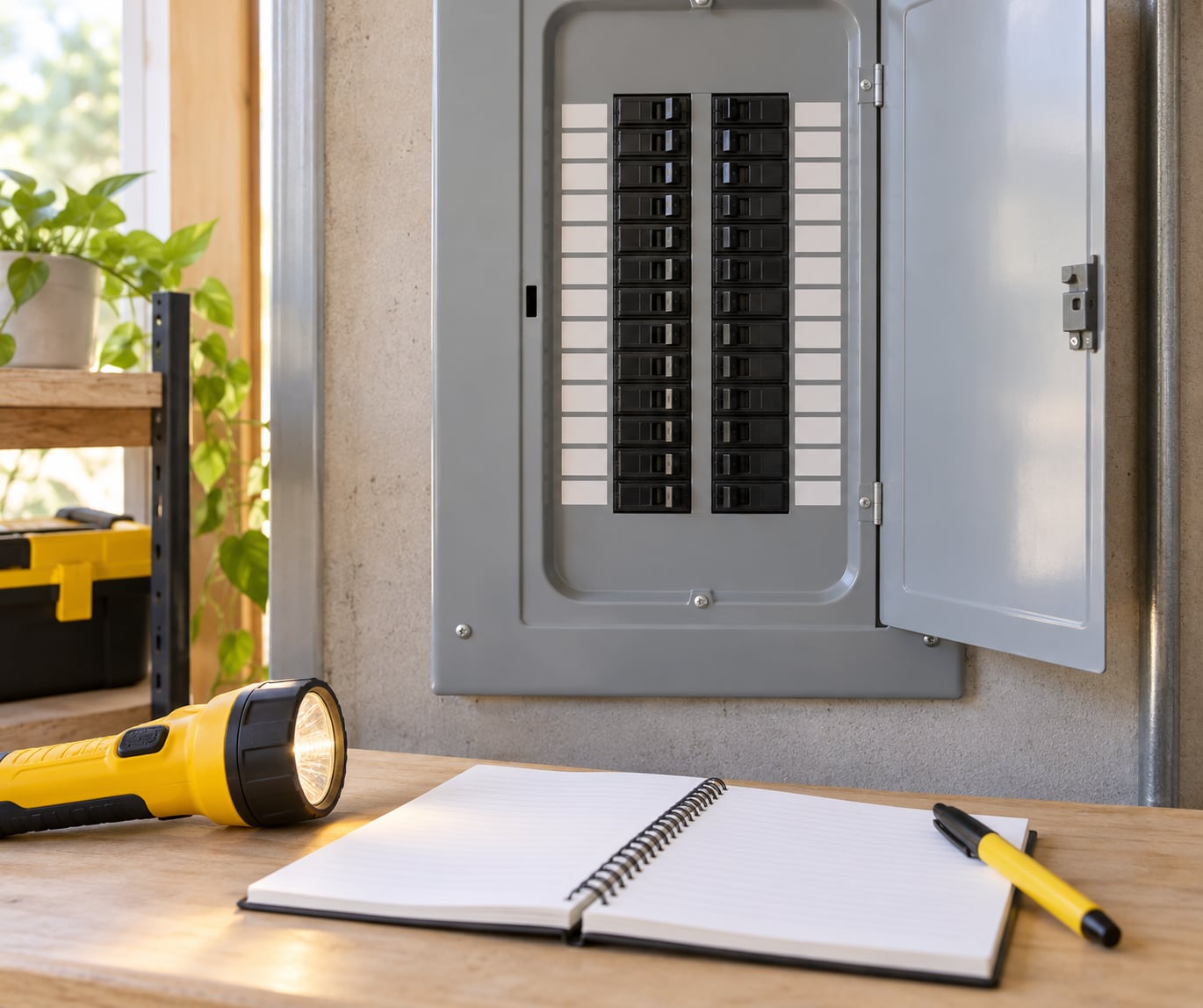
Labeling a breaker panel is mostly observation: you switch off one breaker at a time, find out which outlets and fixtures go dark, and write that answer next to the breaker number. When you finish, the panel door carries a directory that tells you exactly what to flip, and a wall switch or dead outlet is a two-minute fix instead of an hour of guessing.
Budget about an hour if the panel has decent labels to start from, and closer to three if the breakers are bare. You don’t need to move any wiring, but you do need to treat everything inside the panel as live, and there are a few situations where the right move is to stop and call a licensed electrician.
Table of Contents
- What You Need to Label a Breaker Panel
- Step-by-Step: How to Label a Breaker Panel
- How to Identify Each Breaker Without Guessing
- How to Write Clear and Durable Circuit Labels
- How to Create and Update the Panel Directory
- How to Verify the Labels and Restore Power Safely
- Common Mistakes When Labeling a Breaker Panel
- When to Stop and Call a Licensed Electrician
- Frequently Asked Questions
- Does the main breaker have to be off to label a breaker panel?
- How do I label a breaker panel that already has confusing labels?
- What if one circuit serves several rooms?
- Are handwritten labels acceptable for an electrical inspection?
- When does labeling require a licensed electrician?
What You Need to Label a Breaker Panel
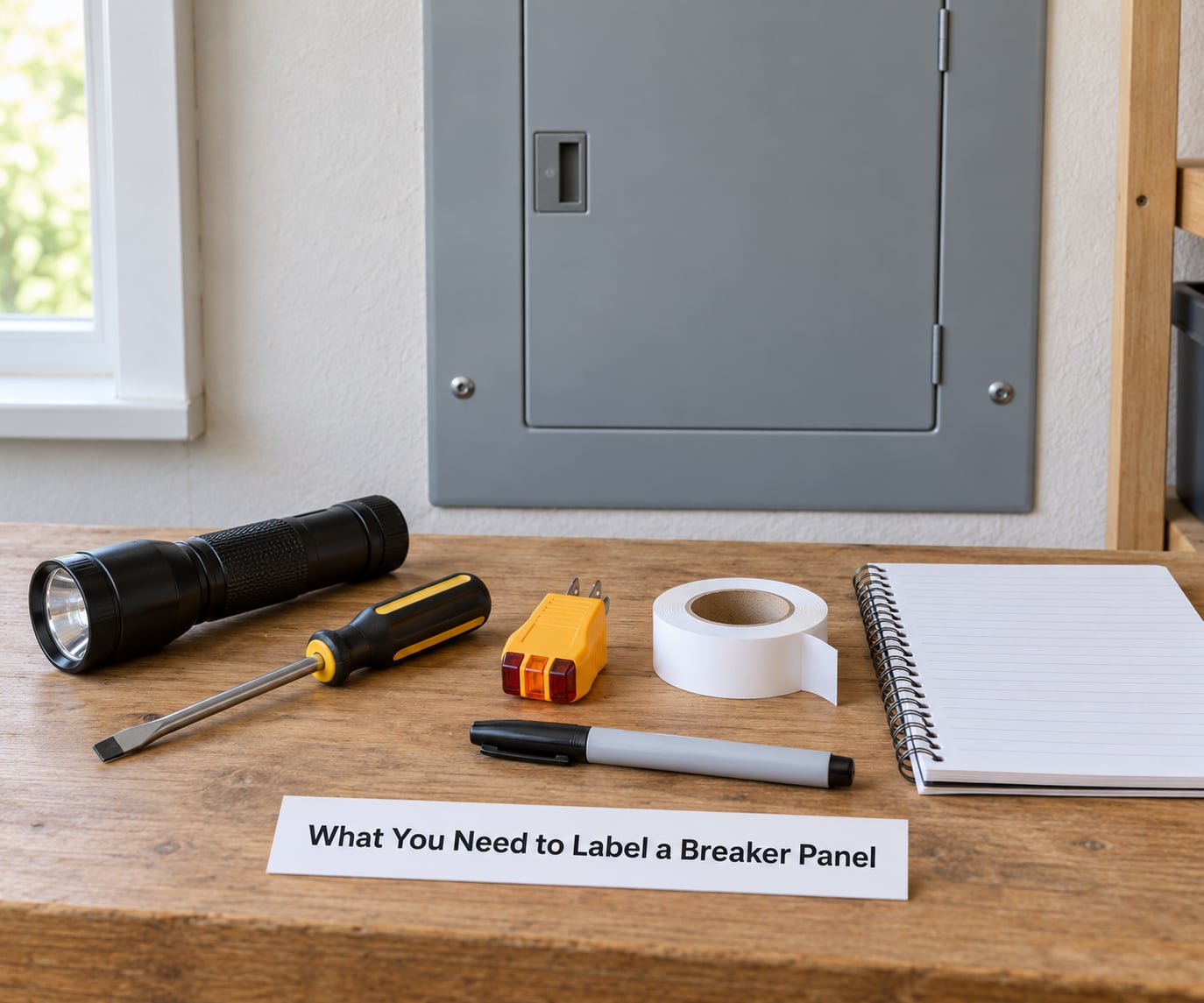
You can label a breaker panel with a flashlight and a notebook. Everything else on the list makes the job faster or the result last longer than two rainy summers.
- A bright flashlight or headlamp. Panels live in closets, garages and basements, and the top row sits in shadow. A headlamp frees both hands.
- A plug-in receptacle tester. This is the cheapest and most reliable way to know an outlet has power. A non-contact voltage tester confirms a conductor is de-energized before you touch anything.
- A flat-blade or Phillips screwdriver. Many panels have a plug-in style cover over the directory, and older ones have a hinged door held by screws. You often don’t need to remove the outer deadfront at all.
- A notebook or your phone’s notes app. Paper beats a phone for a two-hour mapping job, because you flip pages fast.
- Label tape or printable labels. White vinyl from a label maker, or printed strips run through a laminator, both outlast the paper stickers that peel off in a damp garage.
- A permanent marker for marking wire jackets and for any quick fix you have to make mid-session.
- A rough floor plan of the house, even a napkin sketch. Drawing the rooms helps you remember that a circuit you found in the laundry also feeds the hallway closet.
Keep blank labels or a blank tag for every spare breaker. Electricians on home improvement forums all mention the same complaint: a directory full of empty slots reads as a panel nobody maintains.
Step-by-Step: How to Label a Breaker Panel
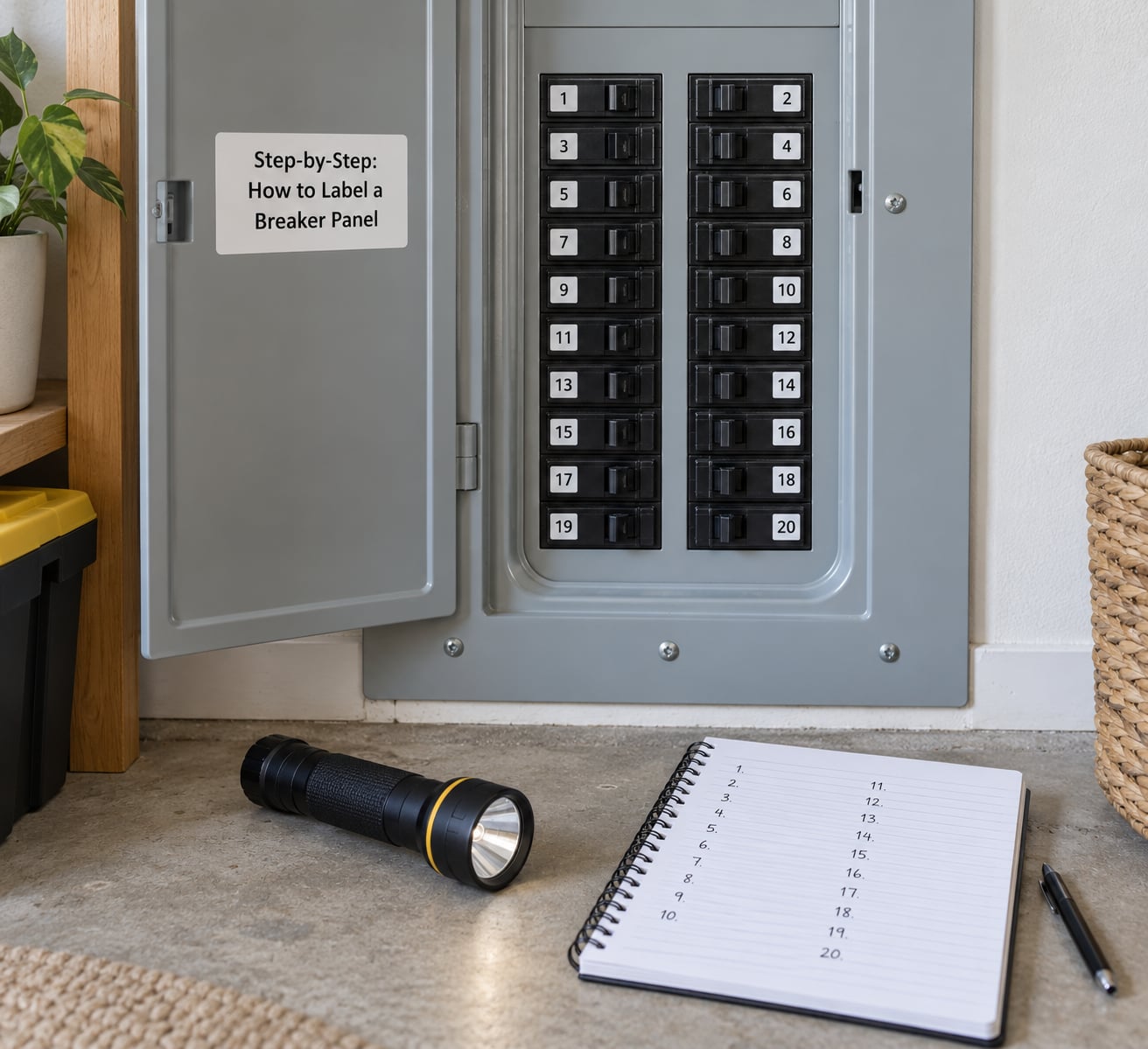
The whole process is eight steps, and the mapping step is the only one that takes real time.
- Read whatever labels already exist and photograph the panel.
- Find the main breaker and confirm it feeds the whole house.
- Switch off one branch breaker at a time.
- Walk the house and test outlets and fixtures to see what went dark.
- Write the breaker number and location in your notebook.
- Apply a durable label to each breaker.
- Build the panel directory and hang it on the door.
- Restore power one breaker at a time and verify every label.
How to Identify Each Breaker Without Guessing
Leave the main breaker on and turn off branch breakers one at a time. You need live power in the house to test outlets, and the only way to know which outlets belong to which breaker is to kill one circuit and walk the rooms.
Start at the top of the first column and work down in order, skipping the main breaker at the very top. Switch off one breaker, plug your receptacle tester into the nearest outlet, and walk room by room testing as you go. Every dead outlet and dark fixture belongs to that breaker. Write it down, switch the breaker back on, and move to the next one.
A second person makes this much faster: one of you works the panel, the other works the house with a radio or a phone call between rooms. The old electrician trick of numbering each electrical box and each breaker, then writing those numbers on the receptacle covers, means you can trace an outlet back to the panel without repeating the sweep. That box-breaker convention comes up constantly in pro labeling threads because it survives future renovations.
Watch for the traps. A switched receptacle may be fed from a ceiling light box, so killing the lighting circuit also kills a kitchen counter outlet. Outdoor and garage receptacles usually sit on their own GFCI breaker. A basement finish or a kitchen remodel often left circuits split in ways the original installer never wrote down, which is why nobody trusts an inherited label.
Verify before you touch: run a non-contact voltage tester on any exposed conductor, and never reach into the panel beyond the breaker handles. If a breaker is warm, discolored, or smells burnt, do not switch it. Call an electrician.
How to Write Clear and Durable Circuit Labels
Write the room and the load, not the circuit type. Good labels read “Kitchen Outlets,” “Master Bedroom,” “Washer Dryer,” “Basement Fridge,” and “Garage Shop Bench.” Bad labels read “Lights” and “Upstairs,” which tell you nothing when you are standing in the dark at the panel.
Keep each label short enough to read at arm’s length in a dim garage, and use the same wording on the breaker, the directory, and any switch or receptacle covers you label. Consistency is what lets a future electrician trust your paperwork.
Vinyl tape from a label maker such as a P-Touch style printer is the field standard electricians reach for, and a waterproof label like the Brady BMP21 line handles a dirty panel cover better than paper. Printed spreadsheet schedules run through a laminator and stuck or magnet-mounted to the door are the other common approach in homeowner forums. Handwritten is fine as long as the ink is permanent and the writing is legible. Paper peel-off stickers are the ones that fail first, usually in a year or two.
Color is a helpful second signal, not a substitute. A red sticker on the breakers for the sump pump, refrigerator and any medical equipment lets a helper find them fast, but a directory that only says “red breaker” fails the moment someone repaints the panel.
How to Create and Update the Panel Directory
The directory is the durable list. Most panels have a card or plastic pocket on the inside of the door, and that space is usually too small for detail, so keep a full version elsewhere and a short version on the door.
A useful directory has three columns: breaker number, what it serves, and a notes field for anything the label can’t fit.
| Breaker | Circuit | Notes |
|---|---|---|
| 2 | Washer and dryer | Double pole, shares with kitchen counter |
| 7 | Basement fridge | Color tape: red |
| 14 | Garage door opener | Also hallway closet outlet |
| 20, 22, 24 | Spare | Unused, breaker off |
If your home has more than one panel, adopt a numbering scheme before you start labeling. The convention homeowners tend to land on is floor, box, breaker, so “2-3-14” means the second floor, third box, fourteenth breaker. With one panel and one subpanel in a detached garage, name both panels in your directory so nobody opens the wrong enclosure during a power outage.
Date the directory. Then update it after any renovation, appliance swap or added circuit, which is when old directories quietly start lying.
How to Verify the Labels and Restore Power Safely
Close the panel cover before you turn anything back on. Then switch the branch breakers on one at a time, and after each one walk to a labeled outlet and confirm it is live. A breaker that trips immediately when you reset it is telling you something, so leave it off and note it on the directory for the electrician.
Do a second pass through the house with the finished directory in hand and call out each label as you test it: “Breaker 2, washer and dryer, confirmed.” That second pass catches mislabeled circuits while your notebook is still in your hand.
Stop and look for warning signs as you go: buzzing or crackling inside the panel, warmth on a faceplate, scorch marks on a breaker, or repeated trips on the same circuit. Any of those are electrician territory, not labeling territory.
Common Mistakes When Labeling a Breaker Panel
These are the errors that show up over and over, each with the safer correction.
- Trusting the old labels. Inherited “kitchen” and “lights” markers are guesses by a previous owner. Re-test everything and rewrite anything you cannot confirm in one trip.
- Labeling by assumption. Assuming the front bedroom breaker feeds the back bedroom is how you shut off something you did not mean to. Test it.
- Putting your hand in the panel. Labeling only requires moving breaker handles. Anything involving cover removal, conductors or added breakers is licensed work.
- Labeling a double-pole breaker twice. One label on the shared handle, listing both loads, such as “Washer Dryer / Kitchen Counter.”
- Leaving spares blank. Write “Spare” on the directory for every unused breaker so the empty space looks intentional.
- Skipping the update. Any circuit you or a contractor changes means the directory changes the same day, before the panel cover goes back on.
When to Stop and Call a Licensed Electrician
Labeling is safe because you never touch a conductor. Stop the moment any of these show up.
- Burnt plastic smell, buzzing, crackling, or scorch marks on a breaker or bus
- A breaker or panel cover that is warm to the touch
- Exposed copper, damaged insulation, or aluminum branch wiring
- Breakers that trip repeatedly, or one breaker that will not reset
- A panel with no cover or deadfront, especially in a rental or multifamily building
- Any need to add breakers, wire a generator interlock, or install a subpanel feeder
- A backfed main or generator transfer equipment you have not had inspected
Homeowners commonly ask whether labeling itself needs a permit or a licensed electrician. Relabeling an existing panel does not, but any work that changes the wiring does, and local rules vary, so check before touching anything.
Frequently Asked Questions
Does the main breaker have to be off to label a breaker panel?
No. You leave the main breaker on and switch off one branch breaker at a time, because you need live power in the house to test which outlets go dark. Treat every breaker and every conductor inside the panel as energized even when you have switched it off. Only turn the main off if you are doing something a licensed electrician should be doing.
How do I label a breaker panel that already has confusing labels?
Retire the old labels instead of working around them. Switch off one breaker at a time, test outlets room by room with a receptacle tester, and write down what you actually find. Most inherited directories are guesses, and confusion usually traces back to a renovation that split or rerouted a circuit years ago.
What if one circuit serves several rooms?
That is normal and not a problem. Name the whole group on the directory, for example “Washer Dryer, Hall Closet, Mudroom Outlet,” so one flip covers everything the circuit serves. Shared circuits become awkward when one item on them trips, but for labeling purposes the whole list goes on one line next to the breaker number.
Are handwritten labels acceptable for an electrical inspection?
Handwritten labels are acceptable when they are permanent, legible, and in place when the panel closes. Inspectors are looking for clear, durable identification of each circuit, not for a particular printing method. Printed and laminated schedules are the sturdiest option for a garage or damp basement, where handwriting smudges and peels fastest.
When does labeling require a licensed electrician?
Relabeling an existing panel does not require one. Call a licensed electrician the moment the job stops being flipping handles: if you need to remove covers to see the wiring, add breakers, handle aluminum or damaged conductors, deal with a warm or buzzing breaker, or work on a backfed main or generator interlock. Rental and multifamily panels often fall under local rules that require a licensed professional.
Start with one afternoon and a receptacle tester. Photograph the panel before you touch it, switch off one breaker at a time, and write down what you see before you label anything, because the notebook is your only accurate record for the first hour.
Then transfer the whole map to a durable directory, date it, and keep it with your other service records. If the panel shows heat, buzzing, damage or exposed wiring, put the notebook down and call a licensed electrician.