The difference comes down to permits, not project size. If your job needs a building permit, touches a structural element, or crosses more than one trade, hire a licensed general contractor. If it is a single-trade, non-structural task you can describe in a sentence, a handyman is the right call and will cost you less.
That rule sounds simple, and most of the time it holds. The messy part is that state licensing rules differ, the line can fall inside your own town, and a project that started as a bathroom update quietly becomes a remodel once you move a wall. Here is how the two professionals actually differ, what each one should be hired for in 2026, and how to check credentials before you hand over a deposit.
Table of Contents
- General Contractor vs Handyman Which Do You Need at a Glance
- What Is the Difference Between a General Contractor and a Handyman?
- Handyman vs general contractor: the difference that actually matters
- Why the business name tells you nothing
- What homeowners and tradespeople say about the line
- What Kind of Work Does Each Pro Handle?
- The hybrid path: handyman for prep, contractor for the build
- Do You Need a Licensed General Contractor?
- What a handyman cannot legally do
- What happens when the wrong pro does the work
- Which Is More Expensive: a General Contractor or a Handyman?
- How Do You Compare Quotes and Check Credentials?
- Checklist for a general contractor
- Shorter checklist for a handyman
- Red flags for either hire
- Which Should You Choose?
- Frequently Asked Questions
- Can I use a handyman for part of a remodeling project?
- Do I need a general contractor for a small bathroom remodel?
- Is a handyman cheaper than a general contractor?
- How can I tell if a general contractor or handyman is properly licensed?
- What should I do if a handyman’s quote is much lower than other bids?
- What Should You Do First?
General Contractor vs Handyman Which Do You Need at a Glance
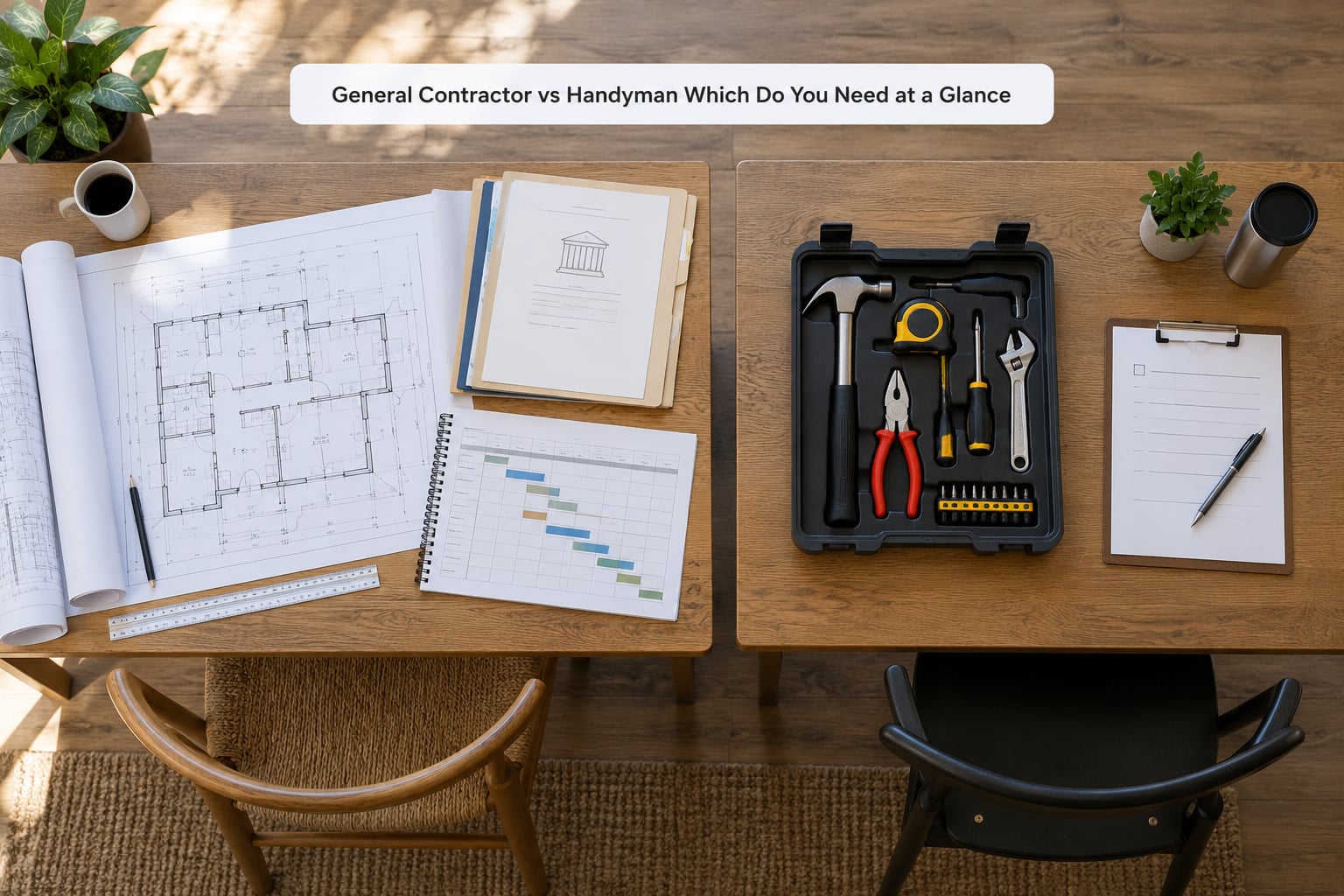
Start with the four signals that decide nearly every case: permits, structure, number of trades, and coordination. If any one of those four is present, you are looking at general contractor territory. If none of them are present and the task is small and clearly defined, you are looking at a handyman.
| Factor | Handyman | General contractor |
|---|---|---|
| Typical work | Small repairs and installations, single trade, non-structural | Whole projects spanning several trades |
| Who manages the work | The handyman, usually alone or with one helper | The GC, who schedules and coordinates subcontractors |
| Business structure | Sole operator or small crew, sometimes working as a subcontractor | Licensed company with office, staff and accounting |
| State license | Often none required below the state handyman threshold; some hold licenses anyway | Required in nearly every state for work above the threshold |
| Permits | Generally not pulled; cannot pull them in most states | Pulled, scheduled and closed out by the GC |
| Structural changes | No load-bearing work, no wall removal that affects structure | Handled, with engineering and inspection where required |
| Project length | Hours to a few days | Weeks to many months |
| How you are billed | Hourly rate or a flat rate for a defined task | Markup on total project cost, usually 10 to 20 percent |
| Project minimum | None, though very small jobs may attract a service-call fee | Often five thousand to ten thousand dollars, below which many decline |
| Insurance | Varies widely; ask for a certificate of insurance either way | General liability and workers compensation are normal, bonds depend on the work |
| Who carries the risk | You do, for anything done without a permit | The GC carries coordination and code-compliance risk |
| Best fit | Leaky faucet, drywall patch, TV mount, cabinet hardware, door hang | Kitchen, bath, basement finish, addition, roof, panel upgrade, deck |
One warning about the table above: the license row is the one that varies most. Everything else tends to follow a predictable pattern across the country.
What Is the Difference Between a General Contractor and a Handyman?
A handyman is a multi-skilled repair professional who takes on small, well-defined jobs that stay inside one trade and avoid structural and regulated systems. They bill by the hour or quote a flat rate for a task, they usually work alone, and in many states they hold no license at all because the work sits under the state’s handyman threshold.
A general contractor is a licensed professional who is accountable for an entire project. That accountability includes pulling permits, scheduling inspections, hiring and sequencing licensed subcontractors for plumbing, electrical, HVAC and roofing, and carrying the project from demolition to final walkthrough.
Handyman vs general contractor: the difference that actually matters
The practical difference is not skill. Plenty of handymen are excellent tradespeople. The difference is legal accountability and organizational capacity. A GC carries a license number you can look up, a contract that assigns responsibility, and a network of licensed trades behind the work. A handyman carries none of that infrastructure, which is exactly why the work has to stay small.
Why the business name tells you nothing
Homeowners constantly report being unable to tell what they are hiring from a name or a website. There is no reliable signal separating “handyman” from “small contractor” from “owner-operator,” and all three can describe the same person doing the same job. A ContractorTalk thread is literally titled “Handyman or small contractor?” with tradespeople debating what to call themselves, and tradespeople there describe handyman territory as “the jobs that are too small for contractors to bother with.”
That is the honest framing. In practice, part of the boundary is drawn by economics rather than law: a GC’s overhead makes small jobs unprofitable, so those jobs flow to handymen by default.
What homeowners and tradespeople say about the line
The top Google result for this question is a Reddit thread in r/HomeImprovement, where the most useful answer is not a rule at all. A commenter writes that “a reputable handyman could probably do everything just fine, but you need to find someone who does great work and isn’t a hack,” then adds that a GC would add management you may not need.
That is the tension most homeowners feel. A BiggerPockets contributor puts the other side plainly: “If it’s a big job needing practically everything completed, including permits and drawings, etc., then you’re much better off with a GC for your own sanity.” A builder on Houzz, who deals with older houses, goes the other way and advises against handymen for wiring work in old homes. All three are describing the same rule. The size of the job and the number of trades decide it.
What Kind of Work Does Each Pro Handle?
Handyman work has a shape: one trade, no permits, no structural consequences, and a finish line you can see. If a task matches all four, a good handyman is the cheaper and faster choice.
- Patching and sanding drywall, then painting the repair
- Replacing a faucet, a showerhead, a garbage disposal or a toilet fill valve
- Hanging doors, blinds, curtain rods, shelves and TV mounts
- Assembling furniture and mounting hardware
- Replacing cabinet pulls and hinges, re-hanging cabinet doors
- Touch-up painting on trim and one room
- Weatherstripping, caulking around windows and doors, minor gutter cleaning
- Small deck board repairs and stair treads
- Grout touch-up and a small patch of backsplash tile
General contractor work has a different shape: several trades, permits, inspections, and a sequence where one trade has to finish before the next can start. A general contractor vs handyman decision usually becomes obvious here.
- Full kitchen or bathroom remodel, especially with a layout change
- Basement finishing or any project that adds living space
- Room additions and accessory dwelling units
- Roof replacement, new decks, garage construction
- Electrical panel upgrades and new circuits
- New service, gas line work, HVAC replacement, water heater replacement
- Removing or relocating a load-bearing wall
- Whole-home renovation or a house with multiple deferred repairs bundled together
| Project | Hire | Why |
|---|---|---|
| Leaky faucet or running toilet | Handyman | Single trade, no permit in most jurisdictions |
| Drywall patch and paint | Handyman | Small, defined, no coordination needed |
| TV mounting or shelving | Handyman | Often a flat-rate task with no trade crossing |
| Door and window replacement, interior | Handyman | Common handyman task when no structural header changes |
| Bathroom update, no layout change | Handyman or GC | Handyman if only fixtures and paint; GC if plumbing moves |
| Bathroom remodel with a moved wall | General contractor | Permit, rough-in plumbing, inspection |
| Kitchen remodel, any scope above a swap | General contractor | Multiple trades, cabinetry, possible electrical |
| Basement finishing | General contractor | Egress, ceiling height and electrical all get inspected |
| Electrical panel upgrade | Licensed electrician, often via a GC | Utility coordination and permit required |
| Roof replacement | Licensed roofer, often via a GC | Specialty license and insurance requirements |
| New deck or load-bearing wall removal | General contractor | Footings, engineering and structural review |
| A list of eight unrelated repairs | See hybrid path below | Split the list by permit status |
The hybrid path: handyman for prep, contractor for the build
Nobody covers this one, and it is the compromise homeowners describe most often. A r/handyman poster put it well: they have a GC they trust without questions from a three-phase renovation, but in the current moment “it sounds like I need a handyman at this point.”
In practice that means hiring the handyman for demolition, haul-away, patching and prep, then bringing in the GC for the work that needs permits and licensed trades. The GC sees a cleaner site, and you get one invoice for the part that actually requires accountability.
Do You Need a Licensed General Contractor?
You need a licensed general contractor when the work requires a permit, alters structure, or crosses into a trade with its own licensing rules. Electrical, plumbing, gas, HVAC and structural work are regulated in every state, and in most jurisdictions the trade itself must be licensed even when a GC is running the job.
Licensing rules are set by state, and in some cases by the town inside the state. A Fine Homebuilding forum post captures the surprise homeowners get: “I’m in MA and different towns” have different requirements. The five-minute call to your local building department settles this more reliably than any rule of thumb, including the ones in this article.
| State or area | Handyman threshold or test | Where to verify |
|---|---|---|
| California | A license is required above five hundred dollars in combined labor and materials | California State Contractors License Board |
| Texas | Uses a permit-trigger test rather than a dollar figure | Texas Department of Licensing and Regulation |
| Florida | No statewide handyman license category; local rules and county thresholds apply | County and city building departments |
| New York | No statewide handyman license; some localities require registration above set amounts | Municipality and county offices |
| Massachusetts and similar New England towns | Rules vary by town, not only by state | Town building department |
| Most other states | A dollar threshold, a permit-trigger test, or both | State licensing board via NASCLA |
NASCLA, the National Association of State Contractors Licensing Agencies, runs the directory that points you to the right board for any state. A 2008-era ContractorTalk thread is still ranking on the California figure, which tells you how long homeowners have been working from the same five-hundred-dollar number.
What a handyman cannot legally do
This is the list that turns a vague rule into a checklist. In most states a handyman cannot:
- Pull a building permit, unless they hold a license that allows it
- Remove or alter a load-bearing wall, or cut into a structural member
- Run new electrical circuits or work on an electrical panel
- Do new rough-in plumbing or gas line work
- Install or replace an HVAC system, water heater or electrical service
- Replace a roof or build a new deck where a permit and inspection apply
Handyman territory stops right at those lines. Everything below them is fair game in most jurisdictions.
What happens when the wrong pro does the work
Hiring a GC for a small job wastes money. Hiring a handyman for permit-required work creates exposure that stays with you as the property owner. There are four failure modes worth knowing.
- At resale. Unpermitted work can surface during a buyer’s inspection and become a credit request or a reason to walk. Sellers have to disclose it, and disclosure tends to move the price your way, not theirs.
- After a loss. Insurers examine the claim and can deny payment for damage tied to unpermitted or non-code work, or limit your payout to the value of the work they consider legitimate.
- Code enforcement. A building department can order a tear-out of work done without a permit, and you pay for the removal as well as the redo.
- Worker injury. If an uninsured handyman is hurt on your property, your homeowner policy may not respond and the liability can land on you.
That last one is why the certificate of insurance question matters even for a two-hour job.
Which Is More Expensive: a General Contractor or a Handyman?
Almost always the handyman, and the reason is structural rather than unfair. A handyman bills the hours they spend. A GC bills a markup on top of subcontractor bids and materials, because they are providing something the handyman is not: permits, sequencing, insurance, and one person answerable for the result.
| Cost factor | Handyman | General contractor |
|---|---|---|
| Billing method | Hourly, or a flat rate for a defined task | Markup on total project cost, typically 10 to 20 percent |
| Typical hourly range | Roughly fifty to a hundred fifty dollars an hour, varying by region and trade | Management fee layered over subcontractor and material costs |
| Materials | You buy them, often at retail | Bought, marked up and scheduled as part of the project |
| Permits and inspections | Not usually part of the price | Line item, sometimes with an admin fee |
| Minimum project | None, though some charge a service-call fee | Often five thousand to ten thousand dollars |
| Two-hour fixture swap | Labor only | Often declined as too small |
| Mid-size bathroom with layout change | Not the right hire | Quoted as a project, with subcontractor bids inside |
These are typical US ranges. Regional rates, material prices and job complexity move the final number a long way, so treat them as a starting point for a conversation rather than a quote.
The cost surprise that catches people is not the markup itself. It is scope creep, handled through change orders. Any change to the written scope should come back to you as a written change order with a price and a schedule impact before the work happens. If extra work arrives verbally and shows up on the final invoice, that is a conversation you should have had earlier.
How Do You Compare Quotes and Check Credentials?
The lowest bid is not automatically the best offer, and on paper it rarely is. A quote that is thin on scope is cheap because it excludes the thing you care about.
For any project over roughly a thousand dollars, get three written quotes. For anything larger, three is not negotiable.
Checklist for a general contractor
- License number verified on the state licensing board site, not just read off a business card
- Certificate of insurance for general liability, with your home listed as additional insured
- Workers compensation coverage confirmed separately, since it is a distinct policy
- A written contract stating scope, total price, payment schedule with milestone draws, start and completion dates
- A written guarantee on the work, and the name of who performs the warranty work
- References for three completed projects similar to yours, with addresses you can visit
- A clear statement about which trades are subcontractors, who schedules them, and who carries their insurance
- An explanation of what happens if an inspection fails
- A change-order process in writing, with pricing method stated up front
- Who pulls the permits, and confirmation the final inspection gets closed out
Shorter checklist for a handyman
- Ask for the license anyway, and for their state license number if they hold one
- Certificate of general liability insurance, and workers compensation if anyone else will be on site
- References for jobs similar to yours, plus one you can see
- A written agreement naming the task, the price or hourly rate, and the payment terms
- Confirmation of what is excluded, especially painting, disposal and finish work
- A payment schedule with no large upfront demand
Red flags for either hire
A few patterns show up consistently in homeowner accounts. Offering to handle the job without pulling a permit is an automatic disqualifier, and it is common enough that owners have learned to ask about it directly. So are asking for full payment before work starts, being unable to produce a license number or proof of insurance, and being unable to explain what happens if an inspection fails. If references have not been checked in advance, that conversation rarely goes well later.
Which Should You Choose?

Work through these five questions in order. The first yes stops the process and settles it.
- Does the job need a permit? If yes, stop here and hire a licensed general contractor. If you are not sure, call your local building department before going further.
- Does it touch structure? A load-bearing wall, footings, roof framing, or a bearing wall being opened up means a GC and probably an engineer.
- Does it cross trades? Plumbing plus electrical plus drywall plus paint in one job means coordination, which is the service you are paying a GC to provide.
- How long will it take? More than a few days with trades waiting on each other changes the risk profile and the scheduling problem.
- Is the scope still moving? If you are still deciding what you want, that is a design phase. Settle the design first, then price the build.
If all five answers are no, hire the handyman. You will get a better price and a faster completion, and you will not be carrying permit exposure.
If some answers are yes and some are no, use the hybrid path. Split the list: handyman for demolition, haul-away and prep, GC for everything that needs a permit or a licensed trade. It is the most common pattern in homeowner discussions and it works.
Frequently Asked Questions
Can I use a handyman for part of a remodeling project?
Yes, and it is often the cheapest way to run a remodel. Handymen handle demolition, haul-away, patching, prep and small finishes without permits. Keep the GC for anything requiring a permit, moving plumbing or electrical, or altering structure. Tell the GC what the handyman already did so the scope and liability stay clean.
Do I need a general contractor for a small bathroom remodel?
If nothing moves and no permit is required, a good handyman can handle fixture swaps, paint and caulking. The moment you relocate a toilet, move a wall or change the shower location, you are into permit territory with rough-in plumbing and inspection. Check with your building department first, because rules vary by town as well as by state.
Is a handyman cheaper than a general contractor?
Nearly always, for a small defined task. A handyman bills hours or a flat rate, while a general contractor adds a markup of roughly 10 to 20 percent on total project cost to cover permits, scheduling and accountability. That premium is not waste on a multi-trade project. On a two-hour job it is simply more than the job is worth, and many GCs decline work under five thousand to ten thousand dollars.
How can I tell if a general contractor or handyman is properly licensed?
Ask for the license number and look it up yourself on your state licensing board website, or use the NASCLA directory to find the right board. A handyman may legitimately have no license below your state’s handyman threshold, so no result is not automatically a problem. It does mean the work has to stay inside that threshold, and asking for general liability and workers compensation certificates is always reasonable.
What should I do if a handyman’s quote is much lower than other bids?
Compare scopes line by line rather than totals. A lower quote often excludes disposal, patching, finish work, permits or materials. Ask each bidder to restate the exclusions in writing. Then ask your one lowest bidder the direct question: is a permit required for this work, and who pulls it. A confident, specific answer matters more than the gap between the numbers.
What Should You Do First?
Write down every task on the list, then sort it into two columns: things that need a permit or a licensed trade, and things that do not. Call your local building department with questions in the first column, because that single call does more than any size-based rule of thumb. Then get three written quotes for anything above roughly a thousand dollars, check the license number and insurance certificate yourself, and put the scope and payment schedule in writing before any money changes hands.
If you take one rule away from this, make it the permits one. Permits, not project size, is what separates the two jobs, and it holds up whether you are in California, Texas or a New England town with its own rules.