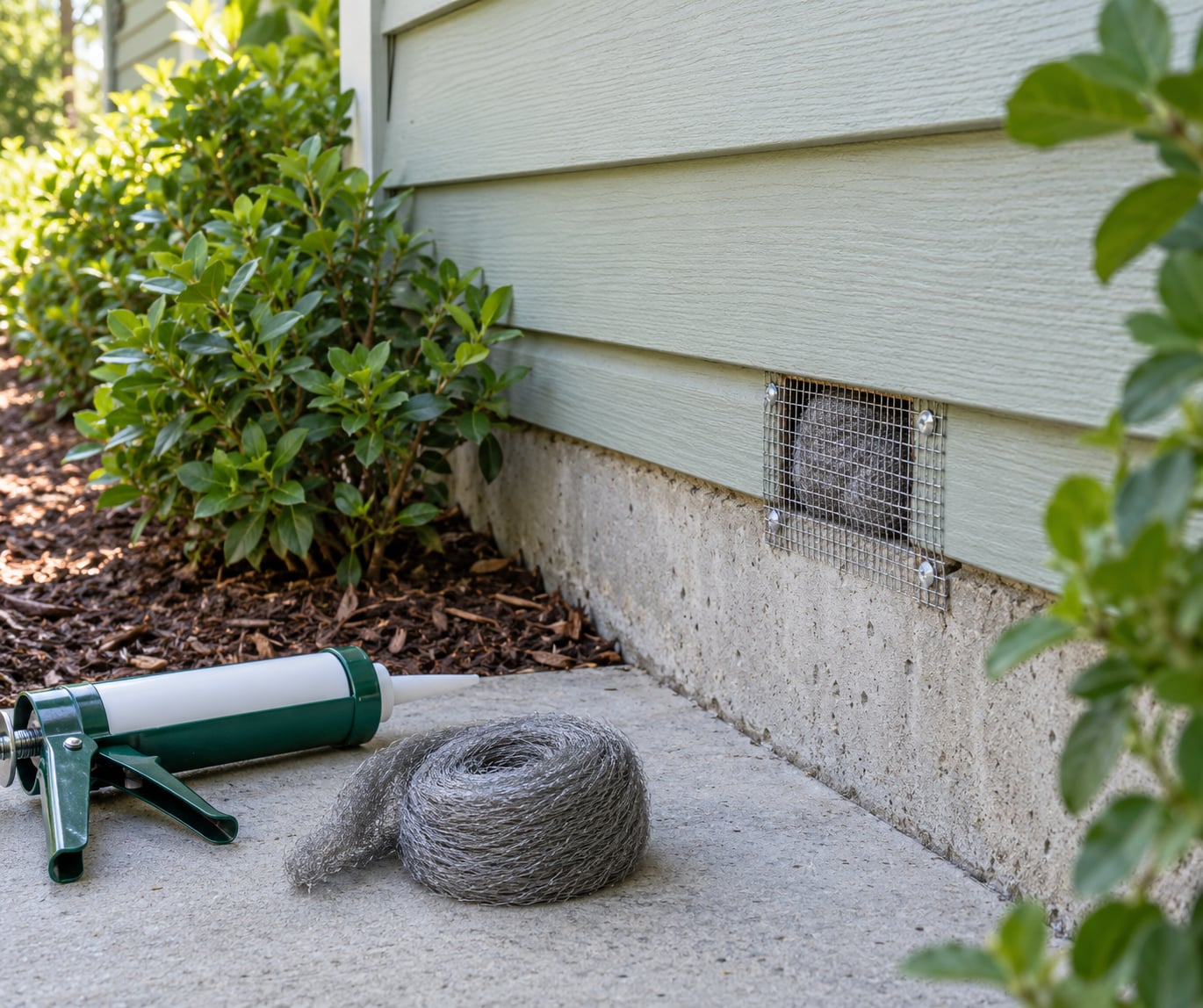
Mice get into houses through openings you would swear are too small, so the fix is not traps on the counter. To prevent mice from entering your home, close every gap wider than a quarter inch with material they cannot chew, then take away the food, water and cover that drew them to your walls in the first place.
University extension guidance puts the threshold plainly: house mice squeeze through openings slightly larger than a quarter inch, about the size of a dime, and they can jump roughly 12 inches straight up. Get that number into your head before you start, because it changes what counts as a repair. A caulk bead over a foundation crack is not exclusion. Stainless steel mesh screwed over a plumbing vent is.
This guide was reviewed in 2026. Most of the work takes an afternoon with a flashlight and a tube of sealant, plus a weekend if your foundation is older than you are.
Table of Contents
- What You Need
- Step-by-Step
- 1. Inspect the Perimeter and Entry Points
- 2. Seal Small Gaps and Holes
- 3. Protect Vents, Pipes, and Other Openings
- 4. Remove Food, Water, and Shelter Attractants
- 5. Create a Safe Monitoring Routine
- 6. Use Low-Risk Deterrents and Barriers
- Common Mistakes
- Frequently Asked Questions
- What is the smallest gap a mouse can squeeze through?
- Can steel wool permanently keep mice out?
- How do I find where mice are entering my house?
- Should I use poison or traps to prevent mice from entering my home?
- How do I mouse-proof vents, pipes, and windows?
- When should I hire a professional for mouse prevention?
- Conclusion
What You Need

Most of this list costs less than a single restaurant meal, and half of it you probably own already.
- A bright flashlight and knee pads. Crawlspaces and attics punish people who skip the second item. A headlamp frees both hands for probing gaps.
- Work gloves and a dust mask. Older mouse droppings can carry hantavirus particles, and the CDC advises against sweeping or vacuuming them dry. Wet them with disinfectant first if you find any.
- Measurement tool. A ruler or a quarter and a dime for comparison. You are looking for anything that admits the dime.
- Stainless steel or copper mesh wool for packing cracks, plus caulk or polyurethane sealant to hold the pack in place.
- Galvanized or stainless hardware cloth, 1/4-inch mesh. This is the real barrier for vents, pipes and any gap a mouse could chew back open.
- Exterior-grade silicone sealant and a screw gun with masonry bits or short screws and washers for fixing mesh and flashing to siding or masonry.
- Sheet metal flashing and a rubber door sweep for thresholds, plus a bottom seal kit if you have a garage with a rolling door.
- A vacuum and a disinfectant spray for cleaning droppings safely if you find any.
Leave mouse traps out of the prevention kit. They handle mice that are already inside, which is a different job. The Centers for Disease Control and Prevention and state extension services both treat exclusion and sanitation as the durable fix, because a treated house with an open gap gets reinfected from the neighbors’ attic every spring.
Step-by-Step
1. Inspect the Perimeter and Entry Points
Walk the outside of the house first, then go back through with a flashlight after dark. Mice travel along walls and edges rather than across open ground, so the places worth your time are the seams where surfaces meet.
Start at the foundation. Look for cracks wider than a quarter inch, gaps where siding ends and concrete begins, and openings around plumbing pipes, drain lines, the water heater, the dryer vent and any cable or conduit entering the wall. Older homes are the hard cases: original mortar cracks, settled slabs that have opened small gaps, and patch repairs from a previous owner that never matched the surrounding joint.
Then check the top. Look at the roof rake where the roof meets the wall, the area around the chimney, plumbing vent boots and j-vents on the roof, the attic hatch, and any gap where the soffit meets the fascia. Homeowners on r/homeowners say the fix they notice most was having sturdy metal mesh installed over roof plumbing vents and j-vents, which professionals frequently leave uncovered even after a visit.
Inside, check behind the washer and dryer, under the kitchen sink, along the plumbing penetrations in the bathroom, around ceiling penetrations in closets and upstairs baths, and inside cabinet walls where a mouse can travel the whole length of a wall.
One safety note before you seal anything: make sure no raccoon, squirrel or bat is nesting in the space. Sealing an occupied den with an animal inside creates a welfare and legal problem that is far worse than the noise.
2. Seal Small Gaps and Holes
Pack the gap with steel wool or copper mesh, then seal over it with exterior caulk or polyurethane sealant. The packing material blocks the route, and the sealant is what keeps water and weather from ruining the pack.
Know what fails. Expanding foam on its own gets chewed straight back out, and homeowners on r/HomeImprovement say over and over that foam without mesh behind it is a false fix. Plastic sheeting, window screen, wood, rubber and drywall are all gnawable, which is why extension guidance lists them as unsuitable. Steel wool works, but it is explicitly a temporary plug: it rusts out within a season or two and leaves you thinking the hole is closed when it is not.
So match the material to the gap. For cracks under a quarter inch, a tight steel wool pack with caulk over it is fine while you decide on a better repair. For anything a mouse could reopen, use 1/4-inch hardware cloth cut larger than the opening, bed it in sealant, and fasten it with screws and washers or masonry fasteners. For a gap at a pipe or a corner that keeps reopening, bend sheet metal flashing over the opening and fasten it. A permanent repair on a foundation crack means mortar or sealant matched to the masonry, not a gap-filled surface.
3. Protect Vents, Pipes, and Other Openings
Larger openings need screening rather than packing. That includes soffit, gable and crawlspace vents, plumbing vent pipes, dryer and kitchen exhaust ducts, the attic hatch, the fireplace flue, window air conditioner sleeves, weep holes in exterior brick, and the gap beside a garage door track.
Buy rodent-proof vent covers and j-vent screens, or cut your own from 1/4-inch hardware cloth, leaving it a few inches larger than the opening so it can be screwed flat against the surface. Cover the gap with sealant, drive the fasteners, and let it cure. The screen must sit tight enough that nothing smaller than a mouse head could push through, and the mesh holes must be genuinely smaller than a mouse can squeeze past.
Do not block ventilation while you are at it. Crawlspace and attic vents exist to move moisture out, and sealing them to solve a mouse problem trades one problem for another. Screen the vent, never brick it up.
Garages deserve their own pass. A rolling door has three separate routes: the bottom seal against the slab, the gap beside each track where the door meets the wall, and any gap under or around the door panel itself when it closes. Replace a split or flattened bottom seal with a rodent-resistant one, add astragal or vinyl weatherstrip to the sides of the track, and check that the door closes fully on a warm day. If a mouse is chewing your weather stripping from the inside, the seal is not tight enough, not that the material is wrong.
4. Remove Food, Water, and Shelter Attractants
Sealing alone fails when the house still smells like a buffet, and cleaning alone fails when the door is open. Mice are driven by smell, so sanitation is the half of prevention most people skip.
Indoors, put flour, sugar, rice, grains, pet food and open packages into hard plastic, glass or metal containers with tight lids. Wipe counters and stovetops every night, sweep or vacuum floors, and get dishes out of the sink or run the dishwasher overnight. Take trash out daily in a can with a tight-fitting lid, including the trash you keep in the garage. Pet food goes into a metal bin, never a floor bowl left out.
Outside is where most of the food comes from. Store firewood at least 20 feet from the house, stacked off the ground and covered, because a stack against the exterior wall is a ready-made highway to the sill. Rake leaf piles, clear spilled seed under bird feeders and move feeders away from the house if you can, trim shrubs back off the walls so nothing touches the foundation, and pull clutter, stacked lumber and stored boxes away from the siding. Keep the garbage cans sealed and rinse out food residue at the source.
Water matters more than people expect. Mice need water, and a dripping outdoor spigot, a leaking supply line under the sink, a clogged basement drain, or a condensation puddle in a crawlspace is an open invitation. Fix the leaks, run a dehumidifier in damp basements, and confirm your attic and crawlspace are ventilated.
5. Create a Safe Monitoring Routine
Prevention only holds if you notice when it fails. Check the house every month or so, and always do a walk-through in late summer before cold weather pushes rodents indoors.
The signs are specific. Droppings are roughly rice-grain sized and clustered along walls, under sinks, inside cabinets and in the garage. Rub marks are dark smears of grease along baseboards and door frames where bodies have repeatedly passed. Gnaw marks show up as irregular scratches on plastic, wiring, insulation and wood. You may hear scratching or squeaking inside walls after dark, or find a nest of shredded paper or fibrous insulation tucked in a warm corner.
A musky, stale odor in a closed space is another reliable tell. If you find droppings, put on gloves and a mask, wet the area with disinfectant, wait a few minutes, then wipe them up and bag them. Never vacuum dry droppings.
Recording what you find and where saves you a lot of guessing later. A pencil mark on the baseboard next to a fresh smear is cheaper than reconstructing the trail in three months.
6. Use Low-Risk Deterrents and Barriers
Be realistic about repellents. Ultrasonic plug-in devices do essentially nothing: the sound is directional, loses intensity almost immediately, and does not pass through walls, furniture or closed doors, and extension guidance does not recommend them. Dryer sheets in the pantry, mothballs, cat hair and scattered essential oils have no reliable evidence behind them, and mothballs are toxic enough to be a genuine hazard for children and pets.
Set realistic expectations for traps and electronic devices too. Snap traps placed along walls, spaced no more than about 10 feet apart, catch mice that are already inside, and that is their whole job. If you are seeing activity and traps are catching nothing, the problem is entry, not capture. If you are dealing with an infestation rather than prevention, a licensed pest management company is the right call, and ask specifically whether exclusion work is included, because treatment without sealing guarantees a return visit.
For most people, the deterrent that actually works is the unglamorous one: a door sweep that touches the floor, a mesh screen screwed to a vent, a tight garbage lid, a bin of pet food that stays indoors. Those are also the child-safe and pet-safe choices. Skip rodenticide outdoors entirely where pets or children have access, and follow the EPA label exactly if poison is ever used indoors.
One more practical check. If you are in a rental or a condo, some of these penetrations are shared: the roof vents, the utility chase between units, and the garage are usually the landlord’s job. Put the request in writing with the specific location and the specific gap size, because a general complaint about mice rarely gets a repair scheduled.
Common Mistakes
Filling gaps with expanding foam only. Foam is a great filler and a terrible barrier. Pack the opening with steel wool or wire mesh first, then foam around it if you want, so the mouse meets metal before it meets air.
Treating steel wool as a permanent repair. Extension services call it a temporary plug for a reason: it rusts and crumbles. Any gap bigger than a hairline crack needs hardware cloth or flashing over the wool.
Ignoring the garage. The rolling door bottom seal, the space beside the track and the gap under the door are the routes homeowners most often miss, and the seal gets chewed because it was the only barrier.
Leaving roof plumbing vents and j-vents bare. They are the single most commonly cited missed fix in homeowner discussions, and screen them before anything else on the roof.
Sealing one hole and stopping. Multiple people report treating an entry point only to find mice coming through the adjacent one within weeks. Work the whole perimeter in one sitting instead of playing whack-a-mole across a season.
Washing the counters but leaving the trash and pet food. If the smell that brought them in is still there, the walls you patched are simply the first place they try again.
Buying repellents instead of repairs. Ultrasonic units, dryer sheets and mothballs solve nothing and mothballs create a hazard. Spend that effort on mesh and sealants instead.
Waiting for the first sign of activity. Entry pressure rises in fall as the weather turns. Work the perimeter in late summer, when repairs are easy and the mice are still outdoors.
Frequently Asked Questions
What is the smallest gap a mouse can squeeze through?
A house mouse can squeeze through an opening slightly larger than a quarter inch, roughly the size of a dime. Its collar bones and skull compress to fit gaps you would not believe are large enough. Anything wider than that needs sealing with a material it cannot chew, such as stainless steel wool packed into the gap or quarter-inch hardware cloth screwed over it.
Can steel wool permanently keep mice out?
Not on its own. University extension guidance calls steel wool a temporary plug because it rusts and crumbles within a season or two, which leaves you thinking the hole is closed when it is not. Use it well packed in cracks and joints, then cover the repair with hardware cloth, sheet metal flashing or a proper caulk job for anything you want to last.
How do I find where mice are entering my house?
Look for the routes mice actually use: along foundation lines, around plumbing pipes, near the garage door bottom seal and track gap, at roof plumbing vents and j-vents, at the attic hatch, and behind the washer and dryer. Rub marks of grease along baseboards and clustered droppings point toward the trail. Follow the marks back to the wall rather than guessing from inside the room.
Should I use poison or traps to prevent mice from entering my home?
Neither one prevents entry. Traps and poison only affect mice that are already inside, so they work best alongside sealing rather than instead of it. For prevention, physical exclusion and removing food, water and shelter are the durable methods. If you already have signs of activity and trapping is not resolving it, call a licensed pest management company and ask whether exclusion is included.
How do I mouse-proof vents, pipes, and windows?
Cover them with rodent-proof screens or quarter-inch hardware cloth cut a few inches larger than the opening, bed the edges in exterior sealant, and fasten them with screws and washers or masonry fasteners. Leave the mesh holes smaller than the gap the mouse needs, and keep ventilation working rather than sealing vents solid. Repair torn window screens and add door sweeps on exterior doors while you are up there.
When should I hire a professional for mouse prevention?
Hire a licensed pest management company when you cannot find the entry points yourself, when the problem is in the attic, walls or crawlspace, when you see activity that traps do not touch, or when the home has original mortar, many utility penetrations or a settling slab. Ask for exclusion work specifically. Without sealing, treatment alone usually means the mice come back.
Conclusion
Start at the foundation with a flashlight and a dime in your pocket. Seal the first five gaps you find wider than a quarter inch, pack them with steel wool, cover them with hardware cloth and sealant, and screen the roof plumbing vents, j-vents and the garage door while you have the tools out.
Then take away the reason they came: move the firewood 20 feet from the wall, bin the pet food and the trash, fix the dripping spigot, and sweep the kitchen at night. Walk the perimeter again in late summer next year, before the weather turns. That two-hour habit, repeated annually, does more than any trap or gadget on the market.