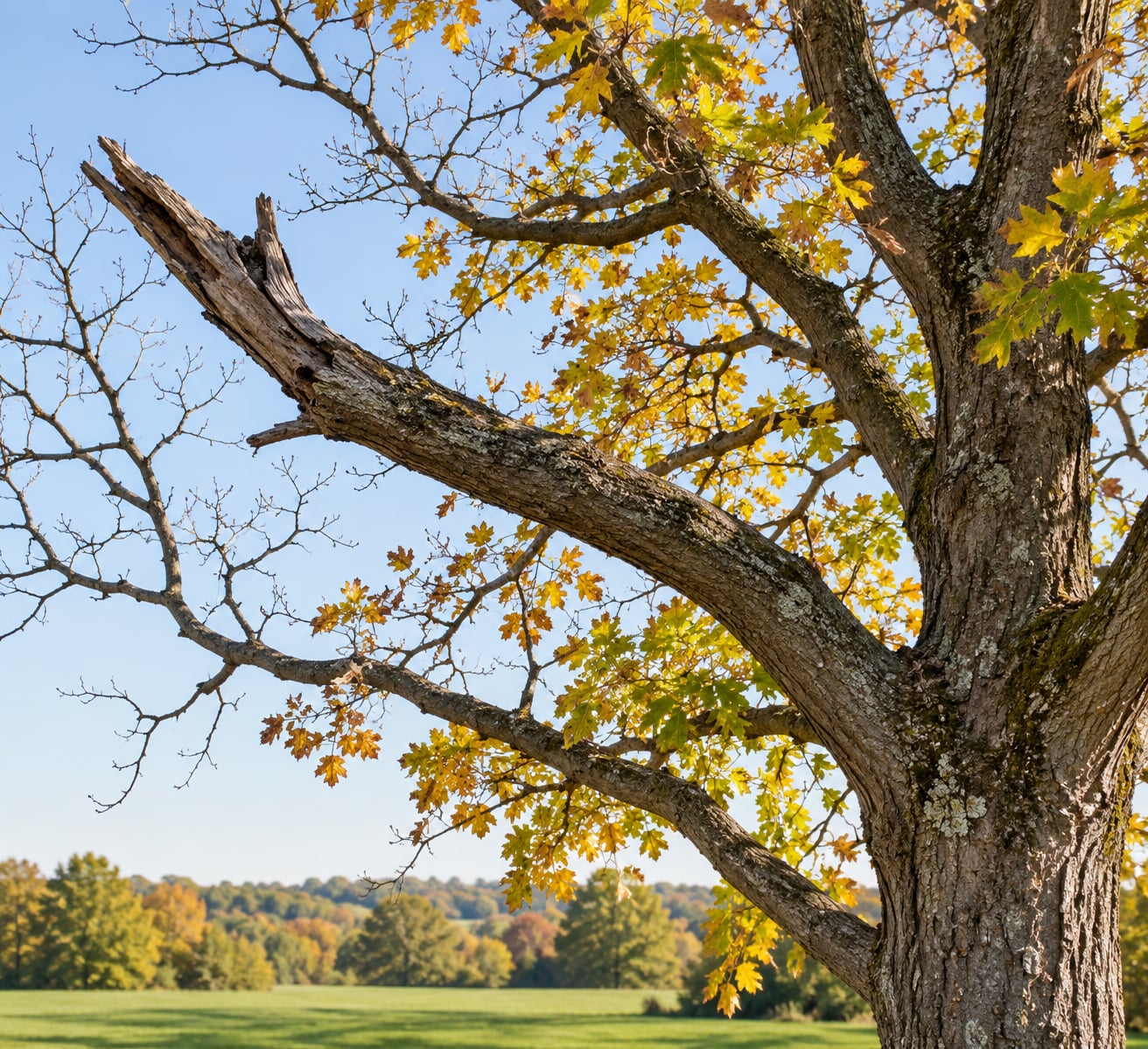
A tree that is on its way out gives off several signs at once: a crown that thins from the top down, bare upper branches, dead twigs, bark sloughing away in sheets, cracks or cavities in the trunk, fungus conks or mushroom clusters near the roots, and a lean that is new or getting worse. Those signs a tree is dying and needs removal are worth acting on early, because a tree can shed a heavy limb without much wind and land on a roof, a car, or a child.
This guide breaks the symptoms into what they mean, how to confirm each one yourself, and how quickly the clock is ticking once you see it. It is diagnostic guidance for a homeowner, not a substitute for an on-site arborist evaluation, and every judgement about a specific tree should come from someone standing in front of it.
Table of Contents
- Signs a Tree Is Dying and Needs Removal: What Each Symptom Means
- How to recognize canopy dieback
- What changes in bark indicate serious decline
- Why roots, soil, and trunk movement matter
- How to tell pests or disease from ordinary stress
- When a leaning tree needs urgent assessment
- Does a Dying Tree Always Need Removal?
- How urgent is each warning sign?
- What to do before having the tree removed
- How to choose between an arborist and a tree removal company
- Frequently Asked Questions
- Can a tree with brown leaves still be healthy?
- Is a hollow tree automatically unsafe and ready for removal?
- Should a tree be removed before storm season?
- Will homeowners insurance cover a dangerous tree?
- Is removing the stump necessary after tree removal?
- Conclusion
Signs a Tree Is Dying and Needs Removal: What Each Symptom Means
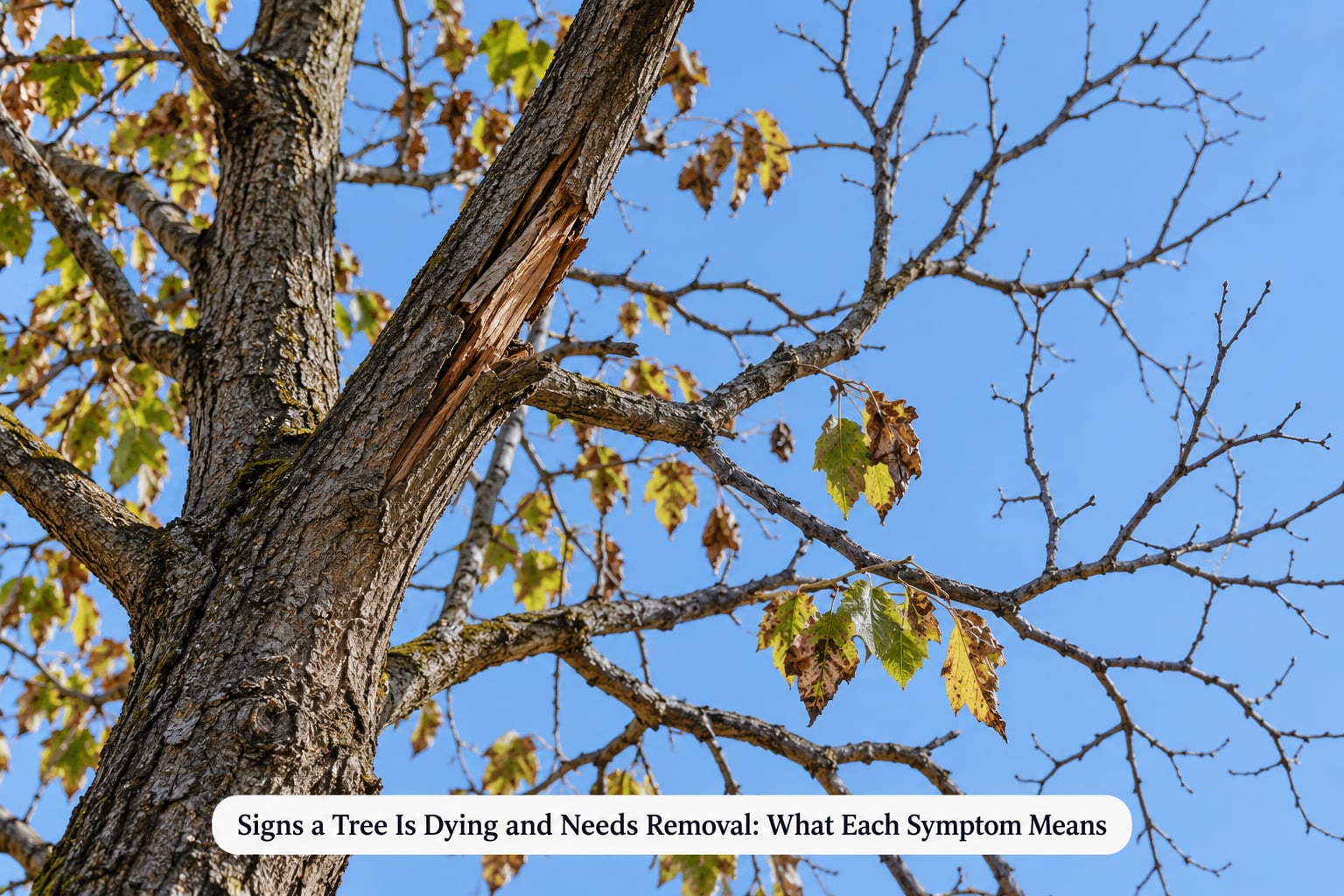
Most of the warning signs fall into four groups: what you can see in the canopy, what the bark and trunk are showing you, what is happening at the roots, and whether something is actively attacking the tree. The important part is that these rarely arrive one at a time. One bare limb in a big crown is normal. Three of the symptoms on this list showing up together is a different conversation.
| Symptom | What it usually means | How to confirm it at home | How urgent |
|---|---|---|---|
| Thinning crown, bare upper branches | Tree is running out of energy and is shedding the parts farthest from the roots | Compare with a healthy neighbour; scratch a live twig | Monitor to prompt |
| Bark peeling in sheets or flakes | Underlying wood may be dead, hollow or decayed | Look for loose bark over dark crumbly wood, no live callus at the edges | Prompt |
| Cracks, cavities, hollow-sounding trunk | Internal decay or a previous structural failure | Tap test with a mallet; look for cavities, fungal conks, soft spongy wood | Prompt |
| Mushrooms or conks at the base or trunk | Decay fungi are fruiting, usually from root or butt rot | Photograph the shape, note whether they come from soil or wood | Prompt |
| Heaving soil, cracked patio or paving | The root plate is moving or roots are dying and the ground is settling | Look for lifted soil rings and new cracks radiating from the trunk | Prompt |
| New or worsening lean, bending trunk | Possible root failure or trunk failure under wind load | Mark the trunk with a marker and re-check monthly for change | Urgent |
How to recognize canopy dieback
Trees decline from the outside in. When a tree cannot move enough water and nutrients, it abandons the branches farthest from the roots first, so the upper crown thins while the shaded lower limbs still look fine. That top-down pattern is the classic silhouette of a declining tree, and it is why homeowners often notice it as a “skinnier tree” before they notice anything wrong with the trunk.
Dead branch tips, bare lower interior branches, twigs dropping without wind, and a crown that fails to leaf out with the rest of the neighbourhood all belong here. The most useful home check is comparing your tree with a similar species nearby: one that leafed out two weeks later and is now fully in leaf while yours is still half bare is telling you something real.
What changes in bark indicate serious decline
Bark peeling on its own is often cosmetic, especially on trees that have just come through drought or a heat spell. Bark sloughing in large sheets, with dark, dry, crumbly wood underneath and no new callus growing at the edges of the bare patch, is a different story. So are vertical cracks, sunken or bleeding areas, cavities where limbs have broken out, and hollow-sounding wood.
Fungal conks or shelf fungi on the trunk and mushrooms clustered at the soil line mean decay fungi are already working inside the tree or the roots. Please do not knock on the trunk with a hammer to find a hollow spot, and do not cut into it to look. You can wound the tree and spread decay, and you still cannot judge how much sound wood is left.
Why roots, soil, and trunk movement matter
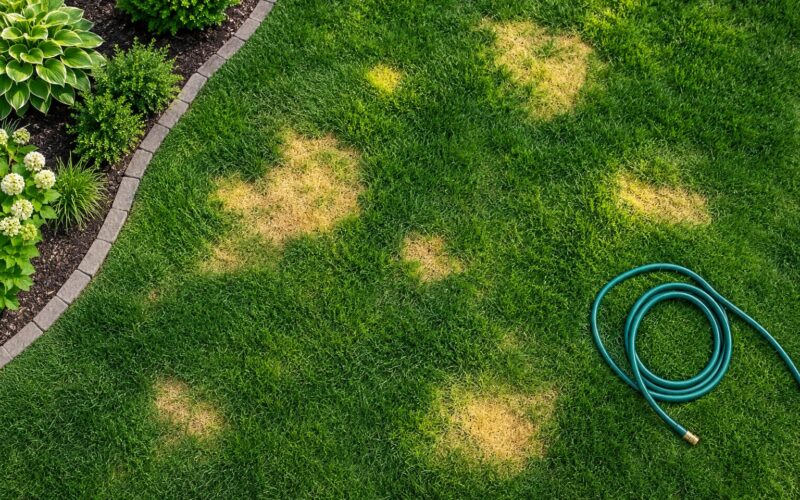
Root decay is the hardest failure to spot because most of the damage happens underground where nothing changes colour. What reaches the surface is movement: soil heaving upward in a ring around the trunk, new cracks radiating out across a patio or driveway, turf that is dying in a band along one side, or the whole root plate tilting after a wet windstorm.
A tree that leans more every month is telling you about the roots holding it up. The root flare is where you would expect to see the trunk widen into the ground, and if it is being swallowed by new soil or mulch, the root collar has been buried, which weakens the tree over years. Root damage from construction, trenching, soil compaction, or a mower cutting into the flare causes the same slow lean with none of the canopy signs showing up first.
How to tell pests or disease from ordinary stress
Look for repeat and pattern, not single incidents. Boring insects leave rows of small holes, sawdust-like frass below the branch, and D-shaped exit holes, often with sap ooze in spring. Emerald ash borer is the widely known example in North America, and oak wilt shows up as foliage browning from the top down on mature oaks. Anthracnose, Dutch elm disease, and Verticillium wilt each have their own signature, and local extension services publish current outbreak maps.
What you will not get from the internet is a diagnosis. If decline is spreading from one limb to the next year over year, get a tree identification and pest inspection before you buy anything to spray. Broad-spectrum pesticide applied to a stressed but healthy tree does more harm than good, and trunk injection is something a qualified applicator should be doing.
When a leaning tree needs urgent assessment
A slow, even lean that has been there for years is usually just how the tree grew, especially if it still puts out a full canopy every spring. The signal that matters is a lean that is new, that changes, or that got worse during wind and rain without recovering.
Mark the trunk with a marker or drive a nail into the wood at a fixed height and check it monthly. Sudden movement of the root plate, cracking ground on the lean side, or a trunk that bends low while staying otherwise healthy all point to root or trunk failure, and those get prompt attention rather than a monitoring plan.
Does a Dying Tree Always Need Removal?
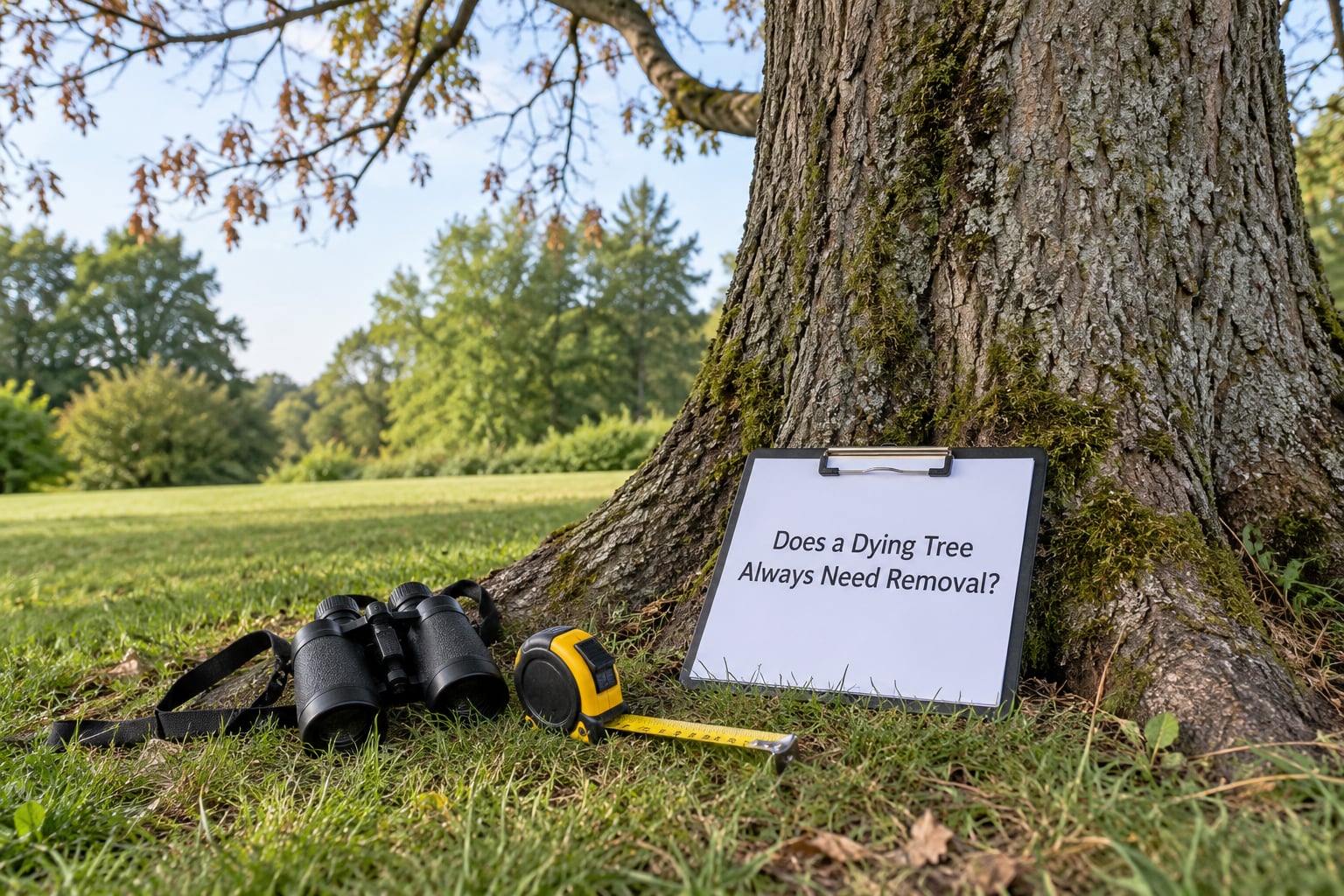
No. Most trees that look alarming in a single season are stressed, not dead, and the honest answer in every case is to judge over time. Arborists on the big forums keep repeating the same rule: wait about three months for health to become obvious, then watch the next leaf-out against neighbouring trees before deciding anything.
The most common false alarm is dormancy. A deciduous tree in early spring looks bare for weeks, some species hold last year’s leaves through winter, and evergreen stress shows up as brown tips that may drop weeks later. Leaf discoloration in summer usually points at water stress, root damage, or nutrient trouble rather than death, and fixing the cause often brings a full canopy back the following year.
The at-home check that separates the two is the scratch test. Take a live twig from a mid-canopy branch, scratch the bark away with a knife or coin, and look at the layer just underneath. Green and moist means living tissue. Brown and dry means that branch is dead. Test three twigs in different parts of the crown, because a tree can be partly alive on one side, and check the trunk itself since bark colour on a trunk is far less reliable than bark colour on a young twig.
How urgent is each warning sign?
Urgency is not the same for every symptom. A tree at the back of a lot in a slow decline and a dead limb hanging over a play area are different problems, even if the decay fungus looks identical. Here is how I would sort them.
| Warning sign | Response level | What to do now |
|---|---|---|
| Canopy thinning over one or two seasons, no structural damage | Monitor closely | Water deeply, mulch to the root flare, re-assess at the next leaf-out |
| Leaning, bark sloughing, cavities, conks, mushrooms at the base | Arrange an assessment promptly | Book an ISA Certified Arborist and stop work under the canopy |
| Dead limb over a roof, deck, driveway, sidewalk or play area | Restrict access, seek urgent help | Keep people and pets out, call a tree service or your utility company |
| Sudden lean change or ground cracking at the base | Urgent | Clear the fall zone immediately, call emergency services if over a road |
| Tree contacting a power line, even lightly | Urgent, utility only | Stay away and call the utility company, never the tree crew first |
| Dead tree already down and blocking a path or fence line | Prompt | Clear small limbs only; leave the trunk for a crew or equipment |
What to do before having the tree removed
Start by documenting. Take dated photos of the whole tree, the trunk, the cavity and the ground around it. If there is a chance of an insurance claim later, those photos and every receipt are the part you cannot recreate later.
Then work through the practical items: keep kids and pets out of the fall zone, check whether your city or county requires a removal permit for a tree over a certain size or in a certain location, ask your utility company whether anything near the tree is theirs, and get two or three written quotes that separate felling, hauling away, stump grinding and any utility clearance charges. Ask about protected species and about nesting birds while you are at it, since federal protections apply to many of the birds and bats that turn up in a hollow trunk during the removal window.
Before a replacement goes in the same hole, find out what killed the first tree. Where the cause is a root disease such as Verticillium, planting a susceptible species in the same spot usually repeats the outcome, and a different species or a different site is the fix.
How to choose between an arborist and a tree removal company
They do different jobs. A certified arborist diagnoses and advises, and will often tell you a tree can stay if that is the honest answer, which is why diagnosis and removal are frequently quoted as separate line items. A tree care or removal company carries out the felling, climbing and hauling, and is what you call once the decision is made or the work is an emergency.
For the person assessing the tree, look for ISA Certified Arborist or Board Certified Master Arborist credentials, liability and workers compensation insurance, and a written scope of work with a stated cleanup and damage responsibility. While the estimator is on site, ask what condition they think the tree is in, what they would do if it were kept, how they plan to protect the lawn and paving, and whether they have seen the same problem before on the same species. A company that answers only with a number and a start date is selling a job, not an assessment.
Frequently Asked Questions
Can a tree with brown leaves still be healthy?
Often yes. Brown leaves usually point to water stress, root damage, salt or nutrient trouble rather than death, and the tree can leaf out fully the next season once the cause is fixed. Scratch a twig: green and moist under the bark means living tissue. Wait through a full growing season and compare leaf-out with a similar tree nearby before deciding anything.
Is a hollow tree automatically unsafe and ready for removal?
No. Hollowing happens as a tree ages, and many hollow trees stand for years. What matters is how much sound wood is left and what the tree is leaning over. University extension guidance commonly treats a cavity spanning roughly a third of the trunk circumference as structurally unsound, which is why an arborist assessment beats guessing from the ground.
Should a tree be removed before storm season?
That is exactly when it should come down, if it is going at all. A dead or badly declining tree loses the internal strength that holds it together during wind, ice and wet soil, so storms are when branches drop with no warning. If the tree shows a new lean, ground cracking, conks, or dead limbs over anything you value, schedule the removal before the season rather than after the first storm.
Will homeowners insurance cover a dangerous tree?
It depends on the cause and on when you knew. Policies commonly respond to sudden accidental damage from a healthy-looking tree, while gradual decline, root damage and neglected limbs are often excluded, and insurers have been known to set short deadlines to trim or remove overhanging branches. Photograph the tree, keep every receipt, and raise it with your agent before work starts rather than after.
Is removing the stump necessary after tree removal?
No, not on a safety basis. The stump decays over several years on its own, and leaving it is fine in most cases. Grinding it below grade matters when you want to replant in the same spot, when the stump harbours pests, or when a lawn mower keeps hitting it. If a root disease is suspected, get the cause diagnosed first, because the species you replant matters as much as the stump.
Conclusion
The first move is documentation, not a decision. Take dated photos of the canopy, trunk, roots and any lean, note whether the symptoms are one-off or spreading, and keep people out of the fall zone if anything is overhead. If decline is progressing across seasons, or the tree leans toward a house, driveway, road or power line, book a certified arborist for an on-site assessment in 2026 rather than guessing from the ground.