To grind or remove a tree stump, most homeowners should cut the trunk flush with the ground and shave the remaining wood down 6 to 12 inches below grade with a stump grinder. Grinding a single average stump takes 30 to 60 minutes once the machine is on site, and the chips rake out cleanly for mulch or fill. Digging is only realistic for a shallow stump under about 6 inches across, and anything bigger, deeper, or sitting near buried utilities belongs with a tree service.
That is the short version of how to grind or remove a tree stump. The longer version is that the method you pick matters far more than how hard you work at it, and the four methods people try first are usually the wrong three. Forum threads on r/landscaping and r/lawncare repeat the same theme: the stump was bigger and deeper than expected, digging wrecked the lawn, and the rented machine was awkward to move. Plan the access and pick the method before the chainsaw comes out.
One more thing before anything else. Stumps are a nesting site for carpenter ants and borers, and they sit in the way of mowing, replanting, fence posts, and building pads. In a wooded lot or a pasture, that pressure to clear them grows on its own. Decide whether the job is worth a weekend, then read on.
Table of Contents
- What You Need Before You Start
- Safety gear that is not optional
- Tools for the other jobs
- Check the ground before you cut
- Step-by-Step: How to Grind or Remove a Tree Stump
- How to Grind a Tree Stump
- How to Remove a Tree Stump Without a Grinder
- What to Do After the Stump Is Gone
- Common Mistakes That Ruin a Stump Job
- Frequently Asked Questions
- How much does it usually cost to grind out a stump?
- Will a tree grow back if I grind its stump?
- How long does it take for Epsom salt to rot a stump?
- How deep should I grind a stump below grade?
- Can I grind a stump near a fence or irrigation line?
- When should I hire a tree professional instead of grinding it myself?
- Conclusion
What You Need Before You Start
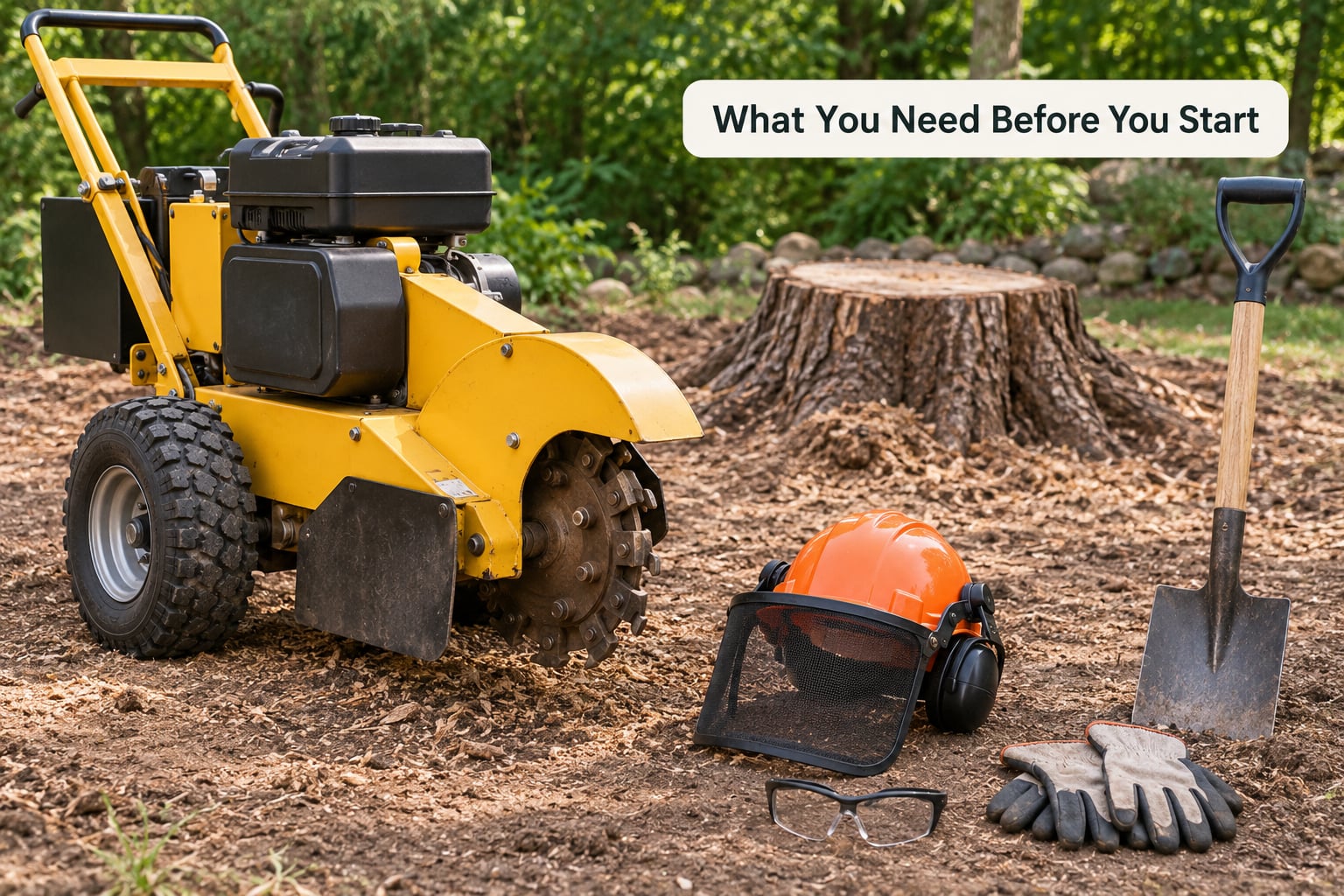
The grinder is the main event, but access decides whether you are renting one at all. Most walk-behind stump grinders are about 36 inches wide, so measure your narrowest gate and gate opening before you book anything. You also need room behind the machine to make a roughly 180-degree turn, because you will be repositioning several times per stump. On a slope, a standard 2WD grinder can lose traction or creep downhill mid-cut; a hydrostatic 4WD model handles uneven ground far better and is worth the extra rental tier if your yard tilts.
Safety gear that is not optional
- A face shield or full face shield over safety glasses. Grinding throws wood chips at head height.
- Hearing protection. Carbide wheels are loud well past the point of comfortable conversation.
- Chainsaw chaps and gloves if you are cutting the trunk down first.
- Steel-toe boots and long trousers. Nothing loose, nothing sleeveless.
- Keep kids, pets and bystanders well outside the swing radius. Lock the machine off when you walk away.
Tools for the other jobs
A mattock or digging bar, a shovel, and a sturdy root rake handle the dig-out option and the cleanup. A wheelbarrow or tarp catches chips; a shop vac or blower clears the dust off the fresh cut surface so you can see what you are doing. For the finish, keep on hand screened topsoil, a wheelbarrow, a garden rake, sod or a seed mix, and a hose. Add a tamper or the back of a flat shovel for compacting fill in layers.
Check the ground before you cut
Call 811 (or your local utility locate service) before you dig or grind anywhere near a fence line, an irrigation zone, a driveway edge, or a septic field. Grinders do not care what is under them, and a cut irrigation line or a clipped buried cable is an expensive afternoon. Watch for sprinkler heads too; elm and other common yard trees often sit in the middle of an old irrigation loop.
Step-by-Step: How to Grind or Remove a Tree Stump
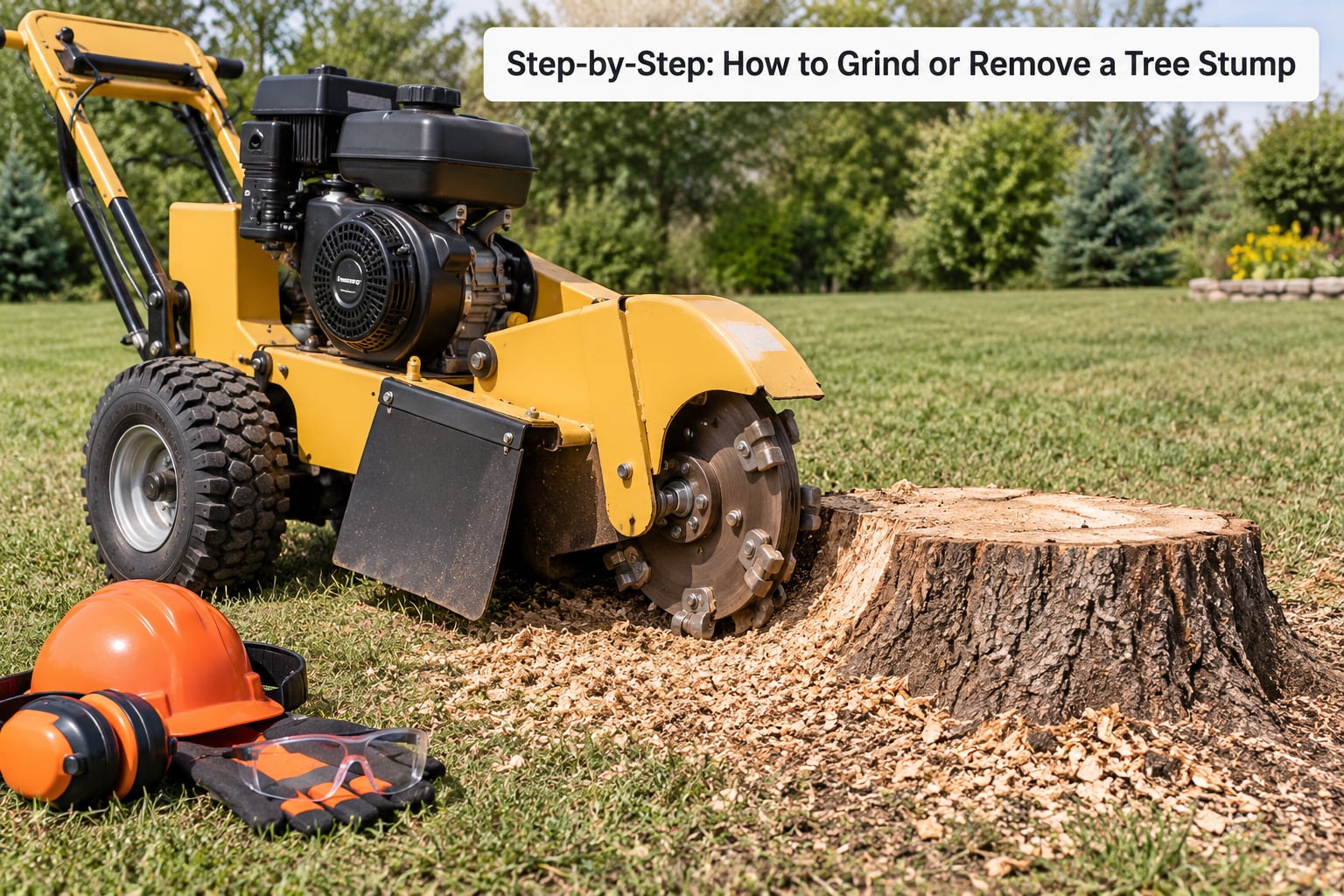
Start by matching the method to the size threshold. Under 6 inches across and barely below grade, a mattock and a stump-specific chemical treatment or a rental grinder on a half-day rental will do it. Between 6 and about 14 inches, renting a grinder is the clean answer. Above that, or where a building pad is planned, hire out. The decision is less about your strength and more about whether the machine physically fits where the stump is.
How to Grind a Tree Stump
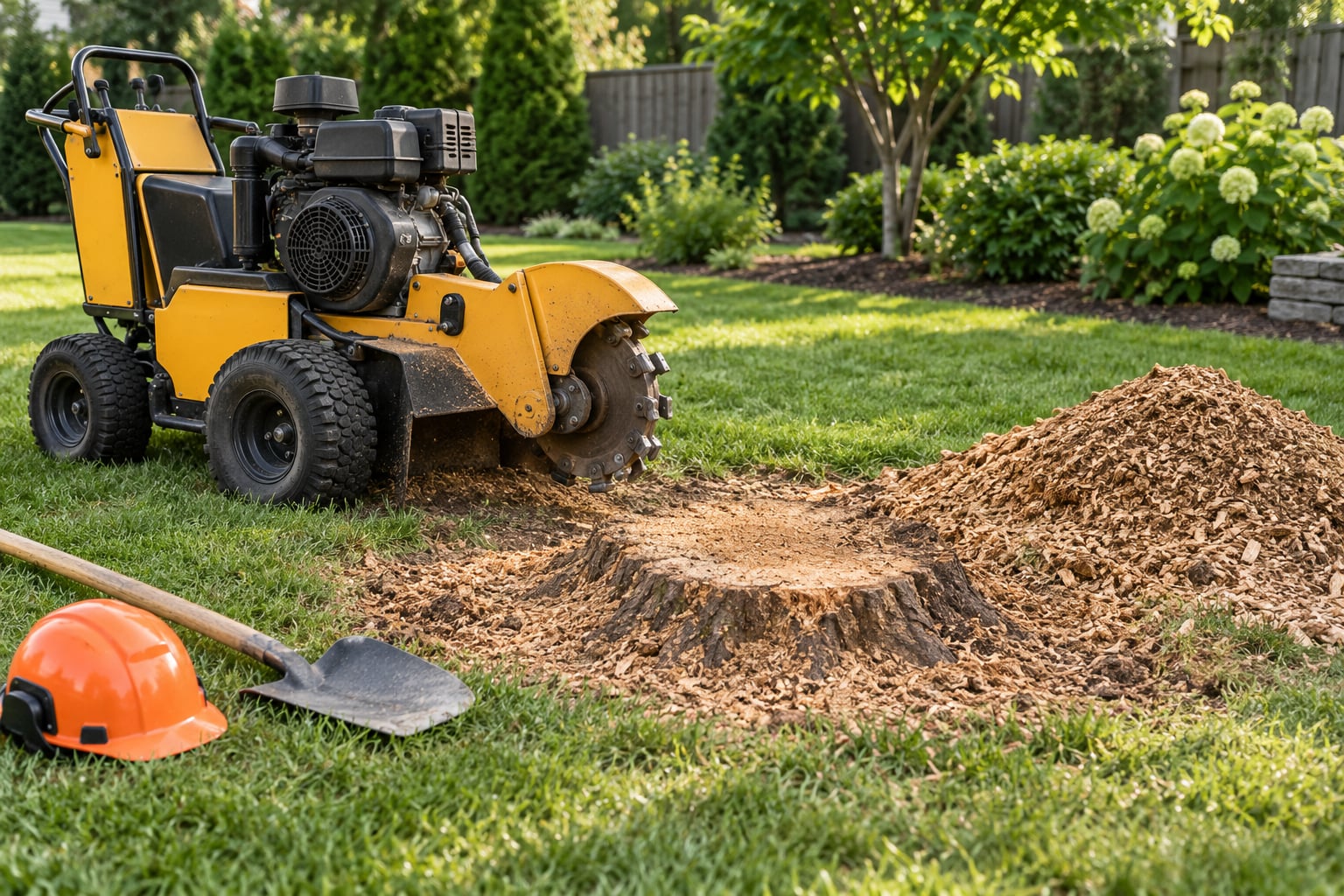
Grinding shaves the stump below the surrounding soil with a spinning carbide cutting wheel. The roots stay in the ground and decay over time, but the surface obstruction is gone, which is what most yards actually need.
- Cut the trunk flush. For a tall stump, make the chainsaw cuts on alternate sides and let the saw run through rather than forcing one deep cut from one face. You want the top of the stump level with the surrounding ground so the grinder has a clean starting line.
- Clear the debris. Rake and shovel away soil, rocks, and old fence or deck debris around the base. Hammer down any protruding nails or screws. Pull the wheel guard to full extension and take a slow walk around the stump looking for the wheel path.
- Set the wheel to rotate away from you. On most machines you reposition the handle to engage forward cutting. Check the label or the rental counter instructions before you start the engine.
- Lower the wheel onto the stump in small steps. Start shallow, sweep left to right across the face, then reposition to shave the leading edge back toward the machine. Repeat passes; resist the urge to drop the wheel in a single plunge.
- Grind below grade to match your goal. For a lawn, stop 6 to 8 inches below the surrounding soil and add more, because the ground will settle. For a fence post site, matching grade is enough. For anything structural, stop and hire the grubbing operator.
- Rake and backfill. Shovel out the chips, add soil, and compact in layers rather than one dump.
You will hear people ask whether the stump grows back. Most trees do not resprout once the stump is ground below grade and the roots are severed, but a few stubborn species do, particularly mesquite, hackberry, and yaupon. Watch for green suckers at the edges and cut them at the soil line before they harden off. Cedar and most common hardwoods stay gone once the wheel has passed through.
How to Remove a Tree Stump Without a Grinder
There are honest alternatives, and there are methods that waste an afternoon and hand you the same stump at sunset.
- Hire a stump grinding service. Usually the fastest route to a finished yard. The crew brings the machine, handles transport and towing, and leaves the chips raked into a pile. This is the right call for more than one stump, a tight access point, or any stump you would rather not wrestle with yourself.
- Grubbing with an excavator. The only method that removes the root ball and leaves buildable ground. It matters for a building pad, a driveway, or a post that needs to carry real load. It also tears up far more of the surrounding yard.
- An approved chemical treatment. Drill a pattern of holes 1 to 2 inches deep, apply a stump-killing herbicide labeled for stump use, and keep people and pets off the pile until the product has fully absorbed. Follow the label exactly; that label is the legal instruction. Note that tree service operators regularly get called back to stumps already treated several times and still fully solid, so set expectations that this is a slow method, not a fast one.
- Epsom salt or potassium nitrate. Widely used and widely debated. It draws moisture out of the wood and can soften a stump in a dry climate, but results are slow and inconsistent, and you will be repeating applications for months. Treat it as a patience exercise, not a scheduled finish date.
- Digging it out. Realistic for a shallow, small stump in loose soil. Work the soil away with the mattock rather than prying the whole ball up, undercut the taproot, and sever it. On anything wider than about 6 inches, expect a root ball far heavier than you planned for. Homeowners on r/DIYUK and r/Homesteading describe manual dig-out jobs as back-breaking and rarely a repeat operation.
- Burning. Not recommended. Fire sends most of its heat upward and outward, and users report being left with a solid core in the middle after a full burn. It also puts your fence, dry grass, and a hidden root network at risk. Skip it.
And two methods to never use: dynamite, and yanking the stump out with a truck or winch. The blast throws wood and soil into the air and sends shock waves through the soil far past the stump, which can crack foundations, walkways, and irrigation lines. Truck yanking works, then tears the lawn apart and snaps anything the roots had grabbed.
What to Do After the Stump Is Gone
Rake the chips out rather than leaving them. Wood chips decompose into organic matter, and ground that settles unpredictably later is the classic complaint about backfilled stump holes. Spread the chips as mulch over soil elsewhere if you like them there, but do not use them as fill.
Backfill with clean screened topsoil in 4 to 6 inch lifts, watering each layer lightly and tamping it before the next. This is the step homeowners skip, and it is why their new patch of grass dips a year later. Once you are level, spread an inch of topsoil over the bare soil, rake it smooth, water it in, and lay sod with the seams staggered, or seed the area and keep it evenly moist until it establishes.
For a lawn, you can sod over a well-settled backfill within a week or two. Do not build or pour concrete over backfill until the ground has settled and dried out over a full season, and if the plan is structural, have a geotechnical or grading professional look at it first.
Common Mistakes That Ruin a Stump Job
The failures are consistent enough to list, and each one has a simple correction.
- Stopping at grade. The surface of the hole then sits level with the surrounding lawn and collects water. Go at least 6 inches deeper than you think you need for turf.
- Diving the wheel into the soil. Dropping the wheel in one motion throws rocks and dirt and can tip the machine. Lower it in small steps and sweep.
- Ignoring stones and buried metal. Hitting a rock throws carbide teeth and dulls the wheel fast. Sweep the perimeter before the first pass.
- Skipping the utility locate. Call 811 first, every time, especially near fences, driveways, and old irrigation zones.
- Grinding on a slope with a 2WD machine. It can creep mid-cut. Rent a hydrostatic 4WD unit or leave the job alone.
- Backfilling with wood chips. Chips rot and collapse. Use soil, in compacted lifts.
- Removing too much soil around a stump. Digging a wide, deep bowl around the base leaves a hole bigger than the stump. Grind instead and refill from what you rake out.
- Trusting a chemical to finish the job in a week. Chemical and salt methods work on soft, decayed wood over many months. On a fresh green hardwood stump, plan on grinding.
- Working on a wet or frost-heavy stump with fire. An unstable stump plus open flame is how out-of-control yard fires start. Leave burning alone.
- Assuming the stump ends at the roots you can see. A taproot can run 3 to 4 feet down on mature trees. No method above ground reaches it except grubbing.
Frequently Asked Questions
How much does it usually cost to grind out a stump?
Cost depends on stump diameter, access, and how many you have. A rental grinder plus your own labor runs less than hiring a crew for a single stump, because the rental is a fixed daily fee. Hiring a service is often cheaper for two or more stumps, and cheapest per stump on a large, open lot. Excavator grubbing costs more but is the only method that yields buildable ground.
Will a tree grow back if I grind its stump?
Usually not. Grinding severs the stump below grade and cuts the roots, so most trees do not resprout, including cedar and many common hardwoods. Some species will push up suckers from the remaining root system, particularly mesquite, hackberry, and yaupon. Watch the edges for green shoots through the growing season and clip them at soil line while they are still soft.
How long does it take for Epsom salt to rot a stump?
Months, not weeks. Salt-based treatments draw moisture out of the wood and can soften a stump over repeated applications, typically over a season or more, and only work reliably where the soil is dry and the wood is already decaying. Fresh green hardwood resists the treatment entirely. If you need the ground sooner than that, grinding or grubbing is the faster path.
How deep should I grind a stump below grade?
For a lawn, take it 6 to 8 inches below the surrounding soil, since the backfilled area will settle over time. For a fence post site or a new planting site, grinding to matching grade is enough. For a driveway, shed, or anything carrying load, grinding is the wrong method entirely, because the root system stays in the ground and the soil above it is not structurally sound.
Can I grind a stump near a fence or irrigation line?
Yes, but only after you locate what is buried. Call 811 and your irrigation contractor before you cut, because grinders chew through drip lines and buried cables without hesitation. Keep the wheel shallow near known lines and grind down in slower passes, watching for water spray or a change in the cut. Septic fields are the exception, where you should not disturb the ground at all without guidance.
When should I hire a tree professional instead of grinding it myself?
Hire out when the stump is wider than roughly 14 inches, sits where the machine cannot reach or turn, is on a slope steeper than most 2WD grinders can hold, sits near buried utilities or a septic field, or needs to become a buildable pad. Hiring also makes sense for several stumps at once, since the crew and equipment travel cost is already paid.
Conclusion
Assess the stump and the access first, then grind. For most yard stumps under about 14 inches, cutting flush and shaving 6 to 8 inches below grade with a rented machine is the safest first choice and leaves you with fill and mulch for the finish. Hand it to a tree service when the stump is large, out of reach, on a slope, or conflicting with utilities, and to an excavator when the ground has to carry a structure. Either way, finish properly: rake the chips out, backfill with soil in compacted lifts, and let it settle before you sod.