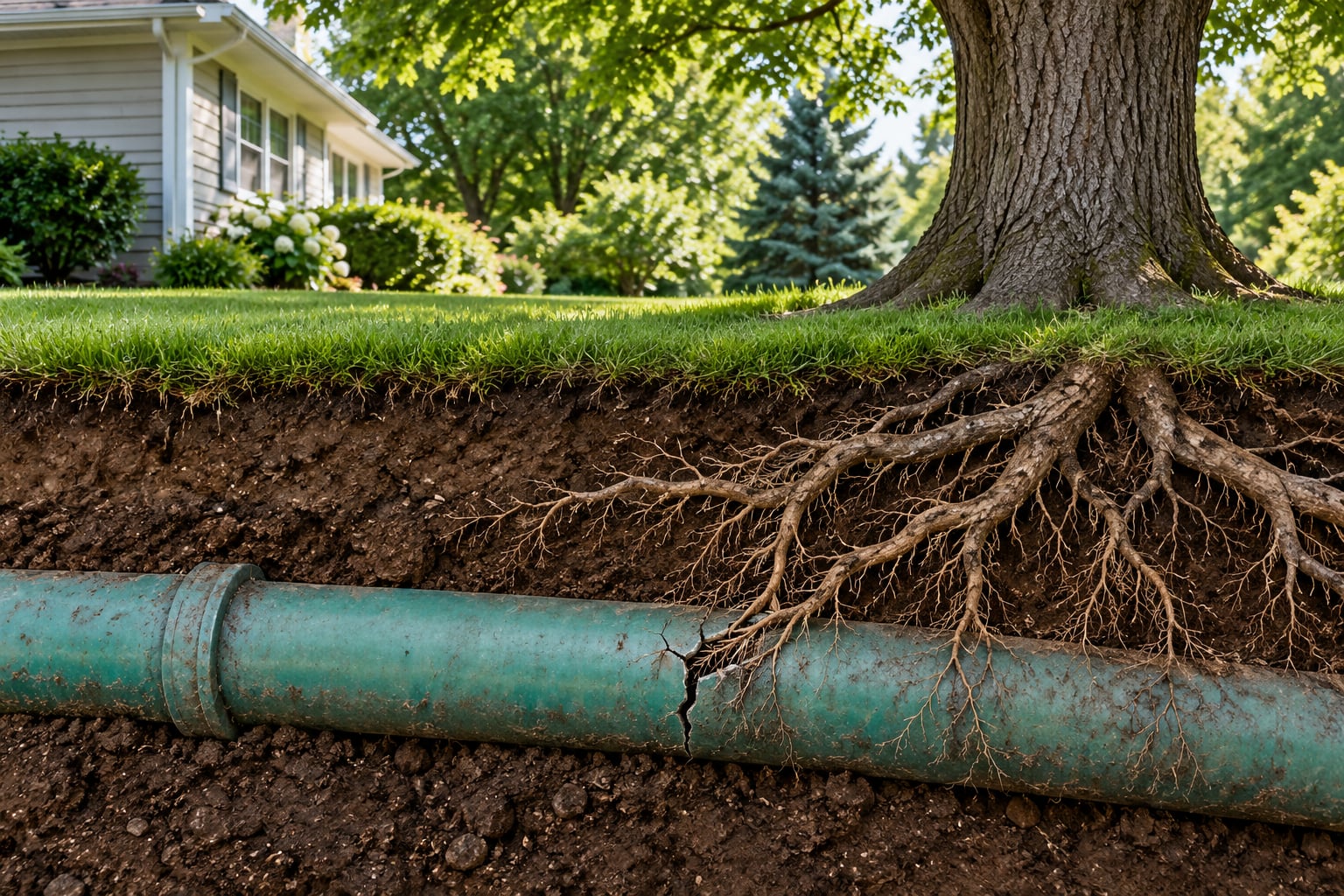
Tree roots in sewer line cause trouble for one simple reason: roots are drawn to moisture, and a sewer line that leaks or has a cracked joint gives them exactly what they want. The roots slip into the opening, thicken inside the warm, wet pipe, and slowly strangle the flow until the line backs up. The good news is that root intrusion is usually fixable, and it is almost always fixable early, before the pipe itself has to be replaced.
Homeowners usually notice this problem in stages. A tub drains a little slower than it used to, then a toilet gurgles, then a cleanup crew shows up twice in one season. By the third backup, the line is badly obstructed and the repair has jumped from a routine cleaning to a much larger job. This guide walks through what causes it, the eight signs worth acting on, how to confirm it, what each solution involves, and how to keep it from coming back.
Table of Contents
- What Causes Tree Roots to Enter a Sewer Line?
- Tree Roots in Sewer Line: 8 Signs to Watch For
- Which signs of tree roots in sewer line trouble need same-day service
- How to Tell Whether Tree Roots Are the Problem
- What Are the Best Solutions for Tree Roots in Sewer Lines?
- How Much Do Sewer Root Repairs Cost?
- Will homeowners insurance pay for tree root damage?
- How to Prevent Tree Roots From Coming Back
- How fast do tree roots grow back after treatment?
- When to Call a Plumber for Tree Root Damage
- Frequently Asked Questions
- How serious are tree roots in a sewer line?
- How much does it cost to remove tree roots from a sewer line?
- Does homeowners insurance cover tree roots in sewer pipe?
- How fast do tree roots grow back in sewer pipes?
- Should homeowners try to remove tree roots from a sewer line themselves?
- What to Do First
What Causes Tree Roots to Enter a Sewer Line?
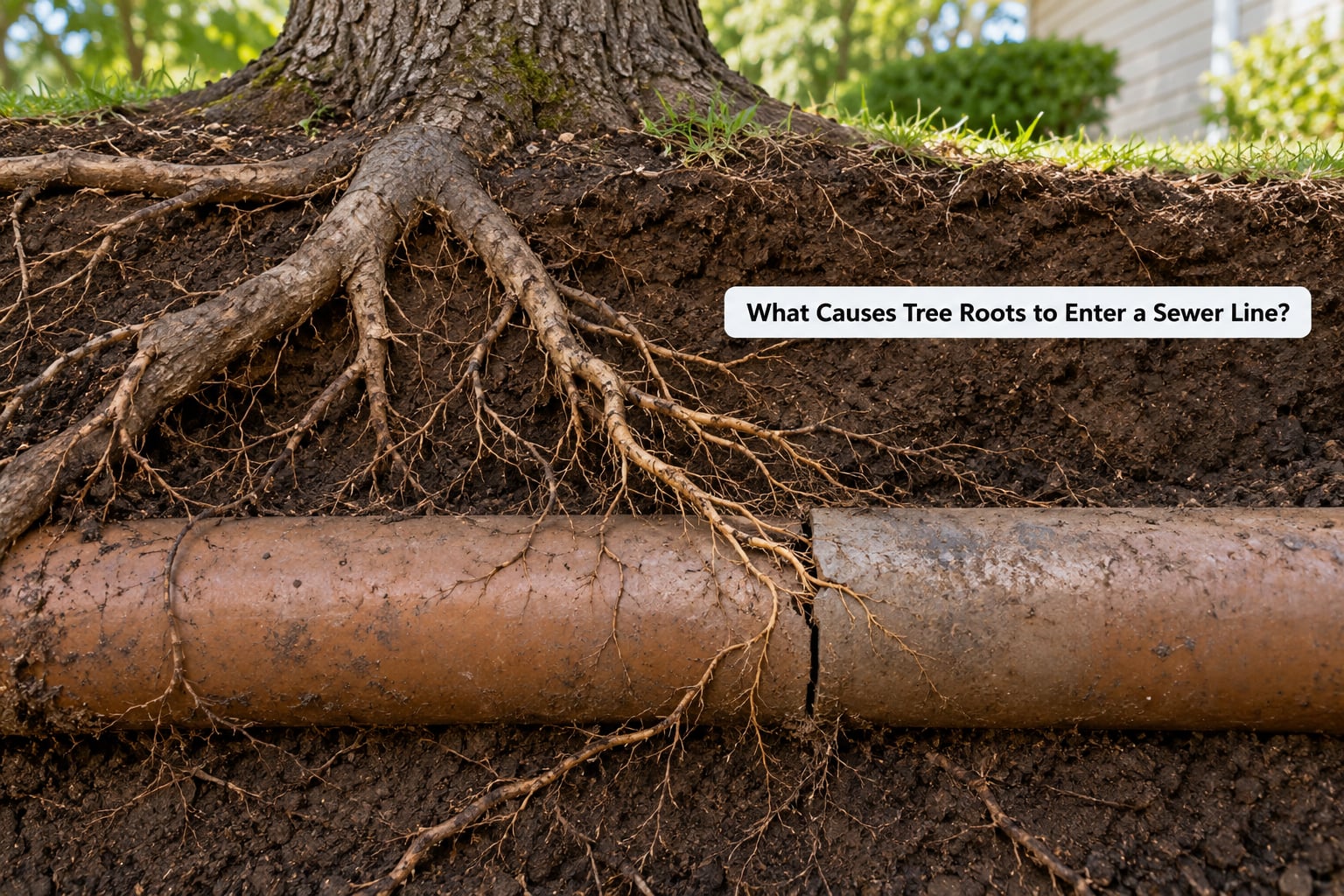
Roots do not attack intact pipe. In nearly every case, the pipe was already compromised by a crack, a loose or failed joint, a root intrusion at an old tap connection, or a section sitting in saturated soil, and the roots found that leak. Homeowners on plumbing forums describe it the same way: the roots are responding to a defect, not creating one.
Once a hair-thin feeder root detects vapor and seepage escaping from the damaged section, it grows toward the pipe, pushes into the opening, and finds a warmer, wetter environment inside. It thickens, sends out more feeder roots behind it, and starts catching the debris that rides along in the wastewater. A root mass works like a net at the narrowing point, and everything else collects there.
The reach involved surprises most people. Some species send roots out 100 feet from the trunk, well beyond the canopy, so the tree directly over the line is often not the guilty party. Inside the pipe, roots have been measured growing up to 25 feet along the length of the line.
Plumbers usually describe intrusion in two ways. Veil intrusion is the early stage, where a thin mat of roots hangs in the water and slows flow without stopping it. Tail intrusion is the advanced stage, where a thick root ball anchors to the pipe wall and physically closes off the line.
Older pipe is far more vulnerable than newer pipe, and material matters a lot.
| Pipe material | Root risk | Why | Typical home age |
|---|---|---|---|
| Vitrified clay | High | Brittle, hairline cracks, porous joints, frequent root entry | Pre-1980 |
| Cast iron | High | Corrodes internally, rough walls hold roots in place | 1900s to 1970s |
| Concrete | Medium to high | Cracks with soil movement; older designs are thin-walled | 1950s to 1980s |
| PVC or ABS | Low | Smooth wall, gasketed joints, resists root growth when installed correctly | 1980s onward |
| HDPE | Low | Flexible, tight joints, poor surface for roots to grip | 1980s onward |
One caveat on the plastic pipe row: properly welded and gasketed plastic pipe holds up well, but a bad joint or a contractor who drilled a hole and sealed it poorly creates the same weak point as any other material. Homeowners on r/Plumbing are skeptical of any diagnosis that blames roots without evidence of a defect, and that skepticism is reasonable.
Tree Roots in Sewer Line: 8 Signs to Watch For
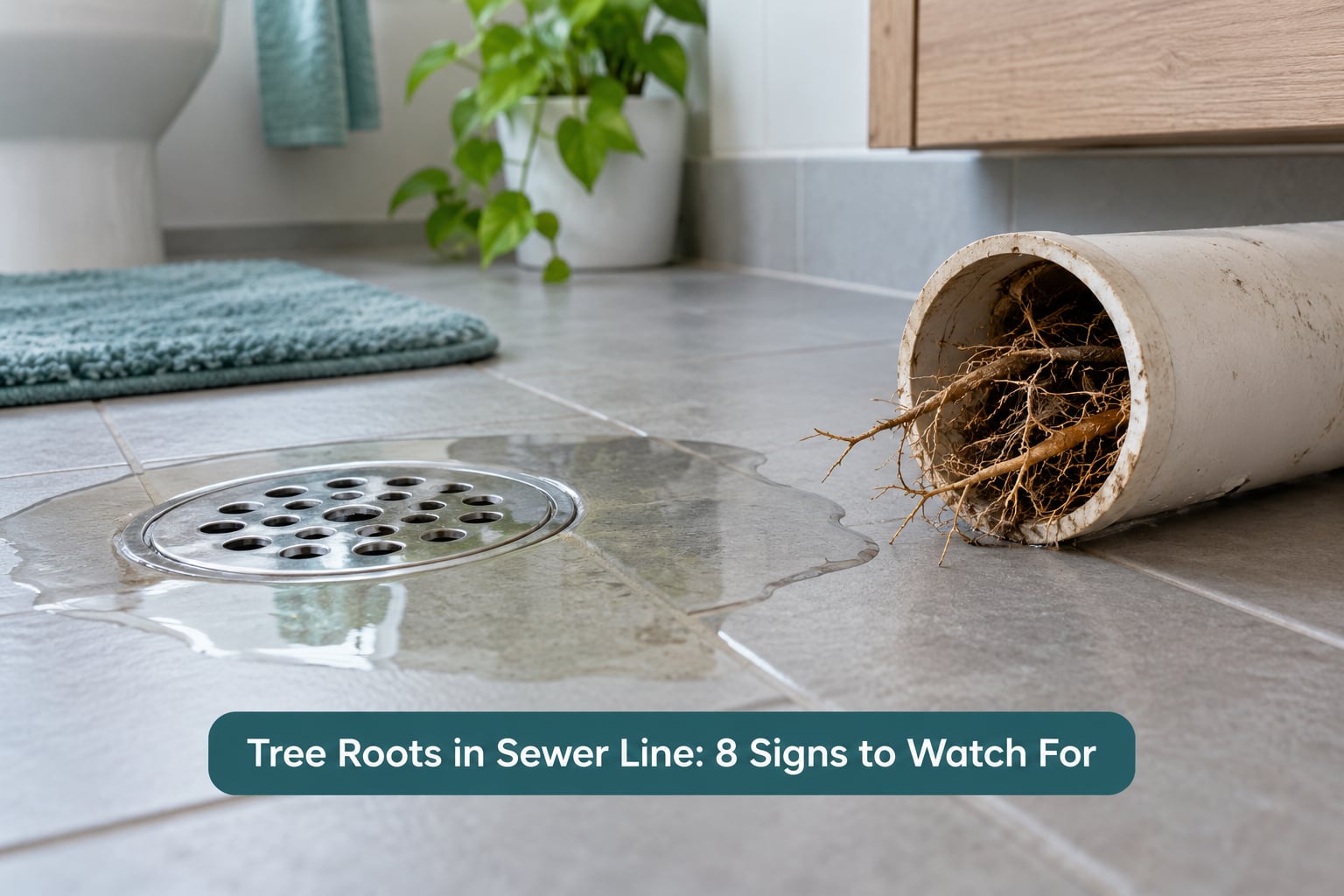
Slow drains across several fixtures are the earliest and most common sign. Gurgling when a nearby toilet flushes, recurring clogs in the same drain, a sewage odor in the yard or near a floor drain, unusually green grass over the line, a soggy patch or sinkhole in the lawn, sewage backups, and a sudden burst of vigorous tree growth all point the same direction.
- Multiple fixtures draining slowly at once. One slow sink is a clog in that sink. Every bathroom on the same branch draining slowly at the same time points to the main line.
- Gurgling from toilets and drains. That gurgle is air being pulled through a partial blockage as water tries to move past it.
- Clogs that keep coming back. If the same drain clogs every few weeks after cleaning, something is re-growing or re-accumulating upstream.
- Sewage odors indoors or outside. A smell near a bathroom, utility area, or low spot in the yard usually means gas from the line is escaping through a defect, which is also an open invitation to roots.
- A strip of unusually green grass. Roots leaking nutrients and water into the soil feed a narrow green band that grows faster and thicker than the rest of the lawn.
- Soggy ground or a small sinkhole. Escaping wastewater saturates soil, which can settle and create a depression. This is one of the more serious signs.
- Sewage backing up into tubs, floor drains, or the lowest toilet. This is the line telling you it is full, not slow.
- A sudden jump in tree growth. A tree that puts on heavy canopy or leaf growth in one season may be feeding on the line running beneath it.
Which signs of tree roots in sewer line trouble need same-day service
Not every sign is an emergency, and treating the mild ones like emergencies is how homeowners talk themselves into an expensive replacement they do not need. Sorting the symptoms by urgency takes about ten seconds.
| Sign | Urgency | Act within |
|---|---|---|
| Backing up sewage inside the home | Emergency | Stop using fixtures, call now |
| Soggy yard or sinkhole forming | Urgent | Same day to a few days |
| Multiple slow fixtures with gurgling | Urgent | Within a week |
| Recurring clogs in one drain | Moderate | Within a month |
| Unusual green grass strip | Watch closely | Note it, inspect within a season |
| Faint odor, no drainage change | Watch closely | Note it, inspect within a season |
The rule of thumb is simple: anything that puts sewage in the house is today, anything that puts water in your yard is this week, and everything else can wait for a camera inspection.
How to Tell Whether Tree Roots Are the Problem
You can narrow it down yourself, but you cannot confirm it without a look inside the pipe. A sewer camera inspection is the only reliable way to know what you are dealing with, and it is the step homeowners most often regret skipping.
Start with the least invasive checks. Note which fixtures are slow and whether the problem follows a branch or the whole house. Fill a tub and watch whether the toilet drains normally, which tests whether the branch line is clear. Locate your cleanout, usually a white or black PVC fitting near the foundation or in the yard, and note whether you can access it easily. That access matters later, because it is the entry point a plumber uses.
If you have a cleanout, a few homeowners pour a bucket of water down and watch the drain behavior at the cleanout. Slow drainage and a lack of overflow at the cleanout suggests a blockage between the house and that point. This is a rough test, not a diagnosis.
A camera inspection is what actually settles the question. The plumber runs a small camera on a push rod or a motorized crawler from the cleanout, and you watch the footage with them. Roots are unmistakable on screen, thick masses anchored to the pipe wall with debris caught behind them. The same footage shows you everything else that matters: grease buildup, mineral scale narrowing the pipe, a belly where the line has sunk, a section that has collapsed entirely, or a clean line with no roots at all.
That last possibility is the one worth taking seriously. Roots, grease, scale, and a collapsed pipe all produce slow drains, and only one of them is fixed by cutting roots. A line that is simply scaled down and coated in grease responds to hydro jetting, and a line that has sunk or collapsed will keep failing no matter how many times you clear it. Plumbers who take photos of the pipe condition at several points are also giving you evidence if the question of whether the pipe is cracked or was poorly installed ever comes up later.
Stop troubleshooting and call a professional when backups return more than twice, when a cleanout will not open, when the line is older than the house, when you smell sewage inside, or when any part of the job means cutting into the yard. Everything past that point is not a homeowner task.
What Are the Best Solutions for Tree Roots in Sewer Lines?
There are five real options, and the right one depends entirely on the condition of the pipe, not on the tree. Ranked from least to most invasive:
- Mechanical root cutting. A heavy-duty sewer auger spins a cutting head through the line and shaves the roots off the wall. It is the standard first step, it clears the obstruction fast, and it is also the reason clogs sometimes return within months. Roots regrow at the same point of entry because the defect is still there.
- Hydro jetting. High-pressure water scours the pipe wall, removing roots, grease, and scale in one pass. It cleans the whole line rather than one spot, which is why homeowners on forums tend to view it as the best value option when the pipe is not fully collapsed.
- Chemical root treatment. Foaming root killer or a copper sulfate solution is applied to the line and left to sit, killing roots on contact. Treat the label directions and local rules as gospel: over-application can harm the pipe itself, and these products belong in the line, never in your lawn or near a septic system.
- Trenchless lining or pipe bursting. CIPP lining installs a cured-in-place epoxy sleeve inside the existing pipe through a single access point, sealing cracks and gaps. Pipe bursting breaks the old pipe outward while pulling new pipe into place. Both avoid a full trench, preserve landscaping, and are the standard answer for a line that is cracked but structurally sound enough to stay in the ground.
- Full replacement. Dig out the line and install new pipe. It is the most expensive option and the only correct one when the pipe has collapsed, shifted out of position, or is badly deformed. It is not the right answer for roots alone in a pipe that is still round and intact.
| Method | What it fixes | Time on site | Expected lifespan | Regrowth risk |
|---|---|---|---|---|
| Root cutting (auger) | The blockage | An hour or two | Weeks to a year | High |
| Hydro jetting | Roots, grease, and scale along the line | A few hours | One to three years | Moderate |
| Chemical root treatment | Live roots at the entry point | An hour plus dwell time | Months | High |
| Trenchless lining | Cracks, offset joints, and entry points | Most of a day | 30 to 50 years | Very low |
| Full replacement | Collapsed or badly deformed pipe | Several days | 50 years or more | Very low |
One myth deserves clearing out. Removing the tree does not fix the line. Homeowners who have it done report the same thing: the root mass inside the pipe is still there, it still has to be cut out, and new growth from neighboring trees and remaining root systems keeps finding the same defect. Cutting down a mature tree also leaves the root plate in place, which can settle and damage the very pipe you were trying to protect. Fix the line, then decide what to do with the tree on its own merits.
How Much Do Sewer Root Repairs Cost?
The range is enormous, which is exactly why it is worth understanding before anyone hands you a quote. A routine clearing is a service-visit cost. Lining a line is a project in the low thousands. A full replacement with excavation can run into the tens of thousands. Owners on home improvement forums describe that gap as the moment they stop feeling in control, so get more than one quote and make sure each one is written down and itemized.
These are typical US ranges, and they vary by region and change over time. Regional labor rates, driveway and landscaping access, and the depth of the line all move the final number more than the method itself.
| Repair | Typical US range | Main cost drivers |
|---|---|---|
| Camera inspection | Low hundreds | Travel, report and footage |
| Mechanical root cutting | Low hundreds | Access, length of line, number of visits |
| Hydro jetting | Roughly seven to ten hundred | Jetter size, footage, water access |
| Chemical root treatment | Low hundreds | Product used, repeat applications |
| Trenchless lining | Several thousand dollars | Footage of line, resin, access pits |
| Full replacement | Several thousand to well over twenty thousand | Excavation depth, yard restoration, tie-ins |
Per foot, expect trenchless methods to run in the low hundreds and open replacement to run several times that, so a 100-foot line tells a very different story from a 40-foot line. The three factors that move the quote most are footage, how easy the crew can reach the pipe, and whether the line is still round.
Will homeowners insurance pay for tree root damage?
Sometimes, and the reason is usually timing rather than the tree. Most policies treat gradual seepage and root intrusion as a maintenance issue and exclude it, because roots are treated as a slow, ongoing condition rather than a sudden event. A pipe that fails abruptly and backs up sewage can sometimes be claimed as a sudden loss. This varies by carrier and by state, so read your policy and ask your adjuster directly rather than assuming either way. Photograph everything the day you notice the problem, and keep the inspection report and written estimates.
How to Prevent Tree Roots From Coming Back
Prevention is mostly about knowing where your line runs and watching it. Root damage is common in older homes, in neighborhoods with mature trees, and in any house where a large tree sits within the reach of a lateral line.
- Schedule a camera inspection every one to two years if you have recurring clogs, clay pipe, or a mature tree near the line. It is cheap compared to what a backup costs.
- Know where the line runs. Check your home’s survey, your original septic or sewer permit, and your municipality’s utility records. If you cannot find it, a plumber can locate it during an inspection. Never dig without calling 811, the national before-you-dig number, and wait for the marks to clear.
- Think about distance before planting. Keep new trees well clear of the sewer easement, and check with your utility about required clearances before you put anything in the ground.
- Choose smaller-rooted species near the line. Dogwood, redbud, Japanese maple, and crabapple are generally better choices than willow, silver maple, or poplar, whose aggressive root systems reach far and seek moisture.
- Consider a root barrier when a tree has to stay. Installed along the line, a physical or chemical barrier redirects roots downward or away. Chemical barrier fabric commonly carries a service life in the mid-teens, so it is a long-term fix, not a lifetime one.
- Fix the leak, not just the roots. A line that no longer leaks does not attract roots. Sealing the defect through lining stops the entry point that started everything.
- Use maintenance products only as directed. Root treatment chemicals belong in the sewer line and follow the label, full stop.
How fast do tree roots grow back after treatment?
Cutting alone buys you the shortest stretch, sometimes a few months, because the entry point is untouched. Chemical treatment extends that a bit but does not change the geometry. Hydro jetting typically holds a year or two before you see the same slowdown, and a lined pipe essentially stops the problem at the source. Spring and fall are the danger windows, when soil is moist and root growth accelerates, so schedule preventive work before those seasons rather than during them.
When to Call a Plumber for Tree Root Damage
Call today if sewage is backing up into the house, if you see water pooling in the yard, if a toilet is gurgling constantly, or if you smell sewage inside. Shut off the water and stop using the affected fixtures in the meantime.
Call this week if several fixtures are slow, if clogs keep returning, or if the yard is soft in a new spot. There is no harm in a camera inspection for any of these, and it is the step that keeps a small problem small.
Before you call, gather a few things that make the visit far more useful: which fixtures are affected, when the problem started, how many cleanouts or previous clearings you have had, whether the home is on a septic system or a municipal sewer, where the cleanout is, and the age of the house if you know it. That five minutes of notes saves diagnosis time on the truck.
Then ask these questions before you sign anything. A contractor who answers all of them clearly is usually the one worth hiring.
- Can you show me the camera footage and the exact condition of the pipe, not just the blockage?
- Is the pipe still round, or is it collapsed, bellyed, or shifted?
- Why is the cheaper option sufficient here, and what would make it insufficient later?
- Does the quote itemize the cleaning, the repair, and any restoration separately?
- What is the expected regrowth interval for this method, and what happens when it returns?
- What pressure and what equipment will you use for hydro jetting?
- Is the work covered by any warranty, and does the warranty cover root intrusion specifically?
Frequently Asked Questions
How serious are tree roots in a sewer line?
It depends on the pipe, not the tree. Roots in a line that is still round and intact signal a clearing and possibly a lining job. Roots in a line that has collapsed, sunk, or shifted mean no amount of cutting will hold, and the line has to be relined or replaced. A camera inspection is what tells you which situation you are in, so treat a recurring slow drain seriously even if nothing is backing up yet.
How much does it cost to remove tree roots from a sewer line?
Routine root cutting and hydro jetting usually run in the hundreds, trenchless lining runs into the low thousands, and full replacement with excavation can reach well over twenty thousand. Per foot, trenchless work is far less expensive than open replacement, so a short line is a much easier problem than a long one. These are typical US ranges that vary by region, yard access, and depth of the line.
Does homeowners insurance cover tree roots in sewer pipe?
It depends on how the failure happened. Most policies treat gradual seepage and root intrusion as maintenance and exclude it. A pipe that fails abruptly and backs up sewage may qualify as a sudden loss, though carriers and states differ. Photograph the damage the day you find it, keep the camera report and every written estimate, and ask your adjuster directly instead of assuming either answer.
How fast do tree roots grow back in sewer pipes?
After cutting alone, roots can reappear within a few months because the entry point is still open. Chemical treatment stretches that a little. Hydro jetting usually holds one to two years before the same slowdown returns. A lined pipe closes the crack where roots entered, so regrowth is largely a non-issue. Growth accelerates in spring and fall when soil is moist.
Should homeowners try to remove tree roots from a sewer line themselves?
Occasionally, with the right rented auger and a clear cleanout, but it is usually a false economy. You cut the roots, leave the defect, and the clog returns a few months later. Do not put root treatment chemicals into your lawn, your septic system, or anywhere the label does not call for them, and never dig without calling 811 first. If backups happen more than twice, hand the job to a licensed plumber with a camera.
What to Do First
If sewage is backing up, stop using those fixtures and shut off the water if you can do it safely. Then take a few photos and a short video with your phone, write down which fixtures are affected and when you first noticed it, and locate your cleanout if you can.
Call a licensed plumber and ask for a sewer camera inspection. Watch the footage yourself, ask whether the pipe is still round, and get a written estimate that separates the clearing work from any repair. That one hour of diagnosis is what keeps a routine clearing from turning into a project you did not plan for.