Your septic tank usually sits 10 to 25 feet from your foundation, off the main drain line, buried deep enough that only the access lid shows. Learning how to find your septic tank location starts with your county health department’s permit records, then moves to surface clues, measurement, and a soil probe if the paperwork comes up empty.
You cannot pump, inspect, repair, or build anywhere near your system without knowing where the tank is. An unlocated tank means extra charges on every service call, and a shovel in the wrong spot can crack a tank and dump a thousand gallons into your yard.
This guide walks through five ways to locate it, roughly in the order that costs you the least, plus what to do when your county has no records at all.
Table of Contents
- What You Need
- Step-by-Step: How to Find Your Septic Tank Location
- Step 1: Check County and Health Department Records
- Step 2: Look for Visible Signs of the Septic System
- Step 3: Measure the Usable Septic Layout
- Step 4: Use a Septic Tank Probe Carefully
- Step 5: Confirm the Location Before Digging or Pumping
- Common Mistakes
- Quick Tips for Finding the Right Access Point
- Frequently Asked Questions
- How deep is a septic tank lid usually buried?
- What tool can I use to locate a septic tank?
- How far is the septic tank from the house?
- What happens if you don’t know where your septic tank is?
- Is there an app that can find my septic tank?
- My county has no septic records. What should I do?
- Conclusion
What You Need
None of this needs a backhoe. Gather these first and the job takes an afternoon.
- Your county septic permit file. Most counties keep permit applications, as-built drawings, and inspection records for every system they approved.
- A tape measure, a marker, and flagging tape to mark the house walls, drain exit, and each probe point.
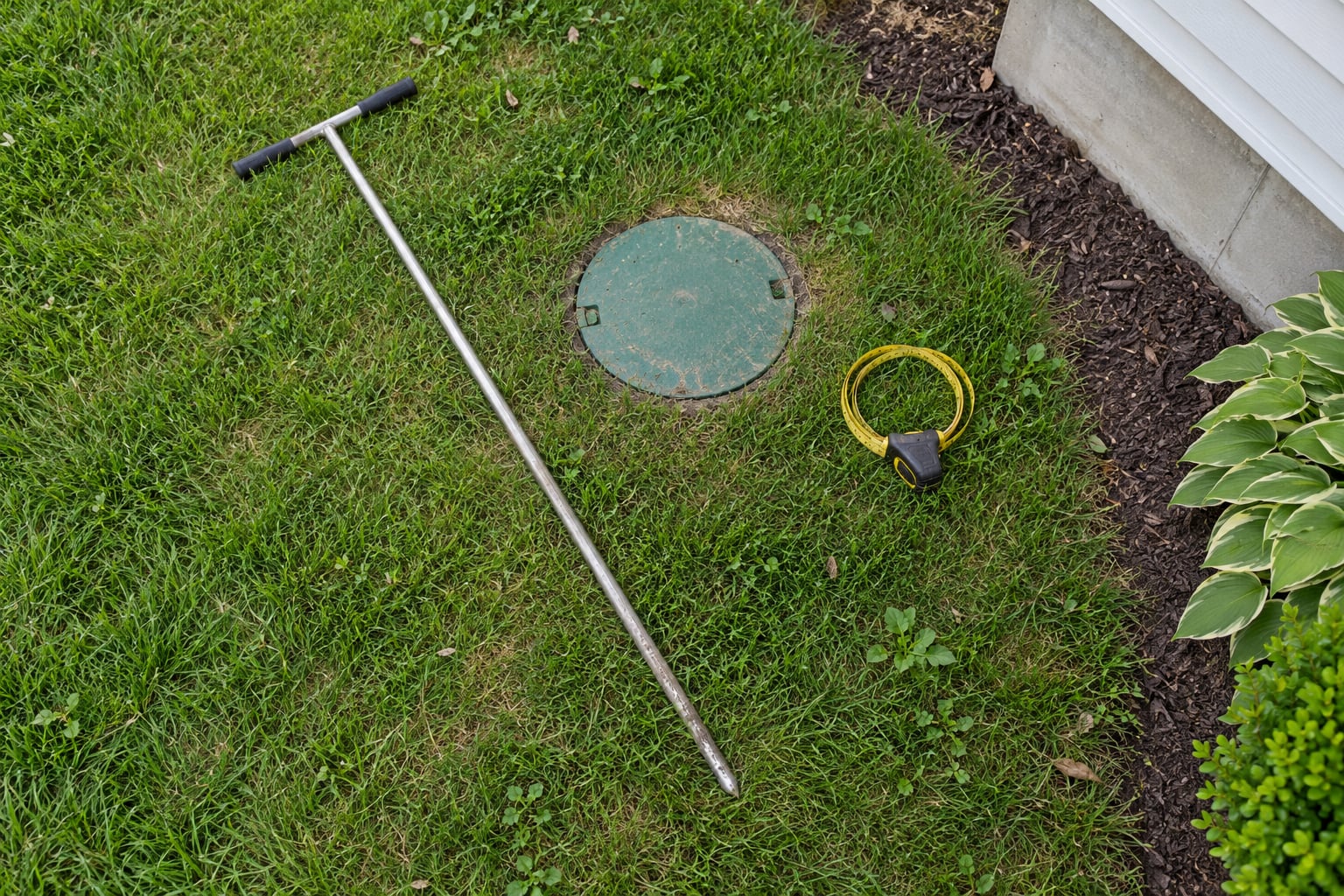
- A soil probe or steel rod, about 4 to 6 feet long. A straight length of rebar or even a straightened coat hanger works in a pinch.
- A small hand trowel for the shallow test hole at a suspected lid edge.
- Work gloves and eye protection. Old lids are often rusted steel or brittle cast concrete.
- Your closing documents or property survey, if you bought the home recently. The survey is where septic lines often show up first.
- Clear access to the yard, plus a phone for calling 811 before any digging.
Step-by-Step: How to Find Your Septic Tank Location
Step 1: Check County and Health Department Records
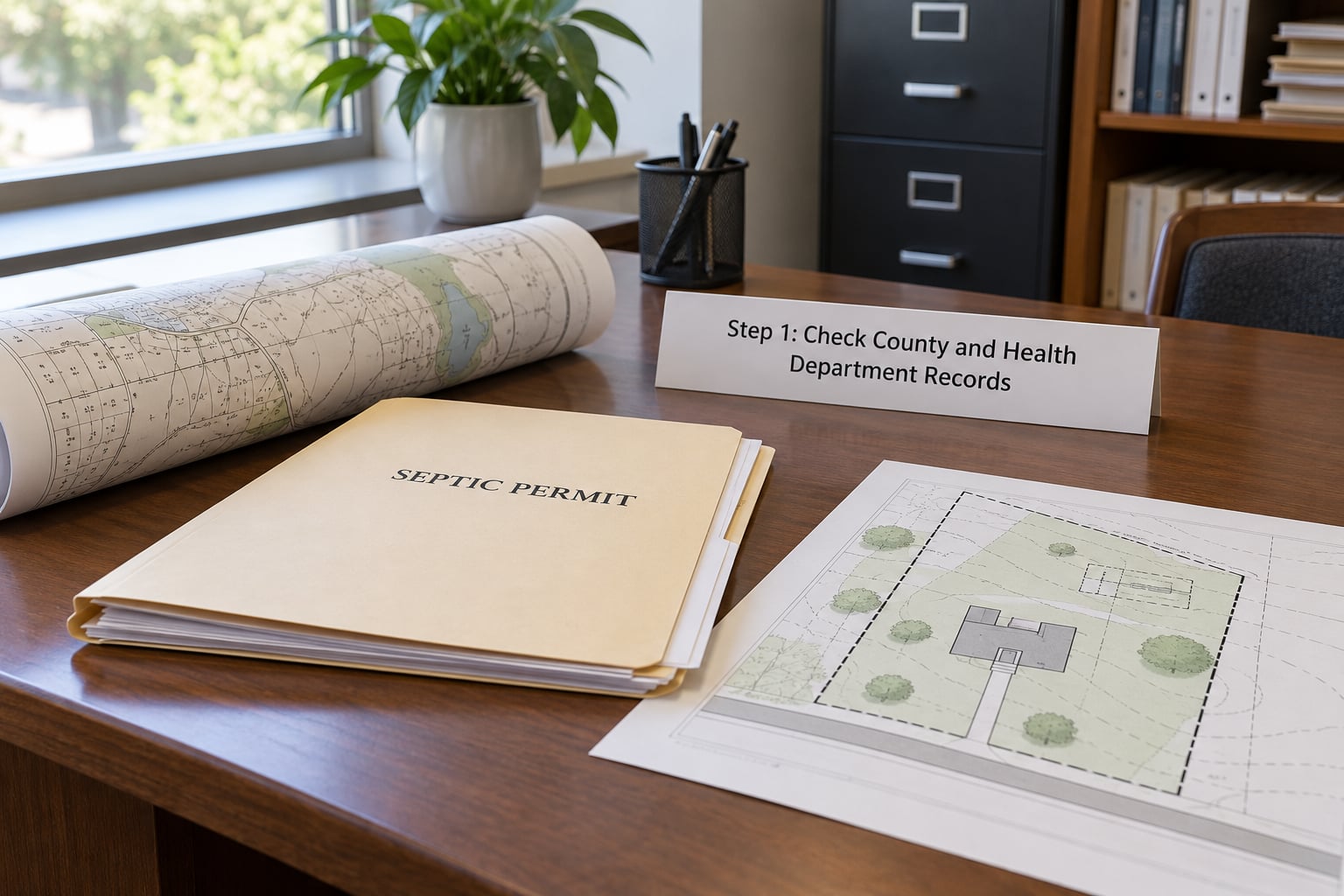
The easiest and most reliable method is your county health department, county environmental health office, or county septic program, which is required to hold permit and as-built drawings for systems they approved. Ask for the septic permit file by address or parcel number, and the as-built drawing inside it usually shows the tank footprint and the drain field layout.
If you get nothing, ask these specific questions at the counter:
- Is there a septic permit on file for this parcel, and is the drawing an as-built or only a permit application sketch?
- Has the system ever been inspected, pumped, or repaired, and is there a record of that work?
- Does the county hold a GIS layer or online parcel map that shows septic systems?
- Can you pull the records for the two parcels on either side of yours, since tanks often sit near a shared line?
Some states centralize these files at a state environmental agency rather than the county, and a few only keep paper records for the oldest decades. Your county clerk or tax assessor can also have the recorded subdivision plat, which occasionally shows the system even when the health department has no permit.
Ask the homeowner who sold you the house too. People often forget that the closing packet already contains the pump record and the permit copy that the county never received.
Step 2: Look for Visible Signs of the Septic System
Surface clues narrow your search area, but they never confirm a location on their own. Walk the yard and note anything out of place.
- An access lid or riser. A flush concrete, plastic, or fiberglass lid, or a green plastic riser collar standing a few inches above grade, is the tank or a distribution box. Some lids are buried completely.
- Greener grass. In spring, homeowners often spot the tank from a second-story window because the grass over it is noticeably lusher or, in a dry spell, greener than the rest of the yard.
- A slight depression or raised mound. Settled backfill often leaves a shallow dip, and sandy soil can leave a low bump instead.
- A brown ring. Plugs and effluent around a leaking tank or failing distribution box can kill or stain the grass in a rough circle.
- New sod or fresh topsoil. Repairs, additions, and driveway work leave obvious seams in an older lawn.
Treat every clue as a lead, not proof. Grass responds to soil moisture and sun, and a bare patch may be a pet’s path. The real answer comes from a probe or a professional, not from the lawn.
Step 3: Measure the Usable Septic Layout
Measurements turn a vague hunch into a two-foot-wide target, and this is the step most skipped. Start at the point where the main sewer line leaves the foundation, usually the 4-inch pipe in a basement wall or the cleanout, the capped vertical pipe beside the foundation.
From there, work with a few fixed rules:
- The tank is typically 10 to 25 feet from the foundation, on the downhill side where gravity helps.
- A single-family home usually has one tank, sometimes a second smaller one serving a cottage or workshop. Larger homes and homes with a kitchenette, wet bar, or guest suite can have two.
- Common residential tanks hold 1,000 to 1,500 gallons and are roughly 4 by 8 or 4 by 10 feet, so expect a couple of lids spaced a few feet apart rather than one small square.
- The drain field, also called the leach field, starts at the tank outlet and typically runs another 20 to 100 feet further out. It is the larger footprint and the one with the strict keep-clear zone.
- Local code sets minimum setbacks, usually measured from the tank and the drain field, and those distances tell you where the tank cannot be.
Sketch this on paper as you go. A simple top-down map of the house, the drain exit, the setback lines, and your probe points is worth more than any app.
Step 4: Use a Septic Tank Probe Carefully

A soil probe finds the tank by feel in about twenty minutes once you know where to stand. Push straight down in short strokes, lifting the tip a few inches each time so you do not bury the rod.
Work in this order:
- Stand about 8 to 10 feet out from where the sewer line exits the foundation, on the side the system is most likely on.
- Probe every 12 inches along that line, marking each point with flagging tape.
- Push to a depth of 3 to 4 feet. Most lids sit somewhere in that range, though risers and mounding push them shallower and deep-set plastic tanks go past 4 feet.
- Feel for a change. A concrete or cast iron lid gives a dull, solid thud and stops dead. A rock gives a similar hit, so confirm the depth from more than one probe point.
- When the hits line up along a straight line about 4 feet apart, you are looking at the tank’s two lids. Mark the corners and stop.
If the probe sinks with no resistance, you are likely past the tank, so move back toward the house or try the other side. A hollow drum sound means you found the tank body but missed the lid, which tells you the lid is offset to one side.
Stop probing immediately if you hit something hollow and round, or a smaller box-shaped lid. That is a distribution box, and it means you are already at the outlet end of the system.
Step 5: Confirm the Location Before Digging or Pumping
Once you have a candidate spot, confirm it before anything heavy touches the ground. Expose only a small area with a hand trowel, far enough to see the edge of a lid or a collar, and leave the rest to a professional.
Call 811 before you dig, every time, and wait for the locate to clear. Do not run a mini-ex, skid steer, or riding mower over the tank or the drain field. Compacted soil over a drain field can kill it, and the repair runs far past the cost of locating the tank in the first place.
Get a written record while you stand there. Photograph the exposed lid with the house in the background, note the distance from the foundation, write the date on your map, and put it with your closing documents. This is the single most useful thing you can hand to the next owner or the next pumper.
Call a licensed septic inspector or a pump truck operator if probing is inconclusive, if the tank sits under a driveway or patio, or if the system has a history of problems. Electronic locating equipment traces the drain line and tank without any digging, and it is the sensible answer when the record is missing and the ground tells you nothing.
Common Mistakes
Most of the damage comes from a handful of predictable errors, and every one of them is avoidable.
- Digging at a guess to save a phone call. A wrong guess can crack a tank, cut the main line, or bury a distribution box under fresh soil. Probe and confirm first, every time.
- Confusing the drain field with the tank. The field is a broad gravel bed 20 to 100 feet beyond the tank, often with no lid at all, and it needs far more room than the tank does. Mark the whole footprint, not just the lid.
- Skipping the records because the office is closed or the file is old. One phone call to the health department, the clerk, or the assessor is free and often ends the search in ten minutes.
- Trusting the grass. A greener stripe proves nothing. Probe it before anyone quotes you a price to open a hole there.
- Booking the pump before the lid is located. Pumpers charge extra to find a buried tank, and some will not come out at all. Locate the access point, or confirm that you will be on site to help find it.
- Letting a seller dodge the pump during escrow. A seller who suddenly will not pump is telling you something. Ask for the last two pump records and the tank’s location in writing before you close.
- Skipping 811. Septic tanks sit in the same ground as water lines, gas lines, and buried cables.
Quick Tips for Finding the Right Access Point
A few small habits make the difference between a clean find and a messy afternoon.
- Compare records against what you see. If the drawing puts the tank 30 feet out with a 15-foot setback line, something is off, and the plan may be to scale rather than measured.
- Probe on a dry day. Wet or frozen ground makes the rod jump and hides the soft resistance over a mound.
- Work from the house toward the field, never the reverse, so you follow the pipe in the direction the flow goes.
- Mark corners with paint on a permanent object such as a paver or a fence post, not just stakes that will vanish in a week.
- Ask your neighbors whether they have a map of their own system and whether the tank was ever under the driveway before a repave. Layout patterns often repeat on the same street.
- Write down the tank size, the lid material, and the distance from the foundation. A future pumper will ask.
- Plan the drain field first if you are building. Patios, sheds, driveways, fire pits, and deep-rooted trees all have their own restrictions on top of the tank’s.
Frequently Asked Questions
How deep is a septic tank lid usually buried?
Most residential tank lids sit between 3 and 4 feet below grade, though shallow tanks in sandy or mounded soil can be closer to 18 inches and deep-set plastic tanks can run past 4 feet. A riser installed over the lid brings the access point up to grade so nobody has to dig to find it again. That is why a probe that finds nothing at two feet is not proof the tank is gone.
What tool can I use to locate a septic tank?
A soil probe is the standard DIY tool: a 4 to 6 foot steel rod or piece of rebar pushed into the ground in 12-inch increments. A straightened coat hanger works in a pinch. Concrete and cast iron lids give a dull, solid thud, plastic lids feel slightly springier, and a rock feels deceptively similar, so confirm every hit from at least two probe points before you dig.
How far is the septic tank from the house?
Usually 10 to 25 feet from the foundation, measured from where the main sewer line exits, and on the side where the ground slopes away. The tank is never directly under the house and never in the side yard next to a wall you intend to dig. The drain field starts at the tank outlet and commonly extends another 20 to 100 feet beyond it.
What happens if you don’t know where your septic tank is?
Every service call gets more expensive, because the pumper has to add a locating fee or a hand-dig charge. Pumping becomes a gamble, inspections are harder to schedule, and any building project has to stop until the tank and drain field footprint are known. If you cannot locate it yourself, an electronic locating service is far cheaper than breaking a tank or a line.
Is there an app that can find my septic tank?
No consumer app locates a tank, because the tank is buried metal or plastic with no signal to receive. The only reliable digital option is your county’s GIS or online permit portal, which shows systems the county has on file. Everything else is the county health department by phone, or a licensed locator using a transmitter and a receiver above ground.
My county has no septic records. What should I do?
Ask the county clerk and tax assessor for a recorded subdivision plat, then check whether a state environmental agency holds older files. Neighbors often know where their own tank sits, and older homes sometimes have a paperwork trail in the closing documents that the health department never received. If all of that comes up empty, skip to probing from the drain exit, then call a licensed locator.
Conclusion
Start with one phone call to your county health department and ask for the septic permit file and as-built drawing for your parcel. That single step resolves the search for most homeowners, and it costs nothing.
When the file is missing, measure from where the sewer line leaves the foundation, probe in 12-inch increments 10 to 25 feet out, and treat grass color as a hint rather than proof. If the tank turns out to be under a driveway or a patio, or probing stays ambiguous, hire a licensed septic inspector or locator rather than guessing.
Once you find it, mark it permanently, photograph it, and file the map with your closing documents. Knowing how to find your septic tank location is a twenty-minute afternoon now, and it saves a very expensive afternoon later.