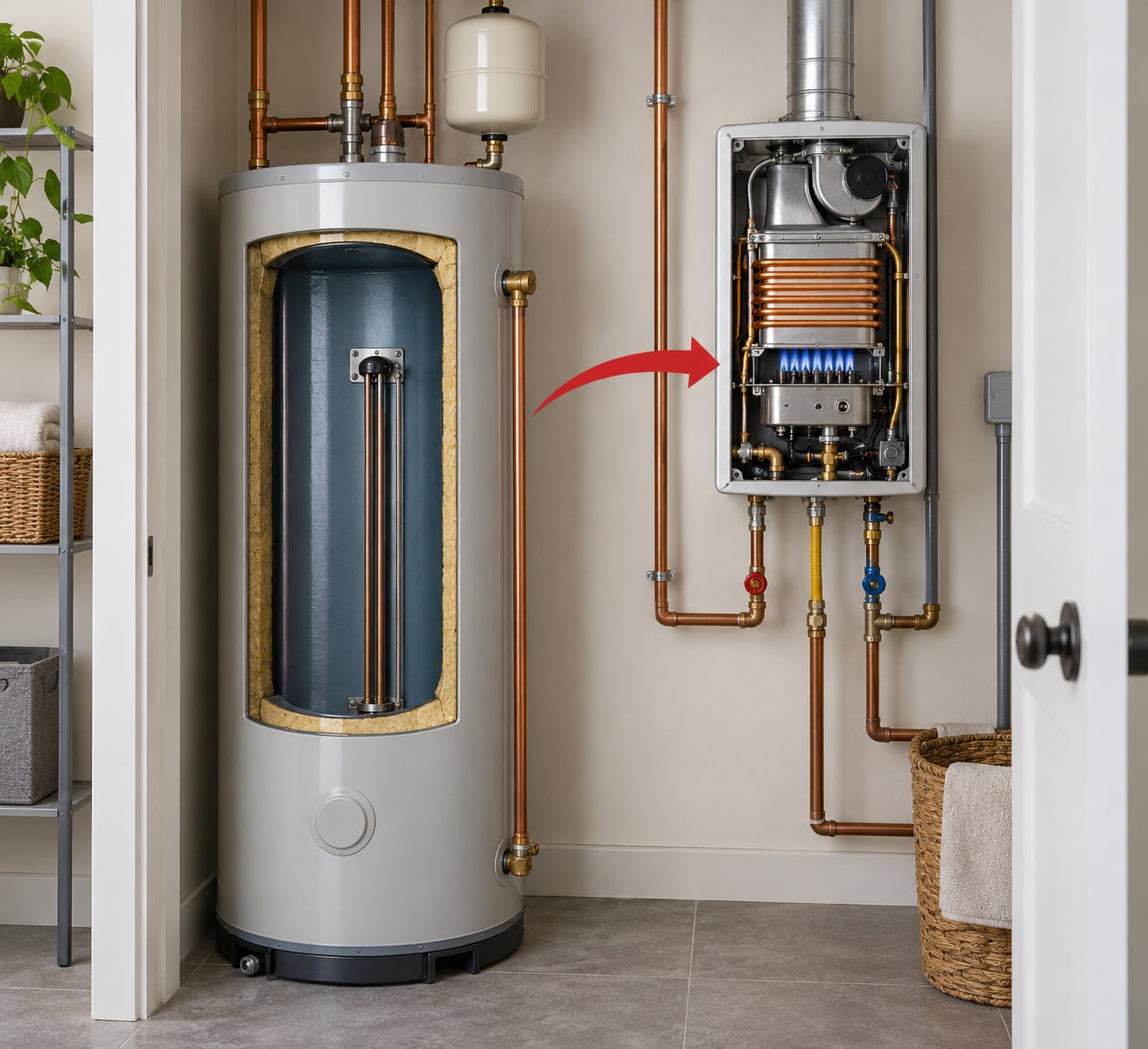
Tankless water heaters cost more to buy and install, run on demand with no standby losses, and last longer. Tank water heaters cost less, heat a stored reserve of hot water around the clock, and handle simultaneous use more predictably. Most households land on one or the other for a clear reason: how much hot water they use and whether they are staying put long enough to recoup the premium.
Tankless vs tank water heater pros and cons come down to a single trade: you either pay more up front for efficiency and longevity, or you pay less and accept standby losses and a shorter service life. That framing is useful, but it hides the details that actually decide it, so here is how each system works, where each one wins, and who should pick which.
Table of Contents
- Tankless vs Tank Water Heater Pros and Cons at a Glance
- How tankless and tank water heaters work
- tankless vs tank water heater pros and cons
- Pros of tankless water heaters
- Cons of tankless water heaters
- Pros of tank water heaters
- Cons of tank water heaters
- Hot-water capacity and household demand
- Energy efficiency and operating costs
- Installation, space, and equipment requirements
- Maintenance, lifespan, and reliability
- Upfront cost and long-term value
- Which should you choose?
- Frequently Asked Questions
- What do plumbers say about tankless water heaters?
- Why don’t plumbers like tankless water heaters?
- Why avoid a tankless water heater?
- Is it worth replacing a tank water heater with a tankless?
- Are tank water heaters being phased out?
- Is it better to get a tank or tankless water heater?
Tankless vs Tank Water Heater Pros and Cons at a Glance
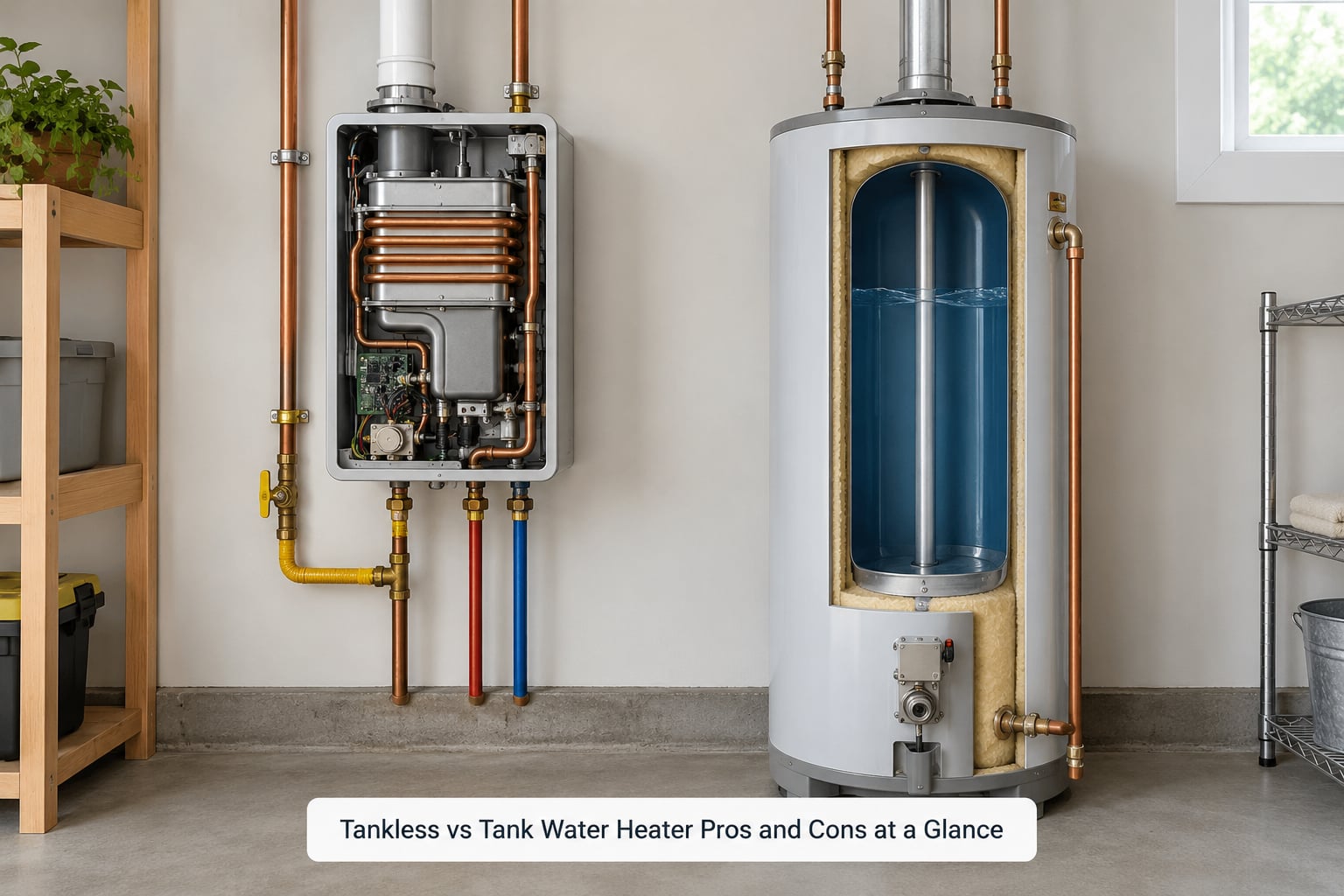
The table below covers the criteria homeowners ask about most, in the order they usually come up during a replacement decision.
| Criterion | Tankless (on-demand) | Tank (storage) |
|---|---|---|
| How it heats | Burner or element fires only while water flows | Tank stays reheated to a thermostat setting all day |
| Upfront equipment and install | Noticeably higher; gas line or panel work can add a lot | Lower, and often a same-code swap |
| Standby energy loss | None while idle | Continuous; a large share of a tank’s fuel bill |
| DOE efficiency edge | 24% to 34% more efficient below about 41 gallons a day; 8% to 14% at roughly double that | Baseline the tankless figure is measured against |
| Hot water on hand | Endless, but capped by flow rate in gallons per minute | 30 to 80 gallons stored, 50 gallons being the most common size |
| Simultaneous use | Can thin out at a high-flow fixture if the unit is undersized | Drains the tank, then slowly recovers |
| Typical flow rate | 2 to 8 GPM, with whole-house units reaching roughly 10 to 12 GPM | Not rated in GPM; sized by first-hour rating and capacity |
| Footprint | Wall-mounted box, often under a foot deep | Large cylinder, usually 2 to 3 feet across |
| Gas demand | Roughly 140,000 to 200,000 BTU | Roughly 40,000 to 50,000 BTU |
| Venting | Direct vent or non-condensing, plus a condensate drain indoors | Standard atmospheric flue |
| Routine maintenance | Annual descaling in hard water, heat exchanger inspection | Annual flush, anode rod check, sediment removal |
| Expected service life | Roughly 18 to 25 years, manufacturer dependent | Roughly 8 to 15 years |
| Repair network | Narrower; fewer technicians trained on the brand | Wide; nearly every plumber handles tanks |
| Best fit | Low-to-moderate use, tight spaces, long tenure | High demand, hard water without a softener, rentals, tight budgets |
How tankless and tank water heaters work
A tankless water heater, also called an on-demand water heater, has no reservoir. Cold water enters through a flow sensor, the sensor spins a small turbine or triggers a pressure drop, and that signal fires a burner or an electric element. Water runs through a copper or stainless heat exchanger, picks up heat on the way, and exits hot at the tap. When the flow stops, so does the burner.
That is why the phrase endless hot water gets used so much. It is accurate within a limit, and the limit is flow rate. A unit rated at 4 GPM will deliver about 4 gallons a minute no matter how long you run the shower, and a whole-house gas unit can push 10 GPM or more while an electric unit typically sits lower.
A storage tank water heater does the opposite. It holds 30 to 80 gallons of water, most commonly in a 50-gallon tank, and keeps that water at the thermostat setting around the clock. A burner or lower-wattage element re-heats the water as you use it, which is the recovery rate, and a magnesium anode rod inside the tank corrodes slowly to protect the steel lining from doing it faster.
Both systems feed the same household plumbing, and both tie into the same gas or electrical supply. The difference is timing: a tank prepares hot water before you ask for it, and a tankless prepares it while you are asking.
tankless vs tank water heater pros and cons
Pros of tankless water heaters
- No standby losses. Once it stops firing, the burner stops. A tank in a cool garage or exterior closet is radiating heat into unconditioned space all night, and that heat is pure loss.
- Longer service life. Roughly 18 to 25 years against 8 to 15 for a tank, largely because there is no tank lining to corrode through.
- Space. A wall-mounted unit frees a 24-inch-wide floor footprint you may want for shelving or a stacked washer and dryer.
- Endless supply. Not an unlimited reserve, but no cold-out moment, and no recovery wait after the last shower.
- Lower flow rates at the tap. A point-of-use unit near a bathroom can cut the walk from the tub, though a recirculation loop does the same job.
- Utility and tax incentives. High-efficiency gas and electric tankless models commonly qualify for rebates from local utilities, and current federal energy credits may apply as well. Programs change, so check your utility before you count on them.
Cons of tankless water heaters
- Higher installed cost. The equipment costs more, and installs regularly need a bigger gas line, a larger electrical circuit, or a vent run nobody budgeted for.
- Maintenance is not optional. In hard water, scale builds on the heat exchanger and eventually the unit shuts down. Descaling once a year is close to mandatory, and skipping it can affect warranty coverage.
- Sizing errors are common and expensive. An undersized unit feels like a downgrade every day. Owners routinely find out mid-install that their household needed more GPM than the unit delivers.
- It still needs electricity. Even gas tankless units use electricity for the flow sensor, control board and igniter. Lose power and you lose hot water.
- Condensate handling indoors. Install one inside conditioned space and you need a drain line and a pump in many jurisdictions.
- Fewer repair technicians. Repair techs specialize in tanks, and owner forums keep circling the same friction: a brand the local plumber simply does not carry.
Pros of tank water heaters
- Lowest cost to install. Most replacements are a like-for-like swap in the same footprint, often the same venting, sometimes the same gas line.
- Predictable hot water. 40 to 50 gallons of stored reserve means a shower and a dishwasher running together do not fight each other.
- Cheap and easy repairs. A failed heating element, thermostat, or T-and-P relief valve is a common, well-stocked part.
- Any technician can service it. This matters in a rental, a flip, or anywhere you are not in one spot for a decade.
- No conditioning on your water. Scale slows a tankless down; in a tank it mostly becomes sediment you flush out.
- Cheaper on a short timeline. If you may sell in three years, the tank rarely repays its extra spend before you move.
Cons of tank water heaters
- Constant fuel burn. A gas pilot or electric element keeps the tank hot through the day whether anyone is home or not.
- Limited reserve. Run out on a busy Saturday morning and you wait through a recovery period, often with lukewarm water in between.
- Short life. Eight to fifteen years, and the tank can fail without much warning.
- Floor space. A 50-gallon tank is about 2 feet wide and 3 feet tall, plus clearance for service.
- Corrosion and sediment. The lining corrodes, sediment settles, and both show up as a puddle in a finished utility room. Many people put a pan and a leak sensor under theirs.
- Losing efficiency with age. A scaled-up tank burns more fuel for the same hot water, so the operating cost drifts upward over its life.
Hot-water capacity and household demand
Capacity is where the two systems are hardest to compare, because one is measured in stored gallons and the other in gallons per minute. A tank holds water. A tankless moves water, at a rated rate, and the rate is the entire design constraint.
For a tank, the numbers homeowners see are capacity, usually 30 to 80 gallons, and the first-hour rating, which is how much 50-degree F water the unit delivers in the first hour after starting. A 50-gallon gas tank commonly carries a first-hour rating in the 60s to 80s of gallons. Electric tanks are slower to recover, which is why they are usually a bit larger for the same household.
For a tankless, the number that matters is GPM. Point-of-use units run about 2 GPM, whole-house electric units commonly 3 to 7 GPM, and high-output gas units reach 10 GPM or more. A low-flow showerhead and a modern faucet pull far less than an older 2.5 GPM shower and a laundry tub, which is why a household that removed aerators and swapped showerheads can be completely served by a mid-size unit.
Rule of thumb that installers use: a two-bath household usually needs roughly 5 GPM, three baths around 7, and a house running a soaking tub or a home with multiple people showering back to back needs the largest gas units on the market. The other half of the point comes from owner reports: some households find the farthest faucet losing pressure once a high-GPM unit goes in, which is a plumbing issue the unit cannot fix.
Nobody runs out of hot water with a correctly sized tankless, but they do notice a dip in the stream if the demand exceeds the rating. A tank runs out, and everyone gets the same lukewarm recovery together. One is a soft failure, the other is a hard stop, and which one bothers you more is personal.
Energy efficiency and operating costs
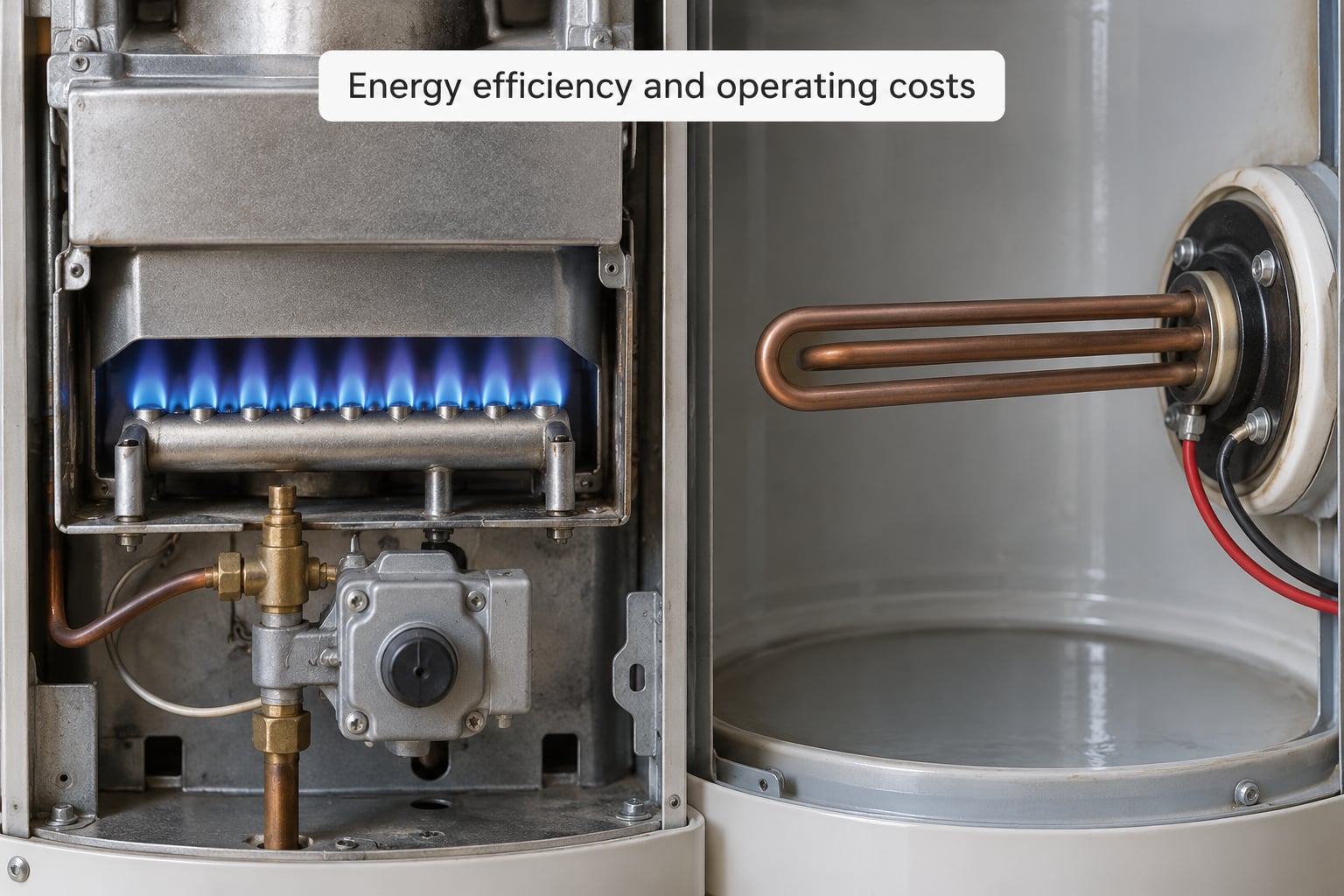
The US Department of Energy puts a tankless water heater at 24% to 34% more efficient than a conventional tank for homes using 41 gallons or less of hot water a day. That is the number every competitor quotes, and it is a fair number for what it measures.
Here is what the number hides. The same DOE guidance says that for homes using about twice that, roughly 82 gallons a day, the efficiency advantage falls to 8% to 14%. A family of five running showers, a washer and a dishwasher is well past the threshold where tankless dominates. This is the single most useful caveat on the topic, and most ranking pages skip it.
Standby loss explains the rest. A gas tank with a pilot light radiates heat constantly, and an electric tank keeps a resistive element cycling to hold temperature. In a warm climate, a garage, or a lightly used home, that idle burn is a real slice of the bill. A tankless burns nothing when nobody is home, so the savings show up exactly when demand is low, which is also the condition the DOE threshold describes.
Gas and electric also behave differently at the margin. A gas tankless heats water faster and recovers from a burst of demand better, but gas prices vary by region and can swing hard. Electric tankless units run roughly at resistive efficiency with no combustion, which is appealing where gas is expensive or unavailable, though they draw a large amount of power and often need a panel upgrade.
A worked example, with no promises attached. A low-use household using 35 gallons a day might save 25% on water heating fuel, and over a year that adds up to real money. A high-use household using 85 gallons a day might save 10%, which over the same span is a much smaller line item and one that a longer tankless life eventually has to justify. The savings scale with usage, and so do the disappointments.
Installation, space, and equipment requirements
A tank replacement is boring in the best way. Same closet, same flue, same gas line, same electrical circuit. Permits and inspection still apply, but the work is a day at most and the existing footprint rarely changes.
A tankless install is a mechanical project. Gas units commonly demand 140,000 to 200,000 BTU against the 40,000 to 50,000 BTU a tank pulls, and an existing line sized for a tank may be too small, which means new pipe, a meter check, and pressure testing. That is the single biggest reason install quotes jump once a contractor opens the wall. Installers describe the same sequence over and over: the tankless number is real, then the gas line is not.
Electric tankless has a different requirement: amperage. Many units need a 40 to 60 amp dedicated circuit, and a 100 to 150 amp panel may not have the spare capacity. Panel upgrades are the second big surprise cost after gas line work.
Venting matters too. Indoor gas tankless units are typically non-condensing with a coaxial or direct vent through an exterior wall, and they produce condensate that needs somewhere to drain. Outdoor-rated models avoid the vent and the drain and work well in mild climates, but freeze protection is a concern in cold areas unless the unit is rated for it.
Space is the easiest win for tankless. A unit roughly 20 inches tall, 15 inches wide and 8 inches deep frees a footprint most utility rooms can put to better use. Tanks need working clearance around the top and a floor pan consideration. If you are remodeling, that difference decides more conversations than the fuel bill does.
Maintenance, lifespan, and reliability
Tank maintenance is a short annual list: flush the tank to clear sediment, test the temperature and pressure relief valve, check the anode rod and replace it if most of the metal is gone, and look for corrosion weeping. It is usually a single service visit once a year. Sediment is the main enemy, and flushing yearly on a softener-fed system can push a tank well past the low end of its expected life.
Tankless maintenance is narrower but less forgiving. The heat exchanger is the heart of the unit, and in hard water, scale insulates it, the unit works harder, and eventually a flow or temperature sensor fails or the manufacturer requires service. Descaling kits and professional service both exist, and in a hard-water area the professional version is an annual line item. Plumbers working in hard-water territory treat yearly descaling as non-negotiable, and that is the right read.
Lifespan is the quiet argument for tankless. Tanks commonly last 8 to 15 years before a leak. Tankless units are commonly quoted at 18 to 25 years, with parts like fans, igniters and circuit boards being replaceable. Treat the 20-plus figure as manufacturer-dependent, since warranties on mainstream units commonly run 10 to 15 years and vary by model.
Reliability has a second side: who can fix it. Any plumber can swap a thermostat. A specific brand of condensing tankless with a proprietary control board may need an authorized service provider. That is not a dealbreaker, it is just something to check before you choose the unit rather than after it fails.
Upfront cost and long-term value
Nobody should quote you a water heater price here. Regional labor, fuel type and gas line condition swing the final number too widely, and it changes constantly. What is stable is the shape of the comparison.
A tankless install commonly runs two to three times a tank-to-tank replacement once labor, venting and any fuel line work are counted. That gap is the number your payback calculation has to overcome, and it is why the honest answer to whether it is worth replacing is usually conditional rather than yes.
Work the ratio instead of a promise. Take the installed price difference between the two quotes and divide it by your realistic annual fuel savings. If the gap is three to four thousand dollars and low-use savings land in the low hundreds a year, simple payback stretches well past the life of many tanks. In a moderate-use home with a larger fuel bill, the denominator rises and payback shortens. A high-use household saving about 10% on a substantial fuel bill can reach payback in closer to a decade. The math flips entirely on three variables: your annual hot water volume, your local fuel price, and whether you stay long enough to reach the tankless unit’s later service life. Get two written quotes and do the division yourself before anyone talks you into anything.
Two things widen the tankless case. One is a gas line already sized for a larger load, which removes the biggest install surprise. The other is tenure, because a unit you keep 20 years amortizes the premium across twice the life. Two things narrow it: a hard-water area with no softener, and any plan to move before the tank’s normal failure date.
Maintenance sits inside the same math. Annual descaling across fifteen years is real money, and it narrows the gap faster than most people expect. Set a softener and the gap narrows the other way.
Which should you choose?
Choose a tank if you are renting, flipping, or likely to move within about five years. The lower installed cost and the fact that a buyer already understands the system both argue for the tank, and there is no scenario where that premium pays off.
Choose a tank if a household of four or five runs showers and laundry at the same time and nobody wants to think about it. 40 to 50 gallons of stored reserve handles that without a GPM calculation, and in a hard-water area without a softener, scale is a far less expensive problem when it is sediment in a tank rather than a failed heat exchanger.
Choose a tank if the budget is the deciding factor, or if you are in a house where the gas line is undersized and the panel is full. A tank works with what is already there. That practicality wins more often than efficiency does.
Choose tankless if the household uses modest amounts of hot water, which is common for couples, retirees, and anyone traveling for work. Space is tight, the utility closet is a dead end, or you are finishing a basement where 2 square feet of floor actually matters. Your gas line is already sized for a larger burner, or the home is all-electric and you want to avoid a gas line entirely. And you expect to stay long enough to reach the payback period.
For a vacation home or a seasonal place, either works, and a small point-of-use tankless near the fixtures can beat a whole-house unit on both cost and simplicity.
Consider a hybrid heat pump water heater as the honest third option in a cold climate or a high-use home. It uses a fraction of the electricity a resistance tank does, but it needs roughly 1,000 cubic feet of surrounding air, it wants ambient temperatures above about 40F, and it gives you no hot water during a power outage.
On replacement timing: if your tank is ten years old and still working, switching to tankless is a planned decision. If it just failed, tankless is a rushed decision that usually costs more. Ask for a tank quote either way, then ask what the tankless version adds, and you will negotiate the tank better and see the upgrade clearly.
Frequently Asked Questions
What do plumbers say about tankless water heaters?
The trade is split, and the split is usually about maintenance and service access. Plumbers like the space savings, the efficiency, and the fact that a correctly sized unit simply works. They hesitate on hard-water installs without a softener, on the gas line upsizing that turns a simple job into a major one, and on servicing a brand they do not already carry. Ask any installer how many of the last ten jobs were that brand.
Why don’t plumbers like tankless water heaters?
Three reasons come up repeatedly. Scale on the heat exchanger is a recurring service call instead of a ten-year replacement, and skipping it can complicate warranty coverage. A gas tankless needs far more BTU than a tank, so an undersized line means extra work nobody quoted for. And a technician can only fix what they are trained on, which matters in an area where tankless brands are still uncommon.
Why avoid a tankless water heater?
In a hard-water area with no softener, you are signing up for annual descaling and a shortened life if you skip it. In a home with an undersized gas line, the install can cost several times a tank. If a household runs two showers and laundry simultaneously, an undersized unit feels like a problem that never goes away. And every tankless unit, gas included, needs electricity, so a power outage means cold showers.
Is it worth replacing a tank water heater with a tankless?
Only if three conditions line up. Your household is a low-to-moderate user, so the efficiency gain is closer to the DOE’s 24% to 34% figure than the 8% to 14% that applies above roughly 82 gallons a day. Your fuel line or electrical panel can carry the load without major work. And you will stay long enough to reach payback. Above 41 gallons a day, do the math before you commit.
Are tank water heaters being phased out?
No. There is no ban and no phase-out. New efficiency and emissions standards affect what manufacturers can build and sell, and those rules push the market toward higher-efficiency designs across the board. Storage tanks remain the default choice for most households, they are cheaper to replace, and roughly 8 in 10 water heaters installed in the US are still this type. Nothing on the regulatory horizon retires them.
Is it better to get a tank or tankless water heater?
A tank fits large households, hard-water homes without a softener, rentals, and buyers with a tight upfront budget. A tankless fits couples and light users, tight utility spaces, homes with a gas line already sized for a bigger burner, and anyone staying long enough to earn back the premium. Neither wins on hot water volume alone: one gives a stored reserve, the other gives continuous flow at a rated rate.
Start by measuring your own hot water use instead of picking a brand. A rough daily household volume, the gallons your highest-flow fixture needs, and whether your gas line or panel can carry the extra load will tell you more than any pros and cons list. If those three answers point to a tank, a tank is the right call and you will not regret it. If they point to tankless and the gas line is already there, you are looking at the better long-term system.
Everything above reflects how water heaters are specified and serviced in the US, where energy codes and rebates change from year to year. Confirm local code requirements, your utility’s current programs, and the manufacturer’s warranty terms with a licensed plumber or HVAC technician before you commit to equipment.