Most appliance damage happens before the appliance leaves the room. Someone yanks a fridge door, drags a washer across bare hardwood, or tips a refrigerator and never gives the compressor time to settle. To move a heavy appliance without damage, you need four things: the manufacturer’s manual, the right dolly, protected floors, and a second capable person for anything you cannot comfortably control alone. A washer or fridge across a flat floor takes about 20 minutes once you’re set up. Stairs turn that into a different job entirely.
Table of Contents
- What You Need
- How to Move a Heavy Appliance Without Damage Step by Step
- Plan the route first: how to move a heavy appliance without damage
- Unplug, shut off and secure the appliance
- Protect the appliance and the route
- Lift and load the appliance safely
- Move through doors and place the appliance
- Reconnect and test everything
- Common Mistakes When Moving a Heavy Appliance
- Frequently Asked Questions
- Can I move a refrigerator on its side?
- Can one person move a heavy appliance safely?
- How long should a refrigerator stand before I plug it back in?
- Do I need transit bolts to move a washing machine?
- Should I disconnect a gas range myself?
- How long does it take to move a heavy appliance?
- Conclusion
What You Need
Gather everything before the appliance comes out of its alcove. Scrambling halfway down a hallway for a strap is how appliances get dropped.
- The appliance manual — your source for transit bolts, tilt limits, settling times and shutoff instructions.
- An appliance dolly or hand truck with ratchet straps, and a stair-climbing model if stairs are involved. A plain hand truck works on flat ground only.
- A four-wheel furniture dolly or platform cart for rolling an appliance across flat floor without tipping it.
- Moving blankets and stretch tape for corners, doors and finished surfaces.
- Floor protection — cardboard from the original boxes, 1/4 inch plywood sheets, and furniture sliders or hard plastic glides.
- Basic tools — an adjustable wrench, a Phillips screwdriver, a utility knife, work gloves and a bucket for leftover water.
- At least one capable helper who will follow your lead rather than improvise.
That last item is the real threshold. If the route includes stairs, a gas line, a load over what you can hold with two good arms, or a narrow doorway you cannot measure, hire a licensed pro. Movers who work with appliances daily carry insurance for exactly these jobs, and the fee is far smaller than a compressor replacement or a back injury.
How to Move a Heavy Appliance Without Damage Step by Step
Work in this order every time. Prep first, protect second, move third, reconnect last.
Plan the route first: how to move a heavy appliance without damage
Measure before you lift. Write down the width of the appliance at its widest point including doors and handles, then measure every door, hallway, stairwell turn, elevator and threshold between the current spot and the destination.
Most pinch points are door jambs and the corners where a hallway turns. Take the door off its hinges if it swings the wrong way, and note any floor vent, threshold strip or low-light fixture along the way. Pull the route through this check: the appliance fits every opening with at least an inch of clearance. If it does not, you need a different door or a different piece of equipment, and you need to know that now rather than halfway across a hardwood floor.
Unplug, shut off and secure the appliance
Unplug the appliance and switch off the breaker for the circuit if you can identify it. Shut off the water supply valve for a washer or dishwasher, then disconnect the hoses and drain the remaining water into a bucket. For a gas range, close the valve and confirm it is off before you touch the connector.
Remove and pack loose parts separately — racks, shelves, door bins, knobs and filters. Tape shut doors that swing open, and tape the control panel on an appliance with a glass front. Follow the manual for model-specific preparation such as transit or shipping bolts for a washer and drum restraints. Result: nothing loose moves inside the appliance during transport, and every utility is physically off rather than switched off at the wall.
Protect the appliance and the route
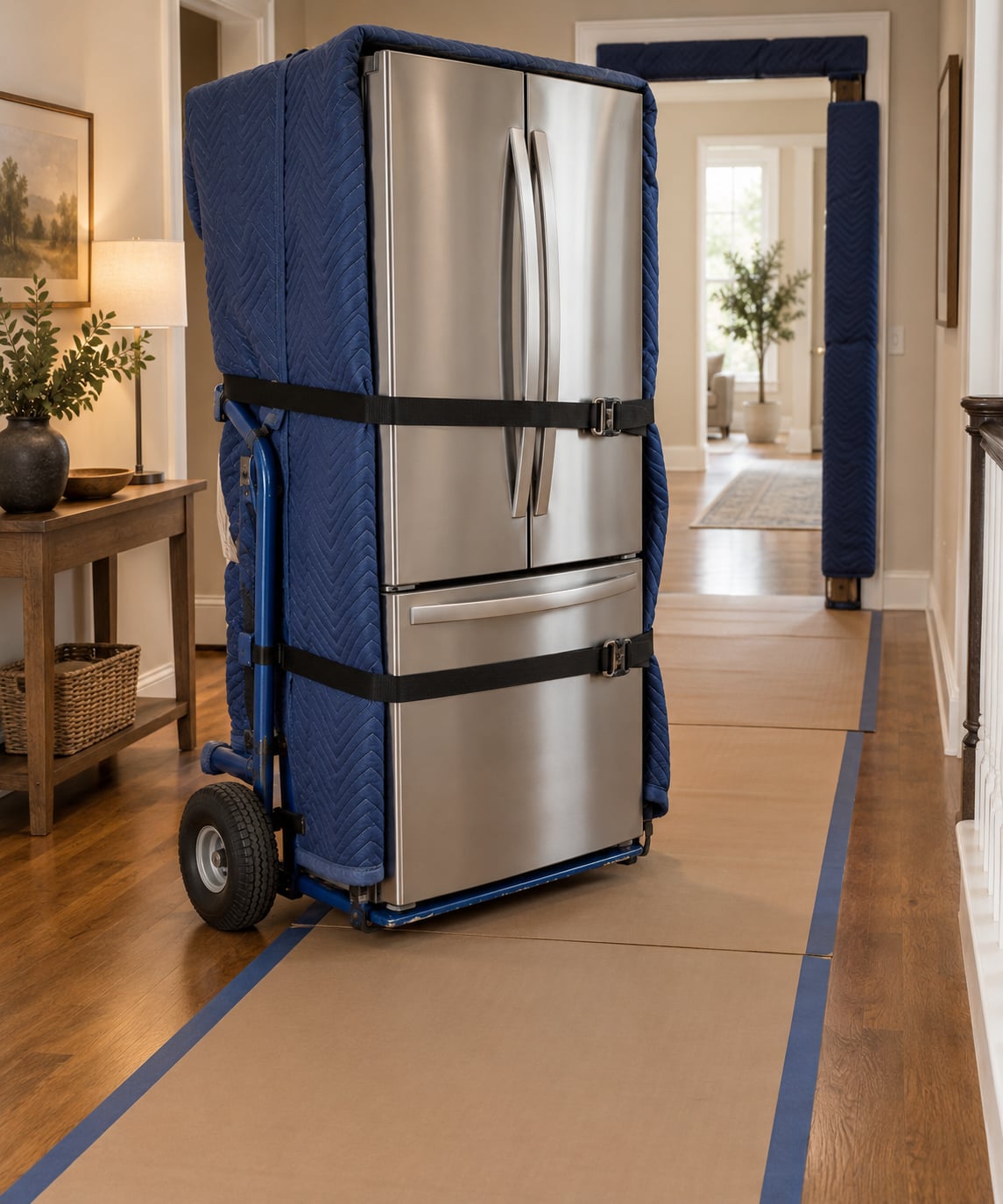
Wrap the corners and any finished or painted surfaces with moving blankets held on with stretch tape. Leave handles and feet exposed so you can still grip and level the unit.
Lay floor protection along the whole route, not just under the appliance. Cardboard from the original boxes is free and works well on finished floors; 1/4 inch plywood is the stronger option and is what I’d use over hardwood or tile. Tape plywood sheets to each other so the seams do not become a ridge the wheels catch. Pad the door jambs and the corners you’ll turn near with a folded blanket, and keep the path clear of rugs, thresholds and clutter that someone could catch a toe on. Result: the floor, walls and doorframes are shielded and the path is walkable while you still have both hands on the load.
Lift and load the appliance safely
Set one person at the top of the load to steer and one at the bottom to lift. Agree on a call — “lift, turn, set” — before you start. Lift from the base frame or the appliance’s designated lift points, never from a door handle, a door edge or a control panel, and keep the load close to your body rather than reaching out for it.
To load a dolly, tip the appliance back onto its rear edge while the helper supports the weight, slide the dolly plate under the base, then strap it in above the center of gravity and lower it onto the wheels. Never leave an appliance strapped to a dolly unattended on a slope. On stairs, use a stair-climbing dolly with the straps crossed and re-tensioned at every landing, with the person below guiding rather than bearing full weight. If you cannot keep one hand on the load the whole way, stop and get help or rent a powered stair climber. Result: the appliance sits centered and strapped, and one person is always in control of the direction of travel.
Move through doors and place the appliance
Tilt an appliance only when the manufacturer permits it. Refrigerators are the usual exception and even then only briefly, on the side, not front or back. Everything else stays upright.
Take the door off if it needs the extra clearance, and put a moving blanket on the jamb so the appliance never touches painted wood. Approach a turn wide and slow, letting the outside corner swing rather than forcing the load to pivot in place. At the destination, set the appliance in position, then use a level on the front-to-back and side-to-side axes and shim with appliance coasters or tapered shims until it reads level. On tile, check for grout lines that rock the unit. Result: the appliance is upright, plumb, stable and clear of the wall or cabinet it sits against.
Reconnect and test everything
Restore connections in reverse order and follow the manual. Reconnect water hoses with new washers and hand-tighten plus a quarter turn, leaving the valve open only when you are ready. Reconnect gas only per the manufacturer instructions, then test with a soapy-water solution or the manufacturer’s procedure and call a licensed gas fitter if you smell gas at any point.
Set a refrigerator upright and leave it unplugged for the settling period in its manual — commonly several hours, sometimes longer — before powering it on. For a washer, restore transit bolts only when the machine is back in place and at its final location. Run a short rinse or fill cycle to check for leaks, watch for vibration during the spin cycle, and confirm the door closes and seals. Recycle or dispose of cardboard, blankets and the old appliance according to local rules. Result: no leaks, no rattle, no burning smell, and packaging gone.
Common Mistakes When Moving a Heavy Appliance
- Dragging instead of rolling. A loaded dolly that gets a heavy appliance out of control will gouge a floor. Keep the load on wheels and add a second spotter on ramps and thresholds.
- Lifting with the back. Squatting with the legs while the load is 18 inches in front of you is still a back lift. Move your feet under the load first, keep it against your shins, and don’t twist while carrying.
- Moving an appliance that still contains water or food. Drain the washer, run the fridge on defrost for a full day, empty the ice maker, and remove the crisper drawers.
- Skipping floor protection. Appliance feet and dolly wheels concentrate enormous pressure on one spot. Cardboard, plywood and sliders cost very little compared with refinishing a floor.
- Using the wrong dolly. A standard hand truck has no stair rollers and no wide base. On stairs it is a coin flip, and usually not in your favor.
- Leaving vents and grilles blocked. If you tape up an appliance, cover the return air vents and any grille, or the unit will overheat the first time it runs.
- Ignoring the manufacturer’s manual. Transit bolts, tilt limits and settling times are model-specific and are not interchangeable across brands. Order transit bolts from the manufacturer rather than a generic pack.
- Working on a gas range without shutting the valve. This is the one step worth calling a licensed technician over. It is not worth the risk for a small saving.
Most injuries come from people improvising under load. If the appliance starts tipping, do not try to catch it with your back — step clear and let it go. Replace the appliance, not the heroics.
Frequently Asked Questions
Can I move a refrigerator on its side?
Sometimes, briefly, and only if your manual allows it. Laying a fridge on its side can shift compressor oil into the refrigerant lines. If you must, lay it on the side the manual specifies, strap it firmly, and keep it that way as short as possible. Stand it upright afterwards and wait the settling period in the manual, often four to 24 hours, before plugging it in. Never transport a fridge on its front or back.
Can one person move a heavy appliance safely?
Only with equipment designed for it, and only on flat ground. A forearm forklift or shoulder dolly moves a refrigerator across a level hallway safely for one strong person. Neither works on stairs, neither works in a tight turn, and neither replaces a second person when the appliance must be tipped or set down. If you cannot lift and steer the load with full control at every moment, get a helper or a mover.
How long should a refrigerator stand before I plug it back in?
Follow the settling time printed in your appliance manual. Common guidance ranges from a few hours up to a full day, and longer if the fridge was on its side or on a stair-climbing dolly. During that time the oil that shifted out of the compressor has a chance to settle back. Plugging in early can shorten the fridge’s life or, in the worst case, damage the compressor.
Do I need transit bolts to move a washing machine?
Yes, for most front-loading washers. The drum is suspended inside the tub on springs, and without the transit or shipping bolts installed it can hammer itself to pieces during transport. Bolts are model-specific, so order them from the manufacturer with your model number rather than buying a generic kit. Leave them in during the move and remove them only once the washer is in its final location.
Should I disconnect a gas range myself?
For a shutoff valve you can reach and a flexible connector in good condition, the manual’s steps are straightforward: close the valve, test for gas, disconnect, cap the line. Beyond that, get a licensed gas fitter. Call a professional if the connector is old, corroded or seized, if the valve is inaccessible, if the range is hard-piped, or if you smell gas. Insurance and code requirements make this the least worthwhile DIY task in the whole move.
How long does it take to move a heavy appliance?
Allow about 20 to 40 minutes for a flat-floor move of a washer, dryer or refrigerator once the route is measured and everything is protected. Add an hour for a full defrost beforehand. Stairs change the number completely: budget several hours with a stair-climbing dolly and three or four people, and expect to reset at every landing. Set aside another 30 minutes to reconnect and test everything at the new location.
Conclusion
Start with the manual and a tape measure, not the dolly. Know your transit bolt requirements, your tilt limits and your settling time before anything moves.
Then protect the floor the whole length of the route, secure every door and loose part, and move with a second person and the right equipment for the terrain. If the route includes stairs, a structural load, a gas connection or anything you are not certain about, call a licensed mover. That call is cheap next to a cracked compressor, a refinished floor or a strained back.