A tripped GFCI outlet cuts power the moment it senses a leak of current to ground, usually in about the time it takes you to blink. Learning how to reset a GFCI outlet takes about two minutes: unplug everything, press RESET firmly until it clicks, and confirm power is back. If the button pops straight back out, the fault is still in the circuit, and that is where the real troubleshooting starts.
A GFCI (Ground Fault Circuit Interrupter) watches for an imbalance between the hot wire and the neutral wire. When roughly five milliamps of difference shows up, it trips in milliseconds, which is what protects you if a powered appliance touches water or your body. The TEST and RESET buttons on the face are the whole user interface.
Here is the short version most people need:
- Unplug everything plugged into the outlet and everything on the circuit.
- Press RESET firmly inward until it clicks and stays in.
- Plug devices back one at a time, watching for an immediate trip.
- Press TEST monthly; RESET should snap back instantly.
If the outlet has no buttons at all, or the buttons live on a different outlet in the room, keep reading. That second situation trips people up more than anything else.
Table of Contents
- What You Need Before You Start
- Step-by-Step: How to Reset a GFCI Outlet
- 1. Reduce the load on the circuit
- 2. Look for moisture or visible damage
- 3. Press RESET firmly
- 4. Test the GFCI with its TEST and RESET buttons
- 5. Confirm protection with a plug-in tester
- 6. Find the upstream GFCI that controls these outlets
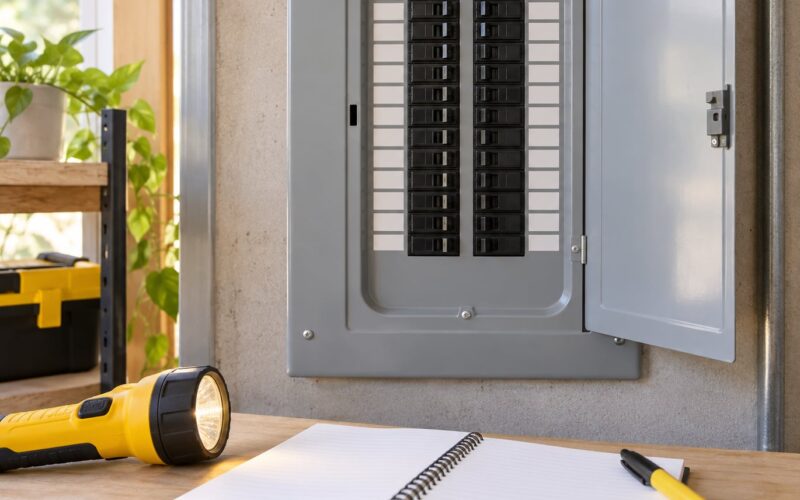
- 7. Check the breaker panel
- 8. Reconnect loads one device at a time
- 9. Why a GFCI outlet won’t reset
- 10. Common mistakes that stop a reset
- 11. Use these safety tips
- Frequently Asked Questions
- Why does my GFCI outlet keep tripping after I reset it?
- Can I reset a GFCI outlet that keeps clicking without turning it off?
- How do I know if a GFCI outlet is working?
- Should I replace a GFCI outlet if it will not reset?
- Why does a GFCI outlet trip when I use a power strip?
- Is it safe to plug a GFCI outlet into a generator or inverter?
What You Need Before You Start
The short list is short because this is a button-pressing job. You need very little:
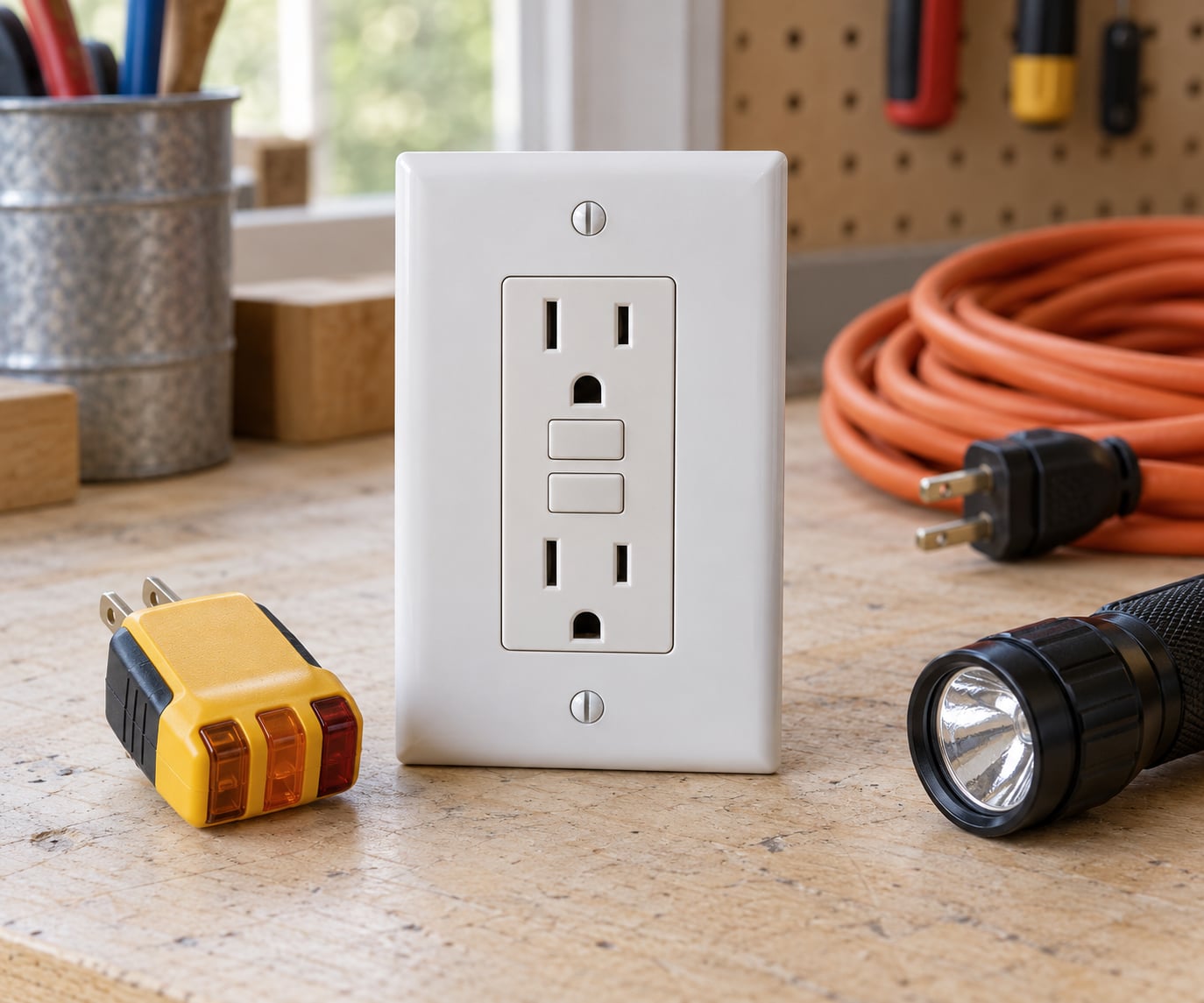
- A plug-in GFCI tester — a small three-prong adapter with indicator lights, roughly the size of a nightlight. A two-light model tests normal and reversed wiring; a three-light model adds a ground-fault test.
- A flashlight — garages, basements and crawlspaces are all badly lit, and you need to see the outlet face and the area around it.
- Dry hands and dry floor — literally the condition the device exists to protect you from. If the outlet is damp, stop and dry it first.
- Access to the breaker panel — not to work on it live, but so you can flip a breaker off and back on later in the process.
You do not need any tools at all to reset an outlet. Everything below happens with your fingertips on the buttons.
Step-by-Step: How to Reset a GFCI Outlet
1. Reduce the load on the circuit
Start by unplugging everything from the outlet in front of you. Then walk the room and unplug anything on the same circuit, because a GFCI in a kitchen often feeds a countertop island and a dining room wall that has nothing to do with the dead outlet you noticed.
Pay attention to power strips and extension cords. Cheap strips with two or three converters on one cord generate just enough leakage to trip a GFCI every time, and outdoor-rated strips with damp connections are a repeat offender after rain.
If you suspect a strip, unplug it completely and leave it out for this test. That single move solves a surprising share of stubborn cases.
2. Look for moisture or visible damage
Crack the door on a bathroom, garage or outdoor box and look before you touch. Check for water droplets on the outlet face, a cover plate that is cracked or the colour of scorched cardboard, a warm or hot faceplate, or a faint burning smell. Any of those and you do not press anything.
Look at what feeds the outlet too. A washing machine hose weeping onto an outdoor receptacle is a common cause of a GFCI that trips after rain and then keeps tripping. Fix the water source before worrying about the outlet.
Buzzing or crackling from the box is not a nuisance-trip issue. Shut the circuit off at the breaker and call a licensed electrician.
3. Press RESET firmly
On a tripped GFCI, the RESET button sits proud of the face and the TEST button sits flush. Press RESET straight in with a thumb or the pad of your finger and push harder than feels polite. The latch is stiff by design, and many people never push it far enough to release it — that is the single most common reason people say the button is broken.
A successful reset is easy to recognise: the button stays in, the red or amber trip indicator light goes out or changes, and anything you plug in gets power.
If RESET clicks in and then pops back out within a second or two, the ground fault is still present. That is not a broken outlet; the device is telling you the fault is real.
4. Test the GFCI with its TEST and RESET buttons
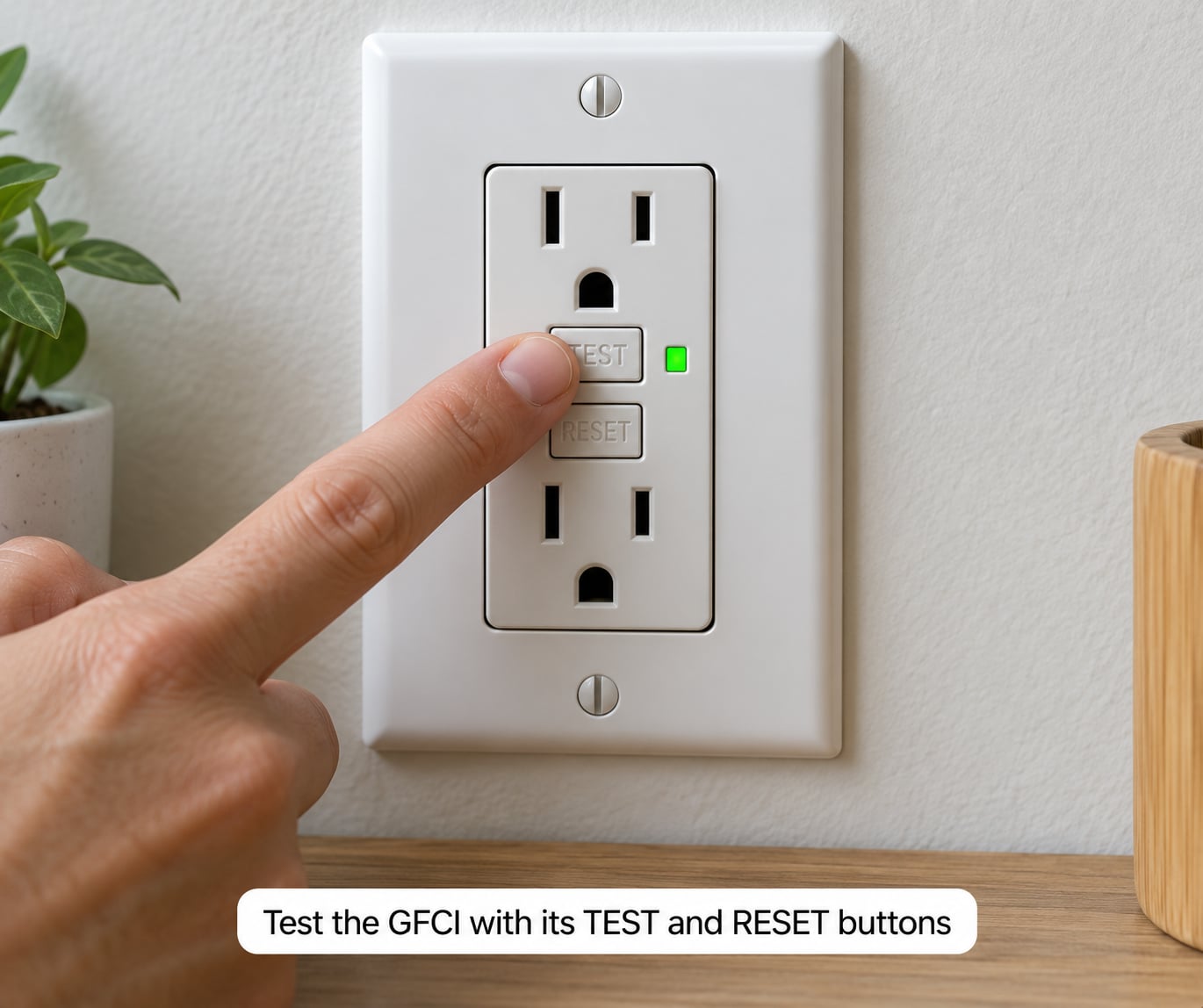
Every GFCI has a built-in self-test, and it is the fastest way to know whether the device itself still works. Press TEST with the circuit live and no appliances plugged in.
On a working GFCI, the RESET button pops out immediately, which simulates a ground fault. Press RESET and it should snap back in with an audible click. If TEST does nothing at all, or RESET will not re-latch afterward, the internal mechanism has failed and the receptacle needs replacing.
Newer self-testing GFCIs do this automatically on their own schedule, typically once a month or whenever power is restored. Either way, a monthly TEST is a free five-second check of every outlet in the house, and it is worth doing.
5. Confirm protection with a plug-in tester
A plug-in GFCI tester tells you more than the buttons do. Plug it into the outlet you’re troubleshooting. With a normal, healthy circuit you get the green or “correct wiring” indication; on a three-light tester, an open ground gives you an amber warning light.
Then press the TEST button on the tester itself while it is plugged in. That deliberately creates a small ground fault through the tester. If the GFCI trips as it should, the protection downstream of it is working. If nothing trips, the outlet is not protecting the circuit and needs attention.
Keep testers away from damp locations, and never use one to justify working on wiring. It is a diagnostic, not a permission slip.
6. Find the upstream GFCI that controls these outlets
If the RESET in front of you works but the dead outlet elsewhere in the room stays dead, you are looking at a downstream outlet. GFCIs pass power through to other receptacles, so the first GFCI on the circuit — the upstream or master GFCI — controls everything wired after it.
How to find it: with the circuit off, plug a lamp or phone charger into outlets one at a time. Or use your tester to hunt for the nearest outlet with TEST and RESET buttons, starting from the dead outlet and moving toward the panel, the garage, the basement, the laundry room, or a hallway. In most homes the master GFCI is in one of those spots, and the outlets you actually needed are just daisy-chained behind it.
This is the answer behind most “I reset it and nothing happened” posts on electrical forums, and it is worth a few minutes of hunting before you assume the worst.
7. Check the breaker panel
If RESET clicks in and stays in, but nothing downstream has power, the reset worked and the circuit is dead somewhere else. Go to the breaker panel and look for a breaker in the middle position, or one that is not fully snapped to ON. Turn it fully OFF, then fully ON once.
Many panels are unlabelled or mislabelled, which makes this step frustrating. Turn breakers off one at a time while someone checks which set of outlets went dark, and write the labels on tape with a marker as you work. Ten minutes now saves the same confusion next winter.
Note that some homes have a GFCI breaker in the panel itself instead of receptacle GFCIs, and that breaker has its own TEST and RESET buttons on the handle. If you press that and nothing downstream wakes up, the fault is downstream and needs an electrician.
8. Reconnect loads one device at a time
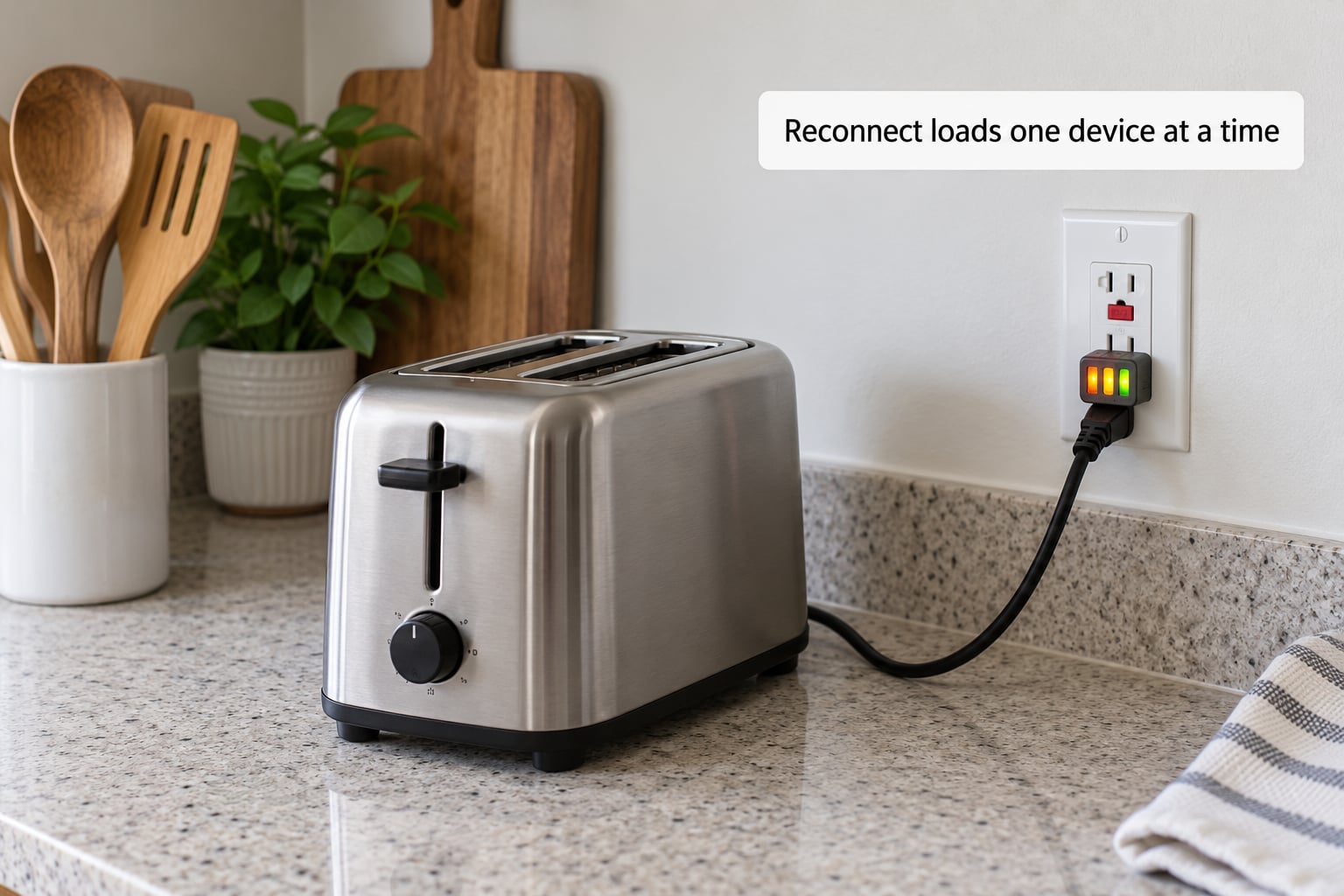
Once the outlet holds a reset with nothing plugged in, reconnect devices one at a time and pause a few seconds after each one. The moment it trips again, you have found the culprit and can stop looking.
Nuisance tripping is common with older refrigerators, air fryers, dehumidifiers, electric toothbrush chargers, power tools and anything with a moisture filter or a motor. Some of these leak a small amount of current by design, and a GFCI at the edge of its tolerance will keep throwing them off.
If isolating the appliance fixes it, you have two honest options: stop using that device on that circuit, or have an electrician look at whether the circuit and the device are a fair match. Unplugging is the free fix and works more often than people expect.
9. Why a GFCI outlet won’t reset
If you have run through the steps and the button still pops out, one of these is almost certainly true:
- A ground fault still exists in the circuit, often moisture in an outdoor box, a basement wall, a crawlspace, a covered patio receptacle, or a pool and spa area.
- A downstream GFCI is the one that tripped, and the outlet in front of you is just a plain receptacle on the same circuit.
- The line and load wires are reversed on a newly installed GFCI. This shows up on forums constantly: the line side has power, the buttons do nothing, and the reset never engages. It is a wiring fault behind the cover plate, not a homeowner job.
- The internal mechanism has worn out. Older GFCIs commonly last 10 to 25 years, and after that the buttons get sticky or the latch fails.
- Line and load are wired to stab-in connectors instead of screw terminals, and the connection has backed out slightly, or a neutral wire is loose in a wire connector. Also behind the plate.
Of these, only the first two are things you can confirm yourself. The last three need the cover plate off with the circuit dead, and that is where a licensed electrician earns the call-out.
10. Common mistakes that stop a reset
Most failed resets are not electrical faults at all. They are process mistakes, and they are easy to avoid once you know them.
- Pushing RESET too gently. The latch needs a decisive push to the face of the receptacle. A half-hearted nudge does nothing at all.
- Resetting with everything still plugged in. The fault may be sitting in one of those devices, so the outlet correctly refuses to reset.
- Repeating RESET over and over. Each attempt without a diagnosis is just resetting the same condition. Fix the suspected cause first.
- Testing before unloading the circuit. You cannot tell a healthy outlet from a leaking appliance until the appliances are out.
- Ignoring moisture. Wiping the face does nothing if water is behind the cover, and pushing a wet GFCI is exactly the situation it was installed to prevent.
- Forcing a stuck outlet or removing the cover plate live. If the RESET button will not move at all, the answer is a replacement receptacle, not leverage.
- Assuming every dead outlet is broken. In most homes the outlet you are staring at is simply downstream of the one that actually tripped.
11. Use these safety tips
Everything above is safe because it stays on the outside of the receptacle. These are the lines not to cross.
Stop immediately if the outlet is wet, hot, sparking, buzzing, discolored, or smells burned. Cut power at the breaker and leave it there. Do not reset a wet GFCI; dry it out completely or replace the unit.
Never remove the cover plate while the circuit is energised, and never work inside the breaker panel. If the problem survives the steps above, call a licensed electrician. Electrical work past the face of an outlet is not a weekend project, and the exposure risk is a shock or a fire rather than a dead appliance.
Frequently Asked Questions
Why does my GFCI outlet keep tripping after I reset it?
The ground fault is still present in the circuit. Common sources are moisture in an outdoor, garage, basement or pool-area box, a failing appliance such as an older refrigerator or air fryer, or another GFCI further upstream that has tripped. Unplug everything, reset, then reconnect devices one at a time. If it trips with nothing plugged in, look for damp or damaged receptacles on the circuit.
Can I reset a GFCI outlet that keeps clicking without turning it off?
You can, and it is the normal first move. Press RESET firmly until it clicks and stays in; a stiff latch usually means it was not pushed far enough. If it clicks and immediately pops back out, the fault has not gone anywhere, so stop pressing. Resetting a wet, hot or buzzing outlet is the one case to skip entirely: shut the circuit off at the breaker instead.
How do I know if a GFCI outlet is working?
Press TEST on the outlet face. A working GFCI pops RESET out immediately and re-latches with an audible click when you press RESET again. For a second opinion, plug in a GFCI tester and press its TEST button; the outlet should trip. Do this on every GFCI once a month, and after any power outage, since a brief power cut leaves many of them open.
Should I replace a GFCI outlet if it will not reset?
Replace it if the internal test fails, if RESET will not latch even with the circuit fully unloaded, or if the buttons feel loose or crumbling. Typical service life is 10 to 25 years, and self-testing models report their own failure. If the button behaves correctly but keeps popping out, replacing the outlet will not help, because the fault is somewhere else on the circuit.
Why does a GFCI outlet trip when I use a power strip?
Multi-outlet strips are the most common household nuisance trippers. Cheap strips, especially ones with several converters on one cord, leak small amounts of current and push a GFCI past its five milliamp threshold the moment you plug in. Extension cords can add leakage of their own, and outdoor strips left damp after rain are worse. Test by unplugging the strip and resetting. If that fixes it, stop using that strip on the circuit.
Is it safe to plug a GFCI outlet into a generator or inverter?
Only when the generator or inverter has a transfer switch or a properly installed inlet, and only when the GFCI is on the same grounded circuit. Plugging a portable generator into a normal wall outlet backfeeds the grid and can electrocute utility workers. Portable generators placed outdoors also need to be kept dry and away from openings, since a damp GFCI outdoors will trip the moment rain hits it.
Start simple: unplug everything on the circuit, check for moisture or damage around the outlet, then press RESET firmly until it clicks. If the button pops straight back out, trace the circuit to the upstream GFCI, usually in the garage, basement, laundry room or a hallway, and reset there. When it holds but the devices still stay dead, look at the breaker panel next. And if anything smells hot or looks scorched, shut the circuit off and call a licensed electrician rather than trying again.