To childproof a bathroom, you change the room so a young child’s normal behaviour cannot turn into an injury: lock the toilet, move cleaners and medicines out of reach, set the water heater to 120 F, cover unused outlets, and cut down slip and fall hazards. Expect the work to take an afternoon and cost far less than a single ER visit.
It is worth doing because the bathroom packs four of the leading home injury mechanisms into one small room: falls, poisoning, burns and submersion. Child-safety guides citing US emergency department data put bathroom injuries for children at roughly 43,000 a year, and Queensland hospital data breaks the causes down as falls about 47 percent, poisoning about 18 percent, finger injuries about 7 percent and burns about 6 percent. The same research notes infants are hospitalised for submersion at many times the adult rate.
None of that replaces an adult in the room. Childproofing buys you margin during the ten seconds you turn away to grab a towel. Everything below assumes you will still supervise bath time directly, keep bathing water shallow, and never rely on a lock as the reason a child can be out of your sight.
Table of Contents
- What You Need
- Step-by-Step
- 1. Identify the main bathroom hazards
- 2. Set a safe water temperature
- 3. Secure toilets, cabinets and cleaning supplies
- 4. Protect electrical outlets and cords
- 5. Reduce slips, falls and climbing risks
- 6. Check the finished bathroom and maintain it
- Common Mistakes
- Frequently Asked Questions
- What is the most important thing to childproof in a bathroom?
- How can I prevent a toddler from getting burned by hot water?
- Do I need to childproof bathroom outlets?
- Are bathroom grab bars safe for children?
- When should I hire a professional to childproof my bathroom?
- Conclusion
What You Need
The supply list for learning how to childproof a bathroom is short, and most of it is a trip to a hardware store or a home centre rather than a specialty shop.
- Child-resistant latches for under-sink cabinets, drawers and any medicine storage.
- A toilet lid lock plus a mechanism to keep the bathroom door shut from the outside.
- Outlet covers for every unused receptacle, or blank faceplates screwed over the ones that are never used.
- Rubber-backed non-slip mat or sticker strips for the tub and shower floor.
- An anti-scald device or thermostatic mixing valve if you cannot set the water heater itself.
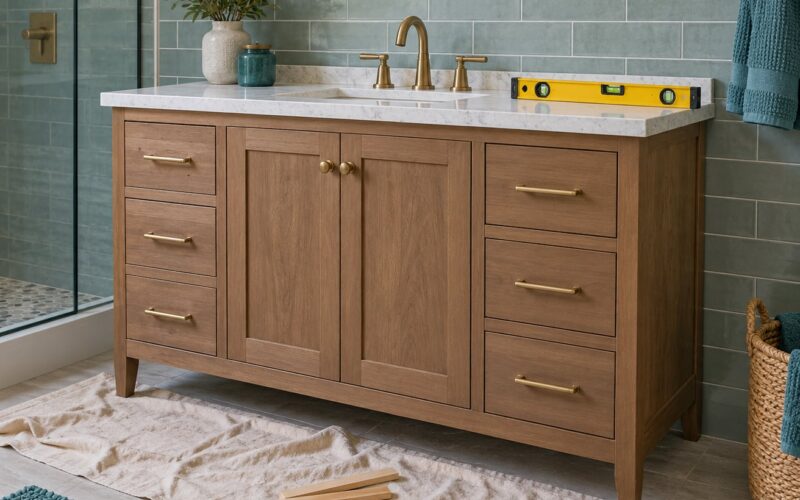
- Faucet spout covers and corner protectors for sharp vanity edges.
- Basic tools: a screwdriver, a drill and bits, a tape measure, a level, and a flashlight for looking behind fixtures.
- A thermometer if you want to verify bath temperature rather than trusting the tap handle.
Some jobs are not DIY at all. Electrical work, including adding or relocating outlets and replacing damaged receptacles, belongs to a licensed electrician, and your local code may require GFCI protection in wet locations. Grab bars need to be anchored into studs or blocking, not drywall. If you find a water heater without a working temperature-pressure relief valve, call a plumber before touching the thermostat.
Step-by-Step
1. Identify the main bathroom hazards
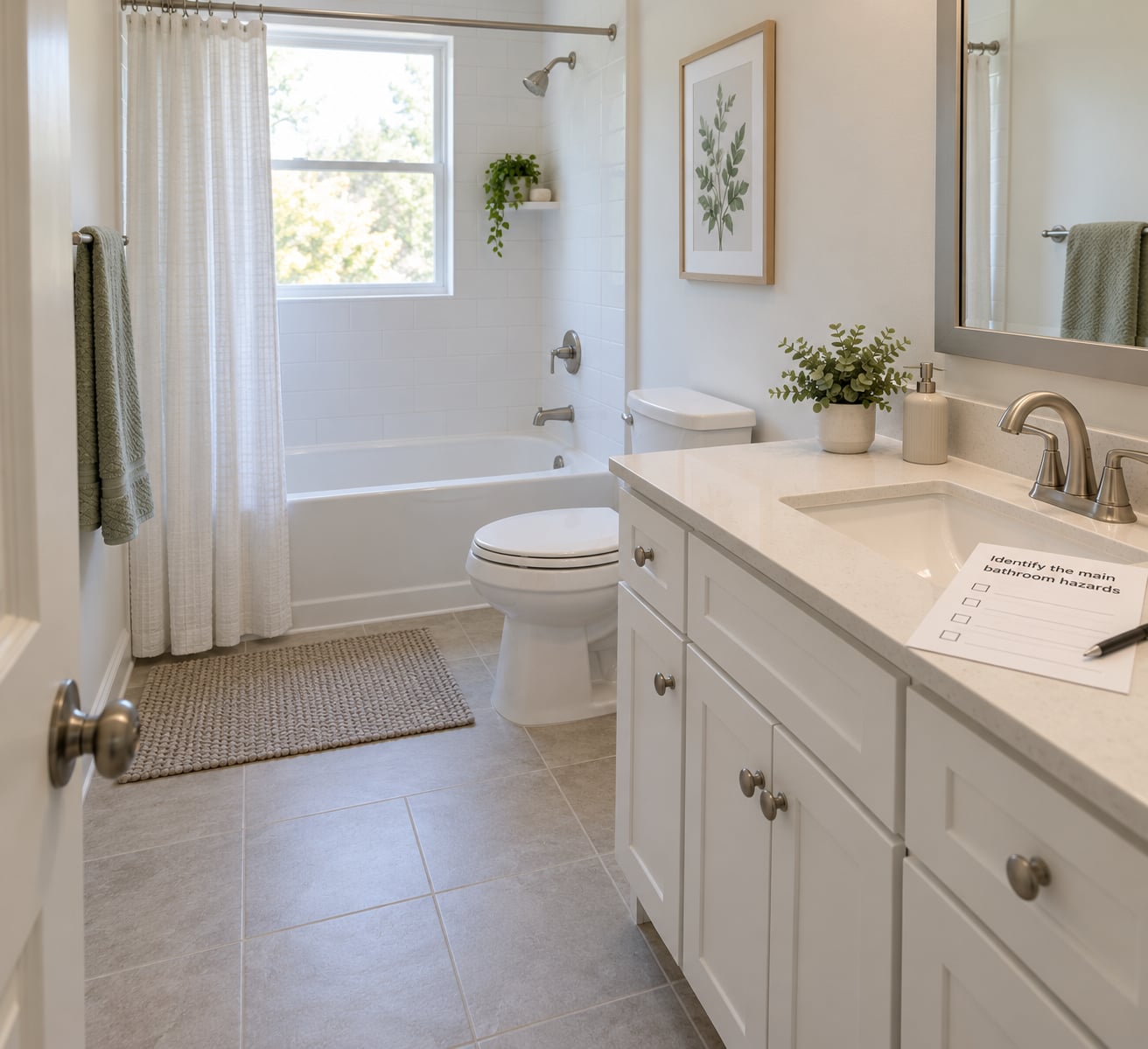
The best audit is done on your knees. Sit or lie on the bathroom floor at your child’s eye level and look at the room the way they do, because everything adult height is invisible to a toddler and everything in the 12-to-36 inch band is a target.
Walk it in this order: tub and shower, toilet, sink and vanity, cabinets and drawers, outlets and cords, then the door, windows and blind cords. At each spot ask what happens if a small hand grabs, climbs or splashes.
- Water: tap temperature, standing water in the tub, an open toilet, a bucket left for mopping.
- Poisoning: bleach, drain opener, ammonia, nail polish remover, detergent pods, medicines, vitamins, a purse or visitor bag on the floor.
- Burns: hot tap, curling iron, hair straightener left plugged in near the tub, a hair dryer on the counter.
- Falls: polished tile, a loose rug, towels on a wet floor, a step stool, a vanity a child climbs to reach the sink.
- Electrical: unused outlets, cords running near water, appliances plugged in during bath time.
- Choking and cuts: loose small items under the sink, razors, tweezers, cotton swabs, a laundry pod or a small toy.
Write down what you find. A list beats memory, and it makes step 6 possible.
Take this step seriously rather than working from memory. One parent on a parenting forum described finding a child not quite two years old out of bed and leaning precariously over the side of the tub after a brief absence. Nothing about that room was obviously dangerous from the doorway.
2. Set a safe water temperature
Scalds are the burns children get in bathrooms, and they come from hot tap water rather than from flames. Set the water heater to 120 F, which is about 49 C, or have a plumber do it if you are not comfortable with the panel and the vent. Two things matter after you set it: verify with a bath thermometer, because the dial drifts, and expect a different reading at the tub if there is a mixing valve or a recirculation loop upstream.
If your water source cannot be limited, add an anti-scald device at the faucet or a thermostatic mixing valve. These sit between the supply and the spout and cap the output, which is a stronger guarantee than the water heater setting alone because it also covers the case where a hot line is mixed with cold at a valve that has drifted.
Fill the tub with cold water first and add hot water last, and keep the tap out of reach or fit a cover over it. Test the water with your wrist or a thermometer before a child goes in, and never leave a child alone in water even for a few seconds. Older children and adults in the house also need supervision here; the risk does not stop at age five.
3. Secure toilets, cabinets and cleaning supplies
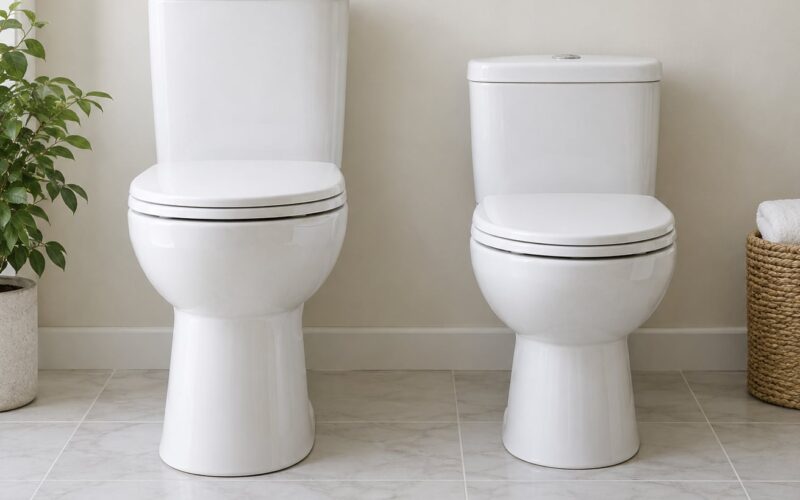
The toilet is a drowning hazard, not a curiosity. Young children can lean in and drown in very little water, and standing water in a toilet bowl or an open trash can can hold enough to be dangerous. Fit a toilet lid lock, and while you are there, check what else has water in it: buckets, the washer in a laundry room off the bathroom, pet bowls, planters.
For storage, decide between out of reach and locked away. Out of reach only works while a child cannot climb, and the people who defeat it are exactly the ones you would expect: a toddler standing on a chair to reach the sink, then opening the cabinet above it. Anything that can burn or poison belongs in a locked cabinet, ideally high and outside a child’s climbable path.
- Under-sink cabinets hold the most dangerous items in the house: bleach, drain cleaner, ammonia, scissors, razors, cleaning tablets and small hardware.
- Medicine storage needs its own decision, and it should not be the bathroom cabinet. Heat and humidity in a bathroom degrade active ingredients faster, so store medicines in a cool, dry, locked place elsewhere in the house.
- Drawer latches matter because they hold tweezers, razors, nail clippers, small batteries and dental floss picks.
Some parents move medicines to a high shelf instead of a lock. That works only if you can change the height yourself without a step stool in the room, since anything a child can pull themselves onto is not out of reach.
Also keep bags off the floor. An emergency services worker on a parenting forum described a two-year-old who reached into a purse on the floor, ate a loose ibuprofen tablet, and told the paramedic it was pink and looked like candy. A floor-level handbag is an open pill bottle.
4. Protect electrical outlets and cords
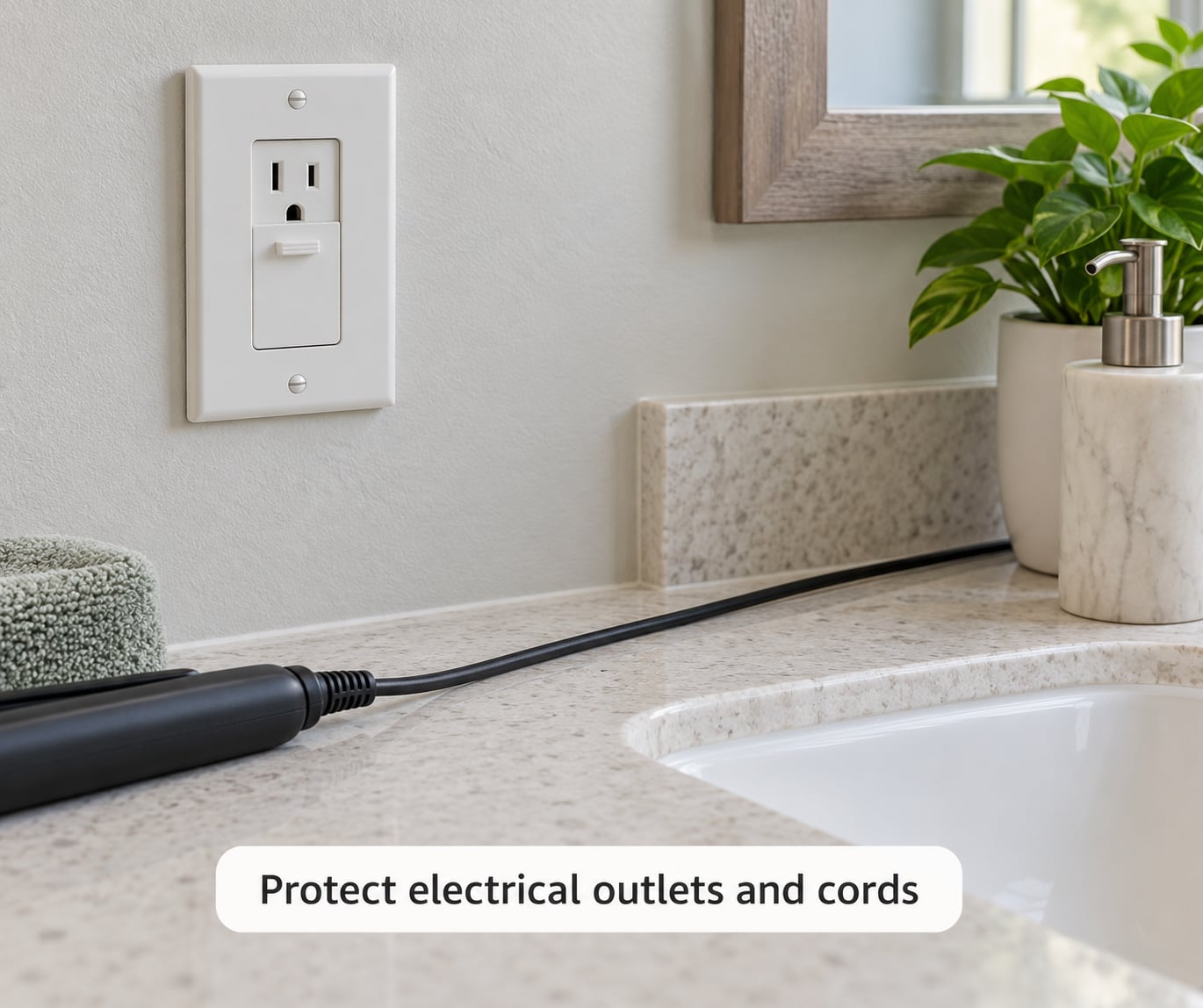
Bathrooms are wet rooms, so electricity is the hazard that demands the most care and the least improvisation. Every unused outlet gets a sliding or screw-in safety cover fitted flush to the faceplate, and any receptacle a child keeps pulling at can be swapped for a blank faceplate.
Keep appliances unplugged when not in use, and never use a hair dryer, curling iron or straightener near a full bath. Those heat tools cause serious burns and are among the most overlooked hazards in a bathroom; a hot flat iron left on the counter next to a running bath is the kind of combination that shows up in burn clinics. Unplug them, then store them away from the tub, ideally in a latched drawer.
Route cords behind furniture or along the wall, never across the sink edge or the tub rim, and never run an extension cord into the room for hairdryers. If an outlet is cracked, warm to the touch, buzzes or trips the breaker, stop using it and call a licensed electrician rather than swapping in a different cover.
5. Reduce slips, falls and climbing risks
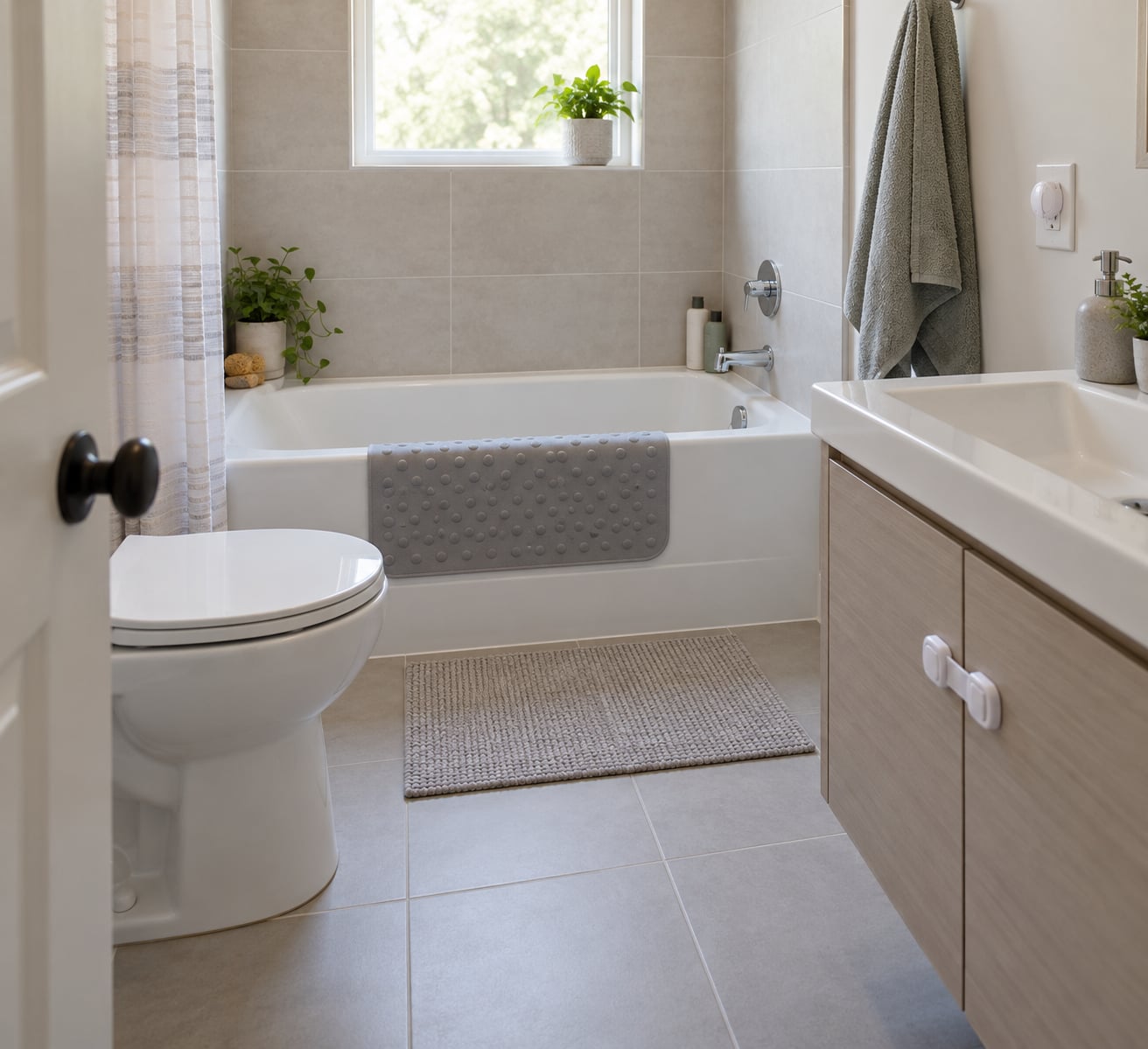
Falls are the largest category of bathroom injury, and most of them are avoidable on a wet floor. Put a rubber-backed non-slip mat in the tub or shower and a non-slip rug outside it. Skip suction cups and adhesive-only strips; they let go exactly when the floor is wet, which is the moment they matter. Wet towel on tile is a trip hazard, so give it a hook near the tub or a hamper instead of leaving it on the floor.
Climbing is the sneak route into everything else. A child who can get onto a step stool can open the cabinet, reach the counter and turn on the tap. Keep step stools in another room, or use a purpose-built one with a wide base and a guard rail if you need it for a taller child, and never leave it beside the tub.
Grab bars are the one thing worth paying a professional to install. Properly anchored bars in a home with young children or an older adult give the whole bathroom a second handrail and reduce slip risk far beyond the tub. Add contrasting tape or a colour-different surface at step edges and on the tub lip so a child and an adult with low vision both see the change of level.
6. Check the finished bathroom and maintain it
Walk the room a second time from the doorway and confirm every item on your list actually works: the latch resists a determined twist, the outlet cover will not come off with fingernails, the tub mat sits flat, the door stays shut from the outside and still opens quickly from inside. Then check that you have not created a new danger, such as a lock that traps a panicking child, a rug edge that trips an adult carrying a wet toddler, or a cabinet that cannot be opened in an emergency.
| Hazard | The fix | DIY difficulty | Who it protects |
|---|---|---|---|
| Hot tap water | Water heater set to 120 F, plus an anti-scald device at the faucet | Easy, or plumber for the heater | Everyone in the house |
| Open toilet and standing water | Toilet lid lock; empty buckets and pet bowls after use | Easy | Toddlers and mobile babies |
| Cleaners and medicines | Locked cabinet outside the bathroom; keep bags off the floor | Easy with a latch | Toddlers, curious preschoolers |
| Unused outlets | Sliding or screw-in covers, blank faceplates where possible | Easy | All children |
| Heat styling tools | Unplug and store in a latched drawer away from water | Easy | Toddlers and preschoolers |
| Wet floors | Rubber-backed non-slip mat, towel hook, bathmat that will not curl | Easy | All children, older adults |
| Climbing routes | Store step stools elsewhere; anchor the vanity if it can be pulled | Easy, brackets are medium | Toddlers |
| Falls getting in and out | Grab bars anchored into studs, with a slip-resistant approach surface | Hire a professional | Children and seniors |
Childproofing is not a one-afternoon project you finish forever. A toddler who has not defeated a latch today may defeat it next month, so treat it like a maintenance schedule rather than a checklist you close.
| Stage | Install now | Retire or upgrade |
|---|---|---|
| 0 to 12 months | Water heater set point, safe fill order, outlet covers, gated bathroom door, toilet lock, no-mat flush floor | Nothing yet |
| 12 to 24 months | Cabinet latches, non-slip mat, faucet cover, closed toilet bin, medicine moved out of the bathroom | Replace suction-cup mats with rubber-backed ones |
| 2 to 3 years | Door handle lever or knob cover, cord management, heat-tool drawer latch, step stool removed from the bathroom | Looser latches can move to a higher cabinet, not a lower one |
| 4 to 6 years | Keep water temperature cap, blind cord cleats, window limit stops | Low-stakes covers, unlocked vanity drawers, handle covers come off |
Put a recurring reminder on your calendar: check every latch, cover and mat for looseness every couple of months, and replace any piece a child can remove. Grandparents and babysitters undo well-meaning measures within a week, so tell them which protections are not optional, and keep an adult key or a working combination for every lock so the bathroom never becomes unusable for guests.
Common Mistakes
Most bathroom childproofing fails in predictable ways, and each one has a simple fix.
- Using an adult-sized latch. Many push-and-turn latches are defeated by a toddler in a few weeks. Test any latch by trying it yourself with two hands busy, because that is closer to a child’s leverage.
- Treating supervision as the whole plan. You will be distracted. Locked storage and capped temperature are the backstop, not the other way round.
- Fitting outlet covers loosely. A cover with a gap the width of a finger is decoration. Snap it flush or screw it over the plate.
- Leaving cleaners in an unlocked cabinet. Out of reach fails the moment a step stool appears in the room.
- Storing medicines in the bathroom cabinet. Humidity and heat shorten their shelf life, so move them somewhere cool and dry.
- Using suction-cup non-slip mats. They release on contact with water. Choose rubber backing and press the edges down.
- Grab bars fixed to drywall. These can pull straight out under load. Anchor into studs or blocking, and hire someone if you are not confident.
- Over-locking the room. A bathroom you cannot use quickly is a bathroom where adults rush, and a locked toilet paper holder is not a safety measure. Lock what is dangerous, leave the rest usable.
Renters can do most of this without drilling: adhesive-mounted latches, hook-and-loop strips over cabinet pulls, a tension-gate bathroom door, and self-adhesive outlet covers. For anything you cannot fix permanently, measure the fixtures first, since cheap gear often does not fit a standard rental door or an unusual toilet.
Frequently Asked Questions
What is the most important thing to childproof in a bathroom?
Water, every time. Start by setting the water heater to 120 F and capping the tap with an anti-scald device, then lock the toilet and move cleaners and medicines into a locked cabinet outside the room. Falls and poisoning follow close behind, so cover unused outlets and put down a rubber-backed mat. Supervise bath time directly; the physical changes only add margin for the moments your attention slips.
How can I prevent a toddler from getting burned by hot water?
Set the water heater to 120 F, about 49 C, and confirm the actual tub temperature with a bath thermometer rather than trusting the handle position. Add a thermostatic or anti-scald device at the faucet if you cannot limit the supply. Fill with cold first and hot last, keep the tap covered or out of reach, and unplug hair dryers, curling irons and straighteners before the bath starts.
Do I need to childproof bathroom outlets?
Yes. A bathroom outlet is the one hazard where a cheap plastic cover costs a couple of dollars and prevents a shock or burn. Fit a sliding or screw-in safety cover on every unused receptacle, or replace the ones a child keeps pulling at with blank faceplates. Keep appliances unplugged during bath time and route cords away from water, and have any damaged or warm receptacle looked at by a licensed electrician.
Are bathroom grab bars safe for children?
Properly installed grab bars are safe and useful for children. They give a toddler something solid to pull up on getting into and out of the tub, and the same bars help an older adult in the same house. The only dangerous ones are bars screwed into drywall with hollow-wall anchors, which can pull out under load. Anchor into studs or blocking, and let a professional handle the drilling if you are not sure what is behind the wall.
When should I hire a professional to childproof my bathroom?
Call a professional when the job touches electricity, plumbing or structure. That covers adding or relocating outlets, replacing damaged receptacles, working on the water heater or installing an anti-scald valve, and drilling for grab bars or vanity anchors. Everything else in this guide, latches, lid locks, outlet covers, mats and cord management, is straightforward DIY and takes under an afternoon.
Conclusion
Work through the hazards in order of how fast they hurt: water temperature first, then the toilet and standing water, then locked storage for cleaners and medicines, then outlets and cords, then slips and climbing. Most of it is an afternoon of latches, covers and mats.
Then recheck the room every few months and again at each new developmental stage, because a child who could not defeat a lock last season can now. For the full checklist of what to buy before you start, see the supplies list above.