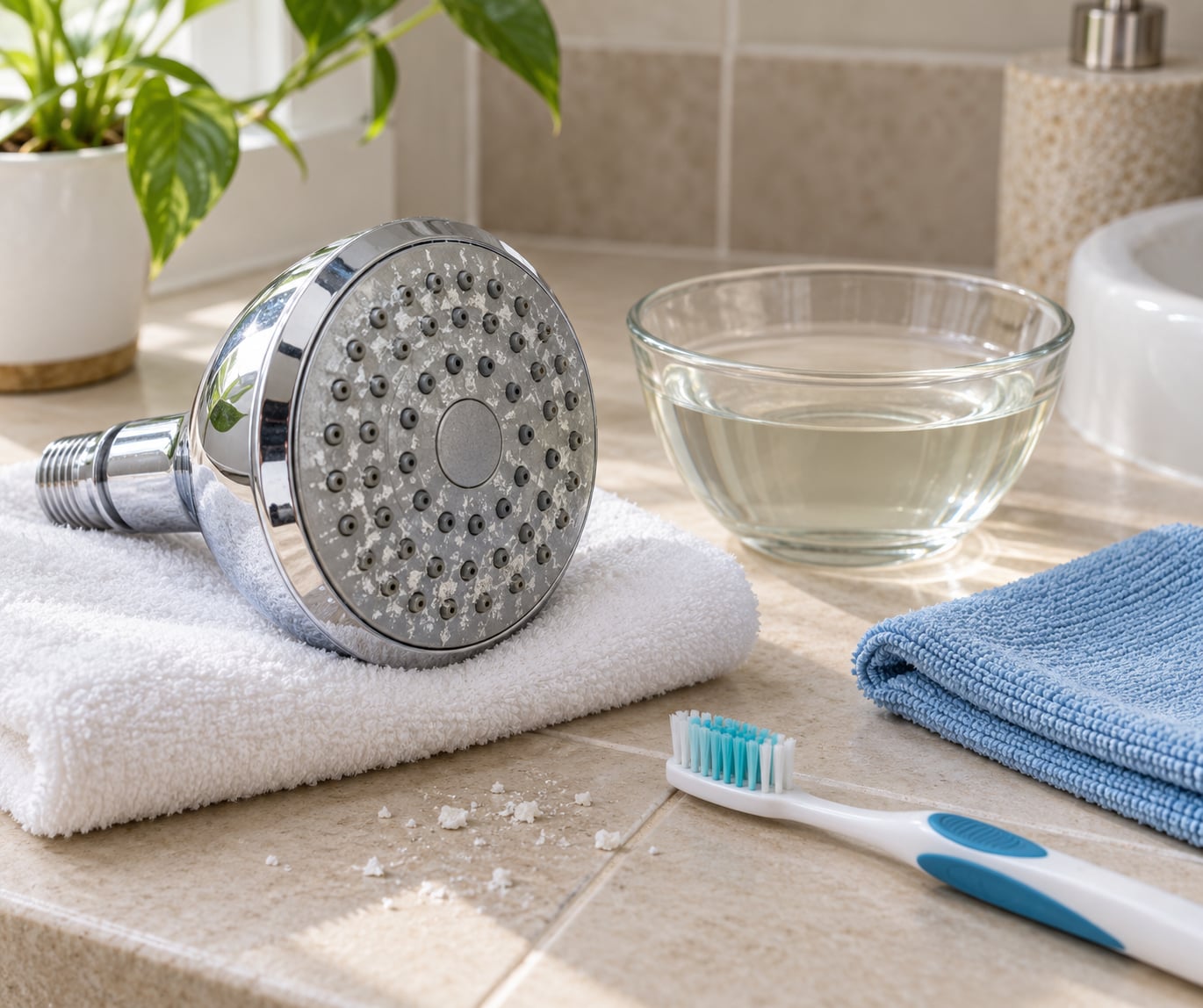
The fastest fix for weak, sputtery spray is an acid soak. To clean a showerhead with hard water buildup, soak the head in white vinegar for 30 minutes to overnight, scrub the nozzles with a soft toothbrush, rinse, and put it back. Hands-on time is about 20 minutes plus the soak, and you need nothing more than a bucket and a brush.
That said, the finish on your showerhead decides how long you can soak it. Chrome and stainless steel handle a long bath in vinegar. Brushed nickel, matte black, oil-rubbed bronze and brass want about 30 minutes and no more.
Table of Contents
- What You Need
- Step-by-Step: How to Clean a Showerhead with Hard Water Buildup
- Inspect and Prepare the Showerhead
- Soak the Showerhead to Dissolve Mineral Deposits
- Scrub the Nozzles and Rinse Thoroughly
- Reinstall and Test the Water Flow
- Common Mistakes
- Frequently Asked Questions
- Does vinegar damage shower heads?
- How long should I soak a shower head in vinegar?
- Can I clean a shower head while it is still attached?
- What if my shower head is still clogged after soaking?
- How often should I clean my shower head?
- Conclusion
What You Need
For the no-removal soak, the list is short. You want a way to hold vinegar against the showerhead face for several hours, plus something soft to brush with afterward.
- White vinegar, distilled if you have it
- A plastic zip-top bag large enough to cover the showerhead face, or a sponge and a bowl
- A soft nylon brush or an old toothbrush
- A microfiber cloth for drying the face so it does not spot
- Rubber band or tape to hold the bag in place
For the deeper method, where the head comes off the arm, add these. A bucket needs to be deep enough that the face sits fully underwater, with room to soak the whole head rather than just the nozzles.
- A container or bucket for an immersion soak
- Adjustable pliers or a wrench, with a folded towel to wrap around the arm
- Fresh plumber’s tape for the threads
- Optional: a flat-head screwdriver, for screw-on heads with a set screw that may be hiding under a rubber cap
Step-by-Step: How to Clean a Showerhead with Hard Water Buildup
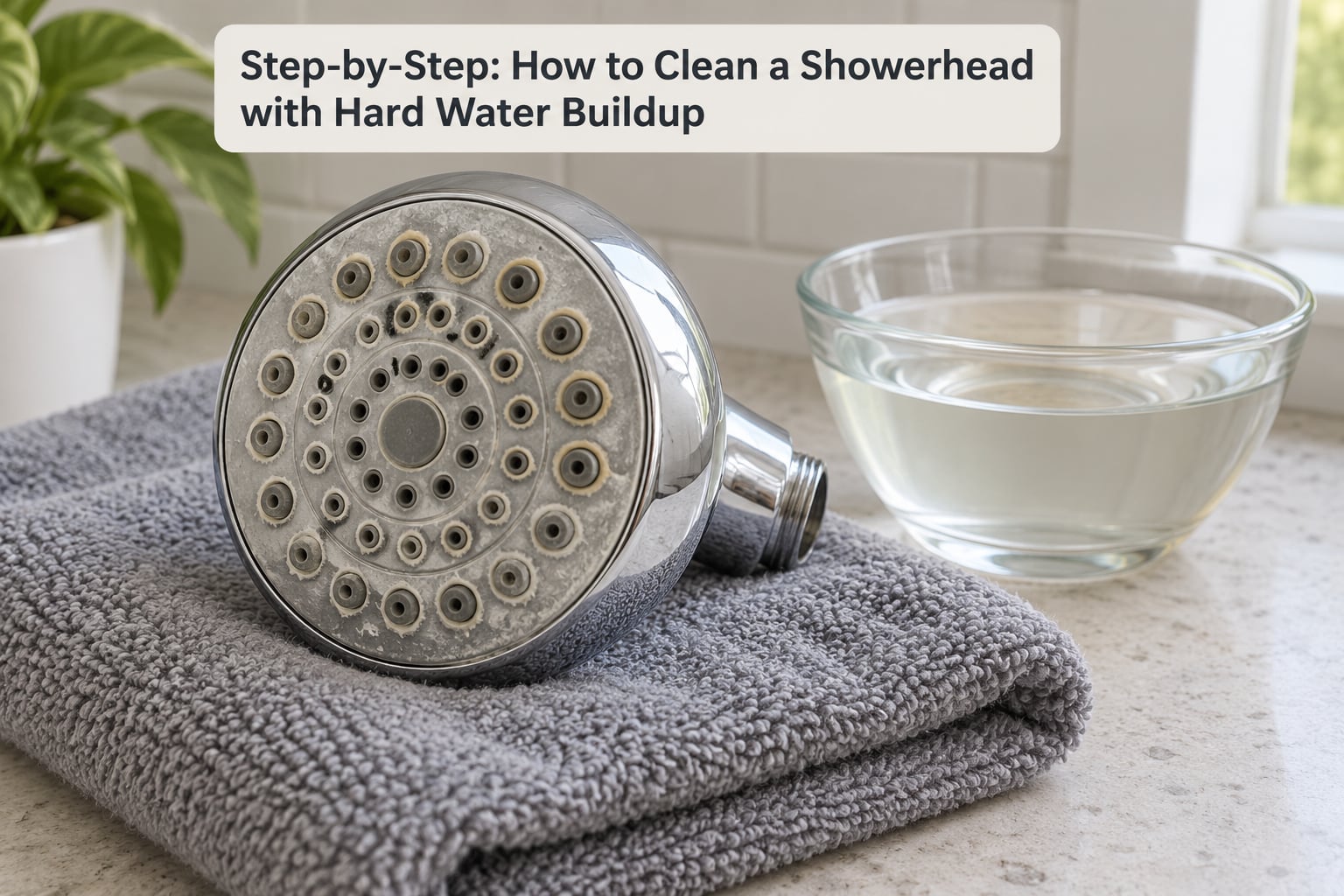
Work out how bad it is before you start, because that decides whether you soak in place or take the head off. If water still comes out of every nozzle and the spray is only a little weak, the in-place soak is enough. If some nozzles are fully blocked, the spray fans sideways, or the swivel is stiff, remove it and soak the whole thing.
Inspect and Prepare the Showerhead
Look at the finish before you soak. Chrome, plastic and stainless steel are the most forgiving. Brushed nickel, matte black, oil-rubbed bronze and plated brass are coated surfaces, and a long acid soak can dull or cloud the coating.
Always spot test first. Put a few drops of vinegar on a spot under the head where nobody sees it, wait 15 minutes, then wipe and look. If the finish dulled, rinse and use a gentler method: a vinegar-soaked cloth held against the nozzles for short bursts, rather than a full immersion.
Then turn the water off, either at the main shutoff or by removing the shower arm’s trim. Plug the drain or drop a towel in the tub, because you are about to send a fair amount of cloudy mineral water downhill. Several readers on r/CleaningTips make the same point: the mess is the part people dislike most, not the work.
Soak the Showerhead to Dissolve Mineral Deposits
Mix equal parts white vinegar and water in your bucket or bowl. Fill it deep enough to submerge the showerhead face completely, with a few inches of clearance so nothing sits against the side of the container.
Leave it 30 minutes for light spotting. Give it a few hours for a showerhead that has gone a year without attention, and overnight for the worst cases. The chemistry is slow but sure: acetic acid reacts with calcium carbonate and turns the alkaline scale into something that rinses away in water.
While the head soaks, you can do the in-place version instead. Soak a sponge or a folded cloth in straight vinegar, press it against the nozzle face, and tape it there. Re-wet it every 30 to 60 minutes and leave it 4 to 6 hours overnight. Straight vinegar works better than a diluted mix, and full submersion beats a cloth every time.
One caution on the container. Users on plumbing forums point out that rain shower heads are too big for most bags and too heavy to lift with one hand, so work near the tub floor or use a step stool rather than balancing on a chair.
Scrub the Nozzles and Rinse Thoroughly
Rinse the soaked head under running water first, then brush. Work the face in small circles with a soft toothbrush, aiming at each nozzle opening. You want the loosened grit to leave rather than smear back into the holes.
For nozzles that are still blocked, pick gently with a toothpick or the end of a paper clip while the head is wet. Push from the face outward so debris falls away instead of driving deeper. Silicone nozzles are soft and rubbery, and a fingernail often works even better on light clogs.
Then rinse thoroughly until the water runs clear and stops smelling sharp. A short backward flush helps: aim the hose into the showerhead and let water run the wrong way through it for a few seconds, which pushes residue out of the inlet and flow restrictor.
Reinstall and Test the Water Flow
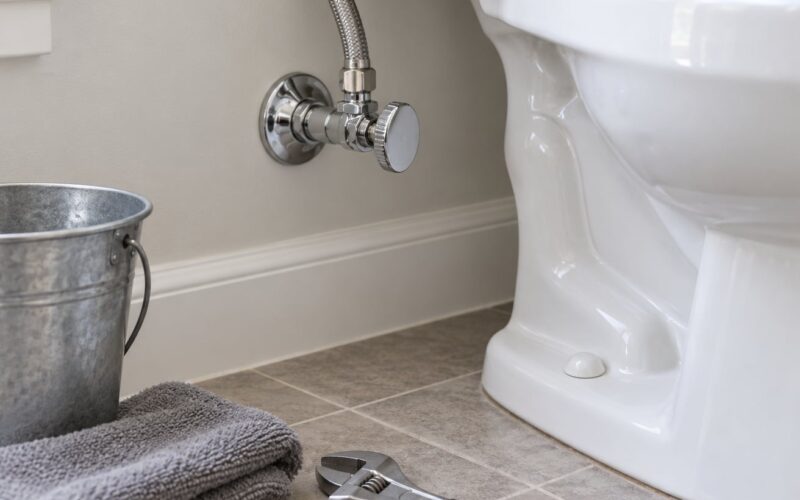
Wrap a folded towel around the shower arm before you touch the pliers, so the tool cannot bite the chrome and leave dents. For a handheld wand, unscrew at the hose collar, usually by hand. For a fixed head, unscrew the whole head or loosen a set screw. Turn counterclockwise, and stop the moment it breaks free rather than forcing a stuck joint.
Scrape any scale off the arm threads, then wrap fresh plumber’s tape around them. Wrap clockwise, in the same direction the threads tighten, so the tape pulls itself flat instead of bunching.
Screw the head back on by hand until snug and add just a quarter turn with the wrench. Overtightening cracks threads and crushes the rubber washer, which is how a cleaning job turns into a leak at 11pm. Turn the water back on slowly, in stages, and watch the joint.
Test the flow with the drain open. Strong, even spray across all nozzles means you are done. A few weak nozzles mean another soak, not a replacement.
Common Mistakes
Boiling water is the classic bad idea. It can craze plastic nozzles, melt the rubber seals, and loosen the bonding on composite heads, and it does very little to the scale. Use hot tap water, not water you brought to a boil.
Abrasive products cause permanent damage. Magic Eraser, scouring pads, and metal brushes scratch chrome and strip thin plating, and a scratched showerhead never looks the same again. Stick to nylon brushes and a microfiber cloth.
Never mix vinegar with bleach, ammonia, or toilet cleaner. Vinegar gives off gas when it meets a hypochlorite bleach, and the combination is genuinely hazardous in a small bathroom. If you used a bleach product earlier in the day, rinse the showerhead well and wait before soaking.
Do not force a stuck showerhead. Scale often glues the threads together, and the pipe elbow behind it is usually plastic. Soak the joint longer, then use a rubber band trick for grip: wrap a wide rubber band around the collar, add pliers over the top, and the band adds friction without metal on metal.
Also stop picking at nozzles with a knife blade or a needle. You will cut the rubber lip and widen the hole permanently, which sprays water in a worse direction than it started.
For prevention, a small routine beats a big restoration. Wipe the nozzle face with a microfiber cloth once a week, run the shower for 30 seconds after every use to clear the face, and do a vinegar soak every two or three months in hard water areas. A filtered showerhead helps too, though it is not a substitute for cleaning; the screen itself needs rinsing on the same schedule.
Frequently Asked Questions
Does vinegar damage shower heads?
White vinegar is safe for chrome, plastic, stainless steel and silicone nozzles when you keep soak times in check. Brushed nickel, matte black, oil-rubbed bronze and plated brass are coated finishes that can dull or cloud with a long soak, so cap those at about 30 minutes and spot test a hidden area first. Rinse and dry the face after soaking to avoid water spotting.
How long should I soak a shower head in vinegar?
Give it 30 minutes for light mineral spotting, a few hours for a showerhead that has gone a year uncleaned, and overnight for heavy limescale. Full submersion in equal parts vinegar and water is more reliable than a cloth held against the face. Check progress at the 30-minute mark by brushing one nozzle, rather than committing to a long soak blind.
Can I clean a shower head while it is still attached?
Yes, and for mild buildup it is the easier option. Soak a sponge or folded cloth in straight vinegar, press it onto the nozzle face, and tape it in place for 4 to 6 hours, re-wetting it every 30 to 60 minutes. This works well for a handheld wand and a standard fixed head. Large rain heads need full submersion instead, so expect to remove those.
What if my shower head is still clogged after soaking?
Check the four things vinegar cannot fix. Sediment and pipe scale may be sitting in the supply line or the flow restrictor screen, which usually needs a longer soak or a plumber. Rubber nozzles hardened by age will not reopen no matter how long you soak them, and those need replacing. A partially blocked shutoff valve looks identical to a clogged head, so rule that out first.
How often should I clean my shower head?
In hard water areas, wipe the nozzle face weekly, run the shower briefly after each use to clear standing water, and do a full vinegar soak every two or three months. In soft water areas, twice a year is usually enough. If you notice weak pressure or a musty smell between soaks, clean sooner rather than waiting for the schedule to catch up.
Conclusion
Start by identifying the buildup and committing to a vinegar soak before you consider removal or replacement. Fill a bag or a bucket, give it 30 minutes, brush the nozzles, and judge the result. Most weak showerheads come back to full flow on the first pass, and the ones that do not usually need a second soak rather than a new fixture.
Then keep it that way. A weekly wipe and a soak every couple of months in hard water territory stops deposits from ever reaching the point where you are scrubbing at midnight. If weak flow or a leak comes back fast, that points at the supply line, the flow restrictor, or an old washer, and that is a plumber question, not a cleaning one.