Most garbage disposals that stop working do not need replacing. They have tripped an internal overload protector, and once you clear the jam and push that button back in, the motor runs again. Knowing how to reset a garbage disposal takes about ten minutes, costs nothing, and avoids a plumber visit for a problem that sits right under the sink.
The short version: turn the power off first, remove the sink stopper, clear anything you can see, then find the small reset button on the bottom of the unit and hold it for roughly fifteen seconds. Turn the power back on and run cold water while you listen for the motor to spin.
One safety note before anything else. A disposal blade does not stop moving the instant you flip the switch, and it is not designed to be reached into. Never put your hand inside the drain, and never work on the unit while it is energized.
Table of Contents
- What You Need
- Step-by-Step: How to Reset a Garbage Disposal
- 1. Turn Off the Power and Check for Hazards
- 2. Remove the Sink Stopper and Inspect the Drain
- 3. Clear a Minor Jam Before You Reset a Garbage Disposal
- 4. Locate and Press the Reset Button
- 5. Test the Disposal with Cold Water
- 6. Know When to Stop and Call a Plumber
- What Your Symptom Actually Means
- Two Different Reset Buttons, One Confusing Problem
- Common Mistakes
- Frequently Asked Questions
- Why is my garbage disposal humming but not working?
- Will unplugging a garbage disposal reset it?
- Why do I have to keep hitting the reset button on my garbage disposal?
- How long should I hold the garbage disposal reset button?
- Is it safe to put my hand in the garbage disposal?
- Why does my garbage disposal trip the breaker after a few seconds?
- Conclusion
What You Need
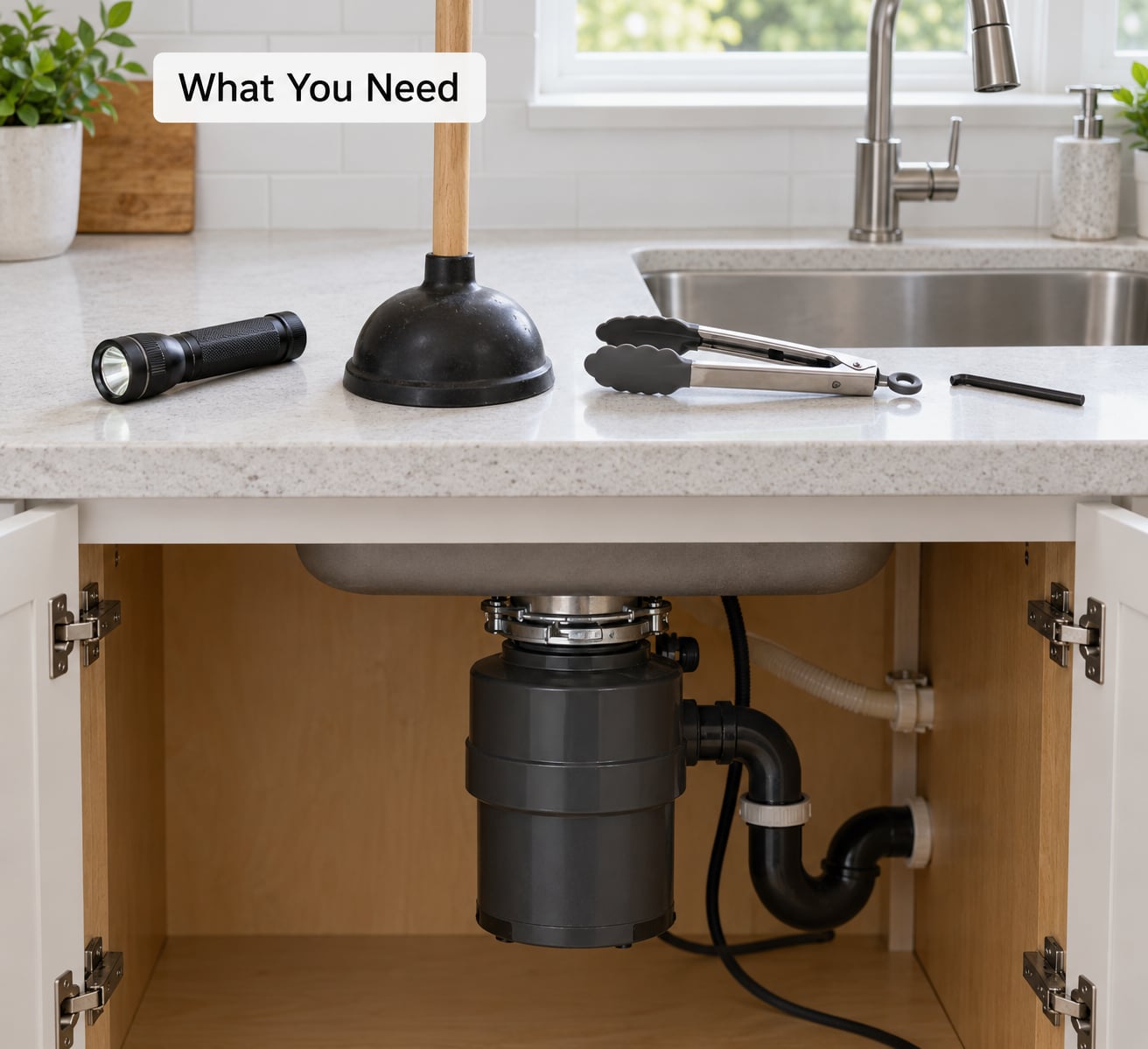
The tool list for this job is short, and most households already own everything on it.
- A flashlight. You are looking for a button on the underside of the unit, usually in shadow at the back of the cabinet.
- A flat-head screwdriver or pliers. For pulling the sink stopper out of the drain flange.
- Kitchen tongs or a sturdy wooden spoon. For lifting visible debris out of the grinding chamber. Fingers are not an option.
- A 1/4-inch hex key (Allen wrench). Many disposals ship with one taped inside or stored in the top of the chamber. This is the tool you turn when the blades are stuck.
- A plunger. Useful later if the disposal spins but the sink still will not drain.
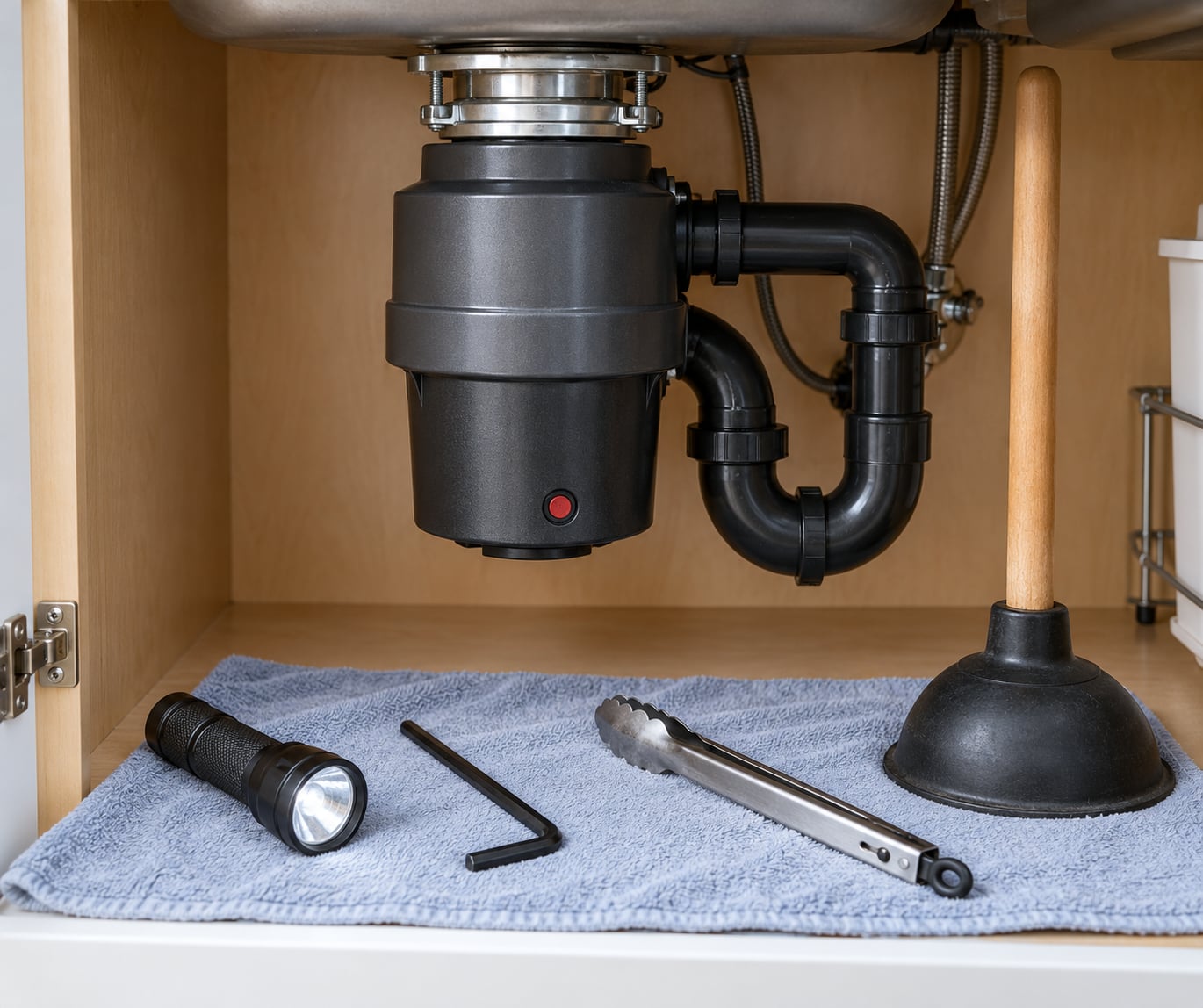
To find the reset control, look on the underside of the disposal motor housing, usually near the top of the unit where it meets the sink drain. It is typically a small red or black square button. Some brands use a round one. When it trips, the button sits slightly lower or pops outward by about a quarter inch, which is a quick way to confirm you have found the right one.
Older Whirlaway-style units and a few compact models integrate the protector so there is no external button to press. On those, resetting means restoring power at the breaker and then working the hex key. If nothing on the underside looks like a reset button, note the model number stamped on the housing before you buy any parts.
Step-by-Step: How to Reset a Garbage Disposal
1. Turn Off the Power and Check for Hazards
Flip the switch off, then open the cabinet and confirm the unit is really de-energized. A plug-in disposal has a cord or an extension-style receptacle under the sink that you pull straight out. A hardwired disposal has no plug at all, so you go to the breaker panel and push that circuit’s handle fully to OFF. Then look at it again.
The reason for the extra look is the breaker reset technique: a handle that has merely tripped does not always latch, and pushing it to OFF and then back to ON is what actually resets it. Do that now, before you start taking anything apart.
Clear the area under the sink and move cleaning chemicals, plumbing supplies and anything else you would not want to reach through. Dry your hands. A disposal switch on the wall or on the counter is never a substitute for disconnecting power.
2. Remove the Sink Stopper and Inspect the Drain
Most stoppers simply lift straight out. Some have a small nut on the underside of the flange that you unscrew with pliers first. Once the stopper is out, use a flashlight and look down into the grinding chamber rather than guessing from above.
You are looking for the everyday causes: a bone, a bottle cap, a nut, a wad of celery or onion skins pressed against the blade, or a film of grease coating the bottom. Run cold water for a few seconds first so you are looking at a wet chamber and any debris floats rather than sitting in shadow.
3. Clear a Minor Jam Before You Reset a Garbage Disposal
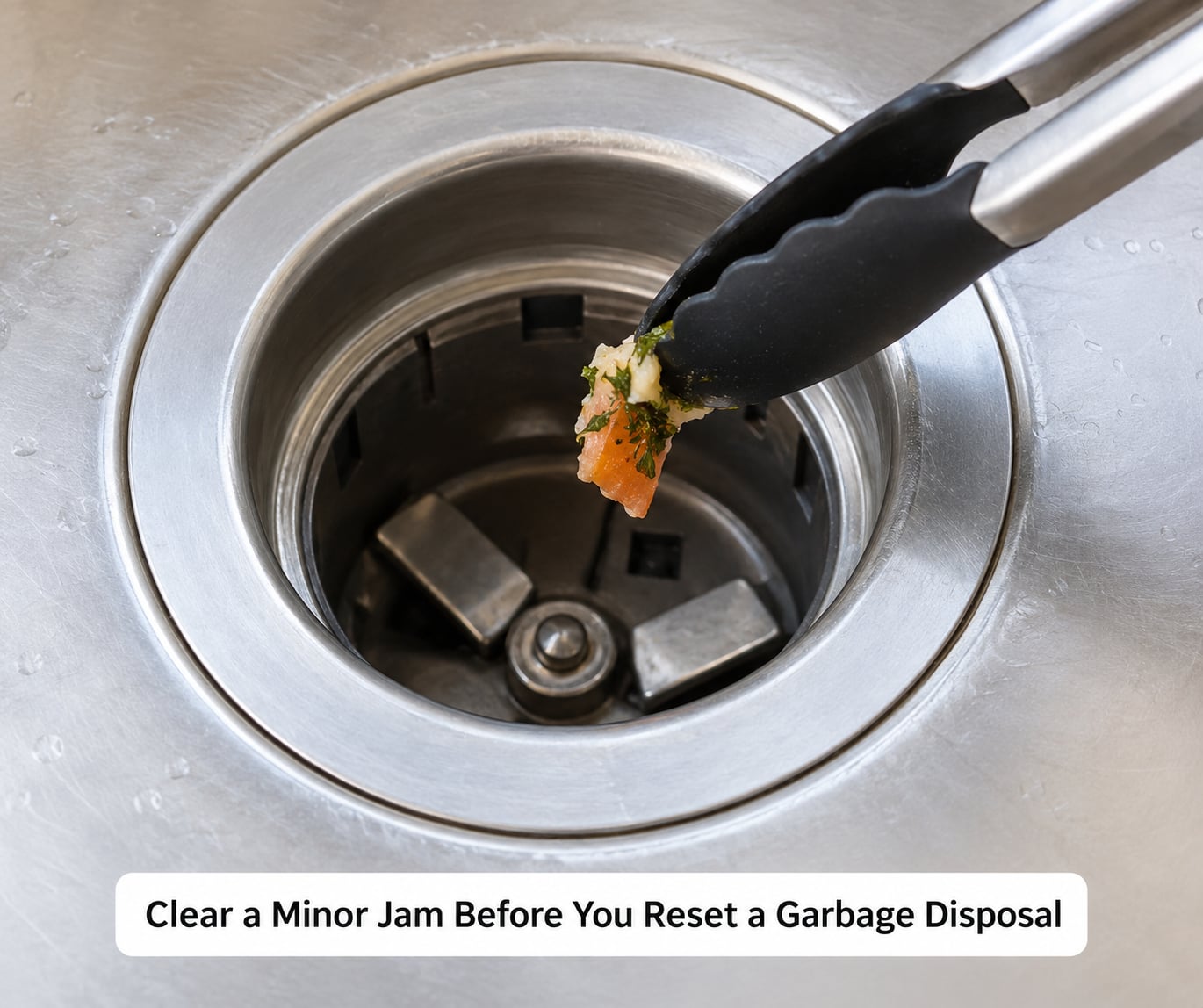
Resetting a jammed disposal is the single most common wasted afternoon. If the blades are loaded with something, the protector trips again within seconds of the motor starting.
Reach in with tongs and lift out what you can see, working from the edge toward the center. Do not push debris deeper, and do not force anything that will not come up. If the obstruction is wrapped tightly around the blade, stop and let a plumber deal with it.
When the blades still will not move freely, insert the 1/4-inch hex key into the square hole at the center of the underside of the disposal and rock it back and forth a quarter turn in each direction. You are turning the flywheel by hand. Keep the power off and use slow, even pressure. If the key spins freely with no resistance at all and no jam in sight, that is not a blockage, and more resetting will not help.
4. Locate and Press the Reset Button
With the power still off and the jam cleared, find the reset button on the underside of the motor housing. Push it in and hold it for about fifteen seconds. InSinkErator’s own guidance gives roughly fifteen seconds, and holding it longer changes nothing. What you are doing is letting the internal thermal breaker cool enough to re-latch.
If it will not latch, the motor is still hot. Wait 10 to 15 minutes with the power off and try again. Forum threads on this question are consistent: several people reported the button refusing to click for about ten minutes after a trip before it went in. That delay is normal and does not mean the button is broken.
If the button was already sitting flush or popped out before you touched anything, leave it alone. If it is already in, you do not need to reset it, and you have a power problem or a motor problem instead.
5. Test the Disposal with Cold Water
Put the stopper back on, restore power at the breaker or reconnect the plug, and turn the disposer switch on with cold water running. The water is not optional. The motor is cooled by water flowing over it, which is why a disposal that runs dry for a minute can trip on the next use.
You will know the reset worked when the motor spins freely and the hum disappears, and the sound changes from a strained buzz to the steady grind of blades moving. Run cold water for 15 to 20 seconds after you switch it off, too, to flush the chamber and the drain line.
If the hum comes back within seconds, the protector is tripping again. That is a signal about the underlying fault, not a reason to press the button a fifth time.
6. Know When to Stop and Call a Plumber
Some symptoms are firmly outside homeowner territory. Stop and call a plumber if you see any of these.
- A humming motor with blades that never turn, and the hex key spins freely. That points to a failed motor or a failed start capacitor, not a jam.
- A burning smell. Do not run it again. Shut the breaker off and leave it until someone qualified looks at it.
- Water leaking from the bottom of the disposal body. The housing itself is cracked or a seal has failed. A reset button cannot fix that.
- A reset button that pops straight back out after a full cool-down. That is an electrical fault or a seized protector.
- Tripped breakers that will not hold. Anything downstream of the breaker, meaning the receptacle wiring or the unit’s own wiring, needs an electrician or a plumber.
- A humming sound after the blades have fully stopped turning. Do not leave it running to see what happens, because it can overheat and trip the breaker again.
What Your Symptom Actually Means
Most repeat trips come down to one of a handful of faults. Match what you hear and see against the table below before you do anything else.
| Symptom | Likely cause | What to do |
|---|---|---|
| Completely silent, no hum | No power: unplugged, tripped breaker, or tripped GFCI outlet | Reconnect or push the breaker fully to OFF, then ON. Press the GFCI test and reset buttons on the receptacle. |
| Hums steadily, blades do not move | Stuck blade or overloaded motor | Power off, remove the stopper, clear visible debris, then work the 1/4-inch hex key back and forth. |
| Hums, hex key spins freely | Failed motor or start capacitor | Stop resetting. Call a plumber or the manufacturer’s authorized service center. |
| Runs a few seconds, then stops | Protector tripping on overload or heat | Clear the chamber, let it cool 10 to 15 minutes, reset once, and test with cold water running. |
| Spins but the sink will not drain | Clog downstream in the drain line or P-trap, not in the disposal | Plunge the sink. If that fails, remove and clean the P-trap under the cabinet. |
| Burning smell or buzzing | Overheated or failing motor | Shut off the breaker immediately and call for service. |
| Water pooling under the sink | Leaking drain connection, flange or housing | Tighten or replace the connection if it is a slip joint. A leak from the housing itself needs a plumber. |
Two Different Reset Buttons, One Confusing Problem
There is a second button in most kitchens and it causes a lot of wasted effort. The disposal’s overload protector sits on the underside of the unit and restores power to the motor. The GFCI receptacle reset sits on the outlet itself and cuts power to everything on that circuit when moisture or a ground fault is detected. They look similar and they solve different problems.
If your disposal stopped because water tracked out to the counter receptacle, resetting the disposal does nothing. Press the GFCI reset button on the wall outlet first, then test the disposal. If the outlet has no reset buttons at all, it is a standard receptacle and the power is being controlled at the breaker.
Common Mistakes
Resetting without clearing the jam. This is the number one repeat trip. The overload protector is doing its job by refusing to run a motor that is locked; resetting it without freeing the blades just recreates the same trip in a few seconds.
Putting your hand inside the chamber. Even with the power off, blades can move when a stuck jam suddenly releases. If you can see debris, use tongs. If you cannot reach it with tongs, a plumber can.
Holding the button forever. Fifteen seconds is the figure in the manufacturer’s instructions. If the button has not latched after that, more pressure will not fix it, and the answer is a cool-down or a different fault entirely.
Resetting repeatedly as a test. Four or five presses in a row tells you nothing except that the fault is still there. Each trip also adds heat to the motor, and a motor that overheats repeatedly can be damaged for good.
Ignoring what the unit is telling you. A leak, a burning smell, or a hum that continues after the blades stop are all reasons to stop, not reasons to keep pressing buttons. Homeowners posting on r/HomeImprovement who worked through the reset and hex key steps usually found the jam; the ones still stuck had a motor, capacitor or wiring fault.
Replacing the unit before checking the warranty. Several manufacturers offer a limited warranty and will route service through an authorized service center, sometimes covering part of the labor. Have the model and serial number from the housing label handy before you shop for a replacement. Replacement reset buttons are rarely sold on their own, which means a bad protector effectively means a new unit.
Two habits prevent most of these problems. Run cold water before, during and after every use, and keep stringy and starchy waste out of the chamber. Celery, corn husks, onion skins, coffee grounds, grease and bones are the usual repeat offenders.
Frequently Asked Questions
Why is my garbage disposal humming but not working?
A hum means the motor has power and is trying to spin, but the blades are locked. With the power off, remove the sink stopper and clear anything visible, then turn the flywheel back and forth with a 1/4-inch hex key in the hole on the underside. If the key turns freely and nothing is jammed, the motor or start capacitor has failed and the unit needs service.
Will unplugging a garbage disposal reset it?
Only indirectly. Unplugging a plug-in unit or flipping its breaker removes power and lets the internal thermal breaker cool, so the reset button may latch afterward. It does not clear a jam or re-energize anything by itself. If the disposal is hardwired with no plug, work at the breaker panel instead and push the handle fully to OFF before returning it to ON.
Why do I have to keep hitting the reset button on my garbage disposal?
Usually because the blades are still loaded, so the motor trips the overload protector again within seconds. Clear the chamber with tongs and work the hex key, then wait 10 to 15 minutes for the motor to cool before pressing the button again. If it still trips after a genuine clear-out and a full cool-down, the fault is electrical or in the motor, not in the drain.
How long should I hold the garbage disposal reset button?
About fifteen seconds, according to InSinkErator’s own instructions. Push the button in and hold it steadily rather than tapping it. If it does not latch after that, the motor is still too hot, and the fix is a 10 to 15 minute wait with the power off. Holding the button down longer adds nothing and will not reset a failed protector.
Is it safe to put my hand in the garbage disposal?
No. Never reach into the chamber, even with the switch off or the breaker flipped, because the blades can move unexpectedly when a stuck jam suddenly releases. Use tongs, pliers or a wooden spoon to remove anything you can see from above. The hex key hole on the underside is the safe way to turn the blades by hand, and the power stays off while you do it.
Why does my garbage disposal trip the breaker after a few seconds?
The breaker is sensing a surge of current as the motor tries to start against a load it cannot move. A jammed blade is the usual reason. Clear the jam, reset, and test again with cold water running so the motor stays cool. If it trips again with the blades turning freely, suspect the motor or the receptacle wiring, and call an electrician or plumber rather than replacing the breaker.
Conclusion
The safest first moves when you need to know how to reset a garbage disposal are always the same: cut the power at the plug or the breaker, pull the sink stopper, lift out only what you can see with tongs, and give the motor 10 to 15 minutes to cool if the button will not latch. Then press the reset button on the underside of the unit for about fifteen seconds, restore power, and run cold water while you listen.
A successful reset sounds different. The hum stops, the blades turn freely, and the unit runs until you switch it off. If the hum returns in seconds, you have found your answer: the jam is not the problem. A humming motor with freely turning blades, a burning smell, a leak from the housing, or a breaker that will not hold all belong to a plumber or an electrician, and no amount of pressing that button will change it.