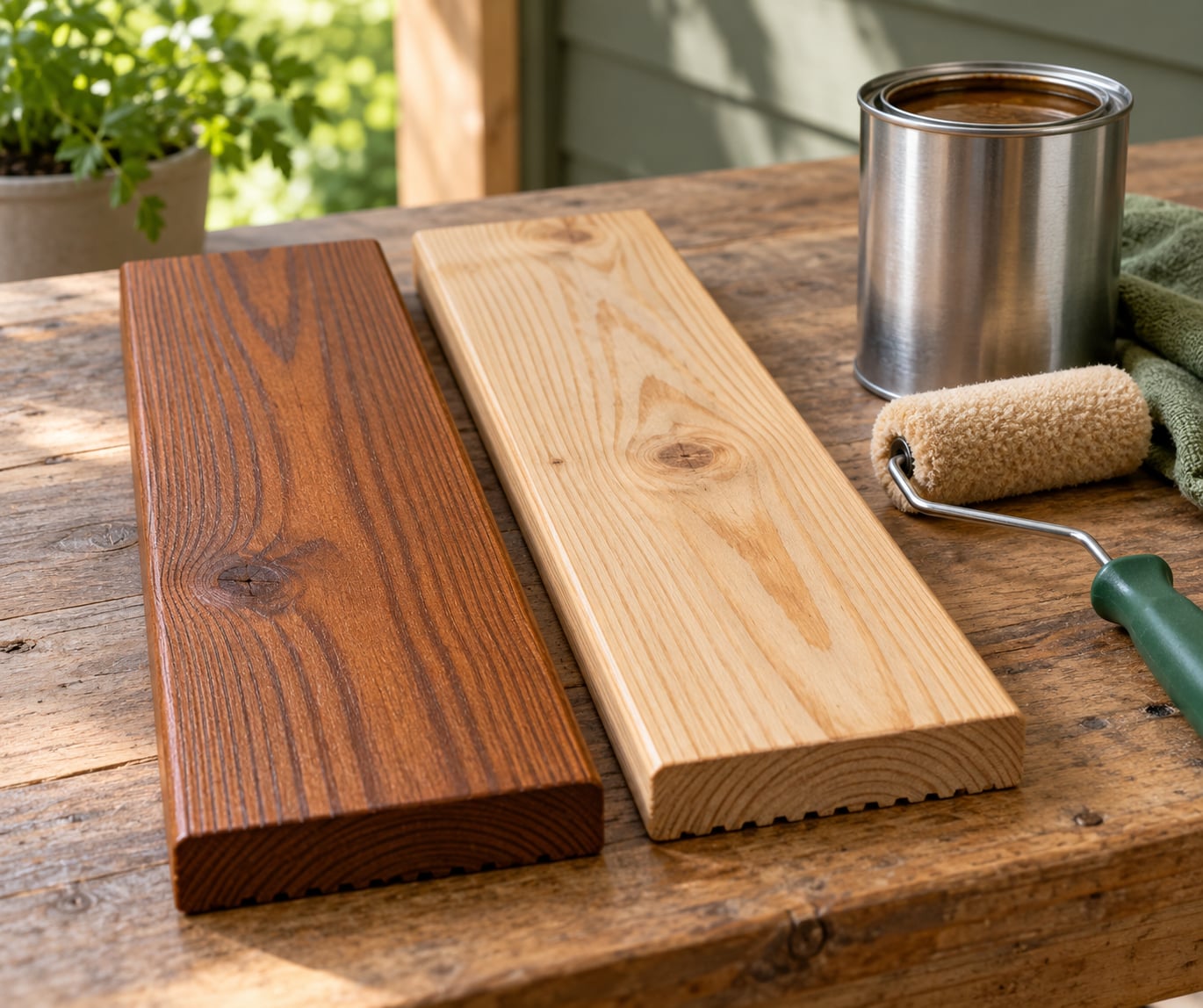
Deck staining vs sealing comes down to one question: do you want the deck a different color, or do you want the wood you already have? Stain adds pigment, which colors the surface and blocks more sunlight. Sealer is clear or lightly tinted, keeps the natural grain, and mainly slows water getting in. Plenty of decks do better with a stain-and-sealer hybrid than with either one on its own.
I’ve laid out how each finish behaves, how long it realistically lasts, and which one suits pressure-treated pine, cedar, redwood and composite boards. Pick the row in the table that matches your deck, then check the prep steps before you buy a can.
Table of Contents
- Deck Staining vs Sealing at a Glance
- What Is the Difference Between Deck Stain and Sealer?
- Penetrating versus film-forming is the second dividing line
- What Do You Want the Deck to Look Like?
- Gray wood and previously finished surfaces change the result
- How Much Protection Does Each Finish Provide?
- What no coating prevents
- Deck Staining vs Sealing Explained by Durability and Maintenance
- Penetrating versus film-forming upkeep
- Which Finish Works Best for Different Deck Materials?
- Deck staining vs sealing by wood species and condition
- How to Choose the Right Product and Apply It
- Which Should You Choose?
- Frequently Asked Questions
- Is deck stain better than sealer?
- Can I stain and seal a deck at the same time?
- Should I seal a new pressure-treated deck?
- How long does deck stain or sealer last?
- Do composite decks need stain or sealer?
- Can I apply deck stain over an old coating?
- Conclusion
Deck Staining vs Sealing at a Glance
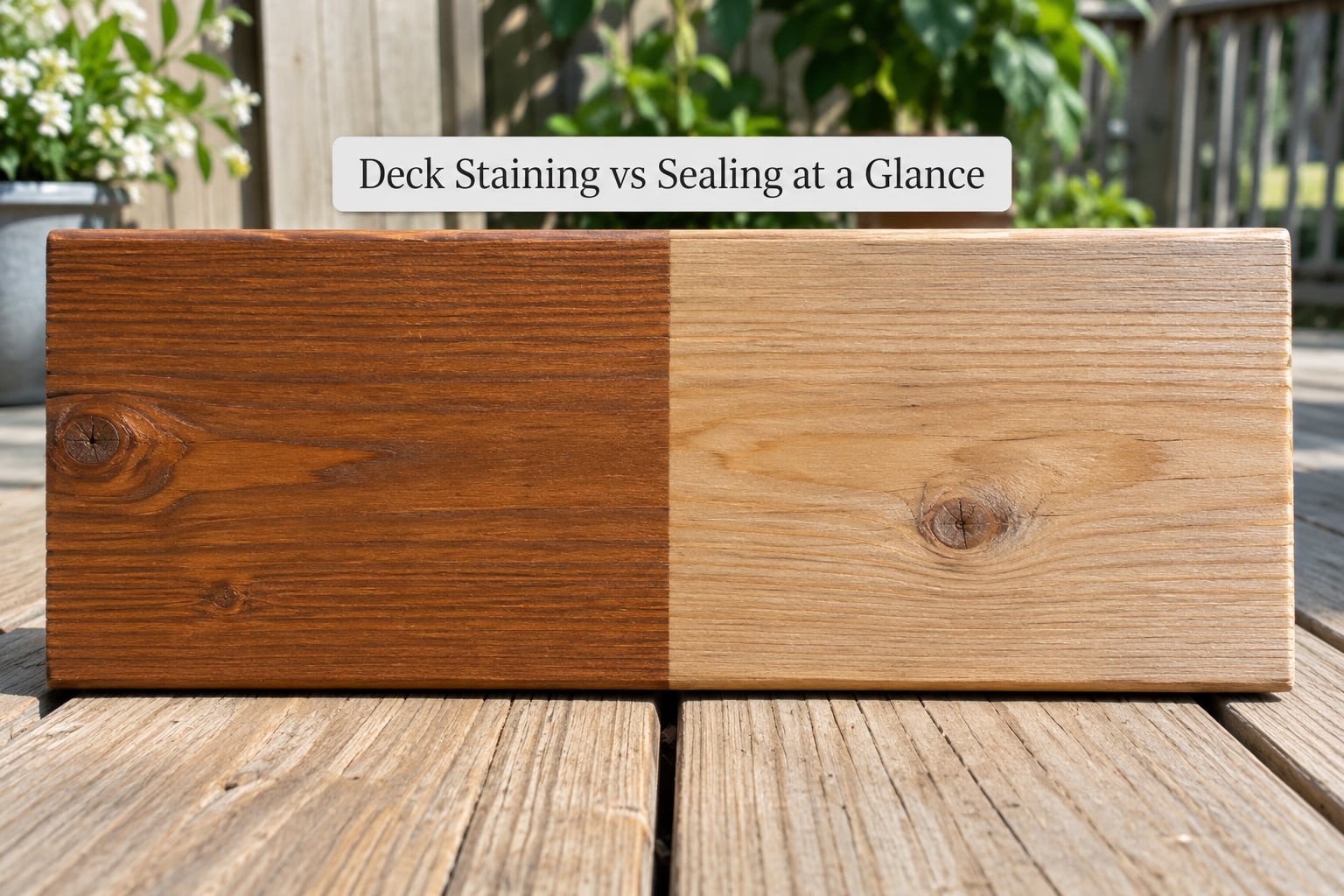
Here is the short version. If color is the priority, stain wins. If the look of bare wood is the priority, seal it.
| What you care about | Deck stain | Deck sealer |
|---|---|---|
| Color change | Yes, from a tint to fully opaque | No, natural wood color stays |
| Wood grain | Visible with semi-transparent and clear stains, hidden by solid stain | Stays visible throughout |
| Water protection | Good, most stain formulas also repel water | Very good, this is the main job |
| UV protection | Stronger, pigment screens sunlight | Mild, wood still greys and fades |
| Surface film | Penetrating or film-forming, depends on the type | Usually penetrates, some form a film |
| Breathability | Good with penetrating formulas | Good with penetrating formulas |
| Typical service life | 2 to 4 years before recoating | 1 to 3 years before recoating |
| Recoat process | Clean, and recoat if the film still adheres | Clean, recoat or restore color first |
| Peeling risk | Real on solid and film-forming stains | Low with penetrating sealers |
| Best for | A specific color, or covering gray wood | Cedar, redwood, teak and other woods worth showing off |
Two rows there cause most of the confusion. Lifespan is not fixed by the product alone, and a solid stain always carries more peeling risk than a penetrating one. Everything below expands on why.
What Is the Difference Between Deck Stain and Sealer?
A deck stain contains pigment suspended in a vehicle. The pigment soaks into the surface fibers of the board and stays there, physically changing the color you see. Because those particles are sitting in the path of sunlight, stain gives noticeably better UV protection than anything clear.
A deck sealer has little or no pigment. It soaks into the wood as an oil or water-based treatment and slows moisture moving in and out, or it forms a thin film on the surface. Either way the wood underneath looks the way it did when it was new, which is the entire point for cedar and redwood.
One bit of label confusion is worth sorting out early. Sealer, sealant and seal get used interchangeably on the shelf, but a sealant is normally a caulk-like product for joints and cracks, not a wood finish. Check whether the container says it is for deck boards and is brushable or sprayable.
Penetrating versus film-forming is the second dividing line
A penetrating product soaks in and leaves the board breathable, so moisture escapes from underneath the surface. A film-forming product sits on top as a thin skin. Films look smoother and take more abrasion, but a poorly prepped surface traps moisture under the film and the coating peels off in sheets.
Most deck complaints trace back to that second category, not to the stain versus seal decision. Forum DIY threads are consistent on this: people who power washed, scrubbed off the old film and let the wood dry before coating report far better results than people who bought a more expensive can.
What Do You Want the Deck to Look Like?
Decide the appearance first, because it’s the choice you live with every day. A clear sealer keeps the deck the color of the wood you bought, which is what most people want with cedar, redwood, teak or mahogany. A tinted or solid stain changes that color on purpose, either slightly or completely.
A semi-transparent stain is the middle ground and the most forgiving option. It tones out blotchy gray wood, deepens the grain lines and still lets you see the board pattern underneath. Solid stain gives you a uniform look and the most UV shielding, but it also hides the grain and puts a film on the deck that has to be stripped someday.
Gray wood and previously finished surfaces change the result
Sun-bleached gray wood has already lost its surface oils. A clear sealer on gray wood will not bring the brown back, it will just make the gray look a bit richer, which is why so many clear-sealed decks look disappointing after a year. Restoring color means cleaning and brightening first, then choosing a semi-transparent stain to put the tone back.
If the deck was previously painted or solid stained, the new finish has to stick to whatever is up there now. Stain applied over an old latex film will peel within a season, and a clear topcoat over an incompatible stain can cloud or flake. Identifying the existing coating is the first job, not the last.
How Much Protection Does Each Finish Provide?
For rain and general dampness, both finish types do useful work, and most quality deck stains already contain water-repellent ingredients. A sealer concentrates on that job and does it thoroughly, which is why it wins on a covered patio or a surface that stays wet often.
For UV exposure the gap is wide. Pigment acts as a screen, so a solid stain slows fading and greying far better than a clear product. Clear sealers mostly protect against water, and the boards will still turn silver-gray on a sunny deck no matter how good the sealer is.
For mildew, rot and foot traffic, the difference is smaller. Good airflow and drainage do more than either coating, and a film that traps moisture can actively make rot worse than leaving the wood alone.
What no coating prevents
Checks and splits come from the board swelling and shrinking with humidity cycles, and a coating slows the water movement that causes them without ever removing it. Rot is a structural problem in wet wood, not a surface problem. Treat both as maintenance to plan for, and replace soft boards instead of coating them.
Deck Staining vs Sealing Explained by Durability and Maintenance
Lifespan numbers are conditional, not promises. Full sun, freeze-thaw cycles, salt air and heavy foot traffic all shorten service life, while a shaded or covered deck stretches it.
| Finish | Shaded or covered deck | Full sun, high traffic |
|---|---|---|
| Clear sealer | 2 to 3 years | 1 year or so |
| Semi-transparent stain | 3 to 5 years | 2 to 3 years |
| Solid stain | 4 to 5 years before a full strip | 2 to 3 years, then more scraping |
| Stain plus sealer hybrid | 3 to 4 years | 2 to 3 years |
Owners on DIY forums usually report redoing clear sealers every year and a half to two, and consider two to three years a good result. That matches the table and is worth knowing before you buy a product promising a decade.
Penetrating versus film-forming upkeep
Penetrating finishes are forgiving. When one wears thin, you clean the deck, let it dry and roll on another coat over the top. Recoating is routine, and the boards never need to be stripped.
Film-forming finishes are pickier. As long as the old film still sticks, you can recoat over it, but once it starts peeling you cannot keep patching it and you are into a full strip or aggressive sanding project. That difference in later maintenance is the strongest practical argument for a penetrating product.
Which Finish Works Best for Different Deck Materials?
Pressure-treated pine is the most common case. The green tint and the chemicals in it mean you should let new boards weather for several months before coating, and seal or stain once the surface is dry and slightly rough. Semi-transparent stain is the standard choice here because it hides the early color variation and still lets the wood breathe.
Cedar and redwood have natural oils that fight absorption. Wipe the surface with a cleaner rated for the species first, or the coating will bead and never bond. Sealer is the traditional finish for cedar because the color is already worth keeping, though a tinted semi-transparent stain works well if you want a deeper tone.
Teak and other tropical hardwoods are dense and oily. Most stain and sealer manufacturers exclude them, and application has to follow the specific product directions or it will sit on the surface. Confirm the label covers your species before buying.
Deck staining vs sealing by wood species and condition
Older solid-stained or painted decks are the hardest case. Nothing you apply will bond reliably to a failing film, so plan on stripping or aggressive surface preparation, then choose a penetrating semi-transparent stain for the recoat. For composite and other manufactured decking, most manufacturers state that their boards need no stain or sealer at all, and applying one can void the warranty.
How to Choose the Right Product and Apply It
Work through this list before opening a can. It takes ten minutes and saves a weekend.
- Confirm compatibility. The label should name deck boards, your wood species, and whether the product is penetrating or film-forming.
- Know what is already on the deck. Water beads on an oily film and soaks in on bare or previously sealed wood, and a splash of water on an unknown film is a fast clue.
- Check the dry and temperature window. Most products need a dry surface, mild temperature and several hours without rain. The back of the can gives you the actual numbers.
- Look at coverage per gallon and multiply by your square footage, since spraying and two coats change the figure a lot.
- Consider the weather ahead. Shade and low humidity speed drying; cool, damp days stretch it out.
- Plan ventilation if the product is oil-based. Work on a calm day, keep pets and children off the deck until it is fully dry, and open the house up.
- Replace loose or soft boards first. Coating a board that has gone spongy wastes the product and hides the problem.
- Plan the re-coat date when you finish, so the next cycle happens before the film starts failing rather than after.
Preparation is where most projects are won or lost: replace soft boards, clean the surface, strip any failing film, sand rough spots, and let the wood dry properly before you start. For structural concerns, ledger attachment, joist spacing or an elevated deck you are not comfortable working under, bring in a qualified deck builder rather than guessing.
Which Should You Choose?
Choose stain when you want a specific color, when the wood is blotchy or gray and you want it to look intentional, or when the deck is cheap pine you would rather not look at raw.
Choose a clear sealer when the natural grain is the reason you built the deck, when the wood is cedar, redwood or another good-looking species, and when you are willing to recoat more often to keep the tone fresh.
Choose a stain-and-sealer hybrid when you want one product that colors the deck and repels water, and you can live with the film that comes with it. Read the label for the actual UV rating and dry time, because hybrids vary widely.
Plan on replacement rather than coating when boards are soft, cracked through, or sitting in standing water. No finish brings back wood that has already gone.
Frequently Asked Questions
Is deck stain better than sealer?
Neither is better in general. Stain is better if you want a specific color and stronger UV protection, since pigment screens sunlight. A sealer is better if you want to keep the natural grain of cedar, redwood or another good-looking wood. On cheap or gray pine, stain usually wins. On a covered patio where color does not matter, sealer is enough.
Can I stain and seal a deck at the same time?
You can, using a product sold as a stain and sealer in one. It combines pigment with water-repellent ingredients in a single coat, which saves a day of work. It is not identical to applying a stain and a separate sealer in two steps, and some hybrids form a film, so check the label for a UV rating and a penetrating or film-forming description.
Should I seal a new pressure-treated deck?
Wait first. New pressure-treated boards usually need to weather and dry for several months before any coating will bond. Once the surface is dry and slightly rough, a clear penetrating sealer or a semi-transparent stain both work. Many people choose semi-transparent stain because it evens out the green tint as the treatment fades.
How long does deck stain or sealer last?
Expect about one to three years for a clear sealer and two to four years for a stain, with the low end on sunny, high-traffic decks and the high end under shade or a roof. Solid stains last longer between full strips but peel if prepped badly. Prep quality matters more than the brand, so budget for cleaning and recoating every couple of seasons.
Do composite decks need stain or sealer?
Most composite decking is designed to weather on its own and needs no stain or sealer. Applying one is usually unnecessary, and some manufacturers say it can affect the warranty, so check your board documentation first. The exception is older composite that has faded unevenly or has mold staining, which can often be handled with cleaning rather than a coating.
Can I apply deck stain over an old coating?
Only if the old coating still adheres. Test a corner: press down hard and scrape. If paint or solid stain flakes off, you have to strip or aggressively sand before new stain will hold, or it will peel within a season. A still-adhered penetrating finish can usually be cleaned and recoated without stripping.
Conclusion
Deck staining vs sealing explained in one line: stain buys color and UV protection, sealer buys a natural look and water resistance, and a hybrid splits the difference. Start by naming your priority, then choose a coating labeled for your deck material and check whether it penetrates or forms a film, because that choice decides how much maintenance comes next. Whatever you pick, the prep work and a proper dry window decide whether it still looks good two years from now. Last reviewed for 2026.