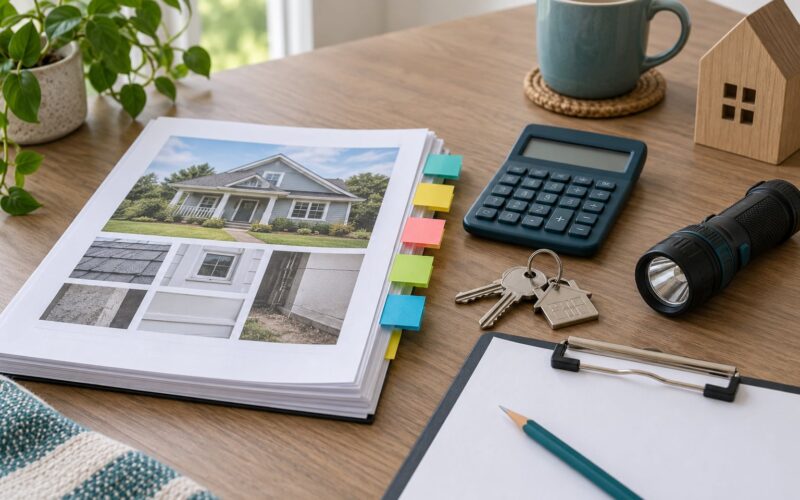
A home inspection is a visual, non-invasive look at a home’s accessible structure and systems, done by a licensed inspector who reports visible defects and safety problems so you can negotiate before you close. In practice, how a home inspection works for buyers is straightforward: you book it inside your contingency window, attend the walkthrough, read the written report, and use the findings to request repairs, ask for a credit, or walk away.
This guide covers the whole sequence, from the moment your offer is accepted to the day you get the keys, including what the inspector actually touches and what they legally cannot see. Last reviewed for October 2026.
Table of Contents
- What Is a Home Inspection?
- How a Home Inspection Works for Buyers
- What to Do Before the Inspection
- What Happens During the Inspection
- What Does a Home Inspector Check?
- How Long Does a Home Inspection Take?
- How to Read a Home Inspection Report
- What an Inspection Does Not Guarantee
- How Buyers Use Findings to Request Repairs or Credits
- When to Call a Specialist
- Frequently Asked Questions
- Should the buyer attend the home inspection?
- Can a home inspector guarantee that a house is in good condition?
- Should the buyer request repairs for every issue in the report?
- Is a home inspection required for a conventional mortgage?
- Can the seller make repairs after the inspection?
- What Buyers Should Do Next
What Is a Home Inspection?
A home inspection is a general assessment of a property’s visible physical condition. A state-licensed or certified inspector walks the structure inside and out, checks the roof, exterior, foundation, electrical, plumbing, heating and cooling, and the interior, then documents anything that looks damaged, unsafe, or worn out.
The work follows a written standard of practice, the ruleset published by trade organizations such as InterNACHI and the American Society of Home Inspectors. That standard is what makes an inspection report defensible rather than a personal opinion. It also defines the limits, which is where most buyer disappointment comes from.
Three different services get confused with each other all the time. An inspection tells you about the home’s condition. An appraisal tells the lender what the property is worth. A home warranty is a service contract you buy after closing that covers certain systems breaking down.
| Service | Purpose | Who orders it | Main output |
|---|---|---|---|
| Home inspection | Condition and safety of the building | The buyer | Written report with photos and defect notes |
| Home appraisal | Value for the lender’s loan | The lender | Valuation opinion |
| Home warranty | Repair coverage after a covered failure | Buyer or seller, often at closing | Service contract with exclusions |
An appraisal does not find a leaking roof, and an inspection does not tell the bank what the house is worth. If the appraisal comes in low enough to matter, that is a separate conversation with your lender, not something the inspection report will resolve.
One more distinction worth making early: an inspection is not a code check. Inspectors are not building officials, and they do not verify that the house was built or remodeled under permit. Municipal building departments handle that, and their records are worth pulling for older homes and recent renovations.
How a Home Inspection Works for Buyers
The inspection is one link in a chain that starts when your offer is accepted and ends at the closing table. These are the eight steps, in the order they usually happen.
- You hire an independent inspector. Choose someone who is licensed in your state and carries errors and omissions insurance. Your agent can supply names, but you pick and you pay.
- You schedule inside the contingency window. Most purchase contracts give you five to ten days after acceptance to complete the inspection. Book on day one, because good inspectors fill up fast in a busy month.
- You give the inspector access. Confirm the seller has set all utilities to running, that pets and valuables are secured, and that the seller will be out of the way if your contract says so.
- You attend the inspection. Two to four hours on site, and your presence genuinely changes what you understand afterwards. Ask questions as they go.
- You get a written report. Usually the same evening or the next day, with photographs and short written descriptions of each finding.
- You call the inspector for clarification. Plain-language explanations are part of the job and are not an upsell. Ten minutes on the phone can turn a line of jargon into a decision.
- You send a repair or credit request through your agent. Put it in writing, list the specific findings you are relying on, and tie it to a deadline.
- You decide before the contingency expires. Proceed, renegotiate, or walk away. After the deadline passes, your leverage on the seller’s condition problems is largely gone.
Two things run in parallel and are easy to miss. Title work, appraisal, and lender review are happening on the same clock, and a badly timed inspection request can eat into your rate-lock window. Also ask whether the contract makes the inspection contingency survive if the closing date slips. Most do, and most buyers never read that line.
What to Do Before the Inspection
Choose your inspector before you choose everything else about the closing week. Look for a written inspection agreement that spells out what is and is not covered, whether the report includes repair-review of contractor work after the inspection, and what that follow-up visit costs. Ask for a sample report. If a potential inspector is vague about exclusions, that is the whole conversation you will have later, in the worst possible moment.
Then prepare the property, through the seller. Ask that all utilities be on, that the attic hatch and crawl space be reachable, and that nothing be staged over the outlets or access panels. Appliances that stay with the home should be connected and running. A locked or blocked area is a hole in your report, and buyers are routinely told that an uninspected space is an uninspected space.
Read the seller’s disclosures before the inspection, not after. Disclosure forms, prior inspection reports, and any permits or receipts for roof, furnace, or electrical work tell you where the inspector should look hardest. Buyers who skip them spend their inspection day learning things that were already written down for free.
Do not negotiate repairs or price before the inspection happens. Pre-inspection demands from a buyer are usually read as an insult, and you have no evidence yet. Let the report do the arguing.
What Happens During the Inspection
How a home inspection works for buyers in practice starts at the front door. The inspector spends the first few minutes going over the inspection agreement with you, confirming what will be looked at, and asking about any work you know about. This briefing is also where you say things like a remodeled bathroom with no permit history, or a bedroom that smells musty.
After that it is a slow, methodical walk. The order varies, but the inspector typically starts outside, then roof and exterior, then structure and attic or crawl space, then the mechanical systems, then room by room inside. Testing is deliberately limited to what is safe and visible: running faucets, flushing toilets, flipping breakers, checking outlets with a tester, and watching a furnace cycle on. Nothing gets opened up or taken apart.
Many inspectors carry a moisture meter, an infrared camera, or a borescope to look into wall cavities and drain lines without cutting anything. That is the standard of practice in one sentence, non-destructive by default.
Near the end, the inspector gives a verbal summary while the details are fresh. This is not the report, and it is not a negotiation position. Ask about anything unclear, but save the real analysis for the written document. If the seller is present and the exchange turns tense, step outside with your inspector instead of arguing on the spot.
What Does a Home Inspector Check?
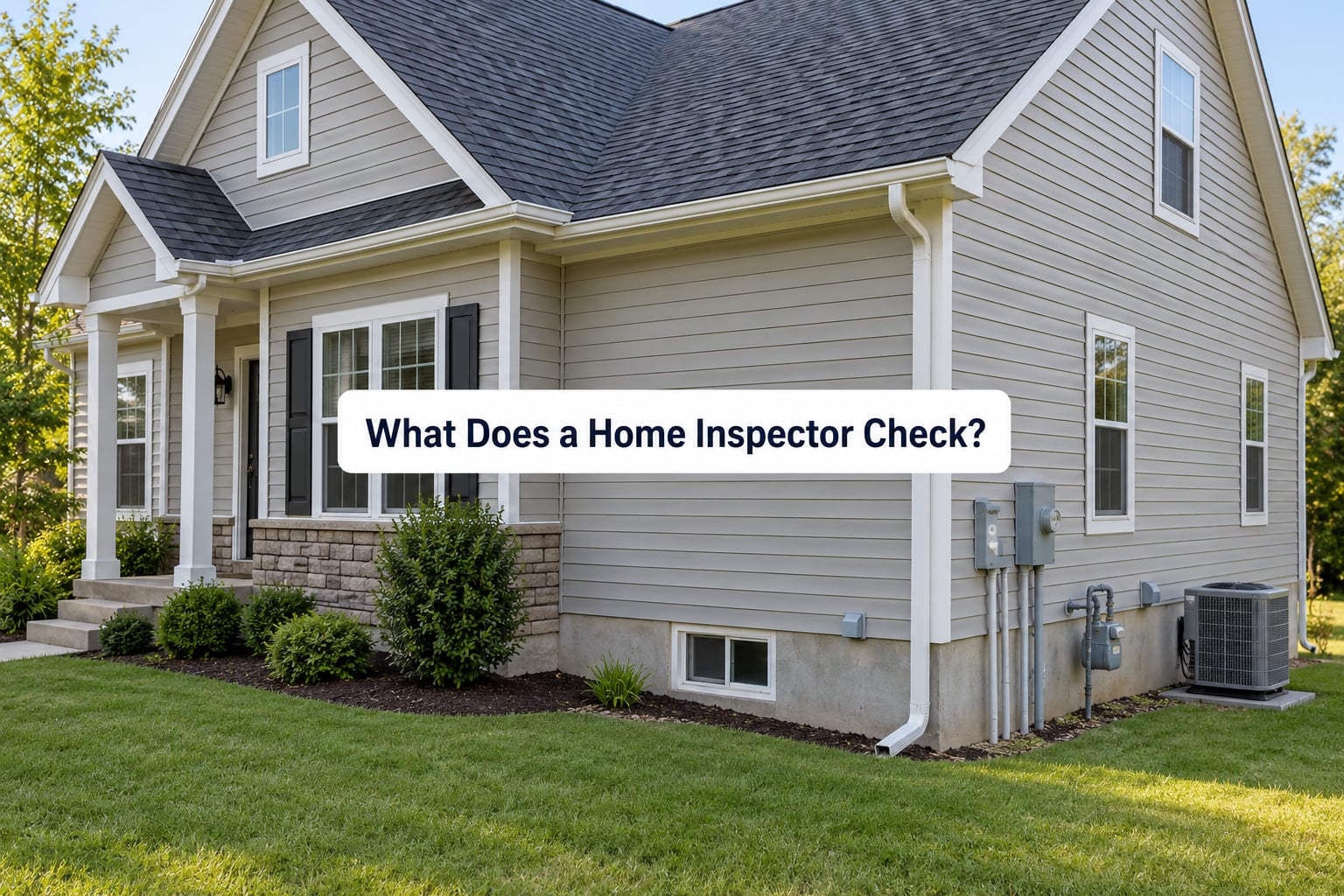
Scope is set by the standard of practice, so one inspector’s list should look broadly like another’s. The grouping below is roughly how a walkthrough is organized, not a promise about sequence.
- Exterior and site. Grading and drainage away from the foundation, siding and trim condition, decks and steps, driveway, and visible evidence of water moving where it should not.
- Roof. Covering material, age estimate, flashing and penetrations, valleys, fascia and soffit, gutters, downspout discharge, and visible attic framing, insulation, ventilation, and evidence of leaks.
- Structure and foundation. Foundation walls and visible crawl space or basement supports, floor framing, columns, load paths, and signs of movement or chronic moisture.
- Electrical. Service drop, main panel, grounding and bonding, branch wiring, GFCI and AFCI protection, and visible outlets, switches, and fixtures.
- Plumbing. Supply and drain lines, water heater and venting, shutoffs, fixtures, visible leaks, and drain flow that can be observed without opening walls.
- HVAC. Heating and cooling equipment condition, service history if disclosed, distribution, condensate routing, and safety equipment.
- Interior. Windows, doors, floors, ceilings, stairs and railings, fire and smoke alarms, and life-safety items like escape windows in sleeping rooms.
- Built-in and attached systems. Kitchen appliances that stay, garage door and opener, and attached structures such as a deck or covered porch.
The distinction to hold onto is visual versus everything else. Inspectors look for material defects: conditions that affect safety, function, or value enough that a reasonable buyer would care. They do not open drywall, remove panels, or test every circuit under load.
That is also why an inspector will sometimes tell you to bring in someone else. A concerning foundation crack is a structural engineer’s call. A suspect wiring panel is a licensed electrician’s. An inspector’s job is to flag it clearly and hand it off, not to diagnose the root cause.
How Long Does a Home Inspection Take?
Most inspections of a standard single-family home take two to four hours. The variables are size, age, access, and how much the systems have to be exercised.
| Property type | Typical on-site time | Why it varies |
|---|---|---|
| Typical single-family home | 2 to 3 hours | Size, number of levels, roof pitch and access |
| Large property or acreage | 3 to 5 hours | Outbuildings, fencing, wells, septic, detached structures |
| Older home | 3 to 4 hours | Legacy systems, more unknowns, careful tracing |
| Complex systems | 4 hours or more | Multiple HVAC units, solar, generators, unusual additions |
Weather causes more delays than anything else. A wet roof slows the inspection down a great deal, and a heavy rain day may push you into a re-attendance fee for a full interior look. Access problems have the same effect. A locked storage unit or a packed garage can turn a two-hour visit into two visits.
The inspection itself is only part of the calendar. Add the wait for the report, typically same-day to 48 hours, and your agent’s turnaround on a written repair request, usually within a day or two.
How to Read a Home Inspection Report
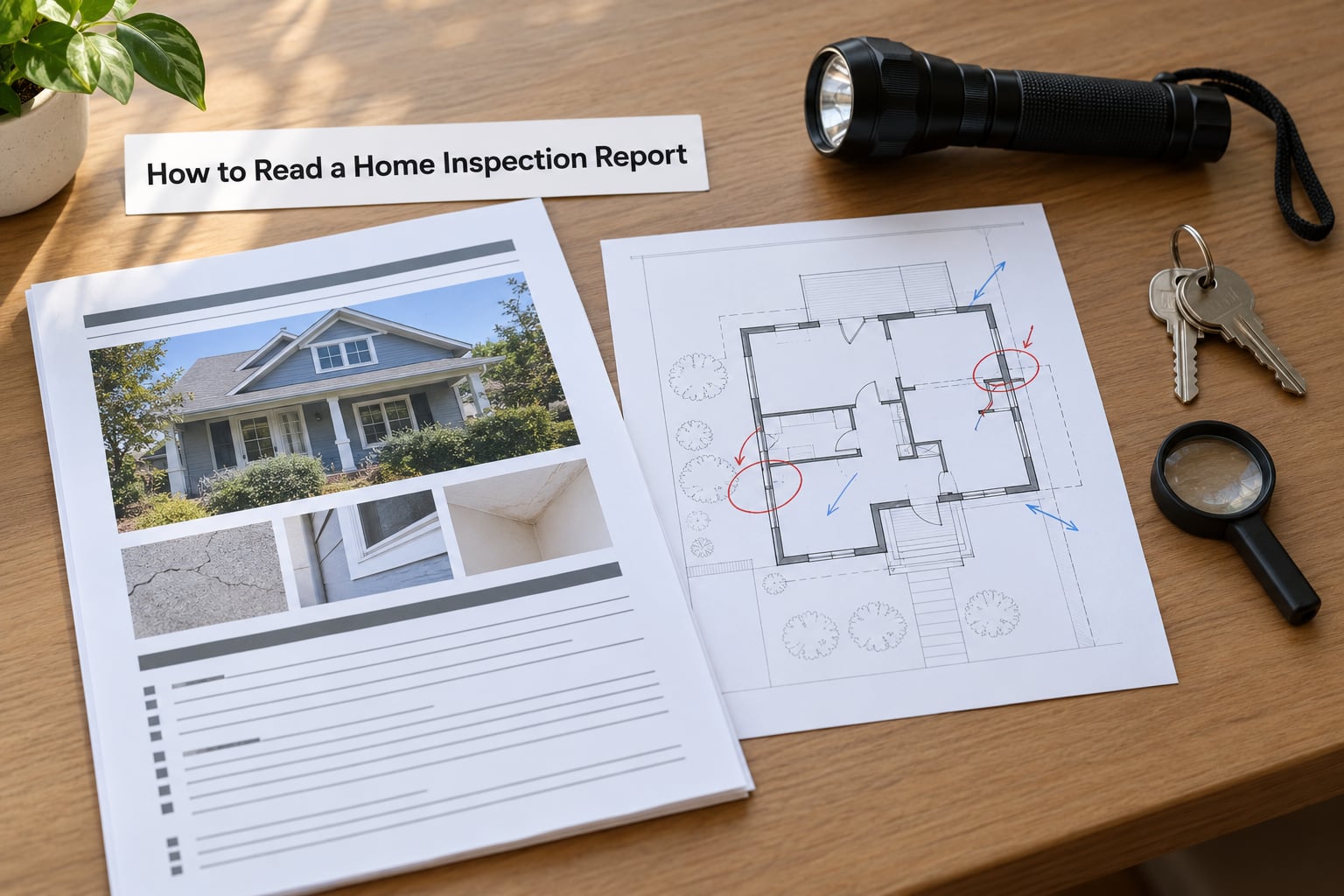
A good report has a summary section, a set of photographs, and a written description for every item worth mentioning. Read the summary first, then look at the photos, then read the descriptions. Reading the descriptions start to finish without photos in front of you is how buyers end up more worried than the facts justify.
Severity language varies by inspector, which is a real source of confusion. Ask yours to explain the terms they use. Generally, treat items in these groups differently:
- Safety. Exposed wiring, an unvented combustion appliance, a missing smoke alarm, a failing stair guard. These matter regardless of price and are the easiest to ask the seller to fix.
- Functional. A water heater that will not hold temperature, a disposal that hums but does not spin, a window that will not open. Affects daily use and future resale.
- Structural and moisture. Foundation movement, roof covering at the end of its life, chronic drainage problems. These are the findings that move value.
- Maintenance and monitoring. Caulking that has failed, a gutter that is sagging, a seal that will need attention within a year. Not defects. They are life-cycle notes.
- Deferred maintenance. A working furnace at the end of its expected life is not automatically the seller’s problem. Buyers who expect the seller to replace every aging-but-functional system misunderstand who owes what.
The separation that matters most is between a maintenance note and a material defect. One is about time, the other is about whether the house is safe, functional, or fairly valued. Buyers on forums constantly describe this as the moment they stopped panicking about forty line items and started reading the report properly.
Look at the limitations page too. It will state the exclusions, and knowing them before you argue about a missed item saves an argument later.
What an Inspection Does Not Guarantee
An inspection is a snapshot, taken on one day, by visual and non-invasive means, of the parts of a home that can be reached and seen. Every limitation follows from that sentence.
- Concealed conditions. Behind walls, under floors, inside finished ceilings, and within the wall cavity between studs. Faulty DIY wiring is the most common surprise in the whole process, precisely because it is hidden.
- Everything below the ground line. Water lines, sewer laterals, and foundation drainage are not visible from inside. A sewer scope is a separate service.
- Invisible hazards. Radon gas, mold behind drywall, asbestos in older finishes, and buried fuel oil. Each needs its own test.
- Code compliance. Inspectors evaluate safety and condition. They do not issue a code certificate, and a house can fail inspection while being fully legal under the codes that applied when it was built.
- Termites and other pests. Visible evidence may be noted, but a licensed pest inspection is required to make a real determination.
- Future performance. Nobody can tell you how many years a roof has left or when a furnace will fail. The report describes condition today.
- Behind closed doors and personal property. Locked or stored spaces, alarm systems, and excluded appliances are commonly written off as not inspected.
None of this makes an inspection a waste. It makes it one line of defense among several, and it is the only line you get before you own the risk.
How Buyers Use Findings to Request Repairs or Credits
After the report lands, you have four real options: proceed as is, request repairs, ask for a credit or price reduction, or walk away. Most buyers use the middle two together, and the first move is the same in every case, which is to understand the finding before you use it.
- Call the inspector and ask. Ask what the finding means, what the consequence is if it is left alone, and how urgent it is. This is free and expected.
- Get a real estimate where the money is large. For structural work, roof replacement, electrical panel work, or a failed sewer line, take a written scope from a licensed contractor. A seller’s repair is only as good as its documentation.
- Prioritize. Put life-safety items first, then active leaks and structural concerns, then systems near end of life, then maintenance notes. Writing this list out makes the trade-offs obvious in a negotiation that runs on adrenaline.
- Send a written request through your agent. Name the finding, why it matters, and what you want: repair with documentation, a credit at closing, or a price adjustment. Attach the contractor scope.
Timing is the whole game. A request that arrives before the contingency deadline carries real weight. The same request after the deadline is a conversation about earnest money and breach terms, which is a different and much more expensive conversation.
Buyers often ask whether sellers fix everything. They usually fix what is cheap, obvious, and embarrassing on a multiple-offer list, and they decline on big-ticket items where they would rather credit or renegotiate. That is normal, not hostile, and it is exactly why you go in with contractor numbers instead of a list of grievances.
Insist on written documentation of any repair, and confirm whether your contract requires re-inspection. The review visit commonly costs extra, usually far less than the work itself, and the inspector confirms the fix was made and was made properly. A seller saying the repair is done is not the same as an inspector saying the repair is done.
When to Call a Specialist
General inspections are broad but shallow. When a finding falls outside a general inspector’s scope, ask your agent about a specialist, and order it quickly because some of these take days to schedule.
| Situation | Who to call | Why |
|---|---|---|
| Cracks, shifting, or sinking foundation | Structural engineer | Distinguishes cosmetic from movement |
| Old or overloaded electrical panel, knob-and-tube wiring | Licensed electrician | Assesses capacity and safe remediation |
| Suspected sewer line failure or recurring backups | Sewer scope service | The only way to see the lateral |
| Radon in a basement or ground-contact space | Radon tester | Not part of any standard inspection |
| Wood-destroying insect evidence | Pest management professional | Termite and decay assessment |
| Mold odor or visible growth | Mold assessor or testing lab | Air and surface sampling |
| Fireplace, chimney, or wood stove | Certified chimney sweep or inspector | Flue lining and clearance checks |
| Pool, spa, or well and septic | Specialty inspector | Excluded from most general inspections |
One safety note that is not negotiable: do not open panels, test circuits, climb on roofs, enter crawl spaces, or attempt repairs yourself while the property is still someone else’s. You can look, take notes, and ask questions. Anything involving wiring, gas, structural load, or confined spaces belongs to a licensed professional on the buyer’s side of the transaction.
Buyer-side inspection of the finished house later, under a home warranty, is a separate and much weaker tool. By then your leverage is gone, most defects are pre-existing and excluded, and a warranty is a contract with fine print rather than leverage in a negotiation.
Frequently Asked Questions
Should the buyer attend the home inspection?
Yes, if you can. Attending costs nothing and buyers consistently report learning more in the two hours on site than from the report alone, because the inspector can point at what they are describing. Bring your own questions about renovations, permits, and history. If you cannot attend, ask the inspector for a phone walkthrough afterward and review the report the same day it arrives.
Can a home inspector guarantee that a house is in good condition?
No inspector can guarantee the condition of a house, and any promise of one should be a warning sign. An inspection is a same-day, visual, non-invasive assessment of accessible parts of the property, so concealed conditions and future performance are outside its reach. What you get is a documented snapshot you can negotiate with, not a warranty that the house will not fail.
Should the buyer request repairs for every issue in the report?
No. Most reports list dozens of items, and many are normal-life maintenance notes rather than defects. Ask your inspector to separate safety items, functional items, and monitoring items, then request repairs or credits on the first two groups only. Handing a seller a forty-item list usually gets the whole list ignored, including the two items that mattered.
Is a home inspection required for a conventional mortgage?
A lender generally does not require a home inspection to approve the loan, and the federal government does not mandate one. Some loan programs and individual lenders impose their own minimum property requirements, especially for FHA, VA, and rural loans. Your purchase contract is the real deadline, so treat the contingency there as the binding date and do not waive it without understanding exactly what you are giving up.
Can the seller make repairs after the inspection?
Yes, sellers routinely repair after the report, and it is often the fastest way to keep a deal together. The mechanics vary by contract: repairs may need written approval, a contractor scope, and a re-inspection before closing, and some contracts require the buyer to approve any increase in price or scope. Ask your agent where the re-inspection fee lands and make sure nothing material changes without written agreement.
What Buyers Should Do Next
Buy an inspection early in the contingency window, attend it, and read the report the day it arrives rather than at the end of the week. Call the inspector with your questions before you form a position, and bring in a specialist for anything structural, electrical, or underground.
Then do one thing most buyers skip: tell yourself which findings would actually make you walk away. Once you have that line drawn, the rest of the negotiation gets much calmer, because you are choosing deliberately instead of reacting to whichever item appears last in the report.
Whatever you decide, decide it before the contingency deadline. After that date, how a home inspection works for buyers changes completely, and the only person still able to fix a hidden defect is you.