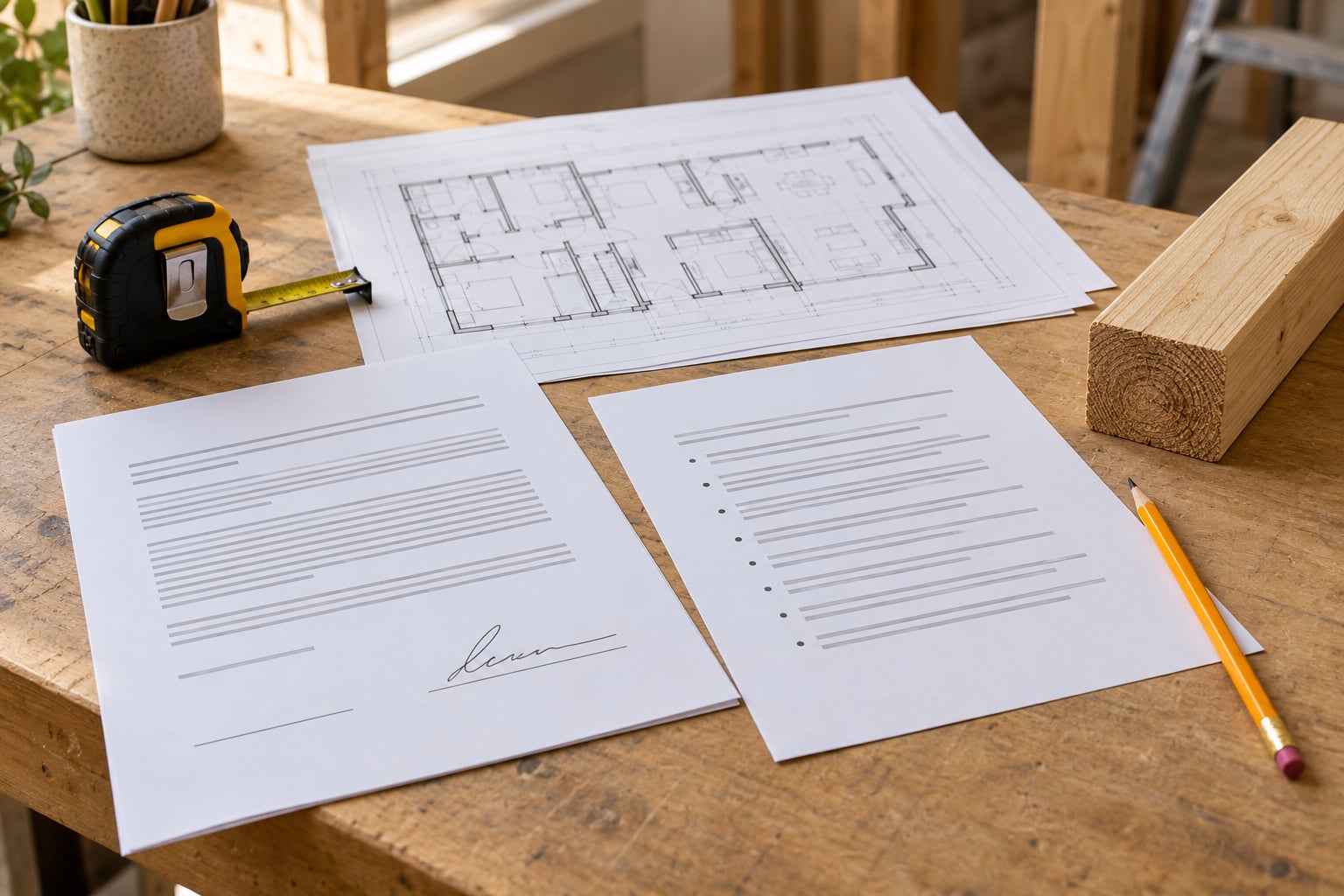
A change order on a remodel is a written amendment to your signed construction contract that changes the scope, price, or schedule of work you already agreed to. To handle one properly, you request it in writing, find out what caused the change, demand a line-item price, and sign the revised document before any changed work starts.
That last part is the whole game. Experienced contractors say a change order is a normal event on any remodel, and the problem is almost never the change itself. It is the missing paperwork, the lump-sum price with no backup, or work that started before anyone agreed to the number in writing. Handling the request takes maybe an hour if you do it in order, and it can run into thousands if you skip the paperwork and argue later.
Below is a seven-step process I built around what homeowners on renovation forums actually get stuck on: who caused the change, whether the price makes sense, and what happens if they say okay in a text message and change their mind a month later.
Table of Contents
- What You Need Before You Respond
- How to Handle a Change Order on a Remodel, Step by Step
- 1. Review the change-order request promptly
- 2. Check the contract and approved plans
- 3. Confirm why the change is necessary
- 4. Evaluate cost and schedule impacts
- 5. Negotiate options and payment terms
- 6. Approve changes only in writing
- 7. Confirm the work and keep the record
- Common Mistakes That Cost Homeowners Money
- Approving work based only on a quick text message
- Failing to ask who caused the change
- Paying a large upfront sum for changed work
- Losing track of revisions and allowances
- Letting a small change create an open-ended budget
- Tips for keeping control of the remodel budget
- Frequently Asked Questions
- Can a contractor refuse a change order during a remodel?
- What should I do if a hidden condition increases the project price?
- How long should a contractor take to respond to a change-order request?
- Should I pay change-order costs before the work is completed?
- Can I cancel an approved change order after signing it?
- Conclusion
What You Need Before You Respond
Assemble the paper before you answer anything. It takes less time than one conversation with a contractor, and it is what separates a real change from a bill for something your contract already covered.
- The signed contract, including all exhibits and addenda
- Current plans and specifications, including any revision clouds or marked-up sheets
- The written change-order form the contractor sent
- The project schedule with the current completion date
- Your allowance list, such as the fixture, tile, and hardware selections carried in the contract
- A dated change log you keep yourself, separate from the contractor’s paperwork
- Copies of the emails, texts, and photos that prompted the request
Two of those do most of the work. The allowance list tells you whether a change is a new item or just a different pick inside money already budgeted, and your own change log is the only record you fully control when the final invoice arrives.
Without these records, every conversation turns into memory, and memory is exactly what gets disputed at final payment.
How to Handle a Change Order on a Remodel, Step by Step
Work through the steps in order. Skipping ahead to the signature is how homeowners end up agreeing to work they never priced.
1. Review the change-order request promptly
Read the request the same day it arrives and ask for what is missing. You want the specific work described, the reason for it, the timing, any design or code implication, and the effect on both the contract total and the completion date.
Written review is what creates a decision record. Replying in text that you accept or reject keeps a dated trail, and answering within a day or two stops the crew from sitting idle while the job waits on you.
That idle time is not free. Homeowners report on renovation forums that every extra week of deliberation added labor remobilization to the bill, which is why a fast, complete answer beats a slow, careful one that never arrives.
How to tell this step worked: you have a dated written reply from you that either approves, declines, or asks specific questions. Silence is not a response.
2. Check the contract and approved plans

Pull the relevant contract section and the plan sheet the change touches, then compare them line by line. Look at the scope of work, the specifications, the exclusions, and the allowances.
Three outcomes are possible. The work is genuinely new and outside what you signed. The work is already included, so it is a no-cost correction. Or the answer depends on an exclusion clause that nobody read out loud when you signed.
Specifications are where the money hides. A contract that calls for a mid-range tile and a change order that swaps in a different material is not necessarily an increase, but a change order that quietly upgrades the grout and the edge trim is.
How to tell this step worked: you can say out loud whether this is new work or work your contract already bought. If you cannot, ask for the plan sheet number and the contract line it modifies.
3. Confirm why the change is necessary
Ask the direct question: what caused this? The answer falls into one of a few buckets, and each one has a different cost consequence.
- Concealed site conditions such as water damage, outdated wiring, or a wall that turns out to carry a load
- Revised design goals from a decision you made, or a designer revising on your behalf
- Code or permit requirements that surface after an inspector sees the work
- Corrected information such as a wrong dimension on a drawing
- Contractor error, where the work was mispriced, missed, or planned badly
Responsibility is the part homeowners skip. A genuine concealed condition is usually a contract matter with real cost consequences, while a planning failure belongs to the contractor and should not be billed back to you. Asking who is responsible, and asking for evidence, is what keeps a real problem from becoming your contingency payment.
Ask for photographs of what was discovered and the date they were taken. Homeowners who keep photo evidence from the moment of discovery have far less trouble at final invoice.
How to tell this step worked: the request states a cause, and you have a document or photo backing it up.
4. Evaluate cost and schedule impacts

Do not accept a single lump-sum number. Ask for the request broken into labor hours at an hourly rate, materials, subcontractor charges, permit fees, and any allowance or contingency effect, plus the schedule consequence stated in days.
The labor split is the fastest sanity check. If a small scope change carries fourteen hours of labor plus materials, the hours deserve a question about what they are doing. The same goes for markup above roughly fifteen to twenty percent, which is high enough that you should expect an explanation rather than an assumption.
Ask whether the number is a firm price or an estimate, and get the not-to-exceed figure in writing. A firm price stops at a number. An estimate without a cap is an open-ended invitation, and remodeling forums are full of homeowners who learned that the hard way on a final invoice.
Also check whether the change draws from your contingency and what remains of it afterward. A request that quietly eats the whole contingency leaves nothing for the next surprise, and on a house built before 1980 there will likely be another one.
How to tell this step worked: you can reproduce the number yourself from hours, rate, materials, and markup. If you cannot, ask for the subcontractor’s quote or receipt behind the line item.
5. Negotiate options and payment terms
You usually have more than one honest answer. You can accept the change as priced, revise the design to hit a number you can live with, spend an allowance differently than planned, phase the work into a later phase, or decline it and deal with the consequences.
Before agreeing, ask how the change affects the payment schedule. More work in the middle of a job often means an extra draw, and it can change retainage, your financing draw schedule, or the final contract balance due at completion.
Renegotiating the design is usually the fastest path to a smaller number. Keeping the existing layout while changing a material grade is far less expensive than relocating a wall, and the contractor knows it even if nobody says so first.
How to tell this step worked: you picked an option on purpose rather than because the crew was waiting, and you know how it changes the money you pay and when.
6. Approve changes only in writing
A change order takes effect when it is a complete document signed by both you and the contractor, dated, and covering the changed work, before that work starts. Everything you approve should carry these fields:
- Project name, date, and change order number
- Description of the added or revised work
- Reason for the change and who is responsible for it
- Cost broken into labor hours, hourly rate, materials, subcontractor charges, and permits
- Markup percentage stated out loud
- Revised contract sum and the not-to-exceed amount
- Schedule impact in days and the new completion date
- Payment terms for the added work
- Effect on the contingency balance
- Signature and date lines for both parties
A text saying okay is not a contract modification. Many remodeling contracts include a no-oral-modification clause, which means the contract itself says that informal approvals do not count, and once properly signed a change order becomes an enforceable amendment to the original contract.
If your change arrives with vague language such as pricing to be determined, send it back. You need a defined scope, a stated amount or estimating method, clear approval authority, and a stated schedule consequence before you sign.
How to tell this step worked: you hold a signed document for every approved change, filed in your own change log the same day.
7. Confirm the work and keep the record
At the end of the job, pull the final invoice next to the original contract and every signed change order, then add up the approved total yourself. Look for work that was billed but never approved, and work that was approved but never performed.
Two patterns show up repeatedly. One is a variation charged without a matching change order. The other is a courtesy credit that raises the base contract figure instead of reducing what you owe, which is the opposite of a credit in plain English.
Bring discrepancies to the contractor in writing and resolve them before final payment, not after. Retainage exists precisely so the last conversation still has leverage.
How to tell this step worked: your own arithmetic matches the final invoice, and both sides have confirmed the number in writing.
Common Mistakes That Cost Homeowners Money
Most of the damage on a remodel comes from a handful of repeated habits. Each of these has a straightforward correction.
Approving work based only on a quick text message
The most common pattern in forum threads about this topic is a homeowner agreeing out loud, then disputing it in writing after the bill arrives. Text confirmation that a price is fine is not a complete change order.
Correct it by pausing. Ask for the document, take the time to check it against the contract, and sign before the crew touches anything new. A day of delay is cheaper than a fight you cannot prove.
Failing to ask who caused the change
Every request should carry a stated cause, and cost responsibility follows the cause. A homeowner design change is yours to pay for. A concealed condition may be handled by an unforeseen-conditions clause in your contract. A contractor planning failure is the contractor’s cost to absorb.
Ask the question out loud in writing before you argue about the number. People who never establish responsibility tend to pay for planning errors they did not cause.
Paying a large upfront sum for changed work
Tying an entire change-order invoice to a single payment made before the work is finished hands over your bargaining position. Link payment to documented progress or to negotiated milestones, and rely on the retainage and draw schedule your contract already sets out.
Some contractors will not work without payment on the change first, which is a normal commercial position. The workable compromise is a milestone tied to completion of the changed scope rather than a full advance.
Losing track of revisions and allowances
Four signed change orders scattered across email threads will make a final invoice nearly impossible to check. Keep one dated log, update it the day you sign, and revise the project schedule and budget whenever an approved change affects either.
Mark allowances as spent, remaining, or replaced. That single habit answers most arguments about whether a material was already in the contract.
Letting a small change create an open-ended budget
The expensive failures are rarely the big change orders. They are small verbal adjustments with no scope, no cap, and no schedule consequence, repeated until nobody can define the job.
Insist on a defined scope, a dollar amount or an estimating method with a not-to-exceed ceiling, named approval authority, and a stated schedule effect. Watch for an administrative or research fee charged even when you decline the change, which homeowners report seeing on final invoices across multiple builds.
Tips for keeping control of the remodel budget
- Keep one document set. Every plan, specification, and signed change in a single folder, numbered and dated.
- Route all requests through one authorized contact, including your designer or architect, so decisions do not arrive from three directions.
- Ask for itemized pricing on anything that is not a straight swap inside an existing allowance.
- Review a second estimate when a change is large relative to the original budget, using a contractor who has no stake in the outcome.
- Set a personal pause rule: anything with a schedule impact of more than a few days waits overnight before you sign, no matter who is standing on site.
Frequently Asked Questions
Can a contractor refuse a change order during a remodel?
Usually yes, in the sense that a contractor is not obligated to perform work outside the signed scope without compensation. The contract, not the request, decides. Your options are to pay for the added work, redesign it to stay inside the scope, or decline and absorb the consequences. Many contracts also let a contractor decline a change that disrupts the schedule or warranty. Read the change-order and termination clauses early so you know the answer before the crew is standing idle.
What should I do if a hidden condition increases the project price?
Slow down and get it documented before work proceeds. Ask for photographs, the date they were taken, and a written explanation of how the condition was discovered. Then compare your contract’s unforeseen-conditions clause, which may set a fixed hourly rate for this kind of work and may shift some cost to you or to the contractor. Request the change order in the same line-item format as any other, and decide based on the evidence rather than on the surprise itself.
How long should a contractor take to respond to a change-order request?
Read the turnaround period your contract specifies, since many set a window of a few days. If the contract is silent, ask for a response within two business days as a matter of course. Prompt replies matter because idle crews create remobilization charges and schedule drift, and homeowners often absorb that cost themselves. You do not have to decide instantly, but you do have to respond, and a written request for a firm date keeps the delay from becoming somebody’s bill.
Should I pay change-order costs before the work is completed?
Not the whole amount, not up front, unless you have negotiated it and understand what you give up. Tie payment to documented completion of the changed scope, or to milestones in the draw schedule, and keep the retainage provision intact so something is still owed at the end. For smaller changes, paying promptly when the work is finished and documented is usually fine. The risk is paying in full for work that has not started, which leaves you with nothing to hold the contractor to if the result is wrong.
Can I cancel an approved change order after signing it?
Sometimes, and it depends on your contract and on whether the work has begun. Once materials are ordered or labor is booked, a contractor will usually seek compensation for committed costs, and those costs can be legitimate. The practical sequence is to request the cancellation in writing before any work starts, offer to pay documented committed costs, and ask for a written confirmation of the credit to the contract sum. Contract terms and state rules vary, so read your termination and cancellation clauses before assuming a reversal is free.
Conclusion
Start with one move: request the change in writing, compare it against your signed contract and approved plans, and get an itemized price and a stated schedule impact before you approve anything.
That sequence handles the ordinary case where you simply want the work done, and it also protects you when the change turns out to be something your contract already covered. Change orders are a normal part of remodeling. Documented ones cost you money; undocumented ones cost you money and the schedule too. Contract and legal rules vary by state, so check your own documents and get professional advice before signing anything you have questions about.