
Verifying a contractor license and insurance takes about 20 minutes: you look up the license number on your state licensing board’s site, confirm the status and trade classification match the work, then get a certificate of insurance and call the carrier to confirm the policy is active. Do both before you sign anything or pay a deposit. I’ve watched homeowners skip this step because it felt rude to ask, and that discomfort is exactly what unlicensed operators count on.
Requirements differ by state and by trade, so there is no single national checklist. The process underneath is the same almost everywhere, and that’s what this guide walks through.
Table of Contents
- What You Need: How to Verify a Contractor License and Insurance
- Step-by-Step
- Confirm the Contractor’s Legal Business Name and License Number
- Search Your State’s Official Licensing Database
- Check Whether the License Covers the Work You Need
- Verify Insurance Coverage and Policy Dates
- Review Disciplinary Records, Complaints, and Business History
- Get Written Confirmation Before You Sign
- Common Mistakes
- Frequently Asked Questions
- How do I verify a contractor license in my state?
- What if a contractor says they do not need a license for my project?
- Is a certificate of insurance the same as proof of insurance?
- How do I check that a contractor’s insurance is currently active?
- Does a contractor license prove the contractor is insured?
- What should I do if I cannot verify a contractor license or insurance?
- Conclusion
What You Need: How to Verify a Contractor License and Insurance
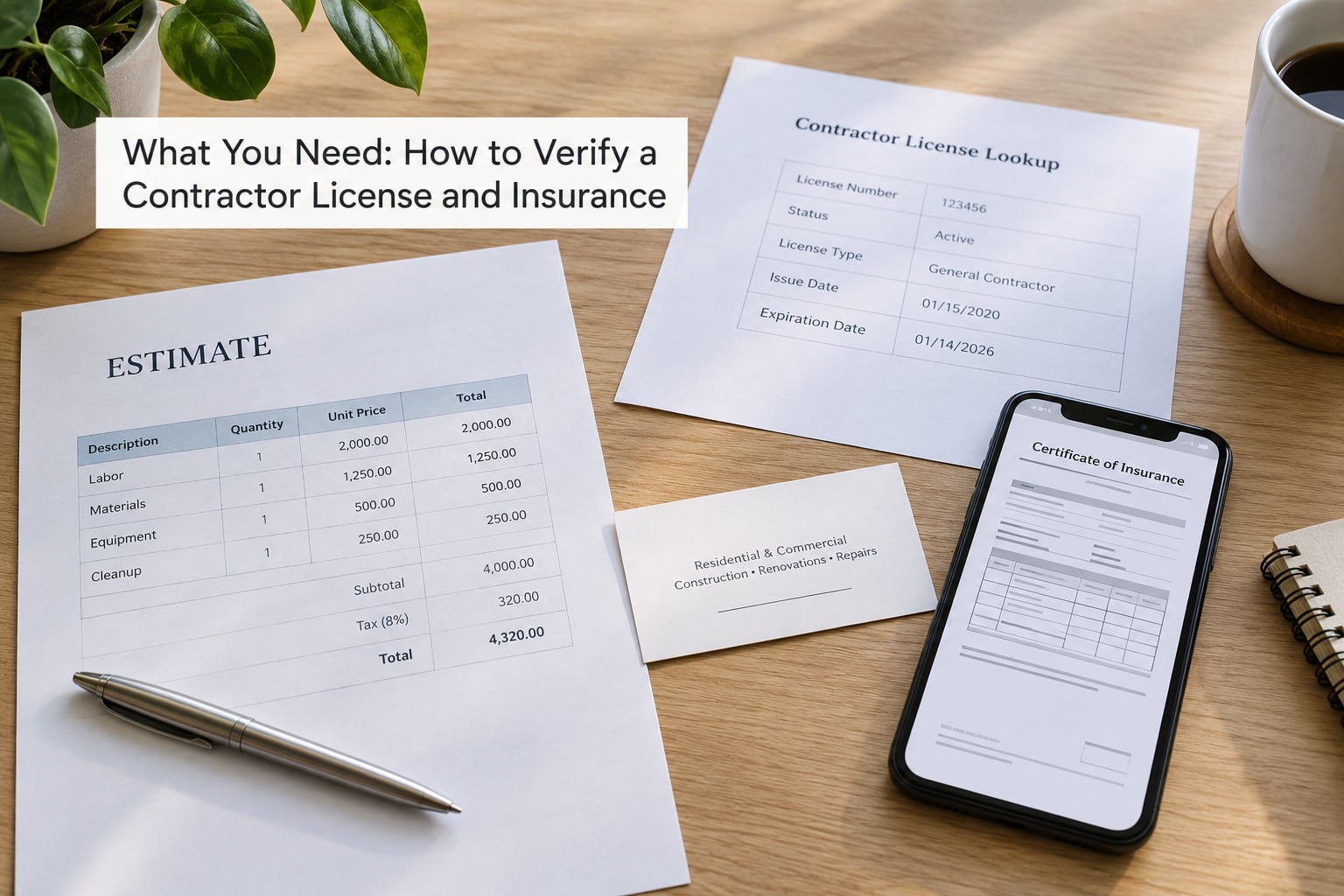
Before you start, gather five things from the contractor. Having them in hand turns the whole job into one short phone-and-browser session.
- Their exact legal business name, exactly as it appears on the license
- The license number and the state that issued it
- The trade or license classification they say covers your project
- A certificate of insurance naming you as the certificate holder
- A physical business address and a phone number that reaches a person
You’ll also need access to your state licensing board’s database and your local building department’s permit records. Most states run a free public lookup, and local departments usually let you pull permits by address or contractor name.
One more thing worth having: a copy of the contract or written estimate. You’ll be adding the license number and insurance terms to it later, so know where that language goes.
Step-by-Step
Confirm the Contractor’s Legal Business Name and License Number
Ask for the legal name, not the marketing name. “Smith Brothers Home Solutions” is what appears on the truck; the license might be issued to a differently named entity or to the owner personally.
Ask directly, in writing, for the license number, issuing state, trade classification, expiration date, and the qualifying individual named on the license. The qualifying party is the person who passed the exam and holds the license on behalf of the business, which matters if the contractor is a one-person outfit.
How you know it worked: the business name and license number on the contract are identical to the ones in your hands. If the contract is signed by an entity you have never heard of, stop there and ask why.
Search Your State’s Official Licensing Database
Go to the licensing board’s own site, not a lead-selling directory. Type “license lookup” plus your state name into a search engine, or start from the state’s official government domain.
Search by license number first. It’s the most reliable identifier because names get duplicated, misspelled, and traded. Search by name second if the number comes back with nothing.
Check four fields on the record: status (active, expired, surrendered, revoked), classification, expiration date, and any disciplinary actions listed. Download or screenshot the record on the same day you check it. If a dispute comes up six months from now, that screenshot is your evidence.
Check Whether the License Covers the Work You Need
A general contractor license does not automatically authorize electrical, plumbing, HVAC, or structural work in most states. Those trades usually hold separate licenses with separate classifications, and the general contractor may subcontract them to licensed subcontractors.
Compare the classification line on the license record to the scope of your project. A bathroom remodel that includes new electrical and new plumbing needs those trades covered, either on the contractor’s own license or on licenses held by subs the contractor names.
Ask who is actually performing each trade and get their license numbers. A reputable general contractor can answer this in one sentence. Hesitation here is informative.
Verify Insurance Coverage and Policy Dates
Ask for a certificate of insurance, usually called a COI, and check what it actually says. You want general liability coverage, and workers’ compensation where it applies. Look at the effective and expiration dates, because a certificate is a snapshot of a moment in time, not a promise to stay covered.
Then do the step most people skip: call the insurance carrier using the number listed on the carrier’s own website, and ask whether the named insured’s policy is active, what the coverage dates are, and what the general liability limits are. You need the limits to meet your state’s requirements, which are often written into the local building code or a permit condition.
Ask whether you are listed as an additional insured. That endorsement is what gives you direct rights under the policy; a certificate alone grants you nothing, which is why you should request the endorsement as well as the certificate.
How you know it worked: you can name the carrier, the policy number, and the expiration date, and the carrier confirmed all three.
Review Disciplinary Records, Complaints, and Business History
The licensing board shows formal discipline. Consumer complaints are softer evidence but still useful, so check your state’s consumer protection agency, the Better Business Bureau, and civil court records for the county where the business sits.
Judge complaints in proportion. One scheduling complaint is noise. A pattern of the same complaint across different customers, especially an unresolved one or a pattern spanning several trades, tells you something real.
Pull permit history from your local building department too. Permits filed under the contractor’s name show whether they actually pull permits on job after job or only occasionally. Someone who discourages permits is usually trying to hide unlicensed work.
Get Written Confirmation Before You Sign
Write the license number, the issuing state, the classification, and the insurance requirements into the contract itself. Add a clause requiring the contractor to notify you if the license lapses, the coverage is cancelled, or an uninsured subcontractor is substituted mid-project.
Keep the contract, the board record screenshot, the certificate of insurance, and the endorsement form together in one folder. If the project runs long, ask for a refreshed certificate before the current one expires.
Never rely on a verbal assurance. If the details will not go in writing, you have your answer about how this project will go.
Common Mistakes
Checking the number but not the trade. A valid license in the wrong classification reads as valid on a fast scan. Fix: read the classification line out loud and compare it to the scope of work before anything else.
Accepting a certificate that’s already expired. Homeowner forums keep the same story: the COI arrived on time but the dates had lapsed. Fix: read the effective and expiration dates first, every time.
Treating a certificate as proof of coverage. A certificate is a document about a policy, not the policy. Fix: confirm with the carrier directly, using a number you found yourself.
Letting the contractor send the certificate from their own inbox. Homeowners on r/homeowners are consistent on this one, and they’re right. Request the certificate from the agency listed on it, or verify it through the carrier, so you know the document didn’t get fabricated.
Paying a large deposit before verification. Money moving early is the whole business model for a bad actor. Fix: no deposit until the license and insurance checks come back clean.
Only checking the state board. Some work needs city or county licensing on top of the state license, and permits are issued locally. Fix: check both, and ask which authority issues the permit for your project.
One more practical tip: verify every subcontractor who will be on site, not only the general contractor. The GC’s insurance covers the GC’s own work and often excludes work performed by others, which is precisely the work you care about.
Frequently Asked Questions
How do I verify a contractor license in my state?
Find your state licensing board’s official site and use its free public lookup. Search by license number first, then by business name if needed. Confirm the status is active, the trade classification covers your project, and the expiration date is in the future. Some states also license at the city or county level, so check both.
What if a contractor says they do not need a license for my project?
Treat that as a red flag. In most states, any paid work on a residence above a small dollar threshold requires a license, and electrical, plumbing, HVAC, and structural work almost always requires its own trade license. If a contractor insists no license applies, ask which law exempts them. A clear exemption is fine; evasion is not.
Is a certificate of insurance the same as proof of insurance?
No. A certificate of insurance is a summary document that an insurer issues to show a policy existed on a given date. It is not the policy, it does not confirm the policy is still active, and by itself it gives you no rights. Ask for an additional insured endorsement as well, and confirm the policy with the carrier.
How do I check that a contractor’s insurance is currently active?
Read the policy number and carrier name off the certificate, then find the carrier’s phone number on its own website rather than on the document. Ask whether the policy is active today, what the effective and expiration dates are, and what the general liability limits are. Confirm the same details in writing through your agent or broker if you have one.
Does a contractor license prove the contractor is insured?
No. A license shows that the contractor is legally authorized to work and passed required exams and financial checks in some states. Insurance is a separate contract with a separate company and is never verified through the licensing board. You have to check both independently, and only current coverage dates tell you whether the policy is live today.
What should I do if I cannot verify a contractor license or insurance?
Pause before signing or paying anything further. Ask directly, in writing, for the missing documents and give a clear deadline. If the contractor cannot produce them, walk away and tell other homeowners, since that pattern often repeats. If work has already started, contact your local building department about permit and inspection issues before hiring anyone to fix it.
Conclusion
Start here: get the contractor’s exact legal business name and license number in writing, then look both up on the official state licensing board site and confirm the status, classification, and expiration date. Next, request a certificate of insurance naming you as certificate holder plus an additional insured endorsement, and confirm the policy is active by calling the carrier using a number you looked up yourself. Save the contract, the record screenshot, and the insurance documents together before any money changes hands.
Twenty minutes of checking is cheap next to a project that gets stopped at an inspection, or an injury that nobody will pay for.