How to choose a tree for a small yard comes down to one number: the tree’s size at maturity, not the size in the pot. Measure your usable planting area, rule out anything blocked by utilities, pipes or setback rules, then shortlist species whose mature height and mature spread fit that space for the next 20 to 30 years.
The most common regret in this category is not a bad tree. It is a good tree in the wrong place, bought at 6 feet tall and 3 feet wide at the nursery, then 40 feet tall and 25 feet wide twenty years later, shading the house and lifting the driveway.
Table of Contents
- What Size Tree Fits a Small Yard?
- How to Choose a Tree for a Small Yard by Site Conditions
- What Tree Shapes Work Best in Tight Spaces?
- Which Trees Stay Manageable in Small Yards?
- How to Choose a Tree for a Small Yard by Mature Size
- Native or Non-Native: Which Is Better?
- How to Check the Root System and Overall Health
- How Much Space Should You Leave Around a Tree?
- What Ongoing Care Does a Small Tree Need?
- How to Buy the Right Tree for Your Yard
- Frequently Asked Questions
- What is the best tree for a very small yard?
- How tall should a tree be next to a house?
- Are columnar trees good for small yards?
- How much space does a small tree need from a fence or foundation?
- Should I buy a container-grown or bare-root tree?
- How do I know whether a nursery tree is healthy?
- Start With the Mature Tree, Not the Nursery Pot
What Size Tree Fits a Small Yard?
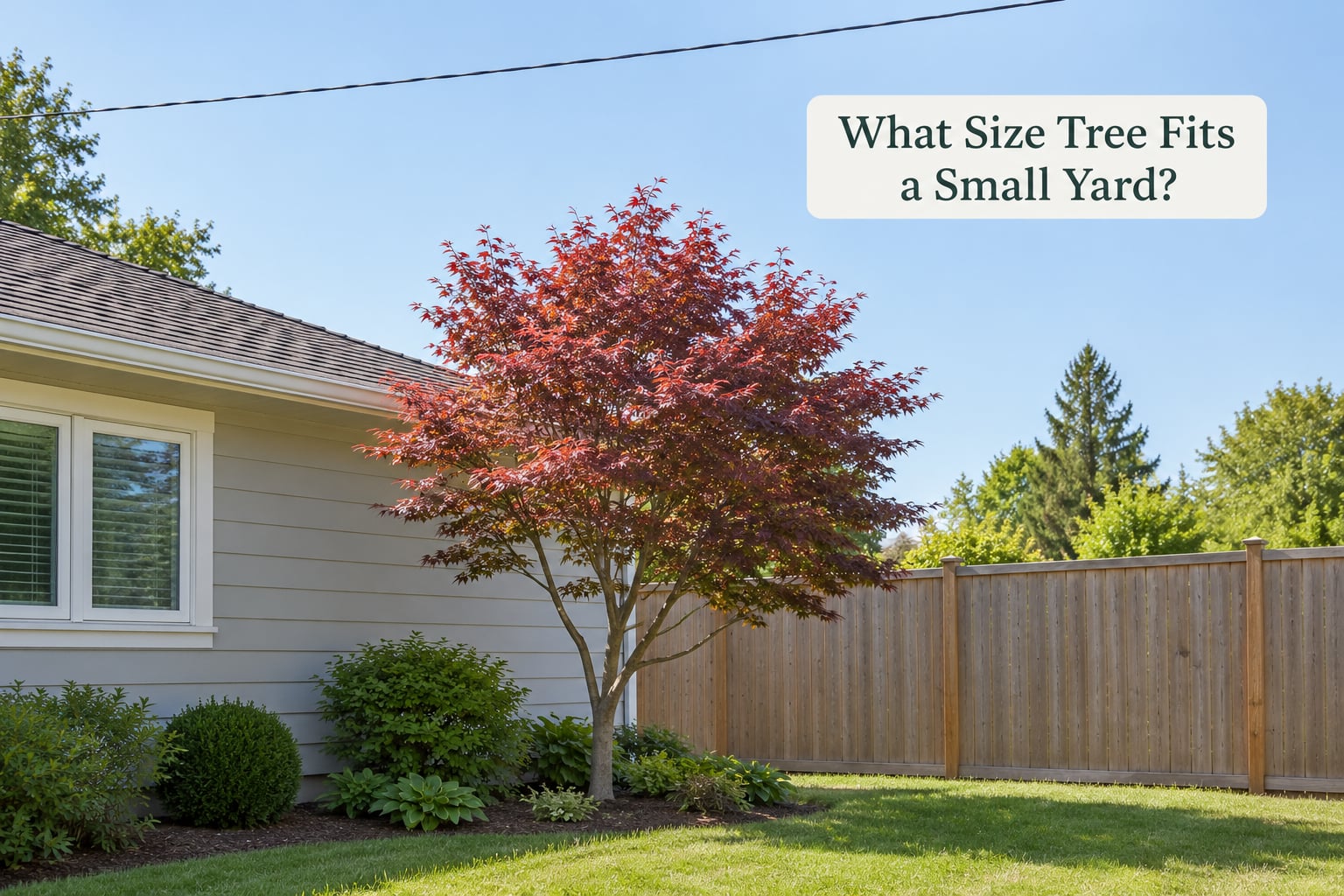
A small yard usually means two separate constraints: a height limit set by the house and the sky, and a width limit set by the lot line, the fence and the walkway. Judge both from the mature size of a specific cultivar, never from the generic species name.
As a working range, front yards on narrow lots handle trees under 20 feet at maturity. Courtyards, parking strips and patios need something under 10 to 12 feet, or a narrow columnar form that trades width for height. If your only open space is a corner, a multi-stem clump often reads bigger than a single-trunk tree of the same height because it fills horizontally from the ground.
Two terms cause most of the confusion here. Mature size is the height and spread a named cultivar reaches in your climate after roughly 15 to 25 years. Nursery size is caliper or container size: how thick the trunk is, measured in inches, at the moment of sale. A 1.5 inch caliper tree tells you almost nothing about where its branches will be two decades from now.
If you remember one number from this section, use the nursery’s own tag. Every reputable nursery lists mature height and spread for the exact cultivar on the tag, and if the tag only says “small tree,” that tells you the seller did not check.
How to Choose a Tree for a Small Yard by Site Conditions
Work through these steps in order. Skipping ahead to species is how people end up with a tree that has to come out within a decade.
- Measure the usable area, not the yard. Mark the spot where a full-grown canopy would touch the house, the fence, the walkway and the neighbor’s lot line.
- Check overhead lines. If conductors cross the planting area, call 811 and ask your utility which trees they permit beneath them.
- Check what is buried. Call 811 for underground utility marking before anyone digs, and locate any septic drain field, easement or irrigation line on your lot.
- Map the sun. Note where shade falls at noon and again in the late afternoon across a full season, because a sunny planting bed in April can be shaded by a neighbor’s evergreen by August.
- Test soil and drainage. Dig a hole 12 inches deep where you plan to plant, fill it, and see how long water takes to drain. Standing water after a day means slow decay of the roots.
- Confirm your USDA plant hardiness zone on the official map and keep to species rated for it, ideally one zone colder for a plant that has to survive a rough first winter.
- Shortlist by form, then by size. Decide whether you want an accent, a screen or shade, then read mature width as carefully as mature height.
- Verify the mature figures from a named cultivar and an independent source, such as your local extension office or the Arbor Day Foundation, before you pay for anything.
Steps 2 and 3 decide what is possible. A canopy cannot be negotiated with a utility easement, and a mature root system near a septic field is a problem you will not be able to prune your way out of.
What Tree Shapes Work Best in Tight Spaces?
Shape matters more than species name in a tight space, because it sets the mature width. Columnar or fastigiate forms grow tall and narrow, sometimes 25 to 40 feet high on a 10 to 12 foot spread, which suits a strip of lawn between a walk and a fence. Weeping forms hang downward and want room to fall into, so place one where a walkway, pond or seating area can take the lowest branches rather than next to a parked car.
Vase-shaped and spreading forms need horizontal room and cast the widest shade. Upright and oval forms sit between the two. Multi-stem clumps spread wide but stay shorter, which makes them a good answer for a corner where a single trunk would look lost.
The usual conflicts are predictable. Columnar trees in a front lawn look like poles with leaves on them and need room from a curb. Weeping trees over a driveway mean sap and fruit on cars. Spreading trees planted too close to a walk will be pruned back by somebody, badly, every year.
Which Trees Stay Manageable in Small Yards?
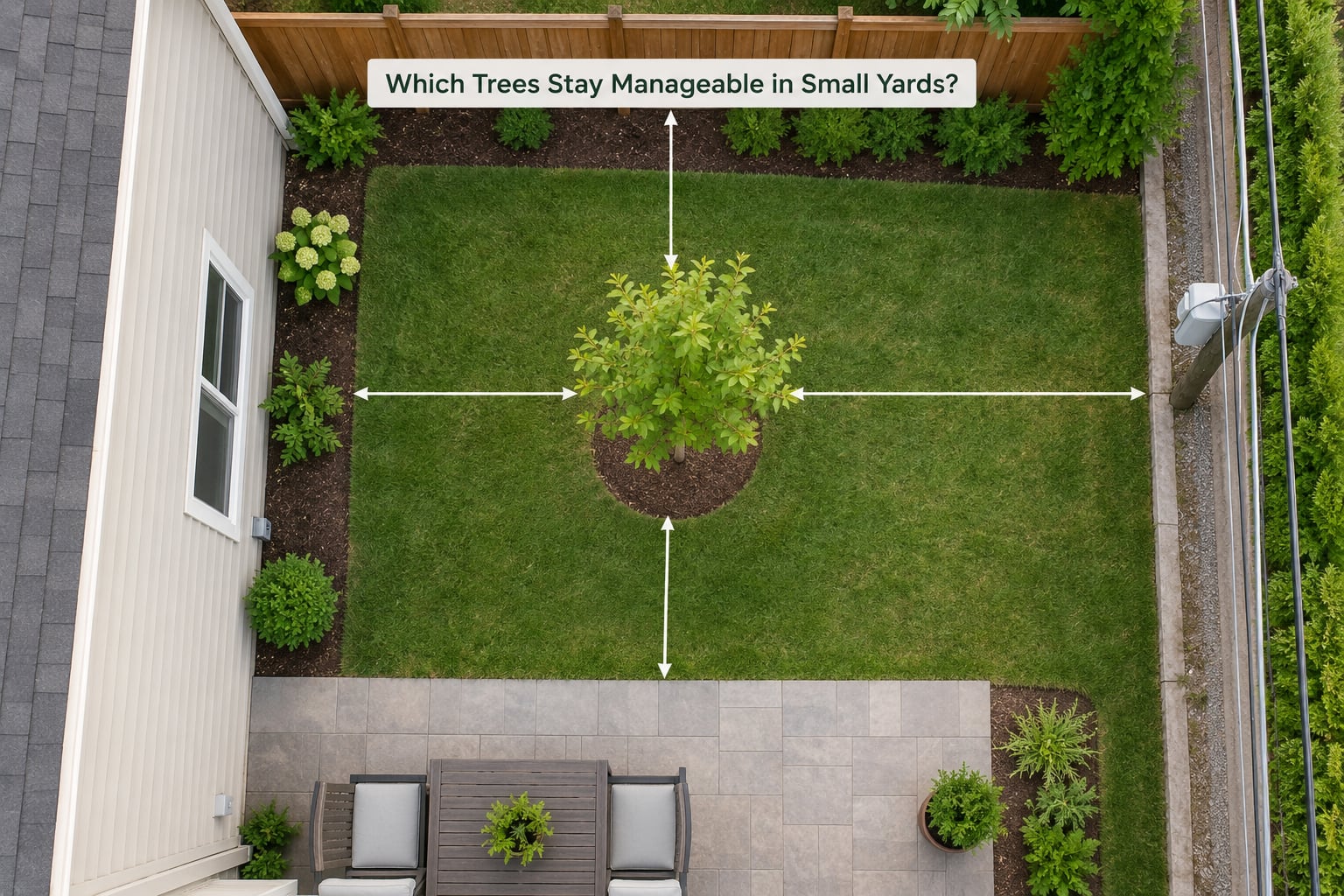
The species below are routinely sold for small yards. Mature sizes vary with rootstock and growing conditions, so treat them as planning figures and confirm the number for the specific cultivar. Zone ranges follow the USDA plant hardiness zone map.
| Tree (Latin name) | Mature height | Mature spread | Sun | Soil | Zones | Form |
|---|---|---|---|---|---|---|
| Sargent crabapple (Malus sargentii) | 15 to 18 ft | 12 to 15 ft | Full sun | Well-drained, adaptable | 4 to 7 | Rounded |
| Downy serviceberry (Amelanchier arborea) | 15 to 25 ft | 10 to 15 ft | Full sun, part shade | Moist, well-drained | 4 to 9 | Upright |
| Apple serviceberry (Amelanchier lamarckii) | 20 to 25 ft | 10 to 15 ft | Full sun, part shade | Adaptable | 4 to 8 | Upright |
| Japanese maple (Acer palmatum) | 15 to 20 ft | 15 to 20 ft | Morning sun, part shade | Moist, well-drained, sheltered | 5 to 8 | Multi-stem |
| Kousa dogwood (Cornus kousa) | 20 to 25 ft | 15 to 20 ft | Morning sun, part shade | Moist, well-drained, slightly acid | 5 to 8 | Rounded |
| Common witch hazel (Hamamelis virginiana) | 15 to 20 ft | 10 to 15 ft | Part shade | Adaptable, tolerates wet clay | 3 to 8 | Rounded |
| Eastern redbud (Cercis canadensis) | 15 to 25 ft | 15 to 20 ft | Full sun, part shade | Well-drained | 4 to 9 | Vase |
| Star magnolia (Magnolia stellata) | 10 to 15 ft | 10 to 12 ft | Full sun, part shade | Moist, well-drained, slightly acid | 5 to 9 | Rounded |
| Saucer magnolia (Magnolia x soulangeana) | 20 to 25 ft | 15 to 20 ft | Full sun | Moist, well-drained | 4 to 9 | Rounded |
| Ironwood (Ostrya virginiana) | 20 to 30 ft | 10 to 15 ft | Full sun, part shade | Adaptable | 3 to 9 | Upright |
| Globe blue spruce (Picea pungens ‘Globosa’) | 6 to 10 ft | 6 to 10 ft | Full sun | Moist, well-drained | 3 to 8 | Rounded conifer |
| Emerald arborvitae (Thuja occidentalis ‘Emerald’) | 10 to 15 ft | 3 to 5 ft | Full sun | Moist, well-drained | 3 to 7 | Columnar evergreen |
| European hornbeam (Carpinus betulus ‘Frans Fontaine’) | 20 to 30 ft | 10 to 12 ft | Full sun, part shade | Adaptable, dislikes drought | 4 to 7 | Columnar |
| Crape myrtle (Lagerstroemia indica) | 10 to 20 ft | 10 to 15 ft | Full sun | Well-drained | 6 to 10 | Multi-stem |
A few practical notes on this list. The serviceberries and ironwood hold leaves and small birds’ food well into winter, which is worth more than flower. Star and saucer magnolia need a site where early frosts will not blacken the buds, and Japanese maple wants afternoon shade and steady moisture or the leaf edges scorch.
How to Choose a Tree for a Small Yard by Mature Size
Size bands make the decision faster than species names. Under 10 feet covers courtyards, large containers and the tightest corners. From 10 to 15 feet covers most suburban front yards and still leaves walking room under the canopy at maturity. From 15 to 25 feet is a real yard tree, giving shade that reaches the house wall in summer if planted on the west or south side.
Beyond 25 feet, you need either a lot of depth to plant or a genuinely narrow form. That is the point at which a tall columnar tree or a multi-stem clump beats a compact round one, because it gives you height without borrowing width from the lot next door.
Some trees to skip, and why. Mimosa (Albizia julibrissin) is invasive in much of the South and reseeds freely. Callery pear (Pyrus calleryana) and its popular cultivars are invasive or weakly structured, snapping in wind and dropping hard fruit onto cars. Silver maple (Acer saccharinum) grows fast, breaks in ice storms and suckers. Paper birch (Betula papyrifera) is not a small tree at all, reaching 50 to 70 feet, though it stays narrow, and it tends to draw borers and early death in warmer climates.
Also avoid anything a neighbor will eventually cut down for you, including trees with heavy spring fruit drop over a driveway or walkway, and species with a documented disease problem in your region. Dogwood anthracnose, for example, makes the native flowering dogwood (Cornus florida) a gamble in wet, humid summers.
Native or Non-Native: Which Is Better?
There is no universal winner. Locally native trees are usually the safest bet because the insects and diseases that trouble them are the ones already present, and the birds and caterpillars in your area are already tuned to them. That said, native is a region-specific claim, not a national one, so check your own state or county recommendations before buying.
Non-natives earn their place when they offer a trait no local native provides: a columnar habit, a longer flowering window, a color the natives lack, or tolerance for a soil condition your yard has. The cost is that you inherit the species’ disease and invasiveness profile wherever it grows.
Use your extension office, your state invasive species list and the Arbor Day Foundation as a cross-check. If a species appears on your region’s invasive list, skip it no matter how good the sales pitch is.
How to Check the Root System and Overall Health
Inspect the tree before you buy it, while you can still walk away. Lift the container or probe the top of the root ball, and if you see roots circling the outside in a tight coil, that is girdling. It will keep circling after planting and strangle the trunk as it thickens.
Look for a visible root flare where the trunk meets the soil. A tree whose trunk goes straight into the soil without a flare has been planted too deep at some stage in its life, which weakens it over years.
On the trunk, look for straight taper from the base to the leader, no sunken or cracked bark, and no graft unions buried below the soil line. On the branches, a healthy small tree has a clear leader and evenly spaced side branches with buds pointing outward rather than all crowded at the top. Skinny, bare lower branches usually mean the tree was held in a container too long.
Check the canopy for dead tips, discoloration or a dusty dull green rather than a firm green. Peel nothing open, but do look under leaves for scale insects and webbing. Lift the balled-and-burlapped root ball a few inches and let it drop: a ball that stays together was handled well, and one that slumps apart was already in poor condition.
Container-grown trees transplant more easily because their root ball has not been cut and rebundled, though they need closer watering for the first season. Choose by what you can inspect, not by format.
How Much Space Should You Leave Around a Tree?
Leave room for the mature canopy, not the current trunk. Mature spread, not trunk diameter, is what decides whether a tree reaches your foundation, lifts a walk, or roots into a drain field, and roots on a well-established tree extend well past the drip line of the canopy.
As practical starting points that local arborists and nurseries use: plant a small tree roughly 10 to 15 feet from the house and about 5 feet clear of a patio, walkway or fence, adjusting for the mature spread of your chosen cultivar. Keep mature canopy at least 10 feet away from overhead conductors, which is why trees planted under lines are usually chosen to stay under 20 feet tall.
One widely used arborist guideline is called the 10/20/30 rule: keep a canopy about 10 feet from structures, 20 feet from other trees, and 30 feet from road edges and utility rights-of-way. It is a guideline rather than law, so confirm the local version with your extension office or municipal forester before you plan around it.
Roots can lift and crack concrete, and they do it by finding existing cracks and widening them, which is why a tree planted on top of a known crack is a bad bet regardless of species. Sidewalks can heave; the fix is usually structural, not a lighter tree, but keeping 5 feet of clearance gives you options.
Septic fields need their own rule. Many county health departments keep large trees 20 feet away and small trees 10 feet away from a drain field, and some specify a figure measured from the system’s outer edge rather than the tank. Mature spread drives the risk more than trunk size, so verify the number that applies to your county and site before you plant.
When the question involves a structure, a boundary dispute or a utility, bring in a qualified arborist or your municipality before you plant. A 30-minute check costs far less than moving a mature tree.
What Ongoing Care Does a Small Tree Need?
Most small-tree failures happen in the first two years, not from bad species choice. Watering is the whole game: a newly planted tree has a root ball roughly the size of its container, so it dries out far faster than the surrounding soil suggests.
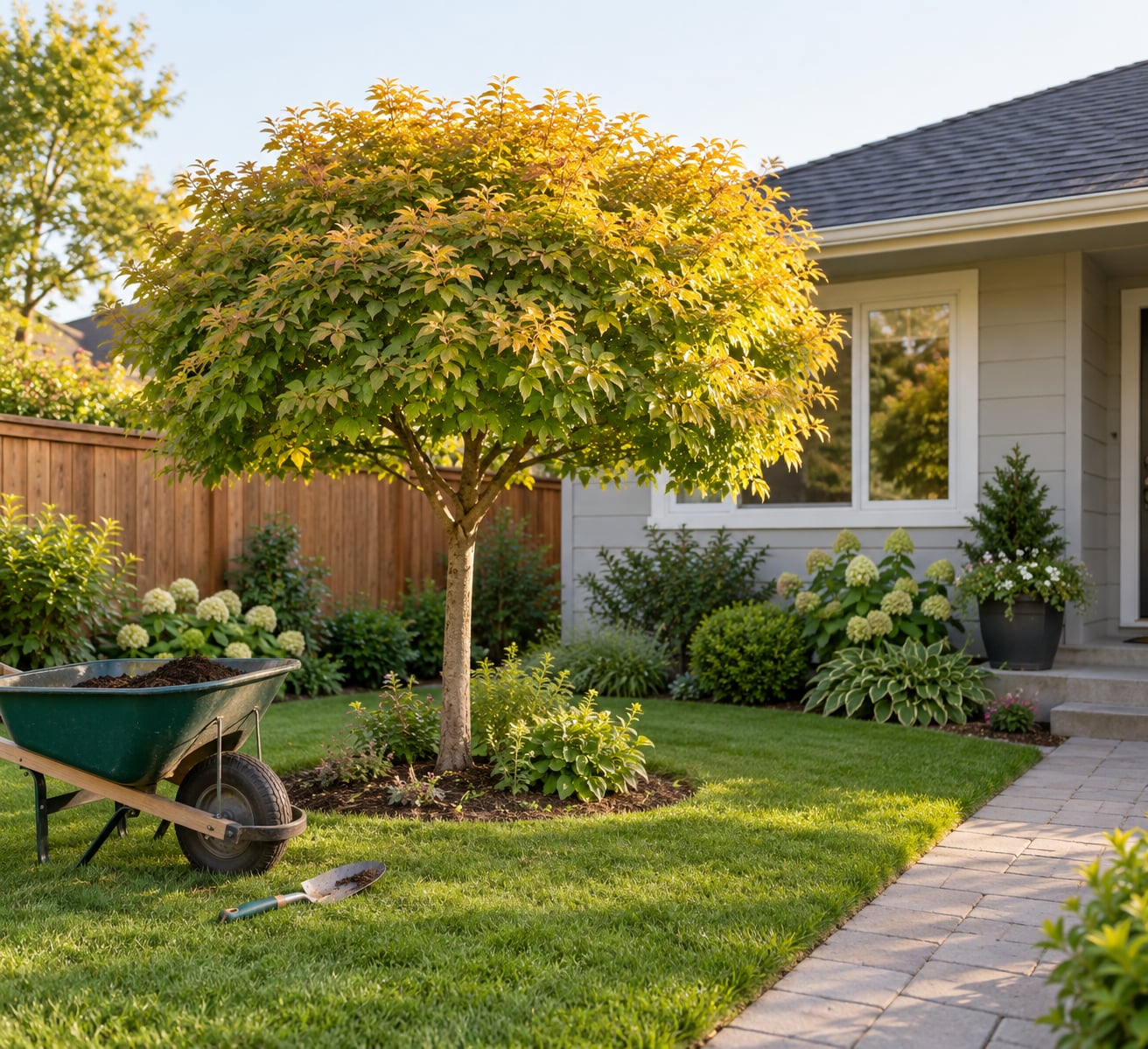
Water deeply and less often rather than shallow and often, and check the soil a few inches down before you water again. Lengthen the interval as the season goes on and the root system extends. Mulch 2 to 3 inches deep over the root ball, keeping it a few inches off the trunk so it does not hold moisture against the bark.
Clear grass and groundcover from the mulch ring. Competing grass is the most common reason a small tree declines in a lawn, and it competes hardest during the dry weeks of midsummer.
Staking is usually unnecessary if the tree is planted correctly; if you stake it, check the ties every spring and remove them within a year or the trunk grows around them. Inspect after storms for broken branches and after winter for split trunks, then prune to remove dead wood and crossing branches. Time structural pruning to the species and to local guidance, since some trees bleed badly when cut in late spring, and never top a mature tree.
How to Buy the Right Tree for Your Yard
Before you pay, check that the tag gives you a full botanical name or cultivar, not just a common name. Common names cover everything from 8 feet to 80 feet, and “Japanese maple” alone tells you nothing about size.
Confirm the mature height and spread against a second source, and check the hardiness zone rating against your own zone. Look at the tree’s roots as described earlier, and ask whether the stock has any known disease issue in your region.
Then handle the practical questions. Will the nursery deliver, and can they plant it, and do they guarantee replacement for a period such as one year? Which species do they carry only in root containers, meaning the size you get is not the size you asked for? And what is the return policy if the tree fails in its first summer?
Take your measurements and photos of the site with you. It makes it much harder for a salesperson to talk you into a full-size variety that does not fit, which is a familiar sales pattern in nurseries that sell mostly to homeowners.
Frequently Asked Questions
What is the best tree for a very small yard?
Under 10 feet at maturity, choose a dwarf conifer, a compact multi-stem clump, or a small-flowering tree such as a dwarf crabapple. Gardeners often suggest a weeping Japanese maple for a tiny courtyard, with the caveat that it needs soil amended for drainage and protection from drying wind. Match water needs to whatever else is in the bed so nothing competes unfairly.
How tall should a tree be next to a house?
As a starting point, keep a small tree roughly 10 to 15 feet from the house and expect it to stay under about 20 to 25 feet at maturity for most front yards. Taller species are workable if the mature spread stays narrow and you have clear depth on the lot. The governing number is the cultivar’s mature spread, since width decides whether branches reach siding, gutters or a walkway.
Are columnar trees good for small yards?
Columnar or fastigiate trees are one of the best fits for tight lots because they add height while taking up very little width, sometimes only 10 to 12 feet at maturity. Examples include Emerald arborvitae and a columnar European hornbeam. Plant them where there is depth rather than in a cramped front lawn corner, and keep the trunk clear of curbs and parked cars.
How much space does a small tree need from a fence or foundation?
About 5 feet clear of a patio, walkway or fence is a reasonable minimum, and 10 to 15 feet from the house, as long as you adjust for the cultivar’s mature spread. Established roots extend past the canopy drip line, so a tree planted at 5 feet can lift a fence panel or a slab within a few years. Check any local setback rule before you plant near a boundary.
Should I buy a container-grown or bare-root tree?
Container-grown trees transplant most easily because the root ball has never been cut and rebundled, and they are the usual choice for container, courtyard and patio plantings. Balled-and-burlapped trees offer a wider selection of larger specimens but need more care in the first year. Either way, reject any tree with roots circling the outside of the ball in a tight coil.
How do I know whether a nursery tree is healthy?
Look for a clear leader, straight taper, healthy buds and evenly spaced branches, plus a visible root flare where the trunk meets the soil. Lift or probe the root ball and reject circling roots. Check that the ball stays intact when lifted, that the bark has no cracks or sunken areas, and that the foliage is firm green rather than dull or wilted.
Start With the Mature Tree, Not the Nursery Pot
If you have only worked through half of the work above, this is the part worth finishing. When you know how to choose a tree for a small yard, draw your lot to scale and plot the tree’s mature canopy on it before you shop. Most mistakes in small yards are spacing mistakes, and a five-minute drawing costs less than removing a 20-year-old tree.
Measure the usable area, rule out anything crossed by utilities, pipes or a septic field, map the sun, and then pick a form that fits the space you have left. Confirm the mature height and spread of a named cultivar, and take those numbers to the nursery instead of letting the tag at the front of the row decide for you.