Most blinds that will not go up are fixed in under ten minutes, and the repair is nearly always one of three things: a cord lock pawl that has stuck in the up position, a spring inside the roller tube that has lost tension, or an obstruction caught in the headrail. Which fix applies depends on the lift mechanism inside the blind, not on the blind’s color or age.
Start by pulling gently, never hard. A yank is what turns a two-minute reset into a stripped pawl or a cracked headrail, and those are the two repairs that end with a trip to a repair shop.
In the sections below I walk through identification, the most common fixes for each blind type, part replacement, and the point where a new blind is the sensible answer. Most people reading this for the first time will land on one of the first three steps.
Table of Contents
- What You Need to Fix Blinds That Will Not Go Up
- Step-by-Step
- How to identify the blind and operating system
- Check for obstructions and tangled cords
- Release a stuck or jammed mechanism
- Corded horizontal: the cord lock pawl reset
- Cordless or spring shade: extend, then tug at 45 degrees
- Roller shade: the manual roll-up reset
- Chain-operated roller shade: check the chain before the clutch
- Vertical blinds: free the carriers and align the track
- Motorized blinds: power, pairing, then calibration
- Replace broken lift cords or components
- Test and adjust the blind
- Common Mistakes
- When to replace the blind instead of repairing it
- Frequently Asked Questions
- Why will my blinds not go up?
- Can I use WD-40 on blinds that will not go up?
- How do I fix a blind with a broken lift cord?
- Is it safe to cut the cords on a broken blind?
- How do I reset a motorized blind that has stopped working?
- When should I replace blinds instead of repairing them?
- Conclusion
What You Need to Fix Blinds That Will Not Go Up
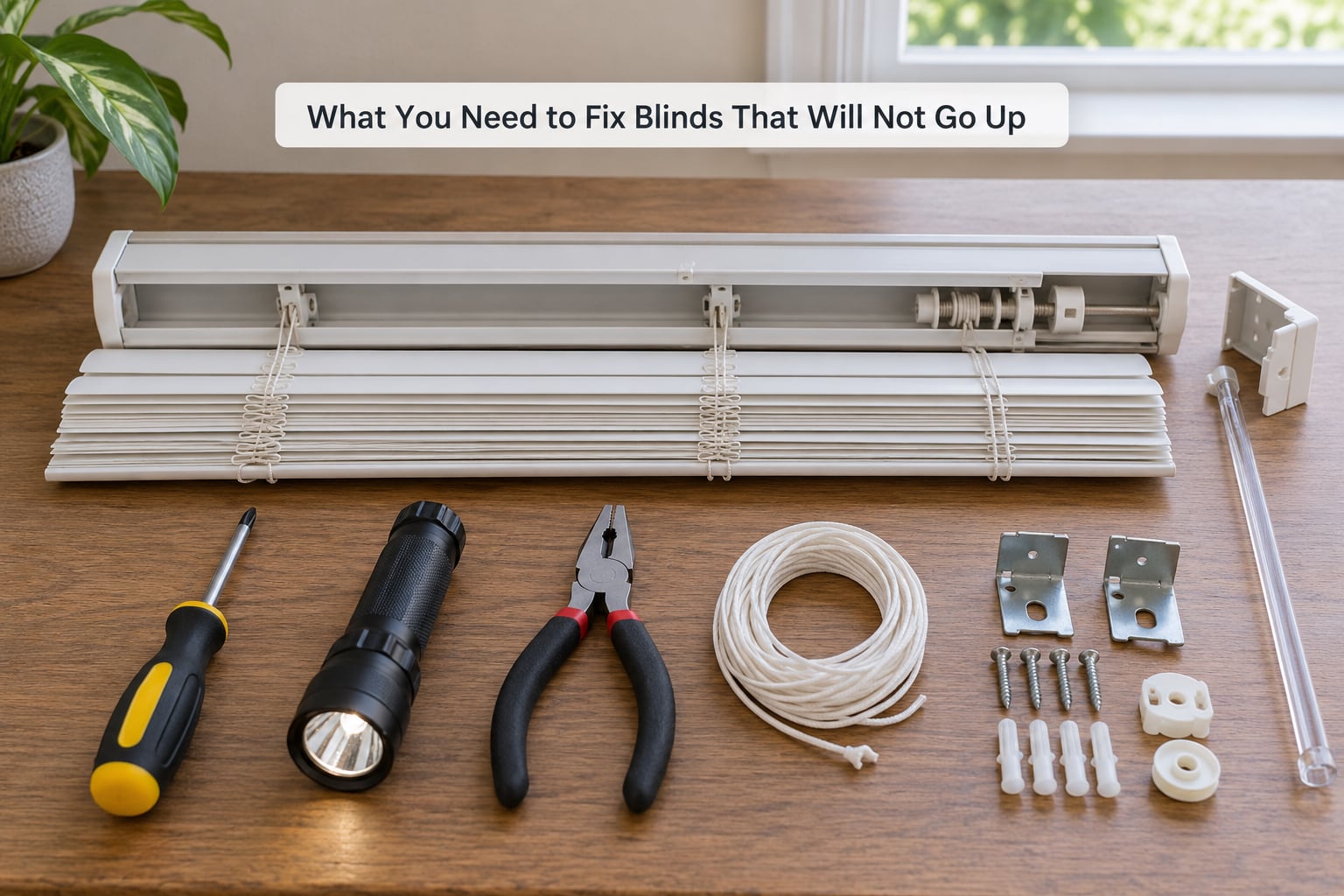
Here is the honest version: about half of these repairs need no tools at all. A cordless shade that has lost its spring usually comes back with a firm pull, and a corded horizontal that will not lift usually needs a flathead screwdriver and fifteen minutes.
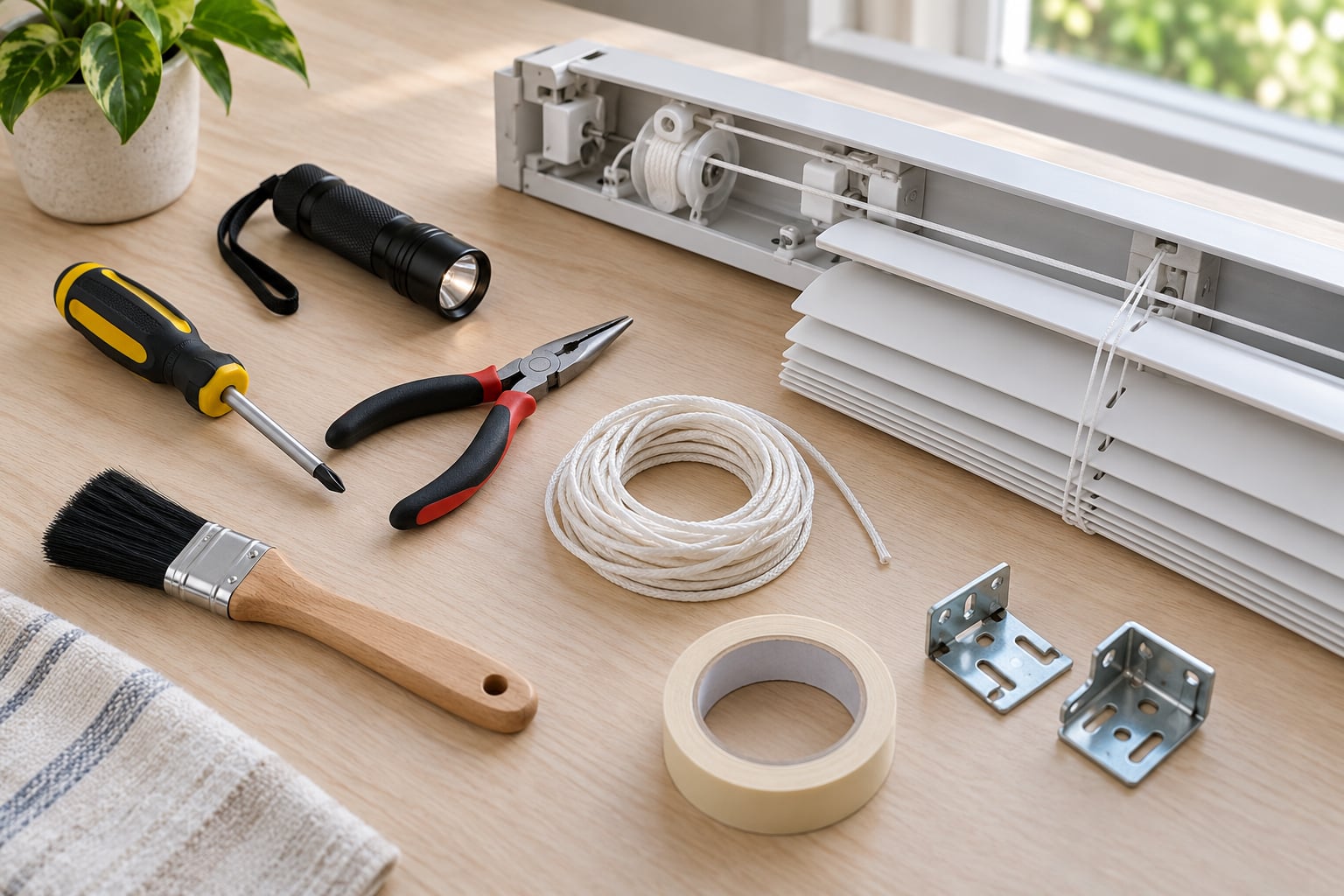
- Flathead screwdriver for depressing the cord lock pawl inside the headrail and for prying the headrail out of its mounting brackets.
- Step stool or small ladder so you can work at head height without stretching your arms overhead. Most headrails sit 6 to 8 feet up.
- Flashlight for seeing inside the headrail, which is a dark cavity with small moving parts.
- Pliers only for gripping and pulling a broken cord, never for the tilt wand or the clutch itself.
- Soft brush or a dry toothbrush for dust and grit packed into the roller tube ends or the carriers in a vertical track.
- Replacement lift cord or ladder cord in the diameter that matches your blind. Measure the existing cord with a ruler before buying.
- Masking tape for the telescoping fix and for marking bracket positions so you can remount at the same height.
- Manufacturer instructions or the brand label photo, if you still have them. The label usually carries the model number, which is what a parts supplier needs to match a clutch or tension device.
- Silicone lubricant, for the rare case where a clutch or carrier needs it. Skip WD-40; it is a poor choice here for the reason explained in the Common Mistakes section.
Before you touch anything, tape a picture of the bracket positions on the wall or the sill. Getting a blind back at the exact original height is much easier than correcting it after the fact.
Step-by-Step
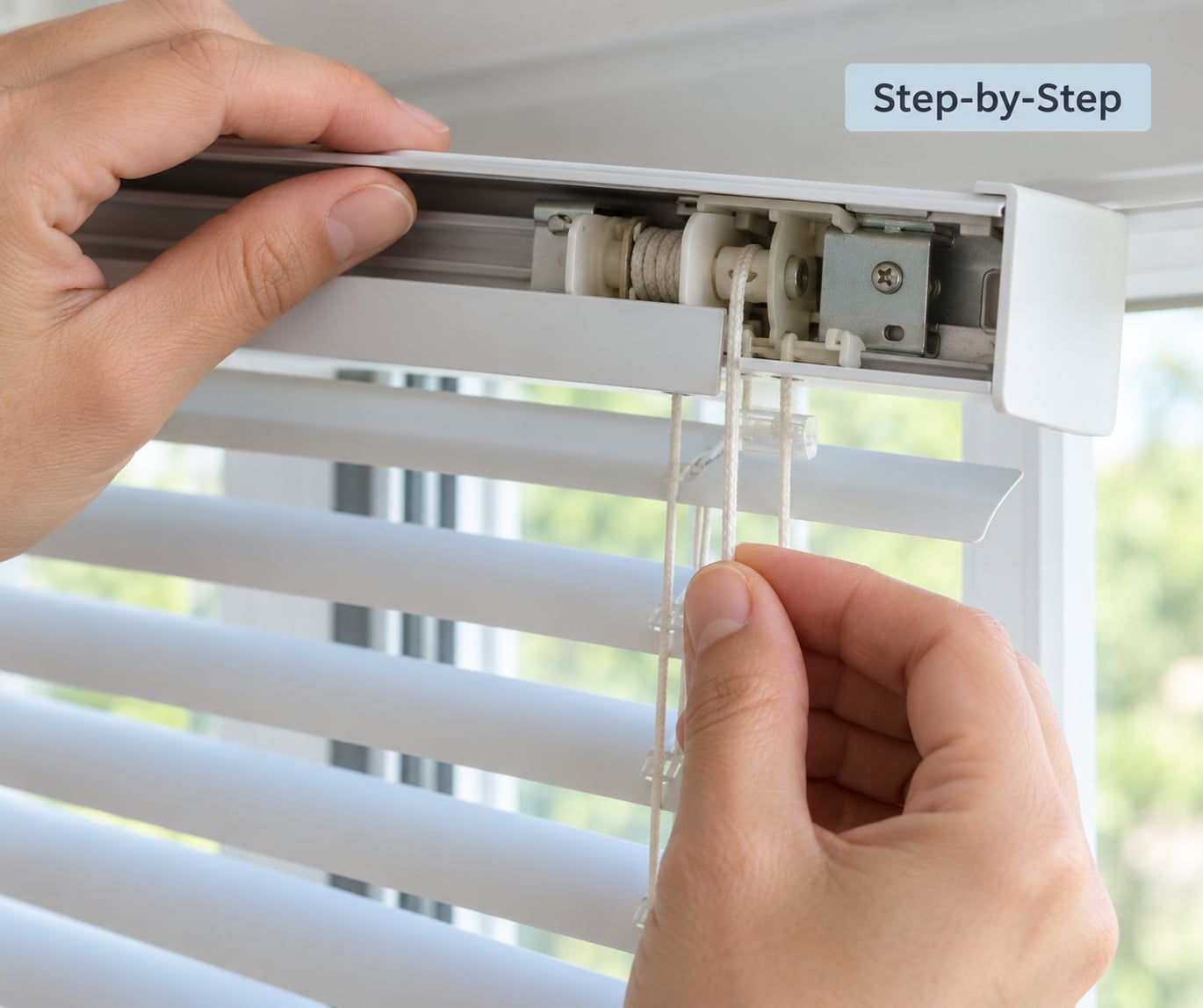
How to identify the blind and operating system
Look at how the blind is operated. That single clue tells you which mechanism to work on, and it takes about thirty seconds.
Corded horizontal blinds, including vinyl mini-blinds, faux wood and wood Venetians, have a continuous loop of lift cords running through the slats and a cord lock in the headrail that grips them. A pawl is the small metal claw that drops into the toothed ratchet wheel to hold the blind at a height. Tilt is usually handled by a separate tilt rod or a wand, and the two systems can fail independently.
Cordless shades, spring shades and push-up tension blinds have no lift cord. A spring inside the roller tube stores energy and pulls the shade up. This system is also called a spring-tube or push-pull lift, and Levolor is one of the brands that comes up most often in questions about it.
Chain-operated roller shades use a bead chain that turns a clutch, which is a small gear housing mounted on the side of the headrail. If the chain moves and nothing else happens, the clutch is the suspect. If the chain will not turn, the chain or clutch has broken or seized.
Vertical blinds use carriers that ride in a headrail track. A wand or rod rotates a shaft that pushes the carriers across. Here the usual complaint is that the carriers will not open and close rather than that the blind will not go up.
Motorized blinds have a battery pack or a hardwired motor in the headrail and are controlled by a remote, a wall switch or an app. Nothing mechanical jams by hand, so the checks are electrical: power, pairing and calibration.
The five definitions worth keeping in your head are short. The headrail is the box at the top that houses the mechanism. The cord lock holds the lift cords. The ratchet is the toothed wheel the pawl locks into. Telescoping means fabric rolling to one side instead of evenly. The clutch is the gear housing the bead chain turns.
Check for obstructions and tangled cords
With the blind in the down position, run a hand along the headrail and look for anything that does not belong. Grit, a paint fleck, a dead insect, a toy fragment, or a piece of the valance that has dropped into the slot will block a pawl or wedge a carrier exactly the way a bent pin would.
Then look at the blind itself. Three things cause most of the reported jams:
- A bent or crossed slat wedged into the headrail opening, which stops the blind before it has travelled more than an inch.
- A tangled lift cord, often after a cord has broken or after the blind has been pulled by the bottom rail rather than by the cords.
- A warped bottom rail that has caught on a bracket, a window frame, or a passing shoulder.
Clear debris with the soft brush. Untangle cords by hand, working from the headrail downward one strand at a time and never pulling a cord that is under load.
If the blind goes up and immediately falls back down, the cord lock is usually working correctly. That symptom means the blind needs a deliberate, fully vertical pull to engage the ratchet, not that something has broken.
What you will hear tells you a lot. Clicking that continues without movement usually means the pawl is moving but the cords are not attached or the lift is loaded unevenly. Grinding means a gear, bearing or carrier is being forced. Scraping that comes and goes with movement is very often the fabric of a telescoping roller shade rubbing the bracket.
Release a stuck or jammed mechanism
Release the mechanism that matches your blind. These are short sequences on purpose, so each one can be followed exactly.
Corded horizontal: the cord lock pawl reset
- Lower the blind fully, then remove the valance or front cover from the headrail. Most are held by screws, clips or a snapped-in plastic strip.
- Support the headrail with one hand and pop it out of the mounting brackets by pressing the bracket levers and pulling the headrail toward you.
- Find the cord lock inside, usually a small metal or plastic block toward one end.
- Push the pawl down with a flathead screwdriver and slide the lift cords toward the outer edge of the lock.
- Snap the headrail back into the brackets and reattach the cover.
If the headrail has no visible screws, look for a clip or a sliding cover rather than a screw. Plenty of blind repairs on the home advice forums go wrong because people drilled into a valance looking for fasteners that were never there.
Cordless or spring shade: extend, then tug at 45 degrees
- Pull the shade down to its full extension, letting it hang completely.
- Tug gently downward and outward at roughly a 45-degree angle, two or three times.
- Guide the shade back up while keeping the fabric square and flat.
Pulling straight down at full stretch loads the shade but does not reset the spring; the angled tug transfers force into the spring barrel the way the lift mechanism expects.
Roller shade: the manual roll-up reset
- Pull the shade down about halfway.
- Take the shade out of the mounting brackets, supporting its weight as you do.
- Roll it up by hand evenly from one edge to the other, keeping the fabric aligned.
- Put it back in the brackets, test it, and repeat two or three times.
This is the single most repeated fix in blind repair forums, and it works because it re-tensions the spring and re-centres the roll at the same time. Rolling it up crookedly sets you up for a telescoping problem later, which is why the even roll matters.
Chain-operated roller shade: check the chain before the clutch
- Turn the bead chain by hand and see whether the clutch responds on both sides.
- Look for a broken, flattened or rusted bead, and check the chain meets the clutch cleanly.
- If the chain turns but the shade stays put, the clutch has lost its drive and needs replacing as a unit.
Replace chain rather than extending it. Joining two pieces with a connector works in a pinch, but a repaired chain skips under load and leaves you chasing the same problem in a week.
Vertical blinds: free the carriers and align the track
- Slide the stuck carriers along the track by hand to find where they bind.
- Straighten any bent section of track with pliers, protecting the finish so it does not crease.
- Reseat the headrail firmly in its bracket if it has shifted.
Grit in the track is common in rooms with construction dust or pets. A dry brush along the channel clears it in seconds and prevents the carrier from hanging up again.
Motorized blinds: power, pairing, then calibration
- Replace the batteries in the remote, or check the power supply if the blind is hardwired. Recharge or swap the blind’s own battery pack where applicable.
- Pair the remote again by following the hold-to-program button sequence listed for your hub.
- Run a full up and down cycle to recalibrate the limit stops.
If the motor hums and the shade does not move at all, the shade is probably over-extended past its limit and the motor has stalled. Unplug the power, raise the shade by hand a few inches, then restore power and recalibrate.
Replace broken lift cords or components
Replace a part only after you have confirmed the part is what failed. Most parts on a blind are inexpensive and widely available, but matching them matters.
Lift cord replacement on a corded horizontal starts with removing the headrail and opening the end caps on the cord rollers. Thread the new cord through the roller, run it up through every slat hole on the way down, and leave enough slack that the blind can raise and lower without the cords going taut. A community trick that works well for realigning a badly uneven blind: let it all the way down, pull on only one cord until the slats line up, then knot that cord at the height you want and let the lock take the load from there.
Ladder cords on a Venetian come loose from the tilt rod rather than from the headrail. Pull the offending slat free, rethread the cord through its holes, and reconnect it to the tilt mechanism. Several slats often share one broken cord, so check the whole run before you close the headrail back up.
The tilt wand or tilter turns when the slats never move, which points to a stripped spline. Match the wand by stem diameter and overall length, and match the tilter by the headrail profile it clips into. Bring photos to a parts counter; a mismatch is the usual reason a “universal” part will not fit.
Clutches, tension devices and springs are matched by tube diameter and headrail width. A clutch that is slightly too large rattles and will not hold; one that is slightly too small will not engage the chain. Mark the position of the existing part before removing it, since chain routing is easy to reverse.
Route every cord and chain exactly as it came out. Lift cords that cross inside the headrail will bind against each other, and a chain routed on the wrong side of the clutch will reverse or jam the shade.
Test and adjust the blind
Run the blind through three full cycles. Two cycles is enough to hide a problem that only shows up when the mechanism reaches the top of its travel.
Check that the slats hang evenly and that the blind sits square in the window. Lift cord blinds that rise but level out unevenly usually need one cord shortened slightly, not a new cord lock.
For a telescoping roller shade, check that the brackets are the same height with a spirit level or a ruler. A bracket sitting a few millimetres lower pushes the fabric to one side every time it rolls. With the brackets level, a strip of masking tape on the opposite side of the roll evens the thickness.
Stop if you feel resistance on the second cycle that was not there on the first. Repeated force on a pawl or a carrier is how small failures become headrail replacements.
Common Mistakes
- Yanking the bottom rail. It does not engage the lift system and it bends the rail. Correct fix: operate the blind with its own cords, chain, wand or pull point.
- Forcing a stuck blind with pliers on the wand. This strips the tilt spline or cracks the clutch housing. Correct fix: take the blind down and open the headrail properly.
- Spraying WD-40 into the headrail. It loosens a pawl that a light silicone film would have freed, and it attracts dust that makes the jam worse. Correct fix: a dry brush for grit, silicone lubricant only on a clutch or carrier that is genuinely stiff.
- Cutting all the cords at once. The slats collapse and the tilt system loses its reference. Correct fix: cut one cord, note which slot it came from, and label it before you remove anything.
- Bypassing or removing the cord safety device. Corded blinds are a strangulation hazard in homes with small children and pets. Correct fix: leave the tension device in place and re-tension with the cleat, or replace with a cordless shade.
- Misbinding the lift cords inside the headrail. Correct fix: photograph the routing before removal and mirror it on reassembly.
- Dragging a bent headrail back into its brackets. The headrail is the structural part. Correct fix: level the bracket and reseat the headrail square, or replace the headrail if it is cracked.
- Repairing rented blinds without checking first. Correct fix: contact the landlord or property manager before altering anything, and keep your parts if the blind is swapped out.
One more caution. If the blind is mounted above a stair or over a doorway, support it before releasing the brackets. An unsupported headrail dropping two metres onto a windowsill is the most common way a careful repair turns into a broken window.
When to replace the blind instead of repairing it
Replace rather than repair when the damage is in the structure or when parts are no longer made for your model.
- A cracked, split or sagging headrail. It carries the whole blind and every repair is a temporary patch.
- Warped slats across a wide span or a bottom rail that no longer sits flat against the closed blind.
- A stripped tilt mechanism inside the headrail when the tilter cannot be replaced separately.
- Parts that are unavailable. Once the clutch, tension device or spring size is discontinued, the blind is done. Older shades rarely share parts with current models.
- Repeated cord failure on a cheap blind, where the cord is routed through thin, brittle slats that break again.
- Fabric off the roller tube with a torn or creased edge, where re-taping will not survive a full season.
Two situations are worth handing to a professional. Blinds mounted high or very wide are awkward and potentially dangerous to work on, and a motorised unit that stalls repeatedly usually has a failed limit switch or a motor that needs replacing rather than resetting.
One caution about the parts themselves: any corded blind in a home with young children or pets should be replaced with a cordless or tension-style unit, or fitted with a certified cord safety device. The Window Covering Safety Council maintains guidance on cord coverings and tension devices for exactly this situation.
Frequently Asked Questions
Why will my blinds not go up?
Three causes cover almost every case: a cord lock pawl stuck in the released position, a spring inside the roller tube that has lost tension, or debris and a bent slat wedged in the headrail. Corded horizontals usually fail at the cord lock, cordless and roller shades at the spring, and motorized blinds at power, pairing or calibration. Listen for the cause too. Clicking points to the pawl and ratchet, grinding to a gear or carrier, and scraping that comes and goes usually to fabric rolling unevenly.
Can I use WD-40 on blinds that will not go up?
Use silicone lubricant instead, and only a small amount. WD-40 is a penetrating oil and solvent: it can strip the grip a cord lock pawl needs, and it leaves an oily film that pulls in dust, which turns a working blind into a jammed one within weeks. A dry toothbrush clears grit better than any oil. If a clutch or a vertical carrier is genuinely stiff, a shot of silicone on the moving part is enough. Never spray into the headrail generally, and never on fabric.
How do I fix a blind with a broken lift cord?
Take the headrail out of its brackets and photograph the cord routing first. Open the end caps on the cord rollers, thread the new cord through the roller, run it down through a hole in every slat, and leave enough slack that the blind moves freely without the cords pulling taut. Knot or clip the cord at the roller as it came off. Raise and lower the blind three times to confirm the cord lock grips evenly and the slats hang level.
Is it safe to cut the cords on a broken blind?
Cutting every cord at once is where most self-repair attempts go wrong. The slats drop into a heap and the tilt mechanism loses its reference, so the blind often cannot be reassembled. If a cord must be cut, cut one at a time, remember which slot it came from, and label it before moving on. Corded blinds are a strangulation hazard in homes with young children or pets, so a blind with broken or cut cords should be re-tensioned or replaced with a cordless unit promptly.
How do I reset a motorized blind that has stopped working?
Work through it in order: replace the remote batteries or check the power supply, confirm the hub is still paired by running its hold-to-program sequence, then run a full up and down cycle so the motor relearns its limits. If the motor hums and the shade does not move, it has likely stalled past its limit, so cut the power, raise the shade by hand a few inches, and restore power. A hub that hums but never drives the shade usually needs replacing.
When should I replace blinds instead of repairing them?
Replace when the headrail is cracked, sagging or split, when slats are warped across a wide span, when the tilt mechanism inside the headrail is stripped, or when the clutch, spring or tension device for your model is no longer made. Cord failure on a low-cost blind is also a replacement signal when the slats are thin and brittle. Call a professional instead of climbing if the blind is mounted high, very wide, over a stair, or if the motor stalls repeatedly rather than stopping once.
Conclusion
The first thing to do is stop pulling. Put the blind down, work out which of the five lift systems it uses, and look inside the headrail for the obstruction or the mechanism that has disengaged. More than half of all jams are a cord lock pawl, a spring reset or a piece of grit, and all three are ten-minute repairs with a flathead screwdriver and no parts at all.
Replace parts only once you have confirmed the part is what failed, and replace the blind itself when the headrail is cracked or when the clutch, spring or tension device for your model is no longer made. Blind repair is one of those jobs that rewards restraint: gentle diagnosis first, and force only when you are willing to accept a new headrail as the consequence.