How to improve front door curb appeal without a remodel? Clean the door, refinish it in a stronger color, swap the hardware to a matching finish, then frame the entry with better lighting, a pair of planters and a swept porch. Most houses need one weekend, and the door carries more of the first impression than any other single change you can make cheaply.
The figure real estate people repeat is that a well-kept exterior can add roughly 7% to a home’s perceived value. That number is a talking point more than a promise, but the underlying point holds up: buyers form an opinion of a house in the first few seconds, and the front door is where that opinion forms.
Table of Contents
- What You Need
- Step-by-Step
- Assess the Front Entrance From the Street
- Refresh the Door and Surrounding Trim
- Upgrade Hardware and Decorative Details
- Improve Lighting Around the Entry
- Clean and Simplify the Porch or Stoop
- Add Low-Maintenance Plants and Seasonal Color
- Make the Final Detail Pass
- Common Mistakes
- Frequently Asked Questions
- What is the easiest way to improve front door curb appeal?
- Should I paint my front door a different color?
- Can I improve front door curb appeal if I rent?
- What plants look good beside a front door?
- How can I make my front door more visible at night?
- Do I need an electrician to add exterior lighting?
What You Need
Start with what the job actually demands, which depends on how far the door has to come back from tired.
- Cleaning: stiff nylon brush, garden hose, deck cleaner or trisodium phosphate, and for wood doors a bottle of oxalic acid to lift dark water stains.
- Paint: 100% acrylic exterior paint rated for the surface, a matching exterior primer, painter’s tape, plastic sheeting and a drop cloth.
- Hardware: a new handle or deadbolt, and optionally a knocker, in one finish so nothing mismatches.
- Lighting: warm LED bulbs in the 2700K to 3000K range, a step ladder, and low-voltage path or step lights if the walkway is dark.
- Planting: two planters, fresh potting mix, and plants matched to the sun your entry really gets rather than the garden center’s chalkboard.
- Safety: eye protection and gloves for cleaning, and a pressure washer if you already own one or can borrow one.
If you rent, ask the landlord before you paint, plant anything in the ground, or mount hardware. Written permission protects your deposit, and in many leases the door itself counts as the owner’s paint surface even when you pay for the paint. If you have an HOA, check the exterior color rules before buying a can, because repainting a door you have to strip back down is a miserable afternoon.
Step-by-Step
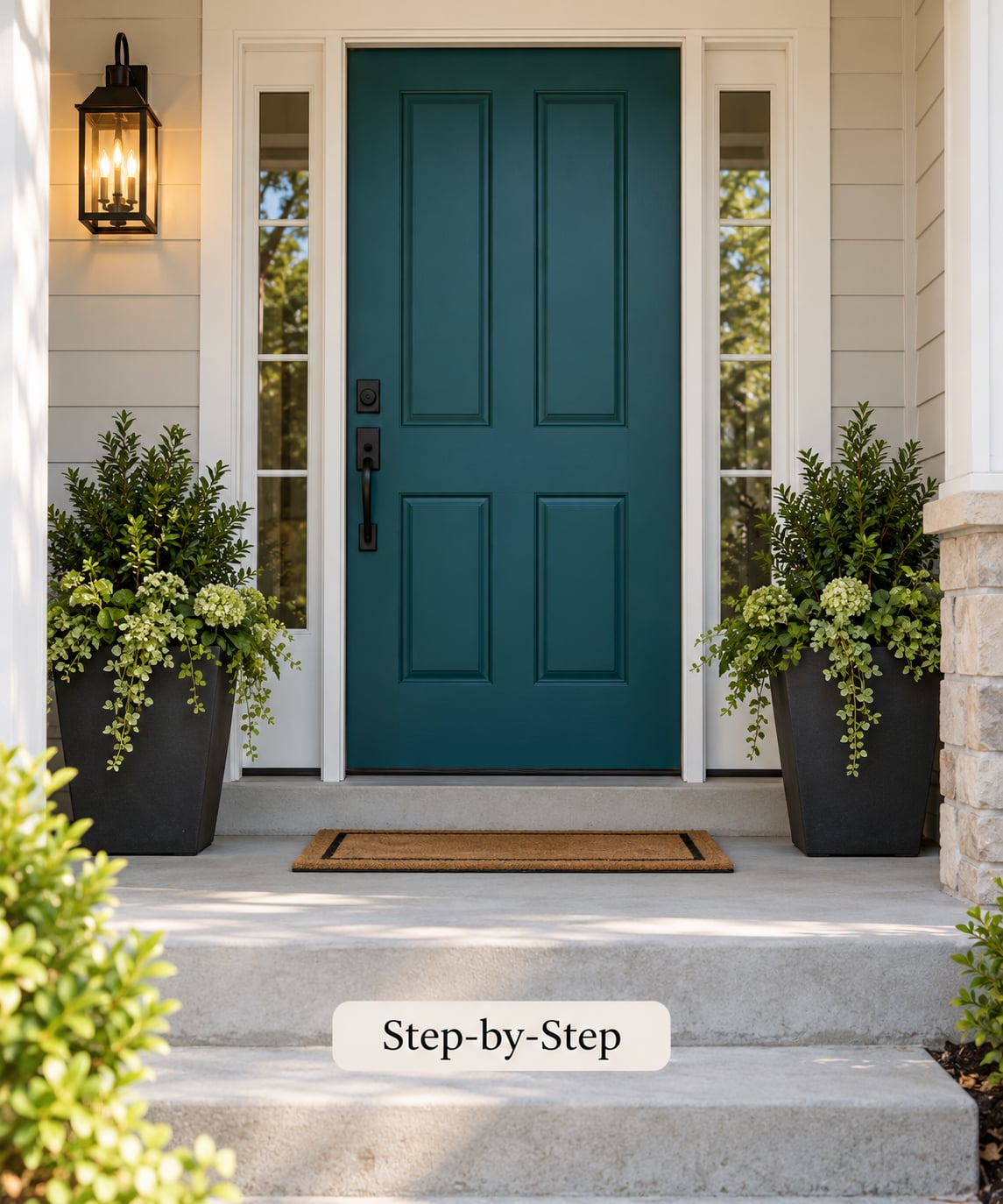
The order matters more than the effort. Work from the biggest visual problem outward to the details you only notice at arm’s length, and check your work from the curb after every stage so you can see whether the next step is worth doing.
Assess the Front Entrance From the Street
Stand across the street at dusk and again at midday. Whatever your eye hits first is your first job, and it is usually not the door itself — it’s the peeling paint beside it, the dead shrub brushing the walkway, or the fixture that has been dark since you moved in. That first glance is also where you learn how to improve front door curb appeal on a budget, because it tells you which problem is doing the damage.
Take a photo from that exact spot before you touch anything. Comparing the same frame later is the only honest way to judge whether a project earned its time, and it takes about 30 seconds.
Refresh the Door and Surrounding Trim
Wash the door down first, then decide between repainting and replacing. Repaint when the slab is solid wood or molded fiberglass and the surface is sound. Replace when it is hollow, warped, rotted at the bottom rail, thin to the touch, or letting cold air around the frame — repainting a door that leaks energy just makes it look better, not work better.
Scuff sand the old finish, clean the dust off with a damp cloth, then prime bare wood or bare metal before two coats of exterior paint. Exterior acrylic on a steel door needs a bonding primer or the finish will peel in a year, which is the single most common DIY failure in this project.
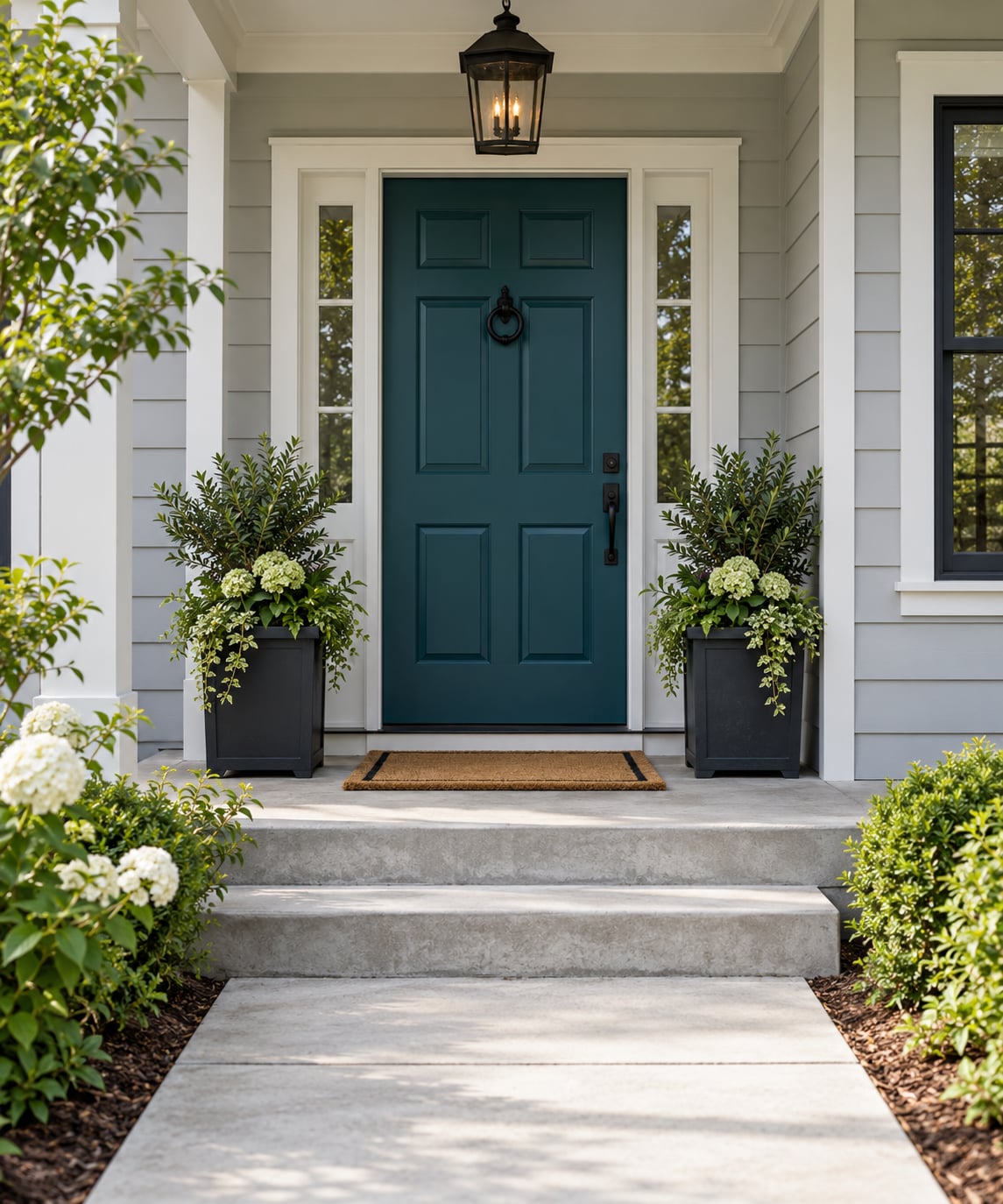
For the trim, most people get the relationship backwards. If your siding is a neutral beige, gray or white, go bold on the door — deep teal, navy, oxblood, or a rich green — and leave the trim white. If your exterior is already a strong color, keep the door in the same family but a shade or two away from the siding so it reads as intentional rather than accidental.
One color to skip is a mid-tone sage or olive on a beige house, which reads muddy from the curb. High-gloss and any sparkle or metallic finish on a door also date fast, because exterior gloss shows every fingerprint and the coating chalks in sun.
Upgrade Hardware and Decorative Details
Hardware is the cheapest way to make a plain door look designed. Pick one finish — brass, black, oil-rubbed bronze or brushed nickel — and use it on the handle, deadbolt, hinges and knocker together. Mixing a brass knocker with a black handle is the fastest way to make an entry look like two different projects.
Check that the new hardware actually fits before you buy. Measure the backset distance from the edge of the door to the center of the handle, and note whether the door is thicker than the standard 1.5 inches. Then test the fit, turn the lock several times, and confirm the door still latches flush in the frame.
Numbers and the mailbox do the same job at street level. Replace missing or crooked house numbers with something that reads at 30 feet, keep them at a consistent height, and check that the mailbox is plumb and has no rust streaks down the siding below it. A wreath hung slightly high rather than slightly low makes the door look considered.
Improve Lighting Around the Entry
Most entries are simply dirty or running on a bulb that emits 800 lumens and looks like a coal mine. Start by taking the shades down, washing them, and swapping in a warm LED in the 2700K to 3000K range. Cool white bulbs flatten a front entry and make the paint read gray.
After that, look at coverage. A wall lantern above the door plus two low-voltage step lights at the bottom of the stairs solves almost every dark entry. Add a motion sensor at the driveway or side path so the light actually comes on when you arrive carrying groceries.
New wiring, new circuits and fixtures rated for damp or wet locations belong to a licensed electrician. Also be careful with a pressure washer near fixtures, and never aim water upward into a light or a window. If your fixtures are old, dated or buzz, replacement is the conversation to have with the electrician while they are out there.
Clean and Simplify the Porch or Stoop
Sweep, then wash. If you use a pressure washer, stay about 12 inches from soft surfaces like vinyl siding and wood, keep the trigger unlatched until the wand is pointed where you want it, and never spray upward into window seals or panel joints — water pushed behind siding is how you create rot instead of removing it.
On concrete steps, a deck cleaner and a stiff brush will remove the gray film that makes an entry look tired from a distance. Repair any cracks and chipped edges while the surface is clean, because filler applied to a dirty, dusty step peels within a few months.
Then remove stuff. One chair, one runner and one planter per zone is plenty, because an over-decorated porch reads as cluttered from the street and loses more appeal than it gains. If you want proof the cleanup worked, look at the stoop from the curb: you should see the door’s full width, a clear path to the handle, and no visual clutter competing with the door itself.
Add Low-Maintenance Plants and Seasonal Color
Two matching planters is the baseline for symmetry, but they are not always physically possible. On a wide double-door entry with no side wall, place a pair of tall urns flanking the outermost edges, or put one large planter centered on the landing. On a narrow stoop, a single well-chosen planter reads better than two squeezed ones.
Choose plants for the light you actually get: full sun for most mums, ornamental grasses and herbs, part shade for begonias, caladiums, ferns and most hostas, and full shade for the few things that tolerate it, like evergreen ferns and hellebores. Check mature size against the space, and stay clear of anything thorny or spiny next to the walkway.
Keep shrubs pruned back off the door and the first-floor windows so daylight reaches the facade, and keep the path at least three feet wide. Rhododendrons and privet that have grown into the entrance are the most common thing I see undoing an otherwise good entry — trimming them back is a two-hour job with an outsized effect on how the house photographs.
Make the Final Detail Pass
Walk the full path once: from the driveway, up the walkway, across the threshold and back out. Test the door for smooth open and close, check the latch and deadbolt engage, and look for cords, tools, packaging and hose runs to remove.
Then photograph the entry from the curb in daylight and again after dark. If the after shots look better, you are finished; if something reads as off, that is usually the one element that does not match anything else on the house, and swapping it is usually a 30-minute job.
Common Mistakes
- Using too many colors at once. Fix: pick one door color, one trim color, one hardware finish. Everything else is neutral.
- Painting over unsound finish. Fix: sand, clean and prime bare spots first. Paint applied to peeling or chalking finish fails in one season.
- Skipping primer on metal. Fix: use a bonding primer on steel doors or buy paint rated for metal.
- Overcrowding the porch. Fix: leave the door’s full width visible and keep the walkway clear. Clutter is the fastest way to lose curb appeal.
- Mismatched hardware finishes. Fix: choose one finish and update handle, knocker and hinges together.
- Letting plants swallow the entry. Fix: prune back from the door and windows and keep a three-foot path.
- Wiring exterior lighting yourself. Fix: fixtures on new circuits, anything buzzy or dated, and any damp-location-rated install go to a licensed electrician.
Priority is simple: fix the thing the eye hits from the street before you buy the thing you like. Cleanliness, the door color and the hardware finish do most of the work when you improve front door curb appeal; furniture and seasonal decor are the last five percent and the fun part.
Frequently Asked Questions
What is the easiest way to improve front door curb appeal?
Wash the door and the siding around it, then give it a fresh coat of a stronger color with matching hardware. Cleaning and color change the first impression more than any purchase, and both are doable in a weekend. Power washing the steps and the walkway in front of the door makes an immediate difference at almost no cost.
Should I paint my front door a different color?
Usually yes. A bold door on a neutral house is the highest-impact, lowest-cost change most people can make. Keep the trim white, match the hardware finish to the door, and repaint the garage door the same color if you have one so the front reads wider. Skip mid-tone sage on beige, and skip high-gloss.
Can I improve front door curb appeal if I rent?
Yes, with the landlord’s written permission for anything fixed to the building, including the door color, hardware and planters anchored to the porch. Keep changes reversible: removable hooks, freestanding planters and removable wreath hangers are easy to undo. Ask about paint colors and any HOA exterior rules before you buy anything.
What plants look good beside a front door?
Match the plant to the light. Full sun suits mums, ornamental grasses, lavender and herbs; part shade suits begonias, caladiums, ferns and hostas. Use two identical planters for symmetry, keep them clear of the door and windows so light reaches the facade, and leave at least three feet of clear path to the walkway.
How can I make my front door more visible at night?
Start by cleaning the fixture shades and fitting warm LED bulbs around 2700K to 3000K. Then add coverage rather than brightness: a wall lantern above the door plus low-voltage step lights at the bottom of the stairs. A motion sensor on the side path helps too. New wiring or dated fixtures should go to a licensed electrician.
Do I need an electrician to add exterior lighting?
Yes for anything beyond swapping a bulb in an existing fixture. Running new cable, adding a circuit or installing a fixture rated for damp or wet locations needs a licensed electrician and often a permit. A plug-in solar path light or a low-voltage kit with an existing transformer is the no-wiring option, though it depends on sun exposure.
If you do only one thing this month, wash the door, the trim and the walkway, then repaint the door a color that contrasts with the siding and update the handle to match. Those three steps change how the house reads from the street more than everything else on this list combined, and none of them require more than a weekend or a contractor.