Double pane wins for almost every home. A single pane vs double pane window upgrade is one of the few remodeling jobs where the physics, the comfort difference and the resale signal all point the same direction: two sheets of glass separated by a sealed insulating gap cut heat transfer, kill drafts, quiet the room and cut the window share of your energy bill.
The catch is that it is not always worth the money. In a mild climate, in a rental, or in a house with a good frame and a bad pane, spending several times more per window buys you very little. Here is how the two actually compare, what a replacement costs in relative terms, and who should spend and who should pass.
Table of Contents
- Single Pane vs Double Pane Window Upgrade at a Glance
- What Is a Single Pane Window?
- What a single pane window looks like in person
- How to tell what windows you already have
- What Is a Double Pane Window?
- Argon and krypton fills, and why Low-E matters
- How Do Single Pane and Double Pane Windows Differ?
- Construction and heat transfer
- Sound transmission
- Condensation behavior
- Frame material, briefly
- Durability and maintenance
- Signs it is time to replace the windows
- Which Window Type Is More Energy Efficient?
- Partial replacement and the order of operations
- How Do They Compare for Comfort, Condensation, and Noise?
- How Much Does a Single Pane vs Double Pane Window Upgrade Cost?
- How to Vet a Window Contractor
- Which Should You Choose?
- Who wins the single pane vs double pane window upgrade in each case
- Frequently Asked Questions
- Is it worth replacing single-pane windows with double-pane windows?
- Do double-pane windows make a home warmer in winter?
- Are double-pane windows much better at reducing noise?
- Can I replace single-pane glass with double-pane glass in the existing frame?
- What is the cheapest way to improve a home with single-pane windows?
- Are double-pane replacement windows eligible for a tax credit?
- Conclusion
Single Pane vs Double Pane Window Upgrade at a Glance
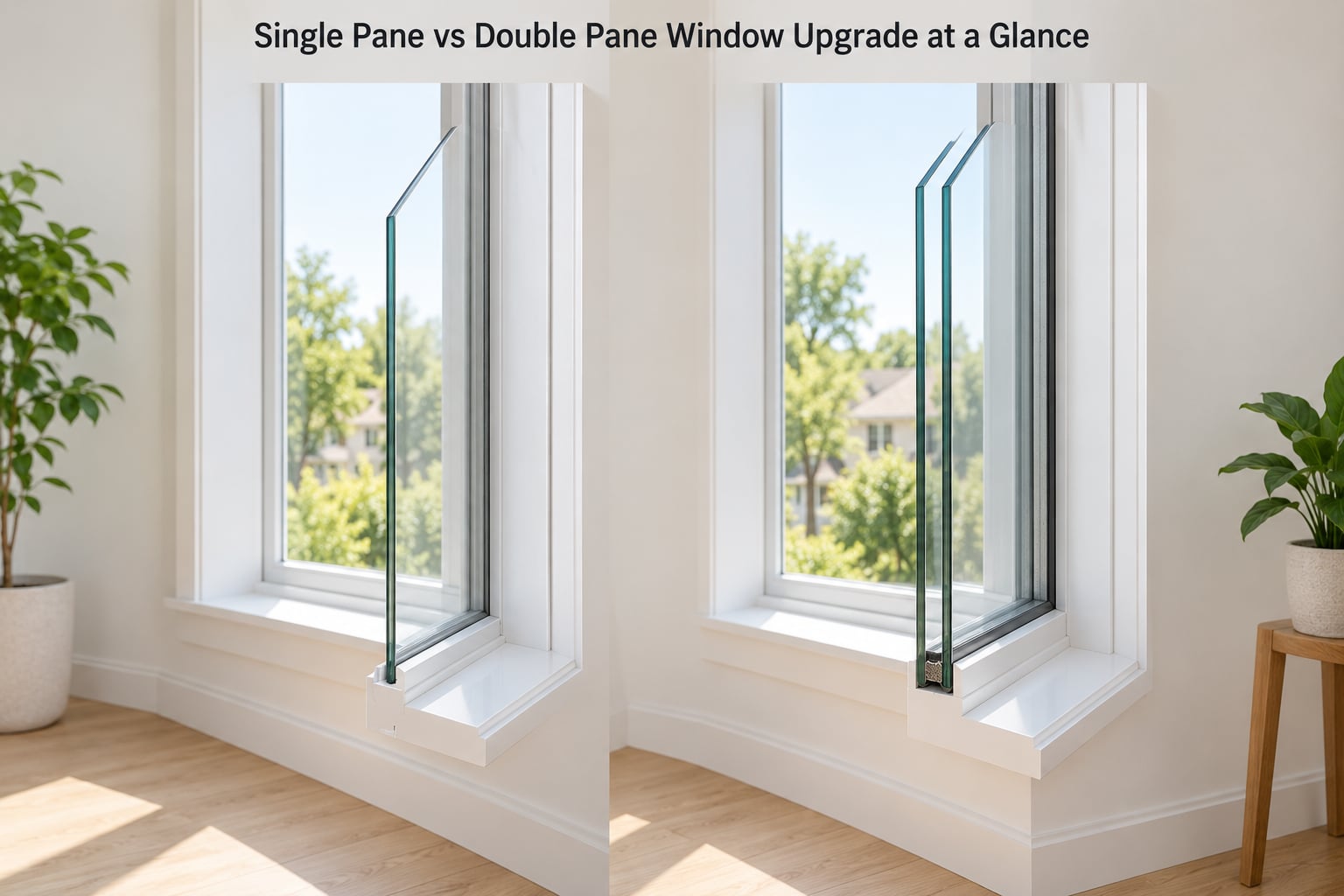
The short version: single pane is one sheet of glass in a frame, and double pane is two sheets separated by a sealed gap of argon or krypton. Everything else in the table flows from that one difference.
| Factor | Single pane | Double pane |
|---|---|---|
| Glass layers | One | Two, with a sealed insulating gap |
| Approximate glass R-value | About 0.85 | About 1.5 to 2.0 |
| Drafts at the glass | Common, especially with worn frames | Noticeably reduced |
| Condensation on the inside pane | Frequent in cold weather | Much less frequent |
| Typical STC range | High 20s to low 30s | Mid 30s and up with an asymmetric or laminated package |
| Relative installed cost | Baseline, roughly one-sixth to one-eighth of a double pane unit | Several times the single pane figure |
| Storm windows needed | Usually | No |
| Best fit | Mild climates, rentals, cheap additions, outbuildings | Older heated homes, cold climates, roads or airports nearby, resale prep |
| Maintenance | Simple, but putty and glass are fragile | Nothing routine, but sealed units can fog when they fail |
One note on the R-value numbers, because they come up constantly: they describe the glass alone, not the whole window. A single-pane window with a terrible frame performs worse than its glass suggests, and that is the whole argument for replacing the unit rather than just the glass.
What Is a Single Pane Window?
A single pane window is a frame holding one sheet of glass, typically a single pane of 1/8 inch or 1/4 inch annealed glass set in putty or a bead. It is the simplest window that keeps weather out, and for a century it was simply what builders used.
You will find them in homes built before roughly the 1980s, in original single-pane openings, in most garage and basement windows, and in almost every unconditioned space: porches, sheds, screen rooms, old sunrooms. Some homes from the 1990s still have them in closets and bathrooms because nobody noticed.
What a single pane window looks like in person
Three quick tells. First, you can feel a cool band around the glass in summer and a warm band in winter, because the glass is conducting straight from outdoors to your room. Second, in winter you will see condensation forming on the inside surface, sometimes in a wedge shape near the corners. Third, look at the edge: single pane has one glazing bead and one sheet of glass visible.
Homeowners on Reddit describe single pane as the thing you notice at 6 a.m. in January. That matches what I would expect from a glass R-value under 1: it is a cold surface, and your heating system is paying to warm the air next to it all season.
How to tell what windows you already have
Check the label first. Most insulated glass units carry a sticker on the spacer bar, the metal strip that holds the two panes apart, naming the manufacturer, the date and often the gas fill. If you see that sticker, you have at least double pane.
If there is no sticker, use the light test. At midday, press your face close to the glass and look at the reflection of the outside. In a double-pane unit the two reflections sit slightly apart, because you are seeing two surfaces a fraction of an inch apart. Then run a hand along the edge and look for the second glazing bead, or feel for the step where the spacer bar sits.
Another method is thermal. A hair dryer on the cold setting held at the glass will warm the outer surface, and on a single-pane window that warmth comes straight through to your hand. It is not scientific, but it settles the question in ten seconds.
What Is a Double Pane Window?
A double pane window, also written dual pane or insulated glass unit, holds two sheets of glass separated by a sealed gap, usually about a quarter inch wide. The gap holds an inert gas, almost always argon, and the whole assembly is bonded to a spacer bar around the edge to keep moisture out.
That sealed gas pocket is what does the work. Argon is denser than air and conducts heat less readily, so heat moving from a warm room to a cold yard has to cross two panes and slow through the gas in between. The same barrier works in reverse in July, when it keeps outdoor heat from arriving.
Argon and krypton fills, and why Low-E matters
Argon is the default fill and covers roughly three quarters of the insulating benefit at a small cost premium over plain air. Krypton is denser still and worth the extra money mainly in wide panes or in double-pane packages where the two panes are separated by a thin gap, because that is where a heavier gas helps most. Most homeowners never need to specify krypton; ask for argon unless a salesperson explains why your window sizes call for something else.
Low-E is a microscopically thin metallic coating applied to one surface of a pane. It reflects infrared heat rather than absorbing it, so it slows heat gain in summer and heat loss in winter. Low-E on both panes of a double-pane unit is the current standard and, together with a gas fill, is what earns a window an ENERGY STAR label. Low-E on a single pane helps, but it does not turn one sheet of glass into an insulating air barrier.
How Do Single Pane and Double Pane Windows Differ?
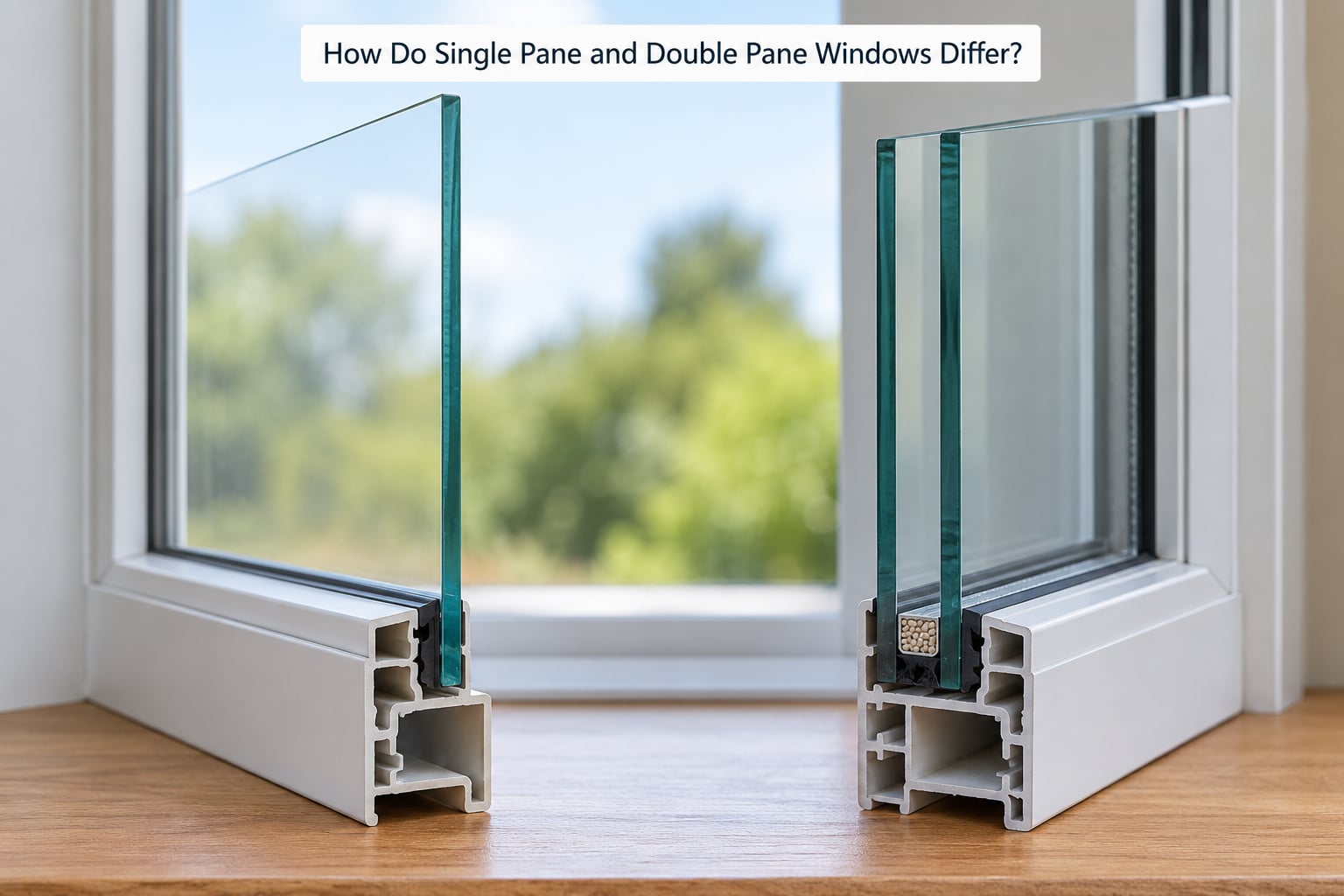
The differences are physical rather than cosmetic, so they show up the same way every season. Here is how each one behaves in a house.
Construction and heat transfer
A single sheet of glass with an R-value near 0.85 loses heat readily in both directions. Double pane with argon roughly doubles that figure, and adding Low-E coatings and a warm-edge spacer pushes it higher again. In practical terms, during a heating season the glass surface stops being the coldest thing in the room, so you stop getting that cold radiating draft feeling near the window even with the same thermostat setting.
Sound transmission
Sound ratings are expressed as STC, the Sound Transmission Class, where a higher number means more sound is blocked. Single-pane glass generally lands somewhere in the high 20s to low 30s. A standard double-pane unit lands in the mid 30s. An asymmetric package with one thicker pane, or one laminated pane, can reach the low 40s.
So double pane helps, but it is not a soundproofing product on its own. The weak link in most noisy homes is the frame and the wall around it, and a well-installed double-pane unit with a tight frame beats a sloppy install every time.
Condensation behavior
Condensation forms when warm humid room air touches a surface colder than its dew point. Single-pane glass goes below that threshold routinely on a winter night, which is why old windows stream water down the inside and breed mold in the corners of the sash.
Double pane keeps the inside surface warmer, so interior condensation drops sharply. The trade is that you can now get condensation between the two panes, which shows up as fogging or a hazy streak that does not wipe off. That means the seal failed and moisture got into the cavity. It is a different problem from the one you started with, and it is repairable by swapping the insulated glass unit without replacing the frame.
Frame material, briefly
The pane is only half the window, and the frame is the other half. Vinyl frames are the least expensive and need no painting, though they expand and contract more than the alternatives and a cheap vinyl frame in a cold climate can feel cold to the touch near the sash. Fiberglass frames hold their shape across temperature swings better and take paint well, which makes them a good fit for a painted interior look. Wood frames insulate well and look traditional, but they need painting and they swell in humidity. Aluminum conducts heat readily unless it has a thermal break, and if you can feel the frame itself cooling the room, you have found part of the problem no matter what glass is inside it.
The spacer bar deserves a mention too. It is the strip that holds the two panes apart and seals the gas in, and warm-edge spacers made of a less conductive material reduce the cold bridge around the perimeter. It is a small detail that shows up in the fine print of a good window spec sheet, and it is worth asking about on cold north walls.
Durability and maintenance
Single pane glass held in putty is easy to repair and easy to break. Patching a chip means working with putty and glazier points, and the replacement glass is a trip to a hardware store. Double pane needs no maintenance while the seal holds, and once it fails the practical fix is a unit swap rather than putty work.
The other maintenance benefit is seasonal. Homes with single pane often carry exterior storm windows that go up in fall and come down in spring: more cleaning, more screens, more storage, more chances to break something. A double-pane window removes that entire job.
Signs it is time to replace the windows
Five signs your single-pane windows have run their course: interior condensation that returns every winter no matter how you run the sash, visible daylight around the sash edges in daylight, a sash that will not stay open or closed, wood that is soft or flaking when you press it, and glass with a permanent haze or a crack running through it. Two of those together are enough to justify replacing the opening. One, on a good frame, might only need weatherstripping.
Age alone is a weak signal. A twenty-year-old window in a well-built frame can outlast a fifty-year-old window in a wet one, which is why the physical checks matter more than the date on the paperwork. What does matter is how the frame was built and whether water ever got behind the sill.
Which Window Type Is More Energy Efficient?
Double pane, without much argument. Windows are roughly a quarter to a third of a home’s heating and cooling energy use, because glass conducts heat far better than insulated wall assembly. Cutting the heat loss through that glass is one of the few upgrades that moves the whole bill.
Figures that circulate in this space put the reduction in window-related energy loss at around 24 percent in cold climates and around 18 percent in warm climates when single pane is replaced with double pane. Treat those as reasonable industry estimates rather than a promise, because the result depends far more on your climate, your ductwork, your furnace and how many square feet of glass you have than on the window itself.
The savings are largest in exactly the situations where comfort complaints are worst: a cold front wall with a lot of glass, a bedroom on a busy road, a bathroom with no exhaust fan. A window on the sunny side of a house in a mild climate saves less, though it still blocks more heat than single pane and usually a lot more UV.
Climate zone pushes the recommendation in a predictable direction. In cold zones, the priority is heat loss, so standard double pane with argon and a warm-edge spacer is the right baseline and Low-E is close to mandatory. In hot and humid zones, the priority shifts to heat gain, so Low-E coatings that reflect solar energy matter more than the gas fill, and a light-colored frame helps more than a darker one. In mixed zones you want a coating tuned for both, which is what most factory default packages already are. Coastal homes add a third concern: salt air eats unprotected steel and aluminium hardware, so the frame and finish matter as much as the glass.
Two factors cut across the zones. First, how much glass you have. A wall of floor-to-ceiling windows in a great room behaves like a slightly worse wall, and no glazing package makes an all-glass design cheap to heat. Second, how good the rest of the envelope is. Double pane in an uninsulated wall is a partial fix, not a solution.
Partial replacement and the order of operations
Replacing three of twelve windows helps less than most sellers imply. Your heating system heats the whole air mass of the house, so a handful of better windows raises average indoor temperature only slightly, while the rooms with the old windows feel unchanged.
If budget forces a phased approach, prioritize the worst rooms first, and keep the same glazing specification across every phase so you are not comparing different windows later. Also think about sequence: new windows installed into an uninsulated wall leave performance on the table, and air sealing around the opening matters more than the pane count at the perimeter. If your walls and attic are bare, doing that work first usually returns more per dollar than new glass.
How Do They Compare for Comfort, Condensation, and Noise?
On drafts, double pane wins clearly but not dramatically. Homeowners frequently describe it as a real, noticeable change rather than a transformation, and that framing is honest. The air leakage around a window is a function of the frame and the installation, so on a leaky frame you can swap the glass and still feel air moving at the sash edges. Weatherstripping and caulking cost a fraction of a window replacement and address that specific complaint.
On winter condensation, the improvement is dramatic. Interior condensation on single pane is the single most common complaint homeowners describe about old windows, and double pane largely ends it. Persistent interior condensation on a double-pane unit usually means a cold frame bridging the insulation, which points back to the frame and the installation.
On noise, expect a modest improvement. One extra pane plus an insulating gas fill takes the edge off traffic and voices. Getting from ordinary noise to real quiet takes different measures: laminated or asymmetric glass for the window itself, and door sweeps, wall insulation and sealing elsewhere for the path the sound actually takes into the room.
Installation quality sits on top of all three. A double-pane window flashed and sealed properly in a prepared opening beats an identical unit crammed into an uninsulated gap every time. When you compare quotes, ask what the flashing, sill plate, insulation and air sealing are included in, because that work is where two bids for the same windows can differ by thousands of dollars.
How Much Does a Single Pane vs Double Pane Window Upgrade Cost?
Replacing single-pane glass with a new single-pane unit is cheap and simple. Replacing it with a whole double-pane window is a different project entirely: new frame, new sash, new hardware, new exterior trim or brickmold, plus disposal of the old unit. Per opening, an installed single-pane replacement typically runs somewhere in the neighborhood of one-sixth to one-eighth of an installed double-pane window.
These are typical US ranges that vary by region and change over time, so treat the relationships here as more useful than any single figure. What moves the total:
- Size and shape. A standard double-hung opening is the cheapest case. Casements, arched tops, skylights and large picture units add labor and custom work.
- Frame material. Vinyl is the least expensive and needs the least upkeep. Fiberglass holds shape better in extreme temperatures and takes paint. Wood is the most expensive and requires more care. Aluminum without a thermal break conducts readily and is a poor fit for cold climates.
- Glazing package. Standard double pane with argon and Low-E is the baseline. Thicker panes, laminated or asymmetric glass, and krypton fill add cost.
- The opening itself. Oversized units need structural support and often a beam or header, which is a carpentry job priced separately.
- Interior work. Drywall repair, interior trim, painting and possible electrical or plumbing relocation at a bathroom window.
- How many openings. Whole-house replacement is cheaper per window than a single unit because of mobilization and setup costs, which is the strongest argument for doing them all at once.
Cheaper alternatives are worth ranking honestly, best value first. Weatherstripping and caulking address drafts on a good frame for a tiny fraction of the cost. Window film cuts heat gain and UV and can modestly help sound, but it is a surface treatment: it does not add an insulating gap, it degrades in a few years, and it does nothing for condensation or noise through the glass. Storm windows add a temporary insulating air gap and help a lot in cold climates, but you still maintain two sets of windows.
The useful middle option most people miss is replacing just the insulated glass unit inside an existing serviceable frame. It cuts drafts and condensation and cuts noise slightly, at a fraction of full replacement cost. It does not fix a rotted frame, an undersized opening or a bad sill, so inspect the wood before you commit.
On incentives: the federal residential energy credit for qualifying exterior windows expired after 2025, and rules change often, so check the current status for 2026 with the IRS or a tax professional. State, utility and local rebate programs often still exist for energy-efficiency upgrades, and some are income-qualified. Also ask your utility about weatherization and comfort programs, which frequently cover air sealing rather than glass.
How to Vet a Window Contractor
Two quotes for identical windows routinely differ by thousands of dollars, and the gap is almost never the windows themselves. Ask these questions before you sign anything.
- Is the quote itemized? You want a line per opening with the size, the frame material, the glazing package and the finish written out, plus separate lines for demolition, disposal, exterior trim, interior patching, sill plate and flashing.
- Who does the install? Some companies sell and subcontract the labor. Ask for the crew’s insurance and whether they are employees or subs.
- What is the air sealing detail? The answer should mention insulation in the cavity, a backer rod or sill plate at the sill, and sealing the interior and exterior joints. If the quote says “caulk” and nothing else, expect drafts.
- What does the warranty cover? Look for a written warranty on both the unit and the installation, and ask what happens to the labor if the unit fogs in year four.
- Are permits and inspection included? Most window swaps do not need a permit, but a structural change to an opening does.
- Can you see recent work nearby? Drive past a job they finished last year and look at the trim joints, and ask the homeowner what the crew was like.
Red flags: a quote that only holds for a few days, a refusal to name the frame material or glass package, a deposit that is most of the price, pressure to sign on the spot, and anyone who tells you single pane is fine for a heated room in a cold climate. Also be cautious of claims that a window qualifies for a federal tax credit, since that credit ended after 2025.
You can install a window yourself if you are comfortable with carpentry, flashing tape and the sill detail, and if a mistake will not let water into the wall. You should not do structural changes to an opening, anything involving rewiring or a bathroom relocation, or lead paint in a home built before 1978. In that last case, testing and abatement need to come first; disturbing lead paint without it is a genuine health hazard.
Which Should You Choose?
Who wins the single pane vs double pane window upgrade in each case
Renters: stay with single pane, or better yet, do the cheap things. Caulk and weatherstrip. Nobody gets a return on a window investment they do not own.
Mild climates with little glass on the cold side: single pane replacement is defensible. The energy case is weak, so spend only if you are already replacing a broken or rotting window.
Older homes with real drafts and high bills: double pane, no debate. This is the group where the comfort and energy math both work.
Homes on busy roads, near airports or rail lines: double pane with asymmetric or laminated glass, and spend the money on the bedroom walls. Standard double pane alone will not make a loud room quiet.
Historic homes: keep the original frames and go interior storm windows, or replace the insulated glass unit in place. Swapping full frames on a protected facade can be a preservation problem as well as a budget one.
Anyone prioritizing long-term energy savings: double pane with argon and Low-E is the standard current package and the only one that meaningfully cuts heat transfer. If you are already going to spend on frames, this is the glass to order.
Tight budget, good frames: replace the glass units instead of the windows. It captures most of the condensation and draft benefit at a fraction of the cost.
Frequently Asked Questions
Is it worth replacing single-pane windows with double-pane windows?
Usually yes, in an older heated home with noticeable drafts, interior condensation or high bills. Double pane roughly doubles the glass R-value, which cuts heat loss and removes most winter condensation. The case is weakest in mild climates with little glass on the cold side, in rentals, and in houses with newer frames where only one pane is bad.
Do double-pane windows make a home warmer in winter?
They raise average indoor temperature by a degree or two at most, not ten. The real gain is that the glass surface stops radiating cold into the room and the drafts around it shrink, so the same thermostat setting feels warmer. If you have ductwork or furnace problems, fix those first; windows will not compensate for an HVAC system that is losing air.
Are double-pane windows much better at reducing noise?
Better, but not dramatically. A typical single-pane window rates in the high 20s to low 30s on the STC scale, standard double pane in the mid 30s, and an asymmetric or laminated package in the low 40s. Most remaining noise leaks around the frame and through the wall, so sealing and insulation often do more than a better glass package.
Can I replace single-pane glass with double-pane glass in the existing frame?
Often yes, if the frame is serviceable and the opening is deep enough for the thicker unit. Glazing contractors cut a new insulated glass unit to fit and set it into the existing sash. You save most of the cost of a full window and keep the frame, trim and look, but a rotted frame, an undersized opening or a shallow sash will not take it.
What is the cheapest way to improve a home with single-pane windows?
Start with the free work: caulk the exterior joints, weatherstrip the sash and check that the trim is intact. Add low-e window film for heat gain and UV. Then consider interior or exterior storm windows, which add a real insulating air gap and can be installed one room at a time. Replacing the glass units rather than the whole windows sits at the expensive end of that list.
Are double-pane replacement windows eligible for a tax credit?
The federal residential energy credit for qualifying exterior windows expired after 2025, so treat any claim of a federal window credit with suspicion. State, utility and local programs vary widely, and some are income-qualified or offered only through utility weatherization programs. Check the current rules with the IRS and your local utility before you count any incentive in a budget.
Conclusion
A single pane vs double pane window upgrade comes down to one question: is your glass the weak link? If your frames are sound but the glass is old, cold, drafty and fogging, double pane pays you back in comfort immediately and in energy bills over time. If the frames are rotted, the opening is undersized or the house is a rental in a mild climate, you will spend a lot for very little.
Before you get quotes, walk the house and note four things per window: where you feel drafts, where condensation forms, whether the frame wood is soft or painted shut, and whether the glass is fogged between panes. Those four observations tell you whether you need a window, a glass unit, or a caulking gun.
Then price the whole job rather than one window, ask two or three contractors what is included in flashing and air sealing, and check current state and utility incentives before you sign. If a single pane vs double pane window upgrade is right for your house, you will know within a week of walking through it.