Inside mount blinds fit inside the window frame for a clean, built-in look, while outside mount blinds attach to the wall or trim above and around the opening, overlapping it to block more light and work on shallow windows. Get the inside mount vs outside mount blinds decision wrong and you are reordering, not just redecorating.
I have measured enough windows in older houses to know the choice is made for you more often than you would think. The frame depth, the sash, the trim and sometimes the crank decide it before taste ever gets a vote. Style only comes into play once the window can physically take what you want.
Here is the short version. Inside mount blinds suit windows with enough recess depth and a square opening. Outside mount blinds win on shallow frames, awkward hardware, out-of-square walls, and anywhere light control matters more than a clean silhouette.
Table of Contents
- Inside Mount vs Outside Mount Blinds at a Glance
- How Mounting Location Changes the Look
- Which Windows Work Best With Each Mount?
- Inside Mount vs Outside Mount Blinds: Light and Privacy
- Installation and Replacement Considerations
- Cleaning and Maintenance Compared
- Which Should You Choose?
- Frequently Asked Questions
- How much clearance do I need for inside mount blinds?
- Do outside mount blinds block more light than inside mount blinds?
- Should blinds rest on the window sill?
- Can I mount blinds outside the frame if I am renting?
- What blinds work best for very shallow windows?
- What to Do First
Inside Mount vs Outside Mount Blinds at a Glance
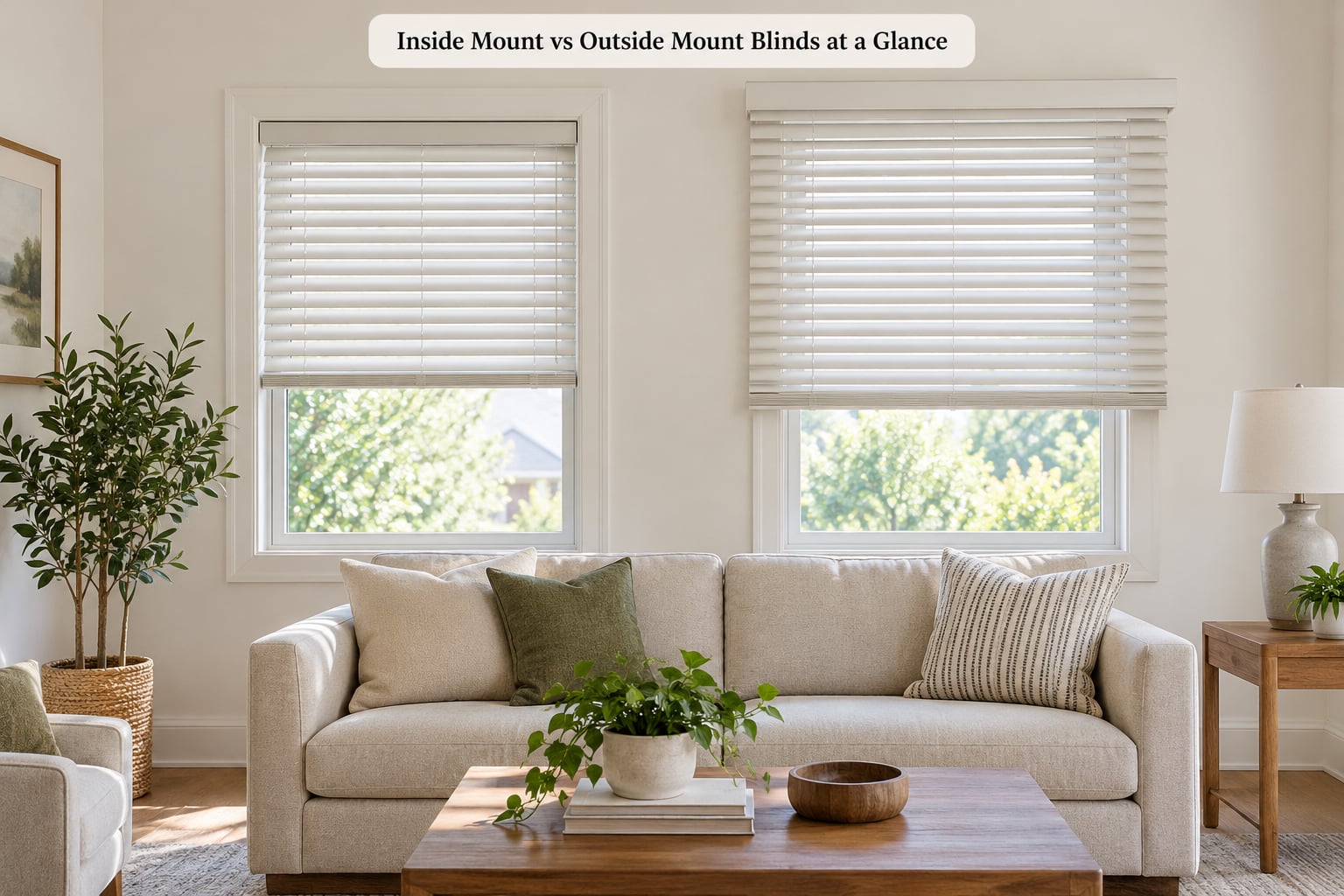
The table below covers the differences that decide it in a showroom, a measure and a tape: where the headrail sits, how the window reads in the wall, how much light gets past the edges, what the frame has to offer, and who can actually install it.
| Factor | Inside mount blinds | Outside mount blinds |
|---|---|---|
| Mounting location | Headrail fixed to the top and sides of the window recess | Headrail fixed to the header trim or the wall above the window |
| Look | Built-in, minimalist, hardware mostly hidden | Traditional, headrail visible, can be dressed with a pelmet |
| Space used | Uses the recess depth already there | Projects into the room, usually 1 to 2 inches past the frame |
| Light | Side light gaps at the edges of the recess | Overlaps the opening, fewer edge gaps |
| Requirements | Enough recess depth for the headrail and hardware clearance | A solid header to screw into, room to hang the blind |
| Best for | Deep reveals, square openings, clean modern rooms | Shallow frames, casement hardware, blackout needs |
| Installation | Precise; measurement errors are hard to hide | More forgiving; brackets can be repositioned |
| Cleaning | Top of the blind sits in a corner you cannot reach easily | Headrail and fabric fully accessible from the room |
| Renters | Usually fine if mounting to the frame only | Often not permitted, brackets go into trim or wall |
How Mounting Location Changes the Look
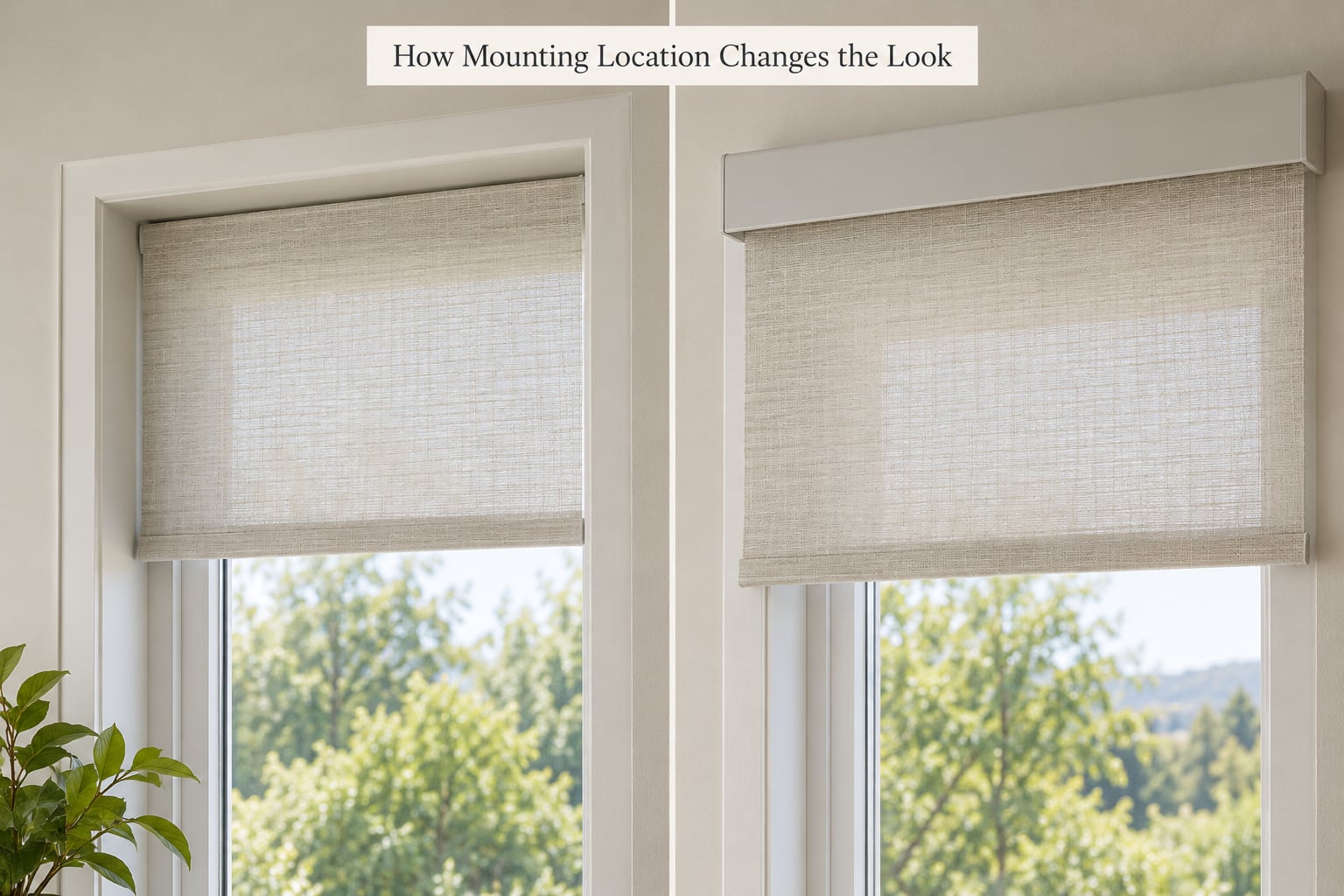
An inside mount blind disappears into the window. The headrail screws into the top and side walls of the recess, so from across the room you mostly see the fabric or slats sitting in the opening, framed by your own trim. That is the built-in look people ask for when a new-build room feels slightly cheap.
An outside mount blind is a separate object mounted on the wall. The headrail sits above the window, often on the flat top edge of the header trim or on the drywall above it, and the blind hangs down over the top of the frame. You are looking at a fixture that was added to the room, not one that grew out of it.
That difference shows up in three practical places:
- Window proportions. An inside mount keeps the blind inside the opening, so the window keeps its original size. An outside mount that is wider than the frame makes a small window read as larger, which is handy in a hallway or a half bath.
- Trim and frame imperfections. Inside mount leaves trim, mitre joints and uneven plaster fully visible. Outside mount covers the top of the frame and often part of the side trim, which hides a lot of what a 1950s sash has going on.
- Visible hardware. Inside mount brackets disappear in the corners. Outside mount leaves the headrail in plain view unless you add a pelmet or a decorative valance above it.
The trade-off is not clean look versus ugly option. A well-proportioned outside mount with a cornice reads as deliberate and traditional. It only looks bulky when the headrail is oversized, hung too low, or wider than it needs to be.
Which Windows Work Best With Each Mount?
Depth is the deciding factor. Measure from the glass to the interior face of the frame at the top of the window, not at the sill, and compare it to the minimum depth the blind manufacturer lists. Most headrails need somewhere between 1 and 2 inches; a standard 2-inch mini or faux wood blind typically wants the full 2 inches to sit flush.
Below about 1.5 inches of recess, the headrail either will not fit or bulges out past the trim, and the blind stops reading as inside mount. At that point outside mount is not a preference, it is the only answer.
| Window condition | Better mount | Why |
|---|---|---|
| Standard double-hung, deep reveal | Inside mount | Depth is there and the opening is square |
| Shallow frame under 1.5 inches | Outside mount | Headrail cannot nest in the recess |
| Casement or crank-and-lock window | Outside mount | Hardware sweeps into the blind’s path |
| Out-of-square or uneven wall | Outside mount | Wide headrail hides the mismatch |
| Skylight | Neither, usually | Use a skylight-specific shade or solar blind |
| Clerestory or high window | Outside mount | Easier to reach and service from a ladder |
| Bay or picture window | Either | Inside mount if depth allows, outside for consistency across the wall |
| French doors or sliding glass doors | Outside mount | Wide opening, handles, and a large surface to cover |
| Thin or flat trim | Outside mount on the wall | No flat surface on the trim to screw into |
Protruding hardware is the failure people regret most. On casement windows the crank and handle swing inward into the recess, and on some older double-hungs the sash lock sticks out far enough that a headrail simply cannot sit behind it. Measure the hardware with the window open before you order, not after.
For a row of identical windows, a single wide outside mount often looks better than three separate inside mounts, especially when the openings are not perfectly level. Homeowner forums argue about this constantly, and outside mount usually wins on consistency.
Inside Mount vs Outside Mount Blinds: Light and Privacy
Fabric opacity and mount type are two different levers, and people constantly confuse them. A blackout fabric in an inside mount still leaks light around its edges. Conversely, a light-filtering fabric mounted outside will never darken a bedroom, no matter how well it overlaps the frame.
Here is where the mount changes the outcome:
- Side light gaps. An inside mount blind is measured to the opening, leaving roughly a quarter inch on each side for the blind to tilt and stack without binding. That gap is the most common complaint from inside-mount owners, and it is what wakes people up on a sunny morning.
- Top and bottom. An outside mount overlaps the top of the frame, so the headrail hides the stack. Inside mount shows the headrail unless a valance or pelmet covers it.
- Nighttime silhouettes. When a streetlight or a porch light is behind a window, inside mount blinds outline the shape of the person in the room. A wider outside mount covers more of the glass and improves privacy, though it is not total.
- Glare and heat. Fabric does most of this work. A cell or solar shade blocks more heat through the glass regardless of mount, and pairing either mount with curtains gives you a second layer for summer afternoons.
If the room needs to be genuinely dark, the mount is only half the answer. Side channels, a wrapped-around shade cassette or a light-blocking valance across the top close the remaining gaps. Outside mount helps by overlapping the frame, but it does not seal the sides of a recess the way a side channel does.
One more thing nobody mentions: a blind mounted outside the recess can be hung higher than the top of the glass, dropping the stack up and out of sight, which cleans up the view when the blind is raised. An inside mount has nowhere to hide.
Installation and Replacement Considerations
Tools are the same for both mounts: a tape measure, a level, a pencil, a drill with a bit matched to your brackets, and a pair of gloves. The difference is where the screws go and how forgiving a mistake is.
Inside mount brackets attach to the top and sides of the recess, usually into the frame or the masonry behind it. Outside mount brackets attach to the header trim or the wall above the window, and they need solid material. A bracket screwed into hollow drywall will not hold a blind that gets tugged every time someone closes the slats.
Timing differs more than most people expect. A single inside mount blind takes about 20 to 30 minutes once the brackets are placed. Outside mount takes closer to 30 to 45 minutes because the headrail is larger, the ladder is out for the full job, and the blind often has to be centred on the opening rather than fitted to it.
For renters, this is where the decision is often made for you. Mounting inside the window recess usually means no holes in the wall, and many landlords allow it if you use the supplied brackets and remove them on move-out. Outside mount brackets go into the trim or drywall, which is a repair and a conversation with the landlord.
Measurement is where the two diverge most. Inside mount means measuring the exact width of the opening at the top, middle and bottom, then using the smallest number, and measuring the depth from glass to interior face. Outside mount is more forgiving: the blind should be wider than the frame so it overlaps, and it hangs from a header that is easier to level.
Before you order, check one more item on the fit list. Blinds that reach the sill should stop about half an inch above it so the blind can tilt without scraping. Blinds with a deep stack need vertical clearance inside the recess, and stack clearance is measured from the headrail down, not from the glass.
If you are on a ladder for an outside mount, treat it as a two-person job whenever the brackets are above the first step. Do not stand on the top two rungs to hold a headrail in place while you drill.
Cleaning and Maintenance Compared
Outside mount blinds are easier to clean. Everything sits in the room: you can dust the headrail with a cloth, wipe the slats from top to bottom, and get to the cord or chain without moving furniture. The blind is also easier to vacuum around and to reach if a slat bends.
Inside mount blinds collect dust in a corner you cannot see. The top of the blind sits up inside the recess, and the headrail is wedged where a cloth will not reach. Vacuuming with a long attachment helps, but plan on dusting twice as often and expect to move the blind out of the recess to wipe the headrail properly.
Two things to protect during routine cleaning. Dust blinds with a dry microfibre cloth or a feather duster, not a wet cloth, because moisture on a foam or fabric surface takes a long time to dry inside a recess. And check the screws on an outside mount every year or two, since the headrail takes the swinging force every time the blind goes up and down.
Repairs and replacements follow the same pattern. A broken slat ladder on an inside mount often means pulling the whole blind out of the recess, and on a deep reveal that is a two-person job. Outside mount blinds lift off the brackets in seconds, which makes swapping in a new size or a different fabric far less of a project.
Which Should You Choose?
Choose inside mount blinds when the window has real depth, the opening is square, and you want the window to read as part of the architecture. It is the better look in a room with good trim, tall ceilings or a modern finish, and it keeps the frame and glass the only things you see.
Choose outside mount blinds when the frame is shallow, the hardware is in the way, the wall is out of square, or light control is the priority. It is also the practical pick for French and sliding doors, for high windows where an inside mount is awkward to reach and service, and for anyone prioritising easy replacement over a built-in look.
A few specific calls:
- Bedrooms and nurseries. Outside mount, sized so the blind overlaps the frame by at least an inch on each side, plus side channels if you need real darkness.
- Bathrooms and half baths. Outside mount on high or small windows. It overlaps the opening and improves privacy without a cord anyone can reach.
- Living rooms and dining rooms. Inside mount when the depth allows. The built-in look keeps the sightline to the garden clean.
- Home offices and media rooms. Outside mount with a blackout or room-darkening fabric, and consider a pelmet over the headrail.
- Kitchens. Roller and Roman shades usually sit inside the recess so the sill stays usable. Outside mount works when the frame is shallow.
- Historic homes. Outside mount in a period-correct fabric, or inside mount if the original trim is the feature you want to show off.
Do not mix mounts on the same wall unless you have to. A run of windows with one blind hung outside the frame and the rest inside is the most visible mistake you can make in a room.
Frequently Asked Questions
How much clearance do I need for inside mount blinds?
Measure from the glass to the interior face of the frame at the top of the window and compare it with the minimum depth listed for the blind. Standard 2-inch mini and faux wood blinds need about 2 inches to sit flush. Under 1.5 inches, use an outside mount, or choose a shallow-mount shade made for tight reveals.
Do outside mount blinds block more light than inside mount blinds?
Usually yes at the top and sides, because the blind overlaps the window frame. It still depends on the fabric: a light-filtering fabric will not darken a room no matter where it hangs. For real darkness, pair an outside mount blackout blind with side channels or a valance that closes the remaining gaps.
Should blinds rest on the window sill?
No. Inside mount blinds should stop about half an inch above the sill so the slats can tilt without scraping the wood. That gap also keeps the blind from picking up dust and paint. Outside mount blinds hang in front of the window and do not reach the sill at all, which is one less thing to fight when cleaning.
Can I mount blinds outside the frame if I am renting?
Check with your landlord first, because outside mount brackets go into the trim or the drywall above the window and patching those holes is usually your problem. Inside mount blinds that use the supplied brackets inside the recess are far more likely to be allowed. Some landlords treat either as a fixture change, so get the answer in writing.
What blinds work best for very shallow windows?
Outside mount mini or faux wood blinds are the usual answer, hung on the trim or the wall above the window. If you want a recessed look on a shallow frame, look for shallow-mount roller shades built for tight reveals, since standard roller cassettes are far too deep. Measure the depth again before you order, because it is the only number that decides this.
What to Do First
Start with a tape measure, not a style catalogue. Check the recess depth on every window you plan to treat, and check for cranks, locks and sashes that swing into the opening.
Anything under 1.5 inches of depth, or any window with hardware in the way, is an outside mount job. Everything else is your call to make, and inside mount is the cleaner look when your window can take it.