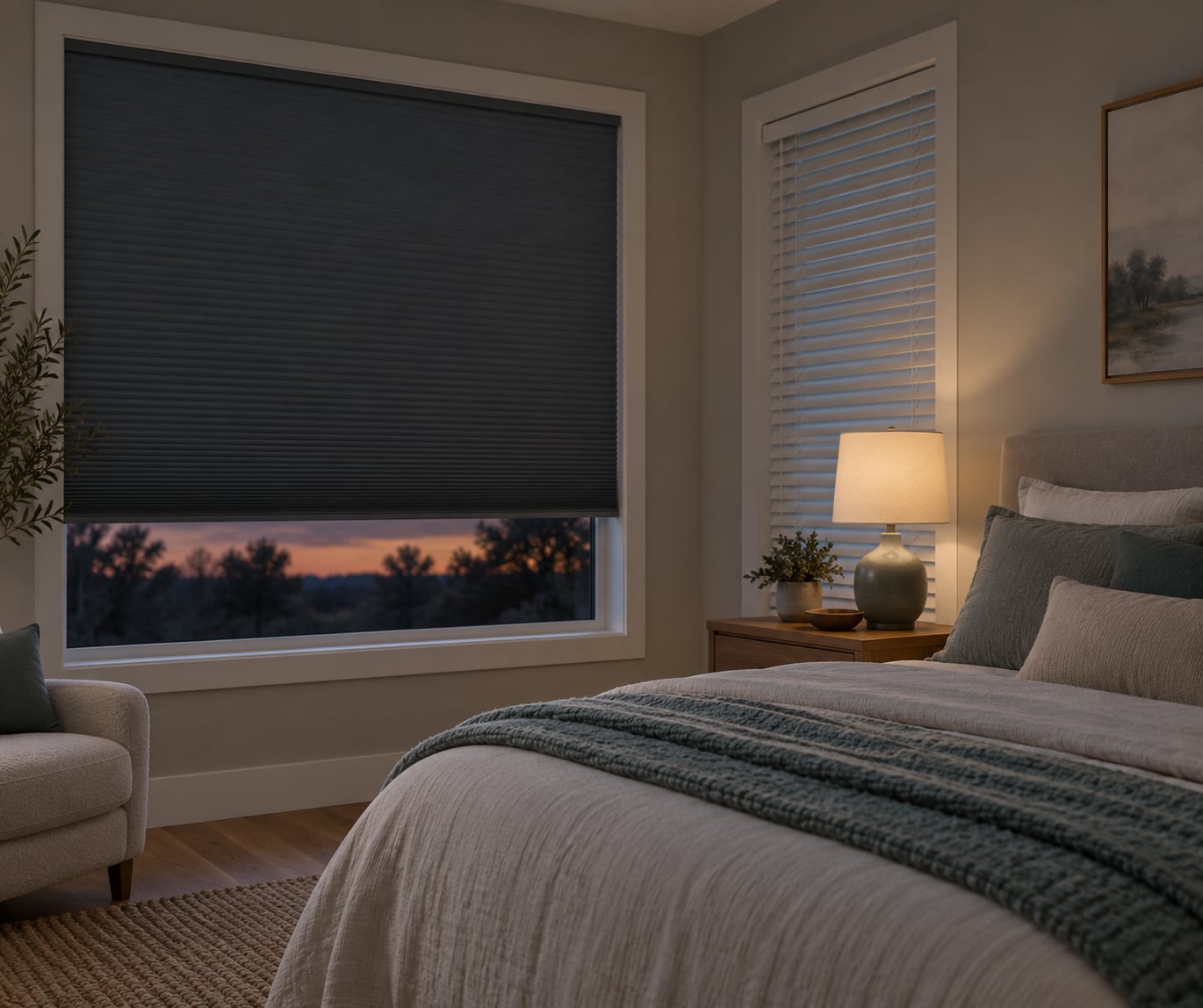
If your bedroom wakes you up at 6am, blackout shades are the better choice. They cover the whole glass area with one opaque surface and block roughly 95-100 percent of light, while blinds are slatted, harder to seal at the edges, and typically cut somewhere between 60 and 85 percent. The tradeoff is that blinds give you adjustable light during the day and tend to be easier on the wallet.
That is the whole comparison in a sentence, but the details are where the wrong orders happen. Below is the head-to-head breakdown, the specific points where blinds leak light, and a decision framework keyed to your window direction and how you actually sleep.
Table of Contents
- Blackout Shades vs Blinds for Bedrooms at a Glance
- Light Blocking and Sleep Quality
- Blackout Shades vs Blinds for Bedrooms: Light Control Compared
- Privacy and Appearance
- Insulation, Noise, and Comfort
- Maintenance, Durability, and Lifespan
- Installation and Window Compatibility
- Which Should You Choose?
- Frequently Asked Questions
- Should you get blackout blinds for a bedroom?
- Is it better to have blinds or shades in a bedroom?
- Can people see through room darkening curtains at night?
- Is it healthy to sleep with blackout curtains?
- How do I stop light leaking around blackout blinds?
- What are the main downsides of blackout blinds?
- Conclusion
Blackout Shades vs Blinds for Bedrooms at a Glance
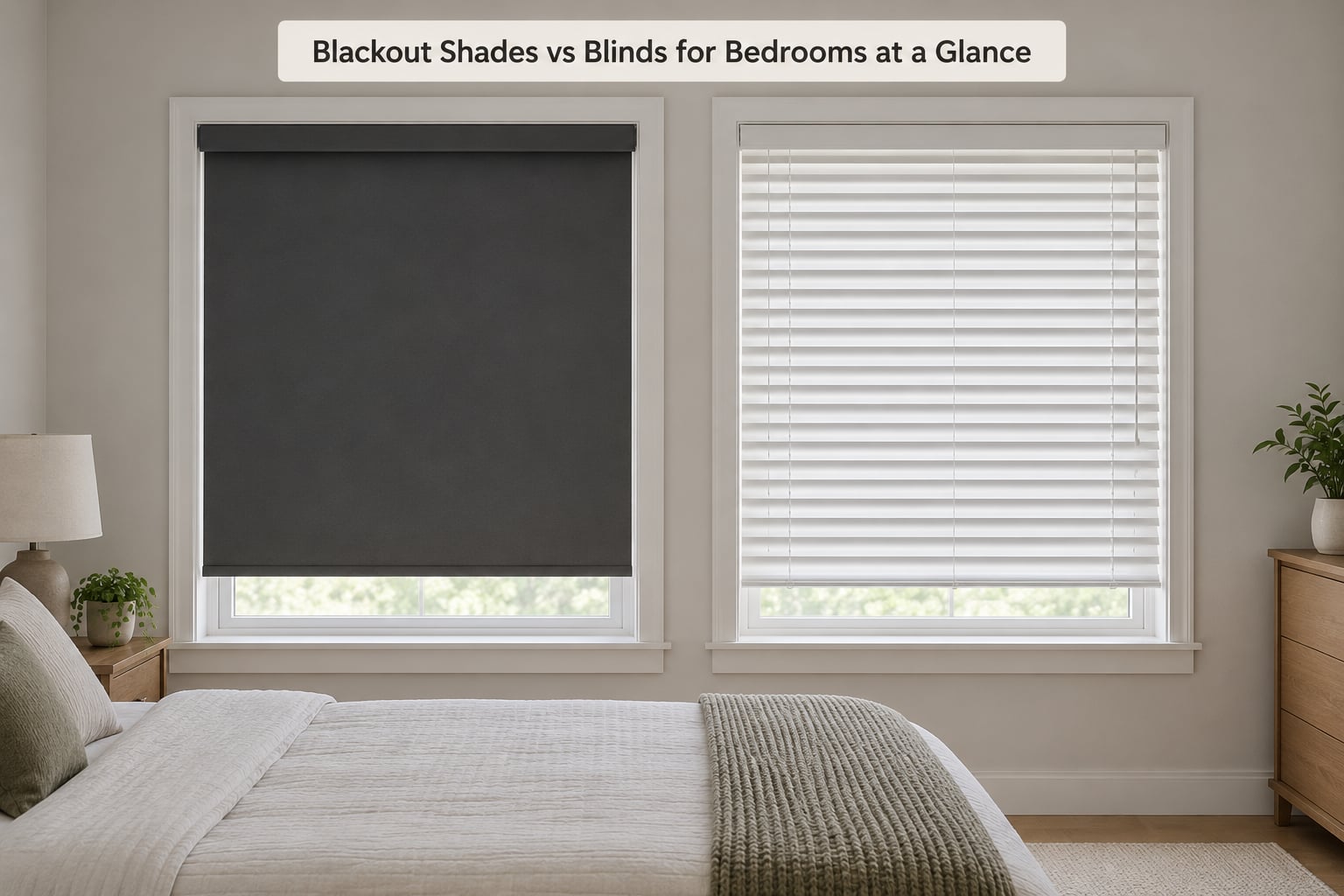
Here is the blackout shades vs blinds for bedrooms comparison in one place. Light blocking figures are the ranges typically claimed and measured for the product type, not for any one brand.
| Factor | Blackout shades | Blinds |
|---|---|---|
| Light blocking | 95-100 percent when properly mounted | 60-85 percent for standard slats; marketed blackout models claim 95-100 percent |
| Adjustable light | Raise and lower only, unless you add a top-down bottom-up or dual-layer system | Slat tilt lets you dial light from open to closed in small steps |
| Privacy at night | Strong, provided the side gaps are covered | Depends heavily on slat overlap and tilt |
| Privacy from inside | Full, no silhouette | Closed slats still outline shapes against strong backlight |
| Insulation | Cellular shades are the strongest, often cited around R-4 to R-5 | Modest, mostly from trapping air in the slat cavity |
| Noise | Soft cellular construction absorbs some high-frequency sound | Hard slats add almost nothing; the window glass is the real path |
| Airflow | Fully sealed when down, so no ventilation | Slats can be tilted open for airflow on warm nights |
| Appearance | Clean, modern, minimal stack when raised | Classic and tailored, with visible hardware |
| Cleaning | Dust the flat surface, spot-clean fabric | Dust each slat individually, harder with fabric slats |
| Lifespan | Usually 7-10 years, fabric can fade or yellow | Usually 10-15 years, easier to replace slat by slat |
| Typical cost | Higher per window, especially custom and motorized | Lower per window, widest budget range |
| Child and pet safety | Cordless or motorized options are common | Cordless upgrades exist, but looped ladders still pose a risk |
| Best window shape | Standard rectangles, arches, and very large openings | Wide windows, sliding doors, and rooms wanting tilt control |
Light Blocking and Sleep Quality
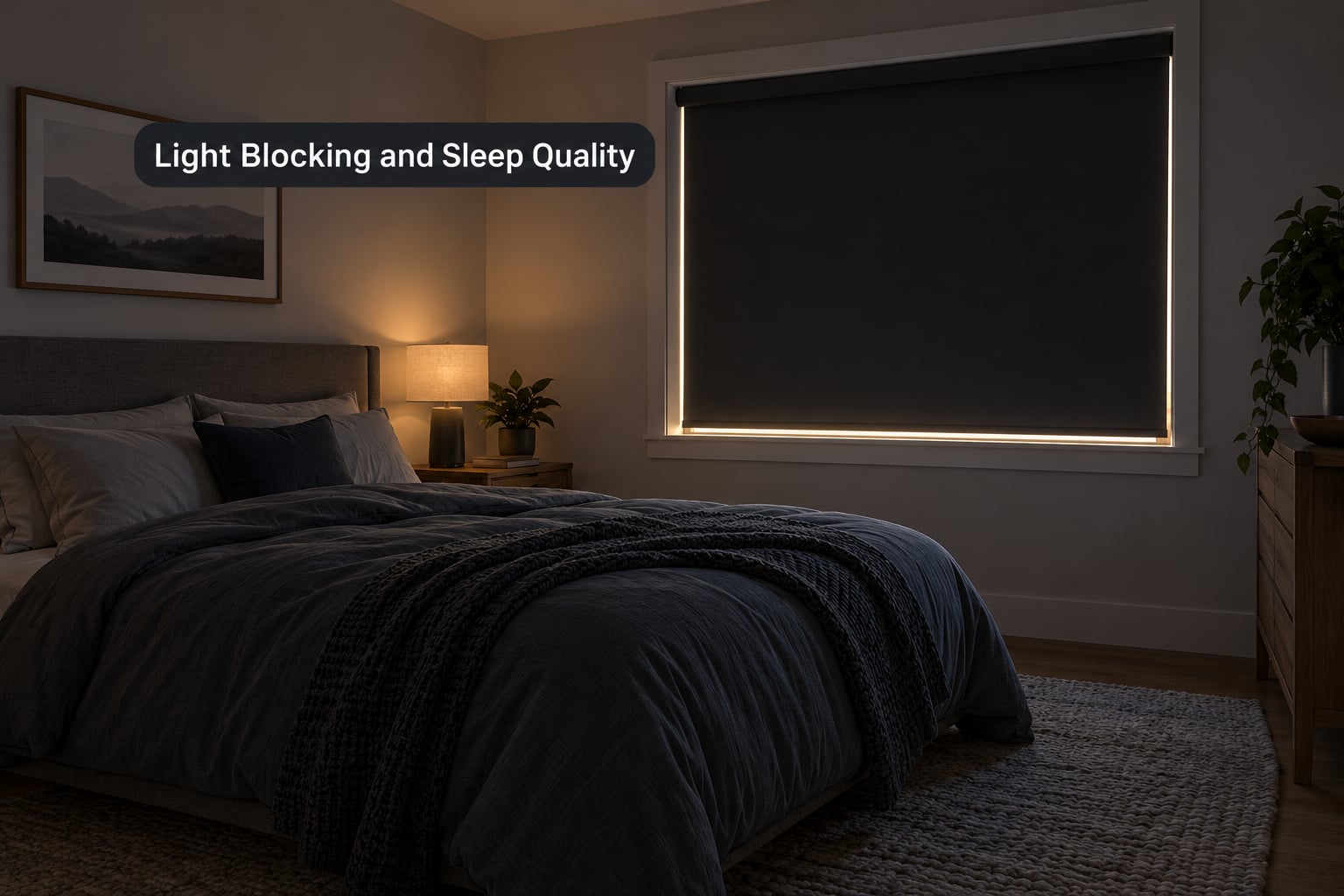
A shade blocks light by putting one continuous, opaque surface in front of the entire glass area. A blind blocks light by rotating hard slats until they overlap, which is a mechanical trick with built-in gaps. That single difference explains nearly every result in the table above.
Three light control tiers come up constantly, and vendors use the words inconsistently. Light filtering fabric passes roughly 10-40 percent of light and keeps a room bright and soft. Room darkening runs about 40-85 percent and softens daylight without turning the room into a cave. Blackout lands at 95-100 percent, and that is the only tier that kills a silhouette from a streetlight or a passing car’s headlights.
The reason this matters more in a bedroom than anywhere else is that you are lying still with your eyes closed for a third of your life. Residual light does not just look annoying, it lands on your eyelids and sets a background brightness your brain keeps responding to. Night-shift sleepers, migraine and light-sensitive sleepers, nurseries, and anyone on an east- or west-facing wall feel this most.
Early risers on a south-facing window have the opposite problem, and it is the one case where a lighter treatment can be the right call. If natural morning light is something you enjoy, a room-darkening cellular shade set to about 50 percent lets you wake gently instead of being startled.
Blackout Shades vs Blinds for Bedrooms: Light Control Compared
Opacity is only half of it. The edge conditions decide whether a treatment delivers the darkness its fabric rating promises.
A vertical blind or a standard mini-blind has slats, and slats have a route hole. Every cord or ladder passes through the slat and exits through a hole in the headrail, and that hole does not close when you tilt. The headrail itself is an open extrusion, so a bright sky behind it creates a glow line along the top of the window. Side returns leak too, because most blinds are made slightly narrower than the opening to clear the frame. Mounting depth is the last gap, and it is the one you can fix with a valance or side channels.
Shades have fewer of these paths. A roller or cellular shade is a single plane of fabric, so there is no slat gap and no route hole, and the headrail is covered by the shade fabric when it is down. What remains is the side gap, which is exactly what side channels or an outside mount solve. A top-down bottom-up design adds a second, separate advantage: you can drop the shade for sleeping and raise the top section for daytime privacy, without either one being a compromise.
Window size changes the math. On a small window, a blind’s leaks are proportionally smaller and often not worth worrying about. On a floor-to-ceiling or corner window, five leak points turn into a glowing outline around the edge of the room. Orientation matters too, because a low sun hits at an angle that finds gaps an overhead sun never would.
Privacy and Appearance
Privacy works in two directions and they have different answers. Looking out, both options are adequate when fully closed. The difference is looking in, and that is where the tiers separate. Room darkening fabric at 60-80 percent still transmits enough light that a person standing outside with a phone can pick out a shape. Blackout fabric at 95 percent or better removes that.
This is the number one complaint in homeowner forums about cheaper treatments. People buy something labeled darkening, install it, and then discover that streetlights throw their silhouette onto the wall. There is no mounting trick that fixes it, because the light is passing through the cloth itself. The fix is a different product or a different fabric rating, not a different installer.
Appearance splits fairly cleanly. If your bedroom decor is minimal, warm wood, or layered textiles, a blackout cellular or roller shade disappears into the room and stacks flat when raised. If you want a tailored, structured look, blinds with wide painted or faux wood slats read as intentional furniture, and they hide hardware better than a bare cord.
One aesthetic note nobody mentions: fabric shows every sun mark. A dark charcoal shade in a room that gets direct midday sun will develop a lighter patch over a few summers, and a pale shade will yellow slightly. Blinds can be refinished or have individual slats swapped, which is a real long-term advantage in a sun-facing room.
Insulation, Noise, and Comfort
Window coverings do not insulate a room, but they do change how much energy crosses the glass. A cellular or honeycomb shade traps air in its pleated cells, which is why blackout cellular shades are regularly cited in the R-4 to R-5 range. A blackout roller shade is mostly a light blocker, and a slatted blind traps some air between the slats but has conductive paths through the headrail, the ladder, and the tilt wand.
In practice that means a cellular shade on a cold night puts a buffer between the glass and the room, and on a hot afternoon it cuts some of the solar gain. The effect is most noticeable on single-glazed windows and in rooms that are unheated overnight. On a modern double-pane unit, the difference is real but modest, and no covering replaces a decent window.
Noise needs a reality check. Cellular shades absorb a small amount of high-frequency sound, mostly the hiss of traffic and voices from the next room, and they dampen echo inside the room. Neither shades nor blinds meaningfully stop sound coming through a closed single-pane window, because the glass and the frame are the path. If traffic noise is the actual problem, the answer is a window upgrade, not a fabric change.
One comfort point cuts the other way. A fully lowered blackout shade seals the window, which is great in winter and wrong on a mild night when you want air. Blinds can be tilted open and cracked, shades cannot.
Maintenance, Durability, and Lifespan
Blinds collect dust in every slat, on every ladder, and along the headrail. Wiping one slat takes a few seconds, doing ninety of them takes an afternoon, and this is the most common reason people replace working blinds with shades after a few years. Fabric slats are worse, since each one has to be dusted individually and creases never quite come out.
A flat shade surface is a single pass with a microfiber cloth. The exception is a cellular shade with an exposed headrail, where dust collects along the top rail in a narrow channel.
Both have the same weak point: the operating system. Cords stretch, tilt mechanisms slip, and the fabric on a shade eventually cracks along the fold lines of a Roman shade or fades on a roller. A damaged slat on a blind is a five-minute swap. A cracked Roman panel usually means a re-cover or a full replacement. Shades generally last 7-10 years; wood, faux wood, and aluminum blinds more often run 10-15.
For a bedroom, safety is the deciding maintenance issue. Looped lift cords and ladder tapes are a strangulation risk for young children and curious pets, so cordless or motorized operation is worth paying for in a nursery or a shared kid’s room. Both product families offer it, though shades made it standard sooner because there is no ladder to hide.
Installation and Window Compatibility
Mounting is where a good product becomes a disappointing one. An inside mount looks cleaner but sits in the window recess, which is exactly where light wraps around the frame. An outside mount sits on the wall or the face of the trim and covers the whole opening, which is the most reliable way to get the darkness the fabric rating promises.
Measurements are simple enough to do yourself. For an inside mount, measure the exact opening width and height and stay within an eighth of an inch. For an outside mount, add 2 to 4 inches on each dimension so the shade overlaps the frame on all four sides, and check that the headrail has clear wall or ceiling space to mount into. Add a few extra inches if you want a valance on top to kill the headrail glow.
Some windows are straightforward for both. Recessed windows, deep sills, and windows with a radiator or a bed underneath argue for an outside mount or a top-down bottom-up design. Very wide openings, sliding glass doors, and corner windows suit vertical or panel track blinds, since one tall fabric panel cannot span that width cleanly. Arched and non-rectangular windows are a shade job, because blinds have nothing to follow the curve.
Renters have a narrower path. Drilling into a wall is usually off the table, so tension-mounted inside-mount roller shades, no-drill blinds that clamp to the frame, or a blackout panel hung from a tension rod are the practical options. Window film is the other one, and it is the only solution that blocks light without any hardware at all, though it has to be applied to the glass and is permanent enough that you may want a professional.
Worth calling a professional: motorized shades, anything on a bay or bank of large windows, a window with a tricky recess, or a rental where a bad install costs a deposit. A good installer will measure with you and tell you honestly if your window cannot reach true blackout.
Which Should You Choose?
Pick blackout shades if any of these are true: your bedroom faces east and you want total darkness, you work nights and sleep during the day, the room is on the street or on the ground floor, someone in the house is light-sensitive or migraine-prone, or the window is large and faces a neighbor. The continuous surface and the ability to add side channels make shades the only realistic path to real darkness.
Pick blinds if the daytime light control matters most, the room needs ventilation on warm nights, you are covering a very wide window or a sliding door, the decor calls for a tailored look, or the budget is the deciding factor.
Go layered when the room has to do both jobs. A blackout cellular shade on the window plus a light-filtering curtain on a rod outside it is the most common answer in homeowner discussions, and it works: the shade handles the light, the curtain handles the softness, and you can open one without giving up privacy. If you only buy one treatment, buy the shade.
Skip true blackout in two cases. A guest room that is only used at night in a quiet neighborhood is fine with room darkening. So is a bedroom that gets no direct sun and already sits in shade, where a cellular shade at 60 percent will read as dark enough.
Frequently Asked Questions
Should you get blackout blinds for a bedroom?
Only if darkness is not the priority. Blackout blinds block far less light than blackout shades because of slat gaps, routing holes, and open headrails, so a street-facing bedroom, a shift worker’s room, or a nursery is better served by a shade. Blinds make sense in a bedroom where you want adjustable daytime light, airflow on warm nights, or a tailored traditional look.
Is it better to have blinds or shades in a bedroom?
Shades, for most bedrooms. One continuous opaque surface has no slat gaps and no routing holes, so it blocks 95 to 100 percent of light against roughly 60 to 85 percent for standard blinds. Blinds win on adjustable light, ventilation, wide windows, and cost. A blackout cellular shade plus light-filtering curtains covers both needs in one room.
Can people see through room darkening curtains at night?
Often, yes. Room darkening fabric typically transmits 15 to 60 percent of light, which is enough for a streetlight or headlights to throw your silhouette onto the wall. In a ground-floor or street-facing bedroom that is a real privacy problem. True blackout fabric at 95 percent or better removes the silhouette, and no mounting trick substitutes for a higher fabric rating.
Is it healthy to sleep with blackout curtains?
For most people, a darker room supports sleep. Blocking all light at night limits the low-level exposure that can delay sleep onset and shift your body clock, which is why blackout is valued for shift workers and light-sensitive sleepers. A completely black room is not required for good sleep, and daylight during the day still matters for your circadian rhythm.
How do I stop light leaking around blackout blinds?
You can close the top glow and the side gaps, but not the routing holes or the fabric itself. Add a valance or a light-blocking filler strip at the top, fit side channels, and use an outside mount that overlaps the frame by 2 to 4 inches. If light still comes through the slats themselves, the fabric is not blackout, and no trim will fix it.
What are the main downsides of blackout blinds?
Light leaks through the slats and routing holes, they collect dust in every slat and ladder, and fabric blackout slats crease and yellow over time. A damaged slat is easy to replace, which is one genuine advantage, but a single daylight stripe along the headrail is hard to eliminate. Most off-the-shelf models labelled blackout are room darkening at best.
Conclusion
Blackout shades win the comparison for most bedrooms because a single opaque surface has fewer ways to leak light than slats, ladders, and an open headrail. Blinds win when adjustable daytime light, ventilation, wide openings, or a tailored look matters more than darkness.
Before you order anything, check five things: which direction the window faces, how dark you need it to be, whether anyone on the ground floor can see in, whether you want airflow, and how much mounting space you have outside the frame. Measure the opening, add 2 to 4 inches if you plan an outside mount, and confirm the fabric rating is 95 percent or better before you pay for anything called blackout.