Most septic tanks should be pumped every 3 to 5 years. That range is honest advice for a fairly average household on an average tank, but your real interval depends on tank capacity, how many people use the system, and what goes down the drains.
Every septic tank follows the same pattern. Solids settle into a sludge layer on the bottom, grease and light material float as a scum layer on top, and clarified effluent in the middle drains out to the drain field. The U.S. EPA’s explainer on how septic systems works describes it plainly: bacteria break down the organic solids between pumpings, and the tank has to be emptied before those layers reach the outlet pipe.
If you have genuinely no idea when the tank was last pumped, the honest answer is simple: pump it now and start writing the date down somewhere you will find it again. This guide was reviewed for accuracy in 2026.
Table of Contents
- How Often to Pump a Septic Tank?
- What Is the Recommended Septic Tank Pumping Schedule?
- What Factors Change How Often You Need Pumping?
- How Often to Pump a Septic Tank With a Garbage Disposal
- What Are the Warning Signs That Your Septic Tank Needs Pumping?
- How Do You Check Your Septic Tank?
- What Happens During Septic Tank Pumping?
- Can You Pump a Septic Tank Yourself?
- How Can You Prevent Septic Tank Problems Between Pumpings?
- Frequently Asked Questions
- How often should a septic tank be pumped for a typical family home?
- What happens if I wait too long to pump my septic tank?
- How do I know when my septic tank was last pumped?
- Do seasonal homes need regular septic tank pumping?
- Why is there standing water over my septic drain field?
How Often to Pump a Septic Tank?

The 3 to 5 year figure comes from how fast solids accumulate in an average tank, and it is the right default only when nothing unusual is happening in your house. A family of two in a 1500 gallon tank can comfortably go five years or a little past it. A family of five in a 1000 gallon tank with a garbage disposal may be due every year or two.
Pumping is not a luxury maintenance item. Solids that leave the tank travel into the drain field, where they settle into a clogging mat that stops effluent from soaking into the soil. Once that mat forms, the whole system backs up, and clearing or replacing a drain field is a project most homeowners never want to take on.
The calendar is a planning tool, not the real trigger. The real trigger is measured depth: about 6 inches of scum or 12 inches of sludge, or roughly one third of the tank’s total depth, whichever comes first. A pumper who measures before pumping is doing the job properly, and a homeowner who knows that number can hold their own in a conversation with a service company.
What Is the Recommended Septic Tank Pumping Schedule?
Here is the schedule most homeowners start from. Treat it as a starting point rather than a guarantee, and check your local health department rules before you settle on a date.
| Household | Typical tank size | Starting pumping interval |
|---|---|---|
| 1 to 2 people, light water use | 750 to 1,000 gallons | Every 2 to 3 years |
| 3 to 4 people, average water use | 1,000 to 1,500 gallons | Every 3 to 5 years |
| 5 to 6 or more people, or frequent guests | 1,500 to 2,000 gallons | Every 1 to 2 years |
| Rental, vacation, or seasonal home | 1,000 gallons or more | Every 3 to 5 years, with a yearly look |
Two things sit underneath that table. First, if your records are unknown, the schedule has already failed you, so pump and start a log. Second, some county and state health departments set their own required intervals, and a local rule of two or three years overrides any national guideline.
What Factors Change How Often You Need Pumping?
These are the factors that move your date forward or push it back. Most homes have two or three of them working at once, which is why two families on the same street can have completely different intervals.
- Tank capacity: A 750 gallon tank fills up roughly twice as fast as a 1,500 gallon tank serving the same household.
- Number of residents: More people means more solids. Households of five or six often land in the one to two year range.
- Water use: Heavy laundry, frequent showers, and a water softener that discharges to the system all increase the load moving through the tank.
- Garbage disposal use: A disposal can add up to 50 percent more solids entering the tank.
- Grease and cooking oil: Fats solidify in the tank and build the scum layer faster than anything else you do indoors.
- Non-biodegradable items: Wipes, paper towels, feminine products, and grease-clogged paper break down slowly or not at all.
- Harsh chemical cleaners: Heavy bleach and drain cleaner use can kill the bacteria doing the breakdown work, and systems loaded with such solids may need service 20 to 30 percent sooner.
- Rainfall and soil drainage: A drain field that stays saturated or receives a lot of roof runoff has less capacity to handle the effluent.
- Occupancy changes: A new baby, a parent moving in, or an added bathroom changes the numbers overnight.
- Tank age and condition: Older tanks with worn baffles or a failing effluent filter hold solids longer than a newer design.
You can do a rough calculation before you pick an interval. Planning figures commonly used by onsite sewage programs put household wastewater generation at roughly 100 gallons per person per day, so a family of four sends somewhere around 400 gallons a day, or about 1,450 gallons a week, into the tank. Whether that is a problem depends on how much of the tank’s usable volume is taken up by solids rather than liquid.
Your county or state health department may also publish a required interval for your area, and that rule is the one that counts legally. Pumping services in different regions quote different numbers, and a two to five year requirement in one state is not a marketing claim. If you cannot find the rule online, ask your pumper, who works under the local code every day.
How Often to Pump a Septic Tank With a Garbage Disposal
A garbage disposal is the single most common reason a household ends up on a shorter schedule than the table suggests. Disposal waste goes straight into the tank as solids, and it can roughly double the solids load. Households that use a disposal every day are usually better off measuring sludge depth on a two year cycle than trusting a five year calendar.
Some local codes actually discourage disposal waste in septic systems altogether, and many extension programs recommend against it. Running the disposal for scraps only, never for grease, oil, or fibrous material, keeps the load down. If your disposal and your tank were both installed around the same time, check whether either came with a written recommendation on disposal use.
What Are the Warning Signs That Your Septic Tank Needs Pumping?
These symptoms show up long before a backup in most cases. Read them as a group rather than one at a time.
- Slow draining toilets, tubs, or sinks
- Gurgling sounds in the plumbing after a toilet flushes
- Sewage odor indoors, sometimes strongest near the bathroom or the tank lid
- Foul smells outdoors near the drain field
- Standing water or unusually wet, spongy ground over the drain field
- Unusually lush, thick grass growing directly over the drain field
- Wastewater backing up into tubs, floor drains, or the lowest toilet
Backing up inside the home and sewage odor inside the house are same-day problems. Stop flushing, stop running water toward the system, and call a licensed pumper rather than trying a drain cleaner.
Slow drains and gurgling on their own can also mean a partially blocked household pipe, so treat them as a prompt to check, not a diagnosis. A single slow bathroom sink is a plumbing problem; slow drains across the whole house on the side of the system with the tank is not.
The lush grass sign gets misunderstood more than any other. An overfertilized lawn over a drain field usually means effluent is reaching the surface unsaturated, which means the field is not taking what it should. That is a reason to have the system assessed, not a reason to mow it proudly.
Homeowners on Reddit have described exactly this pattern in recent r/homeowners threads on how long a tank can really go between pumpings. The recurring theme in a 150-plus comment discussion was that 3 to 5 years is roughly right for a roughly average household, and the households that reported problems were almost always larger families, disposal users, or people who had no idea when the last pump date was.
How Do You Check Your Septic Tank?
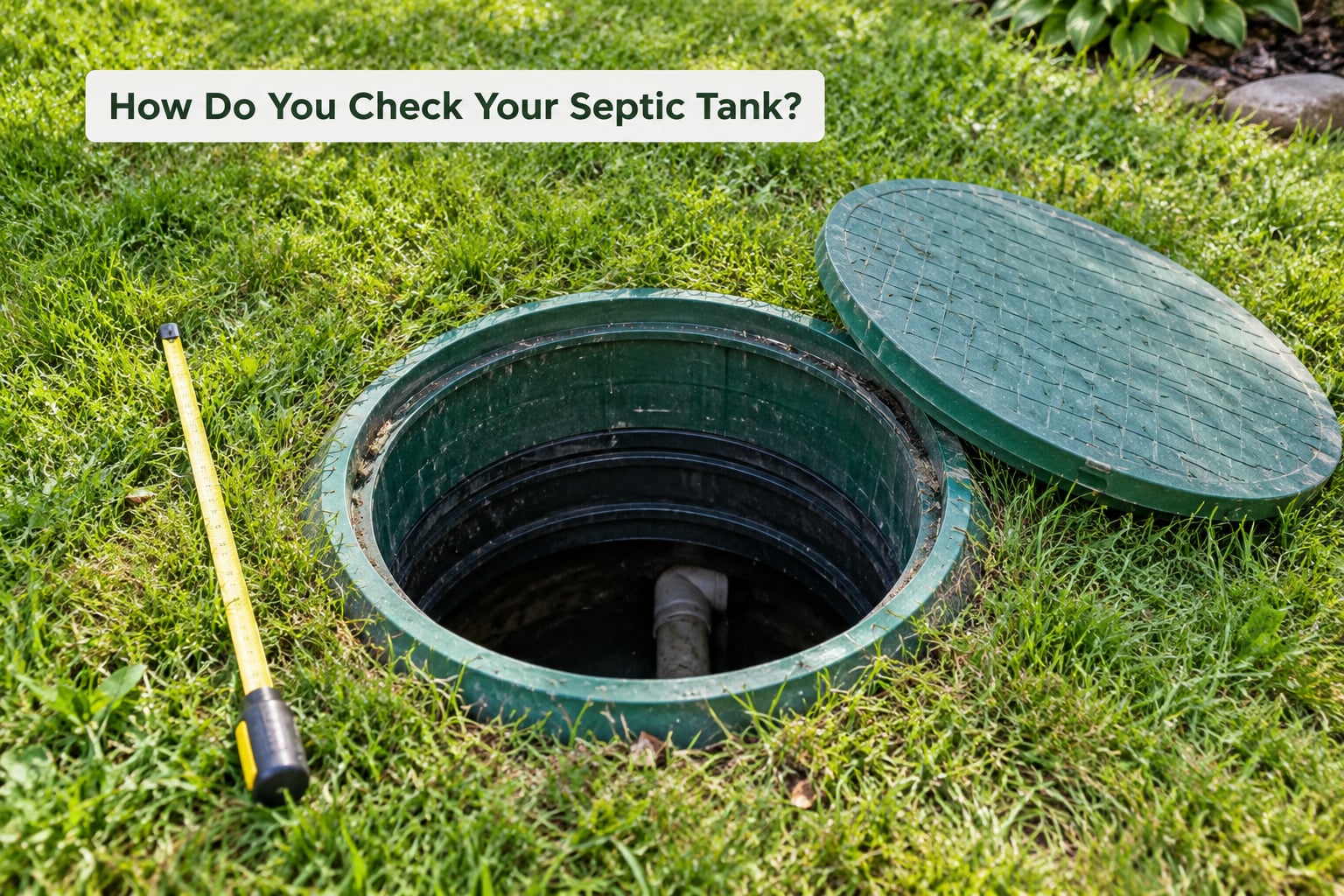
Some of this is safe to do yourself, and some of it is genuinely dangerous. The split is simple: measuring from above ground is homeowner territory, anything involving an open chamber or a truck hose is professional work.
What you can reasonably handle yourself:
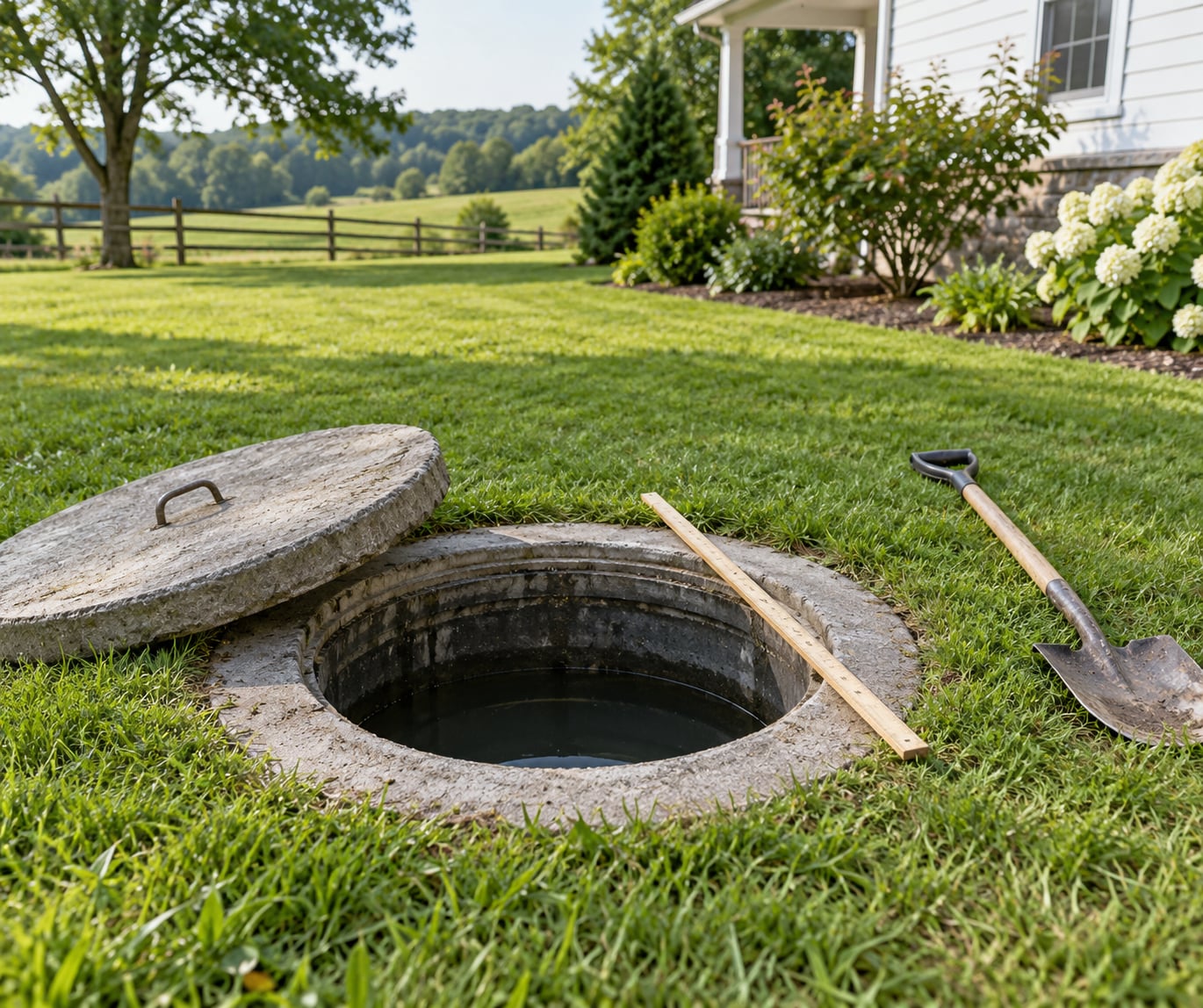
- Locate the tank. Check your home’s as-built drawing or septic permit first. Failing that, look for a 20 to 24 inch plastic or concrete lid in the driveway, garage floor, or grass near the house’s sewer line.
- Find the depth of the tank. Write the number down. You need it to make sense of the measurement thresholds.
- Measure the layers. A sludge judge, or a stiff stick with tape on the end, drops through the opening and reads the levels without anyone going inside. Aim for the bottom of the tank to get the sludge depth, and measure up from there to the top of the water for scum.
- Compare against the thresholds. Pump when the sludge is near 12 inches, the scum is near 6 inches, or either layer has reached about one third of the tank’s depth.
- Check for an effluent filter. Many modern systems have one at the outlet. If it is accessible from the riser, note whether it is coated with solids.
- Pull the maintenance record. Your last pump date, the tank size, and the measured depths at that pump are the three numbers worth keeping.
What belongs to a licensed septic professional: entering the tank, opening a buried chamber, hydro-jetting, running a dye or smoke test, and evaluating drain field condition. Those tasks need gas monitoring and equipment most homeowners do not own.
Never put your head or any part of your body into a septic tank. Even a tank that was pumped yesterday can hold hydrogen sulfide, which knocks people out at surprisingly low concentrations, plus methane and pathogens. A tank pumped yesterday is not a safe tank today.
What Happens During Septic Tank Pumping?
A routine pump-out takes roughly 30 to 60 minutes for a residential tank, longer if the lids are buried or access is tight. The crew locates the tank, removes the lids, and pumps out both the liquids and the settled solids.
While the hose is running, a good pumper checks the inlet and outlet baffles, looks at the effluent filter, and notes the condition of the tank walls and lid. On a two-compartment tank, both compartments get emptied. They also look at the ground over the drain field and will tell you what they see, which is useful information even when everything looks fine.
Afterward, the tank should generally be refilled with water if the system design or the local health department requires it. A tank left dry can crack, and in some designs an empty tank loses the seal that keeps sewer gases out of the house. Ask what your system needs rather than assuming.
Before the truck leaves, ask for three things in writing: the measured sludge and scum depths, the date, and the tank size. That is your log entry, and it is the difference between knowing when the next pump is due and guessing again in four years.
Can You Pump a Septic Tank Yourself?
No, and it is not a close call. A septic tank is a confined space holding toxic gases, heavy sludge that can knock a person unconscious, and untreated pathogens, and pumping it requires a vacuum truck and a lawful disposal site for the contents.
DIY pumping is also illegal in many jurisdictions, both because of the waste handling and because most codes require a licensed pumper to document the service. An improperly pumped tank can also be pumped half empty, which does nothing for the problem you were trying to solve and leaves solids where the crew could have removed them.
What you can responsibly do is schedule the work, keep the log, measure the layers beforehand, and take care of the drain field. Everything past that is the crew’s job.
How Can You Prevent Septic Tank Problems Between Pumpings?
Most of what you can control happens at the drain and in the yard. None of it is complicated, and all of it slows the buildup.
Never flush wipes, paper towels, facial tissue beyond the small amount that is fine, feminine products, cotton swabs, cigarette butts, or grease and cooking oil. They do not break down. Break up the solids reaching the tank and you can stretch the interval; add non-biodegradables and you shorten it.
Use a garbage disposal sparingly, and never as a way to dispose of food scraps in bulk. Keep grease out of the drains entirely, and pour cooking oil into a container and take it to the trash.
Choose septic-safe cleaners for the toilet and drains, and stop pouring bleach down the drains in heavy weekly doses. The bacteria doing the work in an anaerobic tank are not fans of harsh chemicals, and once they are gone the sludge breaks down more slowly and the tank fills faster.
In the yard, keep vehicles, trailers, sheds, and heavy equipment off the drain field. Compacted soil loses the porosity the field depends on. Plant only shallow-rooted ground cover over it, keep trees and deep-rooted shrubs away, and direct downspouts and roof runoff away from the field so it does not stay saturated.
One more thing homeowners ask about constantly: bacterial treatment products. They can modestly extend an interval, sometimes by 20 to 30 percent, by keeping the breakdown process active between pumpings. They do not remove solids, they do not replace a pump-out, and they cannot rescue a tank that already has a full sludge layer. Marketing them as a substitute for pumping is doing you no favors.
Finally, keep a maintenance log. Four columns cover it: date pumped, tank size, measured sludge and scum depths, and what was done. A phone note is enough. A homeowner on Reddit who could not say when the last pump happened ended up treating the interval as a guess, and that is the situation this log exists to prevent.
Frequently Asked Questions
How often should a septic tank be pumped for a typical family home?
For most households, every 3 to 5 years is the right starting point. A family of three or four on a 1,000 to 1,500 gallon tank with average water use usually lands in that range. Larger households, small tanks, and heavy garbage disposal use shorten the interval to one or two years. Your real trigger is measured depth: roughly 6 inches of scum or 12 inches of sludge, or about one third of the tank depth.
What happens if I wait too long to pump my septic tank?
Solids start leaving the tank and entering the drain field, where they form a mat that stops effluent from soaking into the soil. You get slower drains, gurgling pipes, odors, wet ground over the field, and eventually wastewater backing up inside the house. A clogged drain field is far more expensive and disruptive to repair than a routine pump-out, and in bad cases it has to be replaced entirely.
How do I know when my septic tank was last pumped?
Check the home’s septic permit, your closing documents if you bought the house, and any receipt you kept. County health departments sometimes keep service records too, and a quick call to the pumper who serves your area can confirm past work. If nobody can tell you, treat the date as unknown and schedule a pump-out now. Then write the date somewhere you will actually find it next time.
Do seasonal homes need regular septic tank pumping?
They do, and the risk is higher than people expect. In an unused tank, the solids that settle during a season of occupancy stay sitting there with no wastewater flow to move them, and they keep compacting. Solids can also bake onto the tank bottom over a long idle period. A seasonal home on a 1,000 gallon tank is usually pumped every 3 to 5 years, with an annual look at the lids and the drain field.
Why is there standing water over my septic drain field?
Standing or spongy wet ground over the drain field usually means effluent is not infiltrating into the soil the way it should. Common causes are a tank that is overdue for pumping, a failed baffle or outlet, a clogged field, or groundwater and heavy rain saturating the soil. It is a reason to have the system assessed rather than to wait, because a field that stays wet often needs a larger repair than the backup that brought it to your attention.
Find your tank size, then look for the date of the last pump-out in the septic permit, the closing paperwork, or your own records. If that date is missing, or if you are noticing slow drains, gurgling pipes, or odors, schedule the service and start a log today.