A sump pump stops working for boring reasons far more often than dramatic ones. A GFCI outlet tripped quietly, a float switch stuck halfway in its travel, a discharge pipe iced over, or a pump that simply aged out after 7 to 10 years in a wet pit.
Sump pump not working troubleshooting takes about ten minutes if you do it in the right order, starting with power and ending at the motor. Most owners who follow the sequence below either find the fault themselves or learn quickly that it belongs to a plumber, an electrician, or a pump technician. Unplug the pump before you put a hand anywhere near the basin, and stay out of standing water around energized equipment.
Table of Contents
- What You Need
- Step-by-Step: Diagnose a Sump Pump Not Working in Eight Checks
- Check the Power, Breaker, and GFCI Outlet First
- Confirm the Water Is Reaching the Basin
- Inspect the Discharge Pipe for Clogs and Leaks
- Test the Float Switch for a Stuck or Faulty Float
- Listen and Look for Motor, Impeller, and Pump Problems
- Check the Water-Float Backup Switch If Installed
- Confirm the Pump Is Sized for the Basin and Water Conditions
- Decide Whether to Repair or Replace the Sump Pump
- Common Mistakes
- Frequently Asked Questions
- Why is my sump pump humming but not pumping water?
- Why does my sump pump run continuously?
- Can a sump pump be tested with water?
- Why does my sump pump run for a few seconds and stop?
- Should I replace a sump pump or repair it?
- Start With the Power and Water Level
What You Need
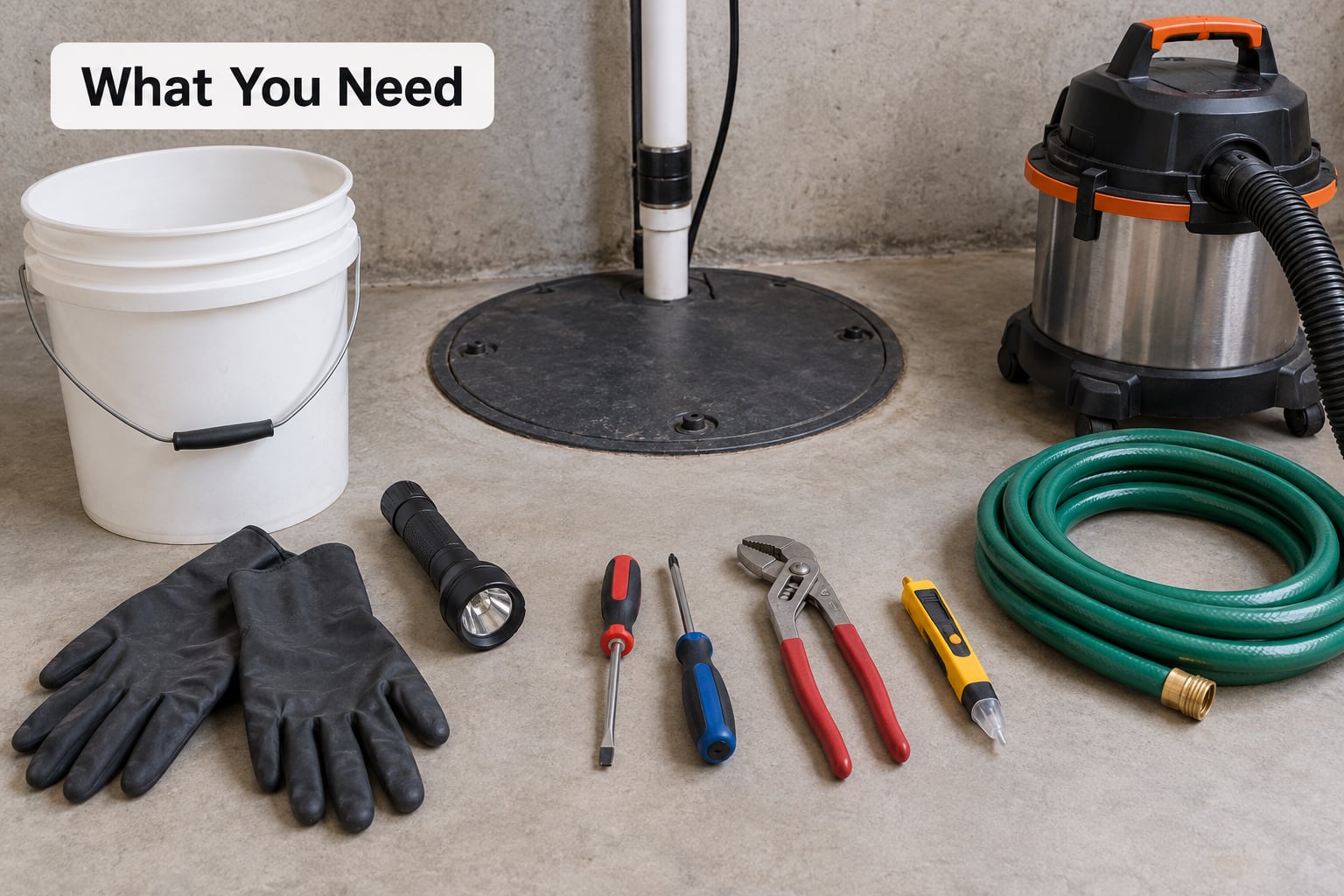
Most of this work happens in a cold, dark pit that is exactly the size a person does not want to be in. Gather everything on the floor above first.
- A flashlight or headlamp with fresh batteries, plus a second light source in case the first dies in the pit.
- Rubber-insulated gloves and closed-toe boots with good grip. Basin floors are wet, slimy and steep-sided.
- A five-gallon bucket and a wet/dry vacuum for bail-downs and for water you find once the power is off.
- A garden hose long enough to reach an outside drain or spigot, for flushing the discharge line.
- Screwdrivers, an adjustable wrench and pliers for removing the pit cover, the pump’s bottom plate and discharge unions.
- A voltage tester, only if you are qualified to use one. If you are not sure how to check for live current, skip it and call an electrician.
Two prerequisites come before the tools. First, locate the breaker and the GFCI outlet that serve the pump, and know how to shut both off. Second, plan how you will stay dry: water plus 120 volts is the real hazard in a sump pit, not the pump itself.
Step-by-Step: Diagnose a Sump Pump Not Working in Eight Checks
Work down this list in order. Each step assumes the pump is unplugged unless the text says otherwise, and each one tells you what a normal result looks like so you know whether to keep going or stop. Good sump pump not working troubleshooting gets you to the answer in about ten minutes. If you would rather hand this to a pro at any point, that is a reasonable call, not a failure.
| What you notice | Most likely cause | Check this first |
|---|---|---|
| Completely silent, pit filling up | No power, or a float that never calls for it | GFCI outlet, then breaker, then cord |
| Humming or buzzing, no water moving | Jammed impeller, closed discharge, air lock | Discharge line blockage, then intake screen |
| Runs and shuts off every few seconds | Float sticking, undersized pump, short basin cycle | Float travel and grime, basin water volume |
| Runs continuously, basin dry | Float stuck on, wrong float setting, short cycling | Trigger collar position and tether snag |
| Water returns after it shuts off | Failed or backwards check valve | Check valve orientation on the discharge |
| Grinding or scraping noise | Debris on the impeller, pump tilted in the pit | Intake screen, pump seating flat |
| Breaker trips every time it runs | Water in the motor housing, damaged cord | Unplug it and stop resetting |
Check the Power, Breaker, and GFCI Outlet First
A ground-fault protected outlet trips without a sound, and it does not always snap back to a visible tripped position. Press the reset button, then confirm the plug is seated and undamaged, then check the breaker.
Stop troubleshooting and kill power immediately if the breaker keeps re-tripping, if you smell burning, if the outlet is buzzing or sparking, or if there is standing water sitting against energized equipment. Those four signs mean the problem is electrical, and a licensed electrician is the next call. Resetting a breaker is not a repair, it is a symptom.
Confirm the Water Is Reaching the Basin
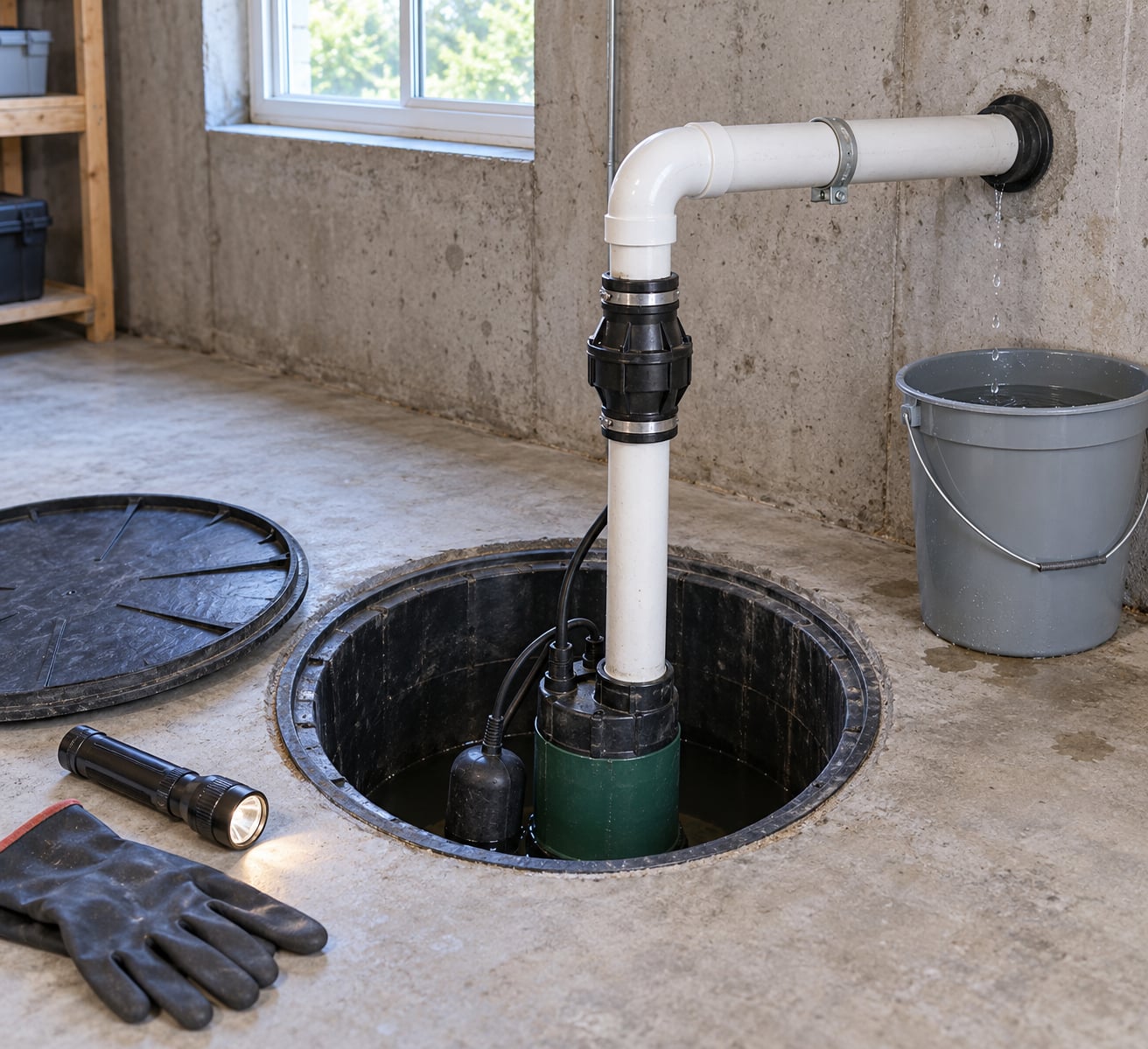
With the pump unplugged, pull the pit cover off and look down. You want to see water collecting, an inlet line or drain tile delivering, and debris that is not matted over the inlet.
A stuck fill float, a frozen inlet line or heavy silt can stop water from ever reaching the switch. If you want to test the pump, add water only after it is disconnected, then watch what the float does. Never pour water into a pump that is still energized.
Inspect the Discharge Pipe for Clogs and Leaks
Follow the discharge line from the pump to wherever it exits the house, checking unions, the check valve and any hose along the way.
A pipe that stays full and dribbles, a union that weeps, repeated short cycling, or a hose that collapses inward all point at a blockage, a failed check valve or an air lock. A blocked line in winter is a common one: the pump pushes against ice until the motor gives up. Owners in r/Plumbing traced a pump running on and off for minutes at a time to a suspected frozen discharge during a New England winter.
Air locks usually clear by filling the line with a hose until water flows steadily, then re-seating the pump. A weep hole at the bottom of the pump housing is there for the same reason, and a few owners in r/askaplumber have temporarily sealed one with silicone, which works and hides the problem rather than fixing it.
Test the Float Switch for a Stuck or Faulty Float
Tethered floats, snap-action floats and float guards all fail the same way: grime builds up and the switch stops calling for a clean on or off. Unplug the pump, then lift the float by hand and see whether the switch clicks, sticks, or refuses to move at all.
A switch that will not activate, one that stays stuck, or one that vibrates and starts and stops the pump repeatedly needs cleaning, adjustment or replacement. In r/homeowners, a pump that died mid-storm came back to life when someone tapped the floater, and a stuck float was the whole fault. On a new build in r/Plumbing, a faulty floater and switch had the pump running nonstop.
Listen and Look for Motor, Impeller, and Pump Problems
A hum means the motor is spinning and water is not moving. A silence means no power is reaching the switch or the motor.
Disconnect the pump and lift it out, then remove the bottom plate and check the impeller by hand. A seized impeller, an obstructed or cracked volute, and dry-run damage from a pump that ran with no water all show up here. Do not try to force a seized impeller free, and do not open a sealed motor housing, since the winding is potted and you cannot service it anyway. Internal faults belong to a pump technician.
Check the Water-Float Backup Switch If Installed
If your pit has a second, separate high-water float or a battery backup unit, an alarm sounding while the primary pump never started tells you the backup circuit is the one in question.
These systems are not interchangeable with the primary pump, and the float, the alarm and the pump each have their own wiring. Follow the manufacturer’s instructions for any wiring work, and test the backup with a full bucket of water on the manufacturer’s schedule rather than waiting for a storm.
Confirm the Pump Is Sized for the Basin and Water Conditions
Sometimes the pump is fine and the system is not. A pit that fills faster than the pump clears, a basin too small to hold a cycle, or aggressive groundwater can push a working pump into nonstop running and start burning motors out.
Swapping a failed pump for a much larger unit is not always the fix, because a bigger pump empties a small basin in seconds and short-cycles, which trips thermal cutoffs and wears the motor out faster. When running behavior only makes sense once you know the basin size, the groundwater conditions and the pipe length, get a professional assessment rather than guessing at capacity.
Decide Whether to Repair or Replace the Sump Pump
Sump pump not working troubleshooting ends with a fair question: is this a cleaning job, a parts job, or a replacement job?
Clean it and go again if the impeller was clogged or the float was simply stuck. Replace a failed part if the float switch, check valve, or cord is dead and the rest is sound. Replace the whole pump if the motor is burned out, the housing is cracked or badly corroded, the wiring is damaged, the pump trips its breaker, or if each repair buys you only a few months.
Most submersible sump pumps last 7 to 10 years, and water with grit, iron and constant submersion shortens that. If your unit is at the end of that range and failed without warning, replacement is usually the cheaper answer than a second repair. One more useful piece of advice from r/DIY: keep the pump from shifting around in the pit, since a brick or similar weight stops it tipping onto its side and jamming.
Common Mistakes
Most failed sump pump repairs start with one of these, and all of them are avoidable.
- Diagnosing with the pump energized. Fix: unplug at the wall, not just at the switch, and keep your hands and tools out of a wet pit.
- Testing a submerged pump carelessly. Fix: raise it, dry the housing, and look for a tripped thermal cutoff or a chewed cord before anything else.
- Forcing a seized impeller. Fix: clear debris gently, and if it will not move by hand, the pump goes to a technician.
- Treating a GFCI reset as the fix. Fix: find why it tripped. Water in the motor housing, a damaged cord and a cracked outlet all look identical from the panel.
- Ignoring the check valve. Fix: water coming back into the pit after shutdown is a failed or backwards check valve. A warranty call in r/Plumbing traced a blown no-hub coupling to a check valve the original installer had put in backwards.
- Resetting a tripping breaker repeatedly. Fix: unplug and inspect. Every reset pushes a motor that is already damaged further along.
Prevention is unglamorous and it works. Test the pump every few months by pulling the float up by hand, clean the pit screen as debris builds, flush the discharge line before the first freeze, clear ice and snow from the outdoor outlet, and check the pit cover is sealed. Fifteen minutes before a forecast storm is worth more than a new pump.
If you also want to trace where the water is coming from, look uphill. Downspouts dumping near the foundation, poor grading and a drain tile that is disconnected all dump more water into the pit than the pump was designed to handle, and fixing the source is the only fix that ends the problem for good.
Frequently Asked Questions
Why is my sump pump humming but not pumping water?
A hum means the motor is spinning but water is not moving. The usual causes are a jammed impeller, debris on the intake screen, a frozen or clogged discharge line, a failed check valve, or an air lock in the pump. Unplug the pump, pull it out, clear the impeller, and run a hose into the discharge line until water flows steady before you test it again.
Why does my sump pump run continuously?
Most often a float switch is stuck on, or its trigger collar is set too low so the pump starts as soon as it starts. A short basin, a pump too large for the pit, or a switched-off drain tile can also cause cycling. Unplug the pump and move the float by hand to see whether it releases cleanly, and clean any grime off the switch.
Can a sump pump be tested with water?
Yes, and the bucket test is the standard one. Unplug the pump, pour several gallons into the pit and watch the float rise. Then plug the pump back in and confirm it starts and shuts off. Never add water to a pump that is still energized, and never reach into a wet pit with a tool in your hand while the circuit is live.
Why does my sump pump run for a few seconds and stop?
Short cycling usually points to one of three things: a float that is sticking partway through its travel, a pump that empties a small basin too fast, or a discharge line that is blocked so the pump never gets flow. Unplug it and lift the float by hand first, then trace the discharge pipe for ice, debris or a closed valve before touching anything else.
Should I replace a sump pump or repair it?
Clean or adjust it if the impeller was clogged, the float was stuck, or the check valve is the only failed part. Replace the pump if the motor is burned out, the housing is cracked or corroded, the wiring is damaged, or each repair only holds for a few months. Most submersible pumps last 7 to 10 years, so a unit at the end of that range that failed without warning is usually worth replacing.
Start With the Power and Water Level
Here is the whole diagnostic in four moves. Unplug the pump. Check the GFCI outlet and the breaker. Look at the water level in the basin and test the float by hand. Then follow the discharge pipe all the way out of the house, staying on dry ground and out of standing water the whole time.
Call a plumber for a blocked or frozen discharge line, a failed check valve, or a drainage design that keeps overloading the pit. Call an electrician for a breaker that re-trips, a burning smell, or anything that sparked. Call a pump technician for a seized impeller, a hum with no water after the line is clear, or a motor that has already burned out. Any of those three is a better use of your afternoon than a wet basement.