If you have ever wondered why one room is always colder than the rest of your house, the answer usually comes down to two things: the room is not receiving enough warm air, or the room cannot hold the warm air it does receive. Everything else is a variation on those two problems.
The distinction matters because the fixes are completely different. A blocked vent needs a ten-minute fix; a leaky exterior wall needs a contractor and a budget. Start by figuring out which side of the problem you are on before spending money on anything.
Last reviewed and updated for 2026.
Table of Contents
- Why Is One Room Always Colder Than the Rest?
- How to Tell Which Heating Problem Is Causing the Cold Room
- Why Do Some Rooms Get More Warm Air Than Others?
- Why Is One Room Always Colder Than the Rest in a Forced-Air System?
- Can a Thermostat Make One Room Seem Colder?
- Could Insulation or Air Leaks Be Responsible?
- What Can You Safely Check Before Calling an HVAC Professional?
- When Is Uneven Room Temperature a Bigger Problem?
- Frequently Asked Questions
- Should I close vents in warm rooms to make another room warmer?
- Why is one bedroom colder than the rest of the house?
- Can adding a second thermostat make the house warmer?
- How do I know whether a problem is caused by ducts or insulation?
- Is a room with cold walls a heating-system problem?
- When should I call an HVAC technician for uneven temperatures?
- Conclusion: Start with the Airflow
Why Is One Room Always Colder Than the Rest?
Most cold rooms come down to one of a handful of causes: uneven air distribution from the ductwork, a thermostat that is not reading the house accurately, closed or blocked vents, damaged or undersized duct runs, weak insulation or air leakage in that room, or a heating system that simply cannot keep up with the heat loss.
One thing worth saying up front, because it surprises people: the coldest room is not always the one receiving the least airflow. A vent can be wide open and blowing air and still deliver far less heat than the room next door, because a long, undersized or crushed duct run feeds it.
So diagnosis should start with two questions. Where is the cold room in the plan of the house, and when does it show up? A room at the far end of a duct run points to distribution. A corner room with cold walls in the middle of winter points to heat loss. A bedroom that is cold at night but fine in the morning points to the thermostat schedule.
How to Tell Which Heating Problem Is Causing the Cold Room
Before you change anything, measure. Put a separate thermometer in the cold room and one in a room you know is comfortable, both about waist height and away from windows and vents. Leave them there for a full day, overnight if you can, then compare the readings.
Readings within two or three degrees of each other are normal in almost any house. A gap of five degrees or more is worth investigating, and a gap of ten degrees means something specific is wrong rather than merely inefficient.
Watch for a pattern in the logs. Does the cold room reach set temperature quickly and then drift back down? Does the whole house get uneven, or only that one room? These answers separate a distribution problem from a heat-loss problem faster than anything else.
| What you notice | Likely cause | Next step |
|---|---|---|
| Cold room sits at the far end of a duct run, and its vent barely moves air | Undersized, disconnected or crushed duct branch | Check the vent with a tissue, then have a pro inspect the run |
| Cold room warms up in minutes, then cools again after the cycle ends | Normal cycling plus heat loss in that room | Check insulation and window seals, not the furnace |
| Walls, windows or floor are noticeably colder than the air | Heat loss through the envelope | Check for drafts at windows, outlets and exterior walls |
| Several rooms on one side of the house are cold | Branch duct restriction or an unfinished adjacent space | Look at that branch and the wall shared with the garage or attic |
| Cold room is fine during the day and cold at night | Thermostat setback schedule | Review the heating schedule and setback temperatures |
| Bedroom over the garage is the cold one, walls are cold too | Missing insulation or air leakage above the garage | Air seal and insulate before touching the ductwork |
Notice that none of these rows say bigger furnace. In my experience, system size is the last thing to check, not the first, because an oversized furnace will not push more air through a crushed duct.
Why Do Some Rooms Get More Warm Air Than Others?

A forced-air system has two kinds of vents. Supply vents, usually floor or low-wall registers, push warm air into rooms. Return vents, usually high on a wall, pull air back to the furnace so it can be reheated. Heat moves through that loop, so anything that disrupts either end shows up as an uneven house.
Closed supply registers are the most common thing homeowners try, and it usually backfires. Closing one vent restricts the system’s ability to move air, which raises static pressure inside the ductwork. The furnace has to work harder to push what air is left, energy use goes up, and on some systems the high-limit switch can shut the burner down entirely.
Blocked returns are quieter but just as effective. A sofa pushed against a return grille reduces the air the room can pull back, which limits the total air the system moves. Curtains pressed against a floor register, a bed against a wall vent, and stacked boxes in front of a return all produce the same symptom.
Opening one more vent does not guarantee that room becomes warmer. If the duct design or the airflow volume is the underlying problem, all you have done is split the same air between more rooms.
Why Is One Room Always Colder Than the Rest in a Forced-Air System?
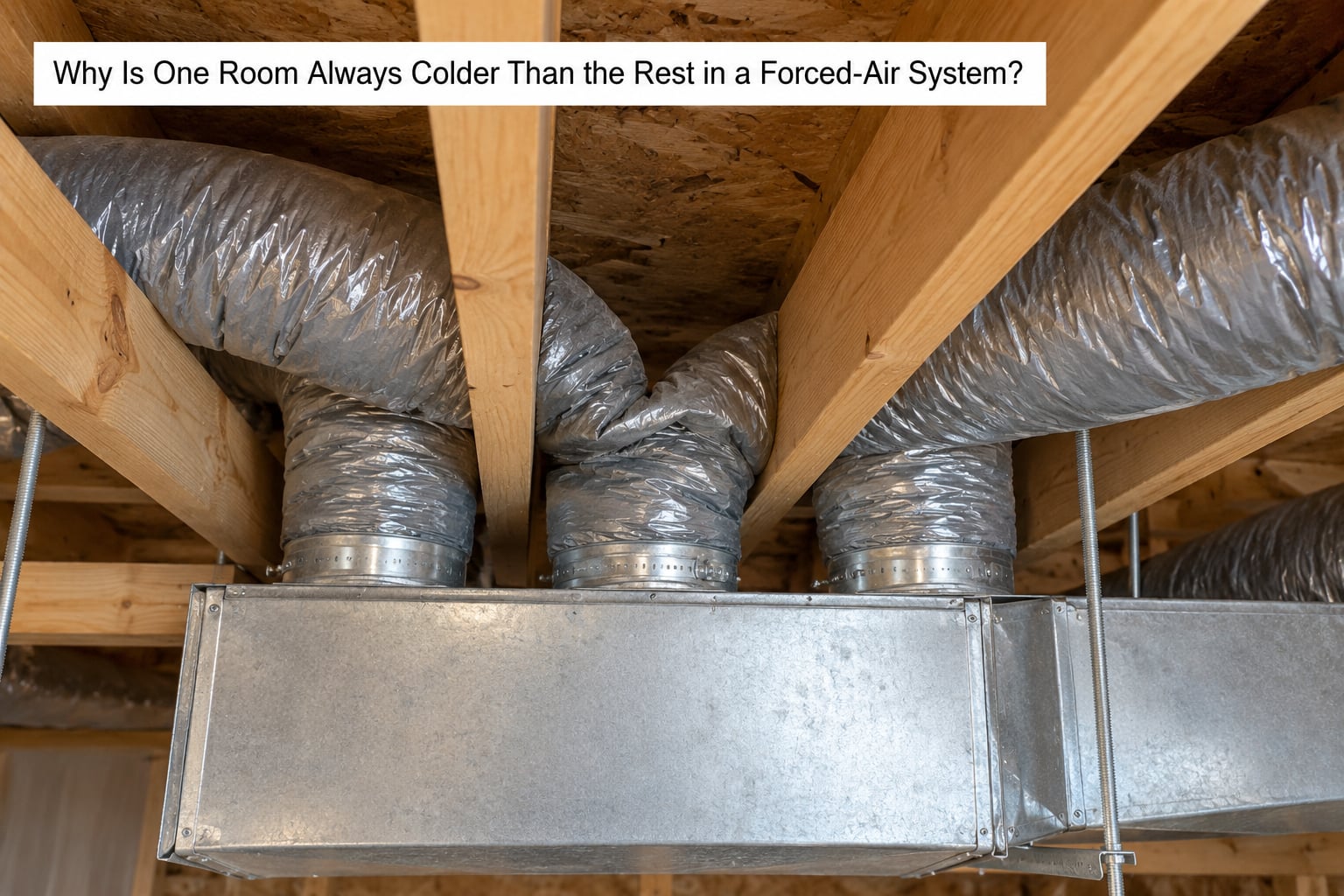
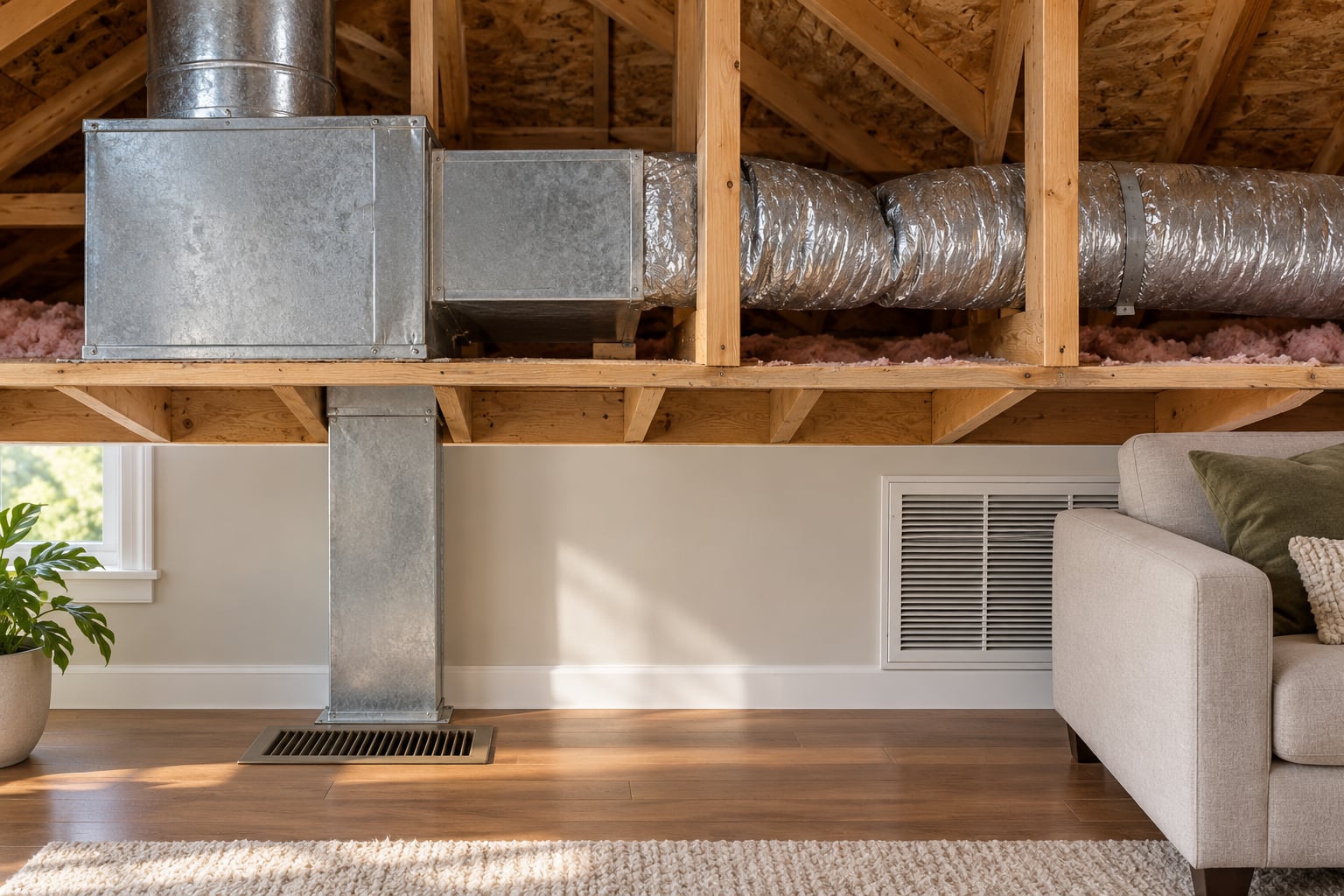
Ductwork is where most chronic uneven-heating problems live. The trunk line and main branches are sized for the whole house, but the branches running to individual rooms are often the weakest link.
Five causes account for most of it:
- Undersized supply ducts. A branch designed for an older, smaller room cannot deliver enough air to a bigger one, and the air that does arrive is diluted.
- Disconnected branches. Ducts worked loose in an attic or crawlspace. You will hear a hiss or a hollow roar from a nearby register, or nothing at all if a damper upstream is shut.
- Crushed flexible duct. This is the one I see most. Flex duct squeezed between joists, dragged over framing, or pinned under insulation loses a surprising amount of its volume.
- Debris and buildup. Ducts behind registers collect dust, pet hair and insulation fibers over years, particularly in homes with renovation dust or pets.
- Damper settings. Balancing dampers are meant to be adjusted by a technician with a flow hood. Settings get changed by well-meaning homeowners over the years and never revisited.
There is one safe test you can do yourself. Hold a tissue to the supply register in the cold room and to one in a comfortable room, then compare how hard they flutter. Equal, weak fluttering in both means the problem is likely not that vent. A register that barely moves while another flutters hard points upstream, to duct or filter.
Visible damage inside an attic or crawlspace, anything that involves opening sealed ductwork, or any change to damper settings is contractor territory. So is tracing a branch past what you can see from a register.
Can a Thermostat Make One Room Seem Colder?
A thermostat controls the whole system based on one reading in one place. If that place is a hallway next to a supply vent, near a sunny window, next to a fireplace, or in the warmest room in the house, every other room is being judged by the wrong number.
Location problems are common. A thermostat on an exterior wall reads cooler than the room, so the furnace runs longer and overshoots everything. One mounted high on a wall with a supply register right underneath reads warm, so the system shuts off before the far rooms get their share.
Schedule problems are just as common. A setback to a lower temperature at night, or a daytime saving window on a work schedule, hits upstairs bedrooms hardest because they cool fastest and recover slowest. Rooms that reach set temperature quickly and then drift back down are usually reacting to a cycling behavior rather than a delivery problem.
Moving or replacing the thermostat rarely balances a house. A room sensor or multi-sensor thermostat helps the system make better decisions, and a proper zoning assessment can divide the house into separate control zones, but neither fixes a crushed duct. If your plan is a second thermostat, put the first thermostat’s location on your list.
Could Insulation or Air Leaks Be Responsible?
There is a difference between a room that is not getting enough heat and a room that loses heat faster than the furnace can replace it. In a leaky room, warm air arrives, warms the surfaces, and then leaks out the moment the cycle ends.
Windows are often the biggest single source. Inefficient windows can account for up to 30 percent of a home’s heat loss, which is why a room with a wall of glass stays cold no matter what the thermostat is set to. Single-pane glass and older double-pane units with failed seals are the usual culprits.
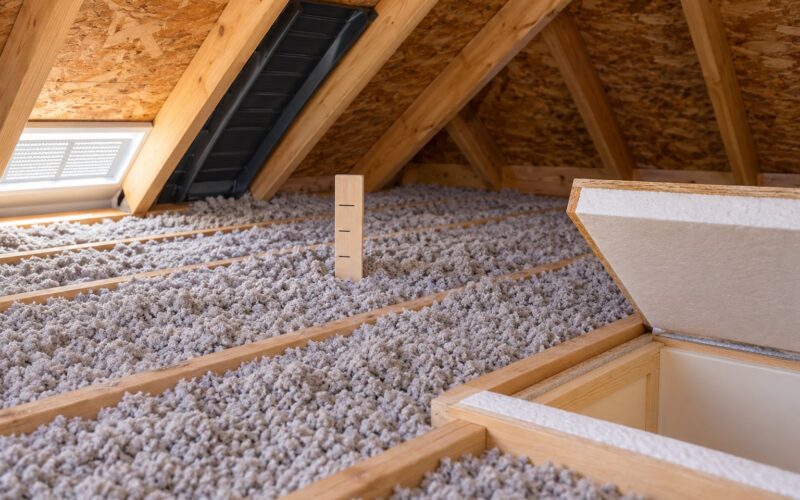
Air leakage is the quieter version. Gaps around window and door frames, missing seals at electrical outlets and switches on exterior walls, and holes around recessed light fixtures all let heated air escape and cold air enter. Interior doors and rooms open to an unheated garage, attic or basement add more.
You can inspect safely with no tools beyond your hands and eyes: run a hand along window frames and door edges to feel for drafts, look for daylight gaps around outlet covers, and check whether curtains and blinds close fully. Do not pull on insulation in a crawlspace or attic, open finished walls, or disturb anything that could be asbestos or vermiculite in an older home.
What Can You Safely Check Before Calling an HVAC Professional?
There is a reasonable short list a homeowner can work through without tools or risk.
- Compare temperatures with a second thermometer in both rooms, at the same height, for a full day.
- Test the supply and return vents with a tissue and compare how they respond.
- Look for furniture, curtains or boxes sitting against any vent.
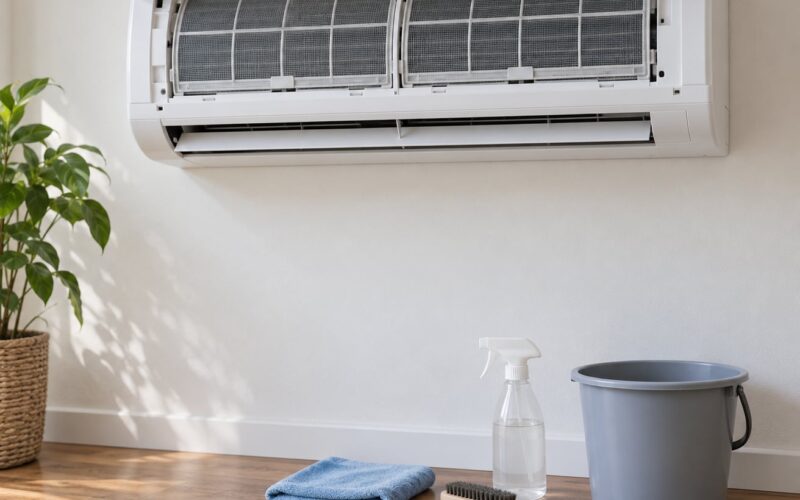
- Check the air filter and replace it if it is dirty or you cannot see through it.
- Confirm the thermostat schedule, including setback times and temperature differentials.
- Walk the register board, if you have one, and confirm the dampers serving the cold room are open.
- Check the thermostat batteries and the date and time on the display.
- Look for daylight at night around window frames and outlet covers.
Stop before you reach for these: changing equipment settings or jumping a safety switch, opening sealed ductwork, climbing onto a roof, or touching gas, electrical or structural components. Also leave refrigerant lines, refrigerant charge and anything inside the air handler to a licensed technician.
One caution about filters. If your system has a media cabinet in the return rather than a slide-in filter, replacing it is not the same job, and the wrong filter or a badly seated one can restrict airflow across the whole house.
When Is Uneven Room Temperature a Bigger Problem?
Uncomfortability is one thing. The following are the reasons to stop troubleshooting and make a call.
Watch for frozen or sweating pipes in the cold room, condensation on windows that persists after the heat runs, or surfaces where mold has started to grow. Repeated short cycling of the furnace, unusually high energy use, strong burning odors, hissing, or visible leaks all point at the equipment rather than the distribution.
A cold room that stays uneven across several heating cycles despite an open vent and a clean filter means the cause is not in the homeowner checklist. Gas connections, refrigerant charge, electrical components, refrigerant lines, and major duct or equipment faults all require licensed professionals, and refrigerant work in particular requires certification.
One more case worth naming: if a renovation moved or added walls, opened up a room, or changed a room’s use, the original duct balance no longer applies. The system can be perfectly healthy and still delivering the wrong amount of air to the new layout.
Frequently Asked Questions
Should I close vents in warm rooms to make another room warmer?
Closing vents in warm rooms usually backfires. The furnace still moves the same amount of air, so restricting the open registers raises pressure inside the ductwork and starves the room you were trying to help. It also raises fuel or electricity use, and on some systems the high-limit switch can shut the burner down. Leaving every register open and asking a contractor to balance the system with a flow hood is the safer fix.
Why is one bedroom colder than the rest of the house?
Bedrooms tend to be cold for three common reasons. The bedroom sits at the far end of a duct run, so it receives the least air. It shares an exterior wall or sits above a garage, so it loses heat through a poorly insulated surface. Or a night setback thermostat drops the temperature, and the bedroom cools fastest and recovers slowest. Measure both rooms over a full day before you decide which one applies.
Can adding a second thermostat make the house warmer?
A second thermostat adds control, not heat. It can let you hold one zone at a different temperature or keep a room from being pulled down by a setback, but it cannot add airflow to a starved room or reduce heat loss through a wall. If your main thermostat is in a poor location, relocating or adding a sensor there will improve accuracy more than adding a second dial.
How do I know whether a problem is caused by ducts or insulation?
Hold a tissue to the supply register in the cold room and to one in a comfortable room. If airflow is equal and weak, the problem is the system or the filter rather than that vent. Then feel the surfaces: if the walls or windows in the cold room are also colder than the air, heat loss is the dominant cause. Both can be true at once, which is common in corner and top-floor rooms.
Is a room with cold walls a heating-system problem?
Cold walls usually mean heat loss, not a malfunctioning furnace. Warm air heats the room quickly, then the surfaces pull heat out of it as soon as the cycle ends, so the room feels cold even with the registers open. Check the airflow first to rule out a distribution problem, then focus on windows, exterior wall insulation, air sealing around outlets and doors, and any unfinished space next to the room.
When should I call an HVAC technician for uneven temperatures?
Call a technician when the difference persists across several heating cycles despite a clean filter, open vents and unobstructed returns. Call sooner if you see frozen or sweating pipes, condensation, mold, repeated short cycling, strong burning odors, hissing or leaks. Gas, electrical, refrigerant and major ductwork work should always be handled by a licensed professional, and anything inside the attic or crawlspace is beyond a homeowner’s safe reach.
Conclusion: Start with the Airflow
The first thing to do is find out which vents actually serve the cold room, clear anything blocking a return, and compare airflow and temperature against a room you know is comfortable. That single comparison usually tells you whether you are chasing delivery or chasing heat loss, and everything after it gets cheaper and faster.
If the imbalance persists once vents are open, the filter is clean and the thermostat schedule is sensible, get an evaluation before anyone talks about a bigger system. Gas, electrical, refrigerant, major duct changes and structural work are jobs for licensed professionals, and so is anything that takes tools into an attic or crawlspace.