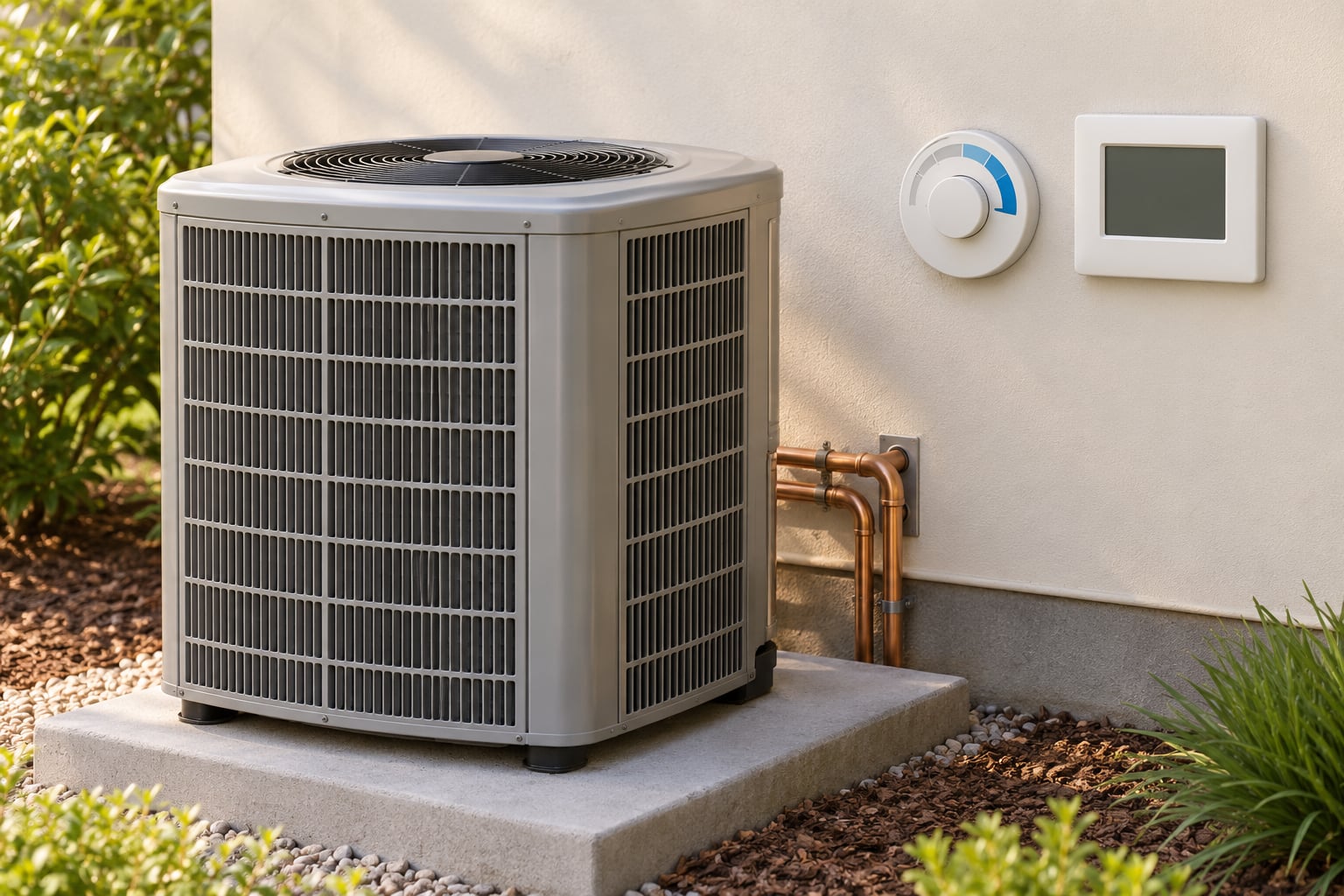
SEER stands for Seasonal Energy Efficiency Ratio. It is the total BTUs of cooling an air conditioner delivers across a full cooling season divided by the watt-hours of electricity it used to deliver them. A higher number means less power for the same amount of cooling, which is why SEER is the first spec most homeowners learn to read.
If you have ever stood in a supply house comparing a 14 to a 20, that is the number you were reading. This guide explains where the rating comes from, what the ranges actually mean, and how to decide whether a higher tier is worth anything in your house.
Every claim below is tied to the standard test, the region rules, or the label on the equipment, so you can check it yourself rather than take a sales pitch on faith.
Table of Contents
- What Does SEER Rating Mean for Air Conditioners?
- What SEER Rating Ranges Mean
- How Is a SEER Rating Calculated?
- What Does SEER Rating Mean for Air Conditioners by Region?
- In the United States
- In Canada
- Other markets and window units
- Which SEER Rating Should You Choose?
- How Do SEER Ratings Affect Energy Costs and Savings?
- What SEER Rating Is Good for a Typical Home?
- How to Check and Compare SEER Ratings Before Buying
- Frequently Asked Questions
- Is a higher SEER rating always better for my home?
- What is the difference between SEER and EER?
- What is a good SEER rating for air conditioners?
- Does a SEER rating tell me how much money I will save?
- Is SEER2 the same as SEER, and how do I convert between them?
- What is the typical SEER rating of a 20-year-old air conditioner?
- Conclusion
What Does SEER Rating Mean for Air Conditioners?
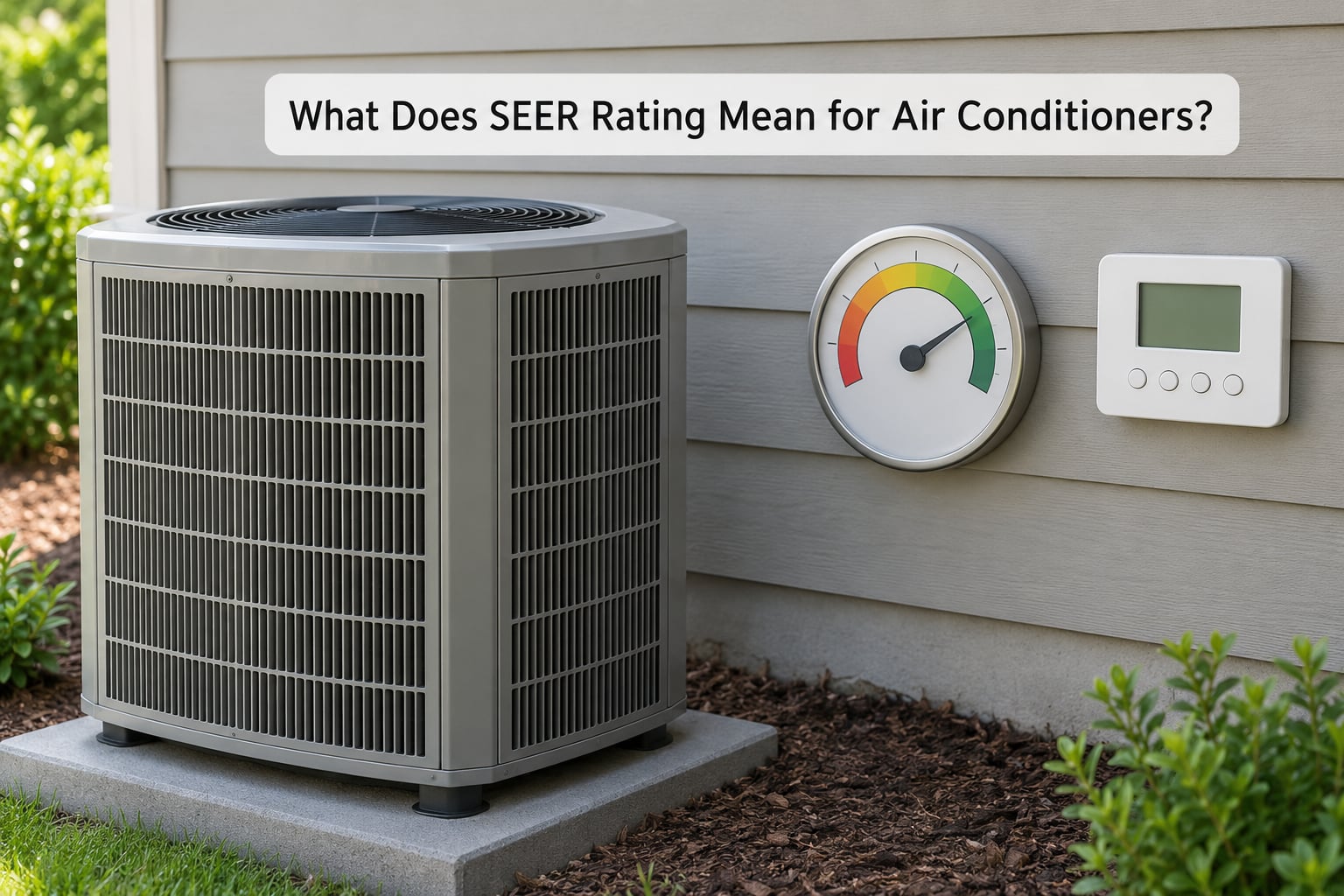
SEER rating is a measure of cooling output per unit of electricity over a season, not a single moment. Think of it as the MPG of your cooling system: two air conditioners can cool the same 2,000 square feet of house, but the one with the higher SEER rating does it using less electricity to do it.
Seasonal matters because a unit that looks efficient on a mild evening is not the same as a unit that still performs when it is 95 degrees outside. The rating blends a spread of outdoor conditions into one figure.
SEER is not the same as EER. EER is measured at one specific condition, usually a single low-speed steady state, and the number looks far higher as a result. Compare SEER to SEER, never SEER to EER.
SEER is also not the ENERGY STAR label. ENERGY STAR is a certification that includes efficiency, sound, and other criteria, so a unit can be efficient without carrying the label.
What SEER Rating Ranges Mean
| SEER rating | Category | What it fits |
|---|---|---|
| 8 to 12 | Legacy | Equipment made before efficiency rules tightened. Common in homes built or conditioned before the mid-2000s. |
| 13 to 14 | Baseline | Meets the US minimum that applied to equipment sold in recent decades. Fine for mild climates and light use. |
| 15 to 16 | Efficient | A sensible middle for most homes. Often the tier that clears utility rebate thresholds. |
| 17 to 18 | High efficiency | Worth the money in hot climates, long run seasons, or on costly electricity. |
| 19 to 21 | Premium | Variable-speed and two-stage compressors. Bigger comfort gains than the bill savings alone would suggest. |
| 22 and up | Top tier | Top of the available range. Only makes sense where cooling load is heavy or incentives offset the gap. |
Those bands describe the current SEER2-era numbers, which read slightly lower than the older SEER scale for the same piece of equipment. That is not a downgrade. It is a stricter test.
How Is a SEER Rating Calculated?
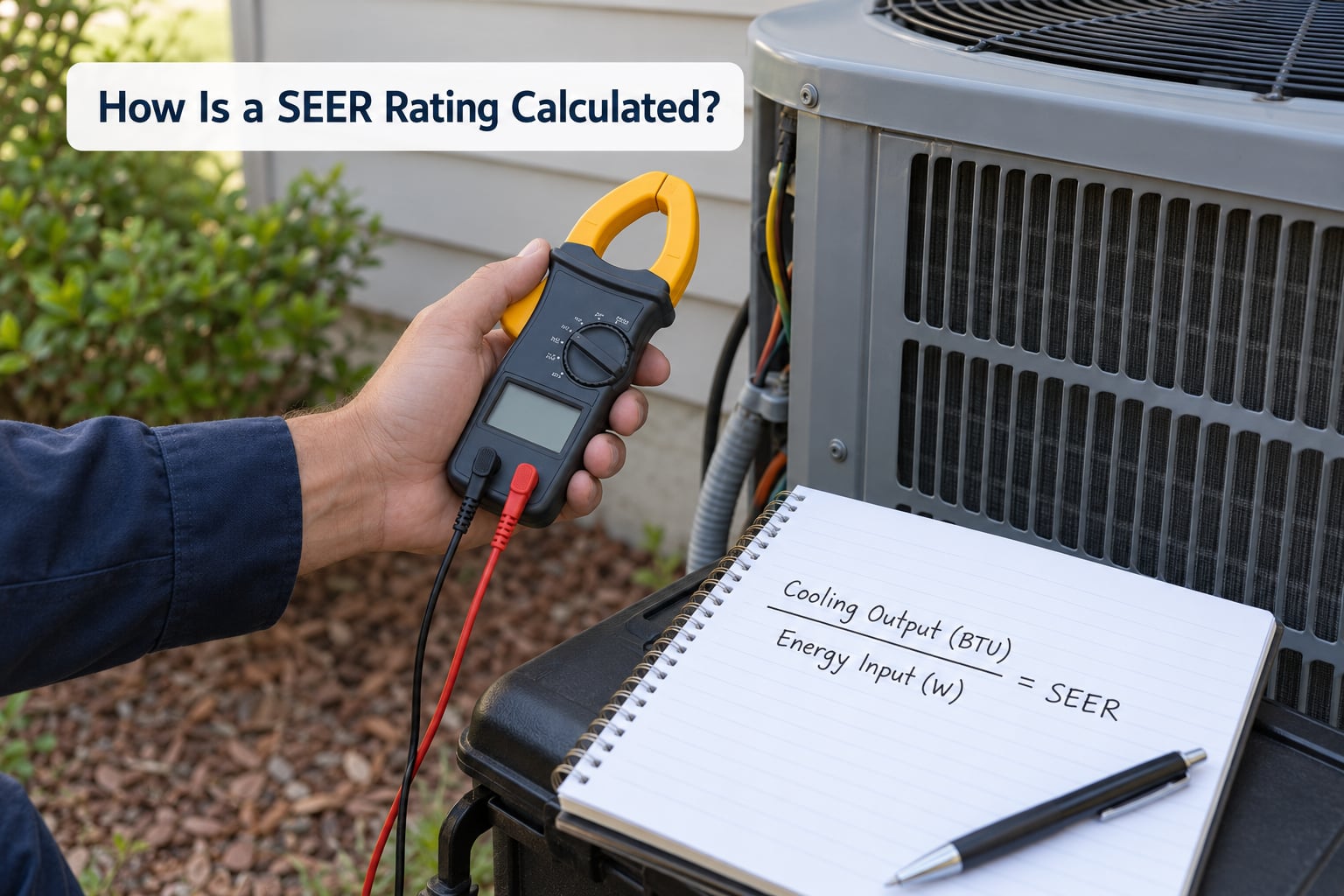
The math is simple. Divide the total seasonal cooling output in BTUs by the total electrical input in watt-hours over the same season. The unit on the result is BTU per watt-hour.
Here is the arithmetic in miniature. A system delivering 12,000 BTUs of cooling for every 600 watt-hours of electricity used works out to a rating of 20. Double the electricity for the same cooling and the number halves.
Getting that season-long total is the part nobody does in their driveway. Each unit is lab-tested under ANSI/ASHRAE Standard 240, with ratings verified through the Air-Conditioning, Heating, and Refrigeration Institute. The test cycles the equipment through a defined range of outdoor temperatures and indoor humidity levels, and it adds a fixed allowance for the pressure the air loses moving through real ductwork. The output is the number printed on the product.
That duct allowance is the difference between SEER and SEER2. Equipment sold since 2023 is tested under SEER2, which accounts for a higher assumed duct pressure drop and therefore reads about 4.5 percent lower than the old test for the same unit. A 16 that used to be sold as SEER shows up as roughly 14.7 on SEER2. Same machine, stricter assumption.
Real-world performance drifts from the test for ordinary reasons: undersized or oversized equipment, a dirty filter, leaky ducts, a system matched badly at install, and how tightly you run the thermostat. The rating is a controlled comparison, not a promise about your July bill.
What Does SEER Rating Mean for Air Conditioners by Region?
In the United States, the federal minimum is not one number. The US Department of Energy sets regional minimums, and the values you will see quoted for current equipment cluster around 13.4 to 14.3 SEER2 depending on where in the country you are. The rule also changed over time. The minimum was 13 under the 2006 rules and 14 under the 2015 rules, which is why an older quote sheet and a new one may not even be speaking the same scale.
In the United States
Southern and southwestern regions carry the higher minimums because the cooling season is long and the design conditions are severe. Northern regions carry lower minimums. If you want the exact number that applies to your address, the Department of Energy and your state energy office publish the regional map, and the data plate on the unit itself has to meet it.
In Canada
Canada has no single national SEER minimum in the way the US has regional ones. Provinces set their own requirements, AHRI certification carries the rating across the border, and many Canadian product sheets list EER and IEER alongside SEER. Check the provincial energy regulator rather than assuming a US threshold applies.
Other markets and window units
Outside North America, the rating is often expressed in a different format entirely, with local energy labels using their own scales and test protocols. Window and portable air conditioners are exempt from the federal minimums and carry their own rating approach, so the numbers on a room unit are not comparable to a central system.
Whichever market you are in, the equipment data plate, the manufacturer specification sheet, and your local code are the three sources that outrank anything a blog says.
Which SEER Rating Should You Choose?
Pick the tier your building, climate, and energy rate support, not the highest number a salesperson can order. These are the inputs that actually move the decision.
Climate and run season. A household in a place where air conditioning runs six hours a night for four months has a very different case than one that needs it for eight weeks. Longer seasons reward higher efficiency more.
Ductwork condition. High-rated equipment often needs higher static pressure to push air through the system. Old undersized ducts, a lot of flex duct, or long neglected runs will quietly undo the efficiency you paid for. Have the ducts evaluated before you commit to a top tier.
Electricity rate. Savings scale with your per-kWh charge. The same efficiency step is worth more where power is expensive.
What you already have. Matching a new condenser to an existing old furnace or air handler is common and often sensible, but the delivered efficiency is the efficiency of the weakest component, not the number on the new box.
Incentives. ENERGY STAR, utility rebates, and the Section 25C federal tax credit all have efficiency thresholds, and some utilities set them well above the federal minimum. If a rebate is on the table, the eligible tier may decide your purchase for you.
Sizing and installation. A correctly sized, correctly installed 16 SEER system will beat a badly installed 20 every time. A Manual J load calculation and verified duct design are worth more than two extra points of rating.
How Do SEER Ratings Affect Energy Costs and Savings?
Higher SEER means fewer watt-hours for the same cooling, so annual consumption drops in roughly the same proportion. The relationship is not linear in dollars, which is where a lot of marketing claims go wrong.
Here is a worked illustration using standard assumptions. A 3-ton system producing 36,000 BTUs per hour and running roughly 2,000 equivalent full-load hours in a season delivers about 72 million BTU-hours of cooling. At a rating of 10, that is about 7,200 kWh for the season. At a rating of 16, the same cooling takes about 4,500 kWh, a saving of roughly 2,700 kWh. Multiply that by your own utility rate to see what it is worth to you, because rates vary enormously by region and season.
Notice the shape of that result. Going from 10 to 16 cut consumption by about 37 percent. Going from 16 to 20 would cut it by a further 20 percent. Each efficiency step is worth less than the last, which is why the jump from an ancient unit to a mid-tier unit is dramatic and the jump from 16 to 20 is a decision rather than an obvious win.
That is also the honest counter to the large savings percentages you see advertised. A widely repeated ballpark in HVAC forums is that each efficiency step returns roughly 6 to 7 percent rather than the 30 to 40 percent headline figures on contractor sites, and the gap is usually down to the low starting point of the old unit rather than over-promising the new one.
A higher rating stops being worth much when the old unit was already modern, when the ducts cannot deliver the air, or when the quoted gap between tiers is large and unexplained. Ask for the written equipment specification and confirm the delivered performance assumption before you compare quotes.
What SEER Rating Is Good for a Typical Home?
For most homes in a moderate climate, a rating in the mid-teens is the practical baseline to aim for, because it clears most current minimums and most utility rebate thresholds without a large price gap. Hot climates with long seasons justify the high teens and low twenties. There is no single best number for everyone.
If your current system is 20 or 30 years old, the more useful question is what it is rated at today.
| System age | Typical rating | What produced it |
|---|---|---|
| 25 to 30 years | 6 to 9 | Pre-2000 equipment, before the first federal minimum of 13 took effect. |
| 15 to 20 years | 9 to 12 | Early 2000s builds, when the 13 minimum applied and efficiency was treated as an option. |
| 10 to 15 years | 12 to 14 | Mid to late 2000s, the 13 minimum and then the 14 minimum in 2015. |
| 5 to 10 years | 14 to 18 | Variable-speed and two-stage equipment became common in this window. |
| Under 5 years | 14.3 to 21 | Current SEER2-rated equipment, from regional minimums up to the premium tiers. |
If you fall in the bottom two rows, replacing the unit is the single largest efficiency move available to you, and the exact tier you choose matters much less than the fact of replacing it.
How to Check and Compare SEER Ratings Before Buying
Run through this before you sign anything.
Read the EnergyGuide label. The yellow label on the outdoor unit lists the rating along with the estimated annual cost and the comparable range across models. It is the quickest confirmation that you are getting the tier you were quoted.
Read the data plate. The metal plate on the outdoor unit carries the model and serial number. The rating itself may not be printed there, but the model number is the key to everything else.
Look up the model number. The manufacturer specification sheet for that model gives the AHRI-certified rating, the cooling capacity, the compressor type, and the sound level. Confirm the rating is the SEER2 number if the unit is recent.
Check the AHRI certificate. The certification directory lets you match the exact model and confirm the published rating rather than a dealer’s rounded-up description of it.
Ask for the rating of the whole system, not the condenser. When equipment is mixed, ask what the delivered seasonal efficiency is based on and why. A new high-SEER condenser on an older air handler delivers the combined number, not the box number.
Get comparable quotes in writing. The same tier, the same tonnage, the same work included, and the same warranty terms. Comparing a 14-SEER quote against an 18-SEER quote tells you about marketing, not efficiency.
Confirm incentive eligibility in writing if a rebate or credit is part of the decision, including the rating threshold, the required documentation, and who files it.
Frequently Asked Questions
Is a higher SEER rating always better for my home?
A higher SEER rating generally means the air conditioner can provide more cooling output for the electricity it uses, but it is not automatically the best choice. Climate, ductwork, insulation, equipment sizing, and your electricity rate all affect whether the extra efficiency pays for itself. On a system that is already reasonably efficient, a moderate upgrade usually makes more financial sense than jumping to the top tier.
What is the difference between SEER and EER?
SEER is a seasonal efficiency measure intended to represent a range of outdoor temperatures and cooling conditions, while EER is measured at one specific condition. Because EER excludes the fan and is measured at a single favourable point, its number is much higher. Use SEER to compare one central air conditioner against another, and never compare a SEER figure to an EER figure on a different product listing.
What is a good SEER rating for air conditioners?
A rating around the mid-teens is commonly treated as a baseline in many US markets, while higher ratings can be worthwhile in hot climates or where electricity is expensive. There is no single best number for every home. Check your regional minimum, your utility rebate thresholds, and the condition of your ductwork before choosing a tier above the baseline.
Does a SEER rating tell me how much money I will save?
No. The rating describes a standardized relationship between cooling capacity and electrical input, not a guaranteed dollar saving. Actual consumption changes with weather, thermostat settings, duct condition, and how well the system was installed and sized. Treat any savings figure as an illustration with stated assumptions, then check it against your own past electricity bills.
Is SEER2 the same as SEER, and how do I convert between them?
SEER2 is the current test standard, introduced in 2023, that adds a realistic duct pressure drop to the calculation and reads about 4.5 percent lower than the old SEER test for the same equipment. To compare an older quote to a current one, divide the old SEER by about 1.09. So 16 SEER is roughly 14.7 SEER2, and 20 SEER is roughly 18.3 SEER2.
What is the typical SEER rating of a 20-year-old air conditioner?
A system installed about 20 years ago is most likely rated somewhere between 9 and 12, since equipment from the early 2000s was built to a federal minimum of 13 and many units ran below the efficient tiers of the day. Find the real number on the data plate or the original paperwork. If it comes back at 10 or lower, replacing the unit is a larger efficiency gain than any upgrade on a newer system.
Conclusion
A SEER rating is a seasonal measure of cooling output per watt-hour, and a higher number means a machine that does the same cooling with less electricity. The right tier for your house depends on climate, ducts, electricity rate, what you already own, and which incentives apply.
Start by finding the rating on your current unit using the data plate and model number, then check your regional minimum and your utility’s rebate thresholds. From there, ask a qualified HVAC contractor for a written whole-system quote that names the model, the rating, the sizing calculation, and the delivered efficiency assumption.