A heat pump works in cold weather by moving heat from outdoor air into your home rather than burning fuel to make it. Even air at 0°F holds plenty of thermal energy, so a modern cold climate unit can carry most of a house’s heating load well below freezing.
The catch is that output and efficiency both shrink as the air gets colder, and the outdoor coil needs periodic defrosting. Three things explain nearly every cold-weather question owners have:
- Defrost cycles run every so often in freezing weather to shed ice from the outdoor coil, and your system pauses heating while it does.
- Efficiency in cold climates depends on the compressor and the design of the unit. A standard single-stage heat pump loses capacity fast; an inverter-driven cold climate model holds much more of it.
- Backup heating — auxiliary electric strips or a gas furnace — takes over when outdoor temperatures fall past the point where the heat pump alone can match your home’s heat loss.
Table of Contents
- How Does a Heat Pump Work in Cold Weather?
- How does a heat pump work in cold weather, in plain terms?
- What Changes When the Temperature Drops?
- How cold is too cold for a heat pump to work?
- Should a heat pump run constantly in cold weather?
- How the Heating Cycle Keeps Your Home Warm
- The four stages, step by step
- A worked example: heating a 2,000 sq ft house
- What Happens During a Defrost Cycle?
- How to tell defrost is happening
- Why Some Heat Pumps Lose Efficiency in Winter
- The three myths about heat pumps in cold weather
- Where the balance point and backup heat come in
- Air source vs ground source in cold weather
- What You Can Do to Support Cold-Weather Performance
- Your cold-weather checklist
- When you need a licensed HVAC technician
- Why some contractors hesitate — and what to ask yours
- Frequently Asked Questions
- How cold is too cold for a heat pump to work?
- Why does my heat pump go cold during the defrost cycle?
- Should a heat pump run constantly in cold weather?
- What is the 20 degree rule for heat pumps?
- What is a major disadvantage of a heat pump in cold climates?
- Why don’t some contractors like heat pumps?
- What to Do First
How Does a Heat Pump Work in Cold Weather?
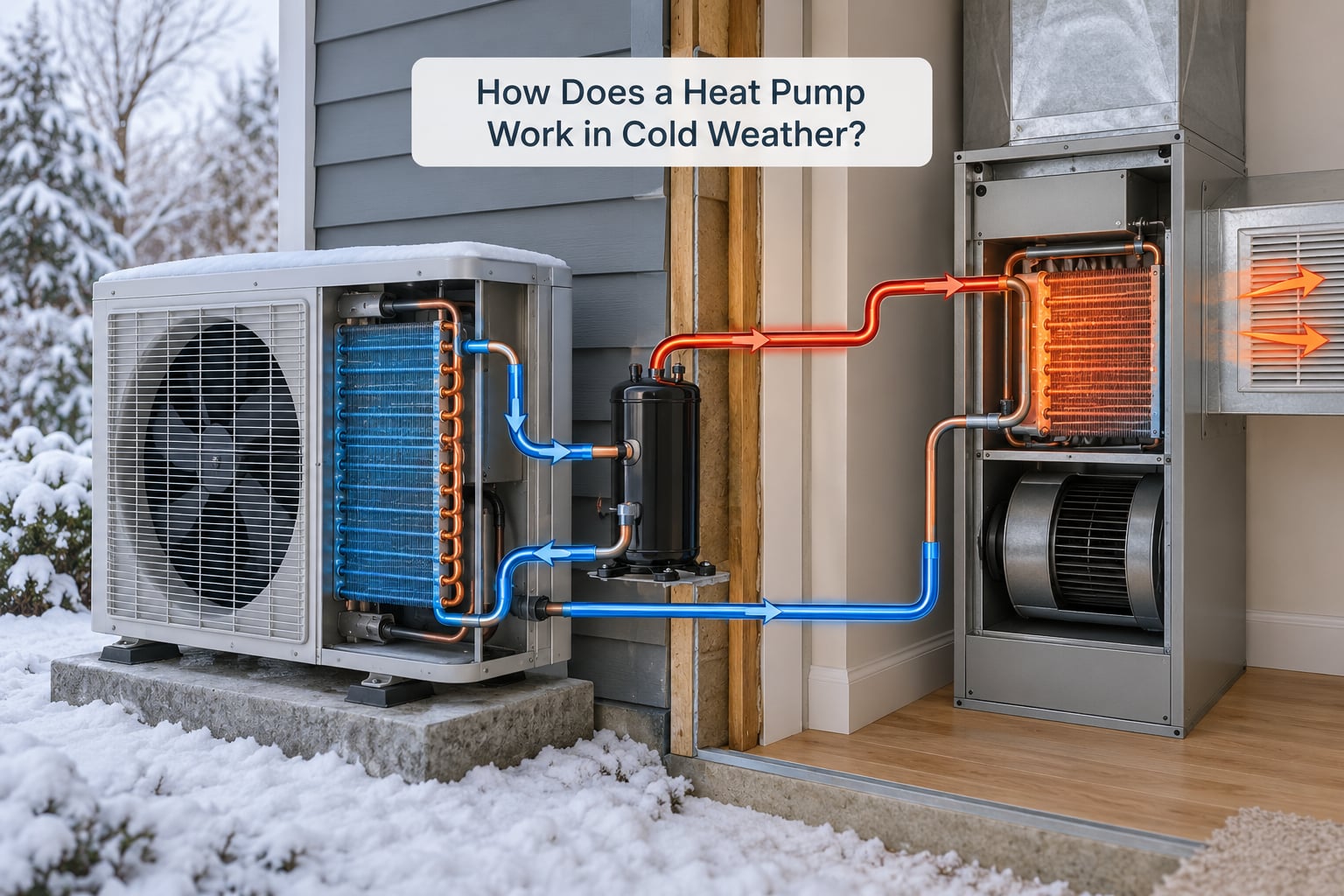
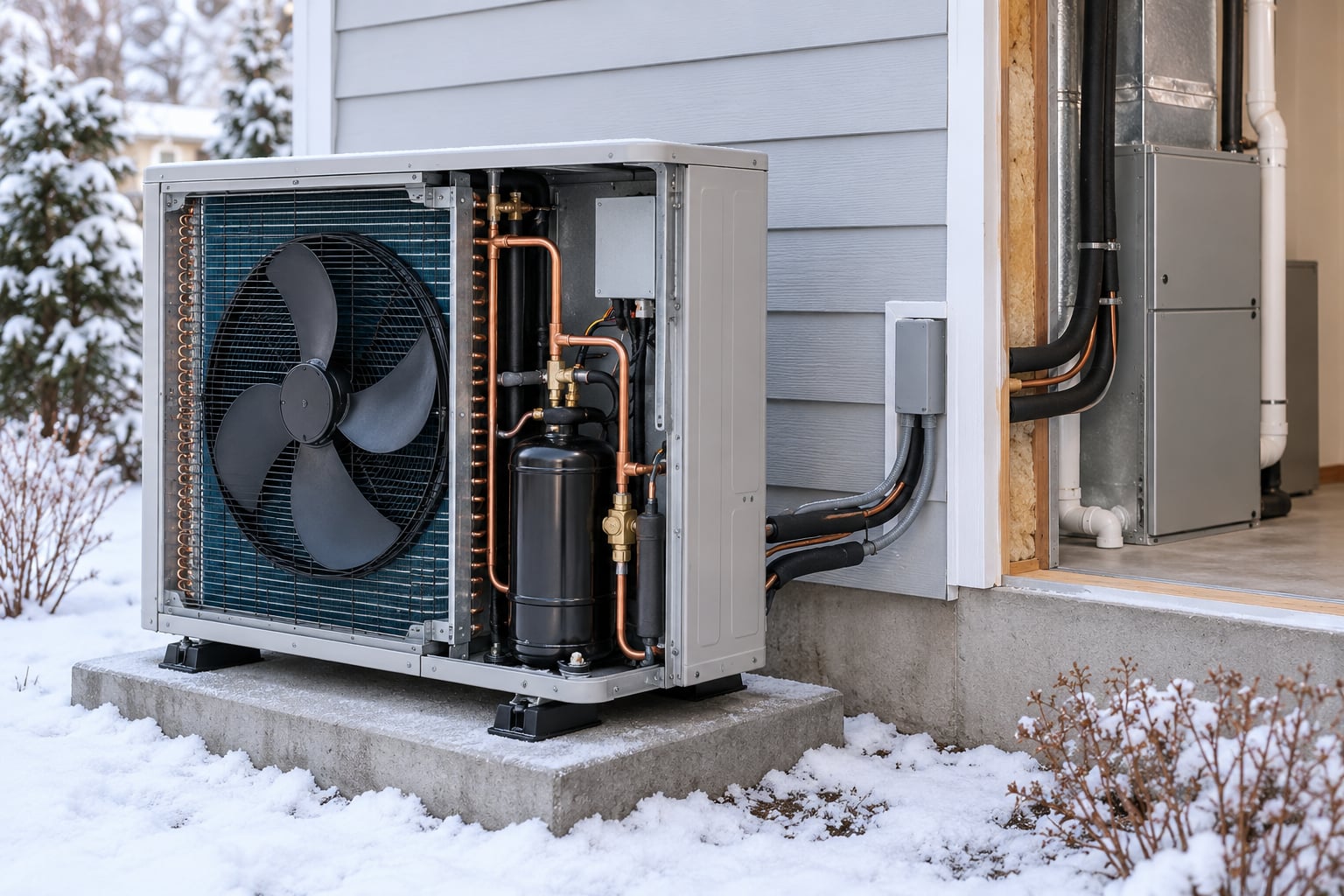
Put simply, a heat pump is a refrigerator running backwards. A fridge pulls heat out of a box and dumps it into your kitchen. A heat pump pulls heat out of the outdoor air and dumps it into your living room.
Three pieces of hardware do the actual work. The refrigerant is a fluid that circulates in a sealed loop and can absorb or release heat as it changes pressure. The compressor squeezes that refrigerant, raising its pressure and temperature. The reversing valve redirects the hot, high-pressure gas to whichever coil needs it — outdoor in summer, indoor in winter.
That last part is the trick that makes one appliance do both jobs. A furnace needs a burner and a chimney. A heat pump needs a compressor and a valve.
How does a heat pump work in cold weather, in plain terms?
Air temperature is a measure of how much energy its molecules are carrying, not a measure of how little energy is there. Air at 0°F still carries roughly three-quarters of the thermal energy of air at 140°F, which is a useful comparison Rewiring America makes when explaining why heat pumps are not fighting an impossible task in winter.
What cold air does change is the gap the pump has to work with. In mild weather the outdoor air is warmer than the refrigerant arriving at the outdoor coil, so heat flows in easily. As the air cools, that gap narrows, the compressor has to push harder, and the unit delivers less heat for more electricity.
What Changes When the Temperature Drops?
Two numbers fall together as the temperature drops: how much heat the unit can deliver (capacity) and how much heat it delivers per unit of electricity (COP, or coefficient of performance). Both taper off. Neither one hits a cliff unless something is wrong with the equipment.
A variable-speed compressor helps a lot here. Instead of firing on at full blast and stopping, it ramps up and down to match the heat the house is losing right now. On mild cold days that means long, low runs at a good COP. On the worst night of the year it runs near its ceiling, and that ceiling is where capacity numbers matter.
| Outdoor temperature | Share of rated heating capacity | Typical COP range |
|---|---|---|
| 30°F | roughly 100% | 3.0 to 3.4 |
| 20°F | roughly 95% | 2.6 to 3.0 |
| 10°F | roughly 85% to 90% | 2.2 to 2.6 |
| 0°F | roughly 75% to 80% | 1.8 to 2.2 |
| -10°F | roughly 60% to 70% | 1.4 to 1.8 |
| -20°F | roughly 40% to 50% | below 1.5 |
Read the last row with care. Below -20°F, an air source heat pump is running at roughly half its rated output and delivering less than one unit of heat per unit of electricity, which means resistance strips would be cheaper per hour of heat. That is exactly why a backup system exists, not a sign the main unit is failing.
How cold is too cold for a heat pump to work?
For a cold climate model, “too cold” is usually a question about your house rather than about the machine. Units certified under the DOE Cold Climate Heat Pump Challenge carry a capacity rating at 5°F, and many retain a useful share of output down to -20°F and below. Check the ratings label or the spec sheet rather than guessing, because a standard efficiency unit in the same climate behaves very differently.
The temperature that matters is the one where heat loss from your home exceeds the heat the pump can deliver. Once you’re past that line, no amount of equipment skill saves the situation — the house simply needs more heat than that unit can move.
Should a heat pump run constantly in cold weather?
Yes, often, and usually with nothing wrong. A heat pump maintains a setpoint far more efficiently than it recovers one, so on a deep cold morning it runs nearly back-to-back just to hold 68°F. If the house was already at 68°F when you woke up, that long runtime is normal. The pattern that suggests trouble is aux heat running continuously rather than the compressor.
How the Heating Cycle Keeps Your Home Warm
The loop runs in four stages, and it runs in a circle. The same refrigerant goes around again and again, changing state at each stop.
The four stages, step by step
- Evaporation (outdoor coil). Cold, low-pressure refrigerant enters the outdoor coil, which is colder than the surrounding air. Heat moves from the air into the refrigerant, and the fan pushes more air across the fins to feed it.
- Compression. The compressor squeezes the refrigerant vapor into a hot, high-pressure gas. This is where the electricity goes, and where most of the energy in a heat pump comes from — the rest is gathered from outside.
- Condensation (indoor coil). The reversing valve sends the hot gas to the indoor coil. Because the refrigerant is now hotter than your indoor air, heat flows out of it and into the house, the refrigerant condensing back into a liquid along the way.
- Expansion. The liquid passes through an expansion device, drops in pressure, and comes out cold and low-pressure again, ready to start at stage one.
Switch the valve and every stage flips. The outdoor coil becomes the condenser and rejects heat; the indoor coil becomes the evaporator and absorbs it. That single valve is the whole difference between heating season and cooling season.
A worked example: heating a 2,000 sq ft house
Suppose a 2,000 square foot house in a northern climate needs about 60,000 BTU per hour at 70°F indoors with an outdoor temperature near 0°F. A 3-ton cold climate unit might deliver roughly 34,000 BTU per hour at 0°F, based on the table above. It cannot close that gap alone, so the system brings in auxiliary heat to supply the rest.
Below about 15°F, most owners expect the same thing. Above about 30°F, the heat pump usually carries the whole house on its own. The forum chatter in r/heatpumps and r/HomeImprovement reflects that pattern closely: people describe heat pumps that hold a setpoint happily through deep cold, paired with a backup furnace they hope never to use.
What Happens During a Defrost Cycle?
When the outdoor coil drops below freezing, moisture in the air freezes onto the fins. That ice is a physical barrier: the coil can no longer pull heat from the air passing over it, and capacity falls. Left alone, the unit would eventually ice over completely. So it thaws itself on a schedule.
Here is the sequence, using the same equipment you just read about.
- Frost forms. The outdoor coil is colder than 32°F and ice builds on the fins, especially along the top edge where the coldest air lands.
- The controller senses it. A sensor on the outdoor coil, or a timed schedule, triggers defrost when enough ice has accumulated.
- The reversing valve switches. The unit runs in reverse: the outdoor coil becomes a condenser and releases heat onto the ice to melt it.
- Hot gas does the work. The compressor pushes hot refrigerant to the outdoor coil. Many systems also send hot water through a coil inside the outdoor cabinet, or reverse the outdoor fan to push warm indoor air across the frozen fins. Defrost commonly runs somewhere around five to ten minutes.
- The valve flips back. Once the coil is clear, the system returns to heating mode within a few minutes.
- Backup heat covers the gap. Because the house is not being heated during those minutes, most systems temporarily call for auxiliary heat — or the house simply drifts a degree or two and recovers on its own.
That last point solves a question that shows up in r/homeowners and r/hvacadvice more than any other: the house briefly goes cool, sometimes on a still, mild, overcast day with no obvious weather reason. Defrost is often triggered by ice rather than by a temperature threshold, which is why it can happen at 36°F as readily as at 20°F.
How to tell defrost is happening
Listen for the outdoor fan cutting off, followed by a hissing or gurgling sound and a fan running in reverse. Indoors you may hear a soft whoosh from the air handler as the mode changes. The thermostat’s heat indicator may switch to auxiliary for a few minutes. If that pattern repeats on a schedule and the house recovers afterward, that is a working defrost cycle, not a fault.
Why Some Heat Pumps Lose Efficiency in Winter
Cold weather is not the only reason a heat pump underperforms. Several ordinary problems look a lot like “the cold got it,” and owners often blame the weather for a fault that would show up in July too.
- Airflow problems indoors. A clogged filter or undersized ducts starve the indoor coil of air, and the system can freeze the coil or blow cold air while reporting that it is heating. This is the most common complaint, and the cheapest to fix.
- A dirty or blocked outdoor unit. Fins clogged with cottonwood seed, leaves or a season of snow cut capacity directly. Clear a foot or so of clearance around the unit after storms.
- Low refrigerant. A system that used to hold temperature and now struggles is worth checking. Most modern residential systems are sealed, so a low charge means a leak that needs repair, not a top-up.
- An oversized system. This is the one that makes no sense at first. A furnace that is twice as big as the house rarely causes a problem because it fires intermittently. A heat pump that is twice as big cycles on and off, wastes efficiency and can fail to clear the air of humidity in winter.
- Thermostat settings and control. Aux heat lockout, balance point control and staging all affect how much work the heat pump does before backup heat joins in. A thermostat set to emergency heat locks the heat pump out entirely.
- Weak ductwork. Rooms that stay cold while the rest of the house is fine point at distribution, not the pump.
The three myths about heat pumps in cold weather
The capacity myth: heat pumps cannot heat a home in the cold. In practice, a properly sized cold climate unit supplies the great majority of heating need down to very low temperatures. Certified cold climate models are tested at 5°F, and capable ones still deliver a large share of their rated output down to -20°F. The heat is there; the question is how your specific house compares.
The efficiency myth: heat pumps are inefficient because they use electricity. Efficiency is a ratio, not a fuel. Even at a COP of 1.8, a heat pump delivers 1.8 units of heat per unit of electricity — better than gas, and far better than electric resistance heat. The advantage narrows in extreme cold; it does not vanish.
The money myth: heat pumps cost more to run. Heating is typically a home’s largest energy expense and the one most exposed to fuel price swings, and this is the category where heat pumps differ most from combustion equipment. Installation and electrical service, not the equipment itself, is what tends to surprise people.
Where the balance point and backup heat come in
The balance point is the outdoor temperature at which the heat pump’s available heat output exactly matches the heat your house is losing. Above it, the heat pump runs alone. Below it, backup heat has to make up the difference, and at some point the two together are still not enough.
That crossover has a name in cold regions: the lockout temperature, often set around 95% to 98% of the indoor setpoint. If the indoor temperature never reaches the lockout point, aux heat never engages — and that is the goal of a well-set-up system. Owners on r/heatpumps frequently describe setting a gas or oil backup to stop at 60°F and letting the heat pump carry the house from 60°F up to 70°F.
Some people call that a dual-fuel or hybrid system: a heat pump on the outside and a gas furnace inside sharing one duct system and one thermostat. It costs more to install and gives up some of the all-electric simplicity, in exchange for never having to think about whether a cold snap will outrun the equipment.
Air source vs ground source in cold weather
A ground source heat pump draws on soil or groundwater, which in most of the northern US stays somewhere around 50°F to 60°F year-round. That means its output barely moves through the winter. A ground source system is more stable and more efficient, and it costs considerably more to install because of the buried loop.
An air source system is far cheaper to put in and is the right answer for most homes. The trade is real but modest once a cold climate model is specified correctly, and the difference shrinks as those units have improved.
What You Can Do to Support Cold-Weather Performance
Most cold-weather complaints trace back to something a homeowner can check in ten minutes, or to something that genuinely needs a technician. Sorting the two apart saves money.
Your cold-weather checklist
- Change the filter. Once a month in heating season. A restricted filter is the most common reason a heat pump struggles and the easiest fix.
- Clear the outdoor unit. Keep leaves, seed pods and snow drifts away from the fins, and leave clearance on all sides so air can move freely.
- Do not cover the top of the outdoor unit in a tarp or cardboard box. It traps meltwater and ice against the coil. A proper winter cover goes over the unit and is removed in the spring.
- Leave the heat pump in heat mode. Do not switch the thermostat to emergency heat for a single cold afternoon, and do not lock the heat pump out to “save” it. Heat pumps are designed to run in the cold.
- Set the fan to Auto. Continuous fan operation often makes a house feel drafty and cold without changing actual supply temperature.
- Watch the thermostat’s auxiliary heat indicator. Occasional short bursts during defrost are normal. Hours of continuous auxiliary heat is a signal, not a fact of life.
- Check your filter and system at the start of heating season. An annual service visit catches refrigerant issues, coil condition and control problems before the first cold snap.
When you need a licensed HVAC technician
Call a professional if the outdoor unit is iced over and does not clear, if the system blows cold air while the thermostat calls for heat, if it short-cycles repeatedly without settling, if the refrigerant line or the compressor area is hissing or weeping, or if you see a burning smell. Electrical work at the disconnect, refrigerant work, and anything involving the duct system or the unit’s electrical supply belongs with a licensed contractor. Never open the refrigerant circuit yourself.
Why some contractors hesitate — and what to ask yours
Some homeowners are surprised to find contractors reluctant to quote a heat pump, and the reasons are usually about the job rather than the equipment. Heat pumps are equipment-sensitive in a way furnaces are not: an undersized or oversized unit, undersized ducts or a house that has not been evaluated will all cause callbacks. A contractor who quotes a cold climate heat pump without doing a Manual J load calculation and looking at your duct size is skipping the work.
Ask for the load calculation, ask for the unit’s capacity and efficiency at 5°F rather than only its seasonal ratings, and ask who sets the balance point lockout. A contractor who answers those three questions plainly is one who has installed enough of them to know what happens in February.
Frequently Asked Questions
How cold is too cold for a heat pump to work?
There is no single cutoff, because it depends on your unit and your house. Cold climate models are rated for capacity at 5°F, and many still deliver useful heat at -20°F. What actually decides the limit is the balance point: the outdoor temperature where the heat the pump can deliver falls below the heat your home loses. Below that, backup heat has to make up the gap.
Why does my heat pump go cold during the defrost cycle?
It is normal and temporary. Defrost switches the refrigerant flow in reverse so the outdoor coil can melt the ice on it, which means for several minutes the system is not heating the house. Most systems call for auxiliary heat to cover it. You may also notice a pause, a hiss from the outdoor unit, and a fan running in reverse before heating resumes.
Should a heat pump run constantly in cold weather?
Often, yes. A heat pump is far better at holding a setpoint than at recovering one, so on a cold morning it runs nearly continuously to keep the house at the temperature it already reached overnight. Continuous auxiliary heat is the part worth investigating. If the backup heat runs for hours, the cause is usually capacity, airflow or a control setting rather than normal winter operation.
What is the 20 degree rule for heat pumps?
It is folklore, not a specification. The idea that a heat pump stops working at 20°F describes older, standard-efficiency equipment, which lost capacity quickly. Modern cold climate units retain a large share of their rated output well below that, and many are certified for performance at 5°F. Check the ratings on your specific unit instead of relying on a rule of thumb.
What is a major disadvantage of a heat pump in cold climates?
Output and efficiency both decline as outdoor temperatures fall, and the decline steepens below about 20°F. That means deep cold often brings the backup heat on, and electricity use rises. Sizing, ductwork condition and where your home sits relative to its design outdoor temperature all affect how often that happens.
Why don’t some contractors like heat pumps?
Most often because the equipment is unforgiving of a sloppy install. A heat pump needs a proper load calculation, duct sizing that can handle high airflow, and control settings for auxiliary heat. Get a written Manual J load calculation, the unit’s rated capacity at 5°F, and the balance point lockout setting, and a contractor who answers all three is one to trust.
What to Do First
Start with the filter, then walk outside and look at the outdoor unit. A clogged filter and a blocked or snowed-in coil explain a startling share of “the heat pump stopped keeping up” complaints, and both take minutes to deal with.
Next, check the thermostat. Make sure it is in heat mode rather than emergency heat, the fan is on Auto, and note how often the auxiliary indicator comes on. Continuous auxiliary heat is the signal worth acting on; a brief flash during defrost is not.
If the problem survives those checks, call a licensed HVAC technician. Ask for a load calculation, the unit’s capacity at 5°F, and the balance point lockout setting. And remember the short version of how does a heat pump work in cold weather: it moves heat rather than making it, it does that job most efficiently in mild cold, and it leans on backup heat only for the part of the winter it has to.