To clean vinyl siding without damage, wet it with a garden hose, apply a mild dish soap or vinegar solution with a soft-bristle brush, and work from the top down, rinsing thoroughly. Skip pressure washers, metal brushes and undiluted bleach, and never spray water at an upward angle that could force moisture behind the panels.
The whole job takes a couple of hours on a one-story house and most of an afternoon on two stories, and it needs nothing more specialized than a bucket, a hose and a brush. Dirt, pollen, algae and a dull UV-induced chalk film are the usual reasons siding looks tired, and all four come off with soap, water and a little patience.
Plenty of people have learned this the hard way, usually on older, faded siding. A jet of water driven behind a loose panel swells the sheathing behind it, and a stiff wire brush leaves scratch marks that hold dirt forever. So this guide walks through the gentle method first, then covers what to avoid.
Table of Contents
- What You Need to Clean Vinyl Siding Without Damage
- Step-by-Step: How to Clean Vinyl Siding Without Damage
- Test the Cleaner on a Hidden Section
- Remove Loose Dirt with Low-Pressure Water
- Apply the Mild Cleaning Solution
- Scrub Gently Section by Section
- Rinse Thoroughly and Let the Siding Dry
- Common Mistakes
- Using a pressure washer at full force
- Bleaching faded or oxidized panels
- Using abrasive tools
- Letting the solution dry on the siding
- Cleaning hot, dry siding in direct sun
- Skipping the window, door and outlet zones
- Frequently Asked Questions
- Can a power washer damage vinyl siding?
- What PSI will damage vinyl siding?
- Can vinegar ruin vinyl siding?
- Is Dawn dish soap good to clean vinyl siding?
- What should you not clean vinyl siding with?
- Why does my siding look worse after cleaning?
- Start With the Bottom Panels
What You Need to Clean Vinyl Siding Without Damage
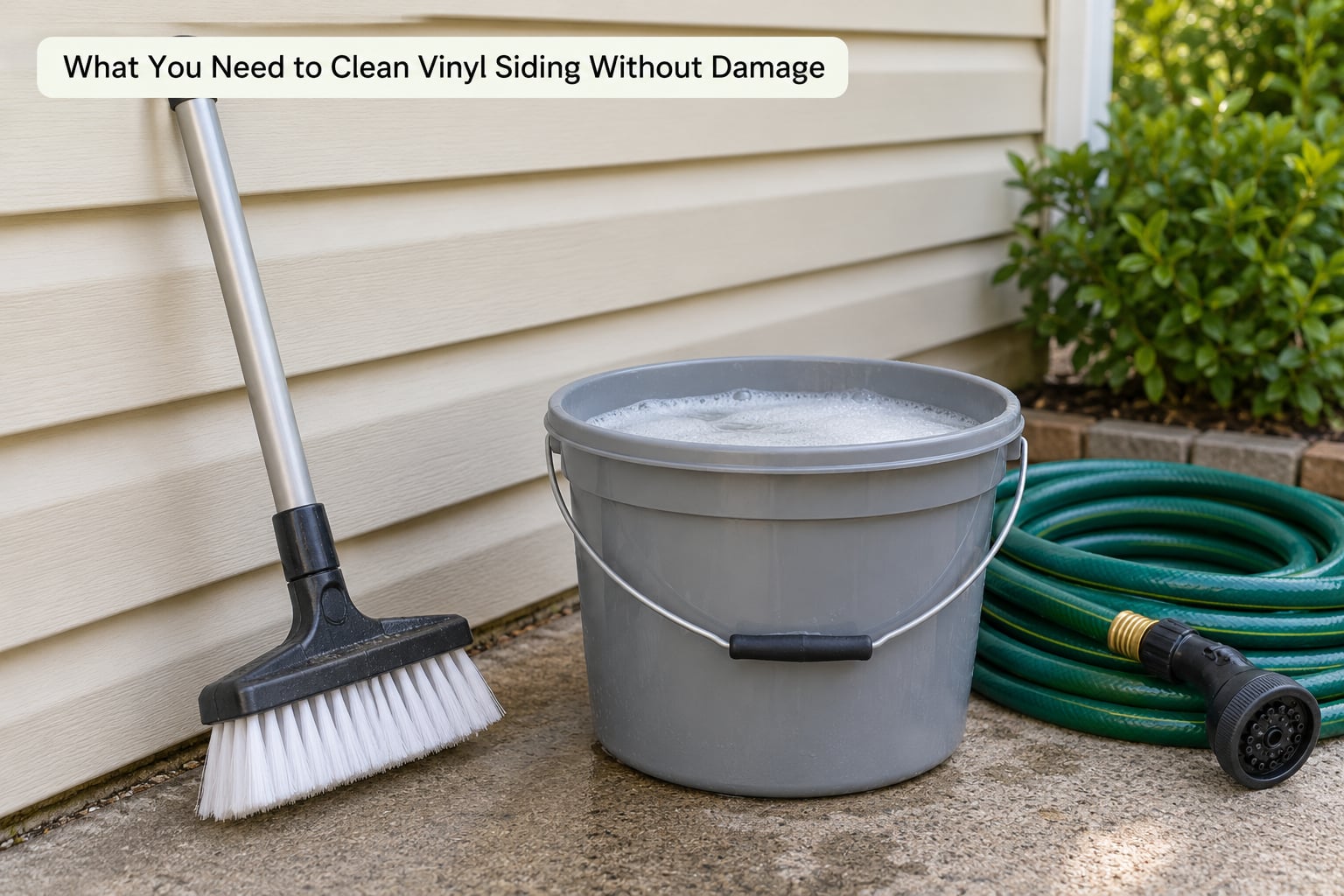
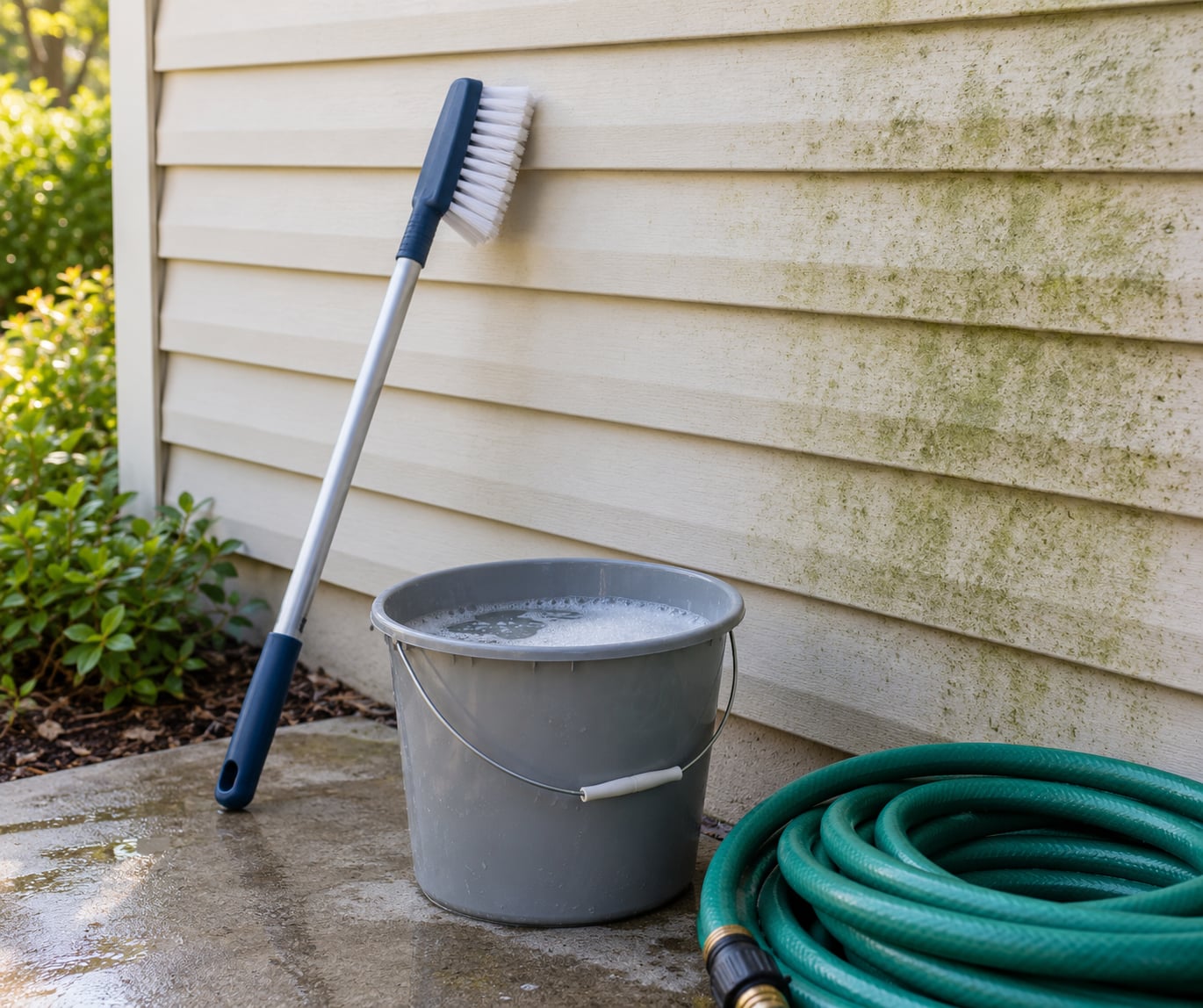
Most of the gear is already in the garage. What matters most is that the brush is soft and the soap is mild.
- A soft-bristle brush. Nylon bristle, not wire, not stiff. A long-handled or telescoping brush saves a lot of reaching.
- Mild dish detergent or white vinegar. Plain dish soap diluted in warm water works for general grime.
- A bucket and a garden hose. The hose needs a spray attachment, or a hose-end sprayer for even coverage.
- Clean microfiber cloths or a soft sponge. Useful for windows, doors and light fixtures around the openings.
- A soft-bristled handheld brush or old toothbrush. Small brushes handle trim, soffit vents and caulk lines.
- Optional: a garden pump sprayer. Homeowners cleaning their own houses call this the single best upgrade, because it lets you apply solution top-down instead of climbing.
- Optional: a ladder with a stabilizer, or a roof rake for debris. Only if you plan to work overhead.
Before you mix anything, find the manufacturer’s care instructions. Most vinyl siding manufacturers publish a cleaning bulletin and a warranty, and some will not cover panels damaged by an unapproved cleaner or by power washing. CertainTeed, for example, does not recommend power washing vinyl or polymer siding because it can drive water behind the panels. Reading the bulletin takes five minutes and settles most arguments before they start.
Step-by-Step: How to Clean Vinyl Siding Without Damage
Work on an overcast day, or in the shade of one side of the house at a time. Six steps, in this order.
Test the Cleaner on a Hidden Section
Mix your solution first, then find a patch of siding nobody sees, usually behind a shrub or on the back wall near the ground. Paint it on, wait the full dwell time you plan to use, and rinse.
A mild dish soap mix is about 1 tablespoon per gallon of warm water. The common homemade recipe is 70 percent water to 30 percent white vinegar, which handles general grime and light algae without any of the bleaching risk.
Stop and dilute further if you notice any of four things in the tested patch: the color shifts, the surface bubbles, the vinyl goes soft or tacky, or the panel looks duller than it did before. Any one of those means the solution is too strong for the finish you have.
Remove Loose Dirt with Low-Pressure Water
Wet the siding evenly with the hose before any soap goes on. Start at the bottom of the wall and work upward, because gravity carries grime down onto panels you have already cleaned. Loose dirt rinses away here instead of getting smeared into the finish by your brush later.
Hold the nozzle at least 18 inches from the wall and angle the spray downward or straight across, never up. A 25- to 40-degree fan is gentle enough for panels that are tight and sound. Anything above roughly 1,500 PSI, held close with a narrow nozzle, will etch the surface and can blow water into wall cavities.
Apply the Mild Cleaning Solution
Put the solution on the brush or the cloth, not straight onto the siding. Spraying cleaner directly at the panel sends it running down into seams and around window openings before it has a chance to work, and that runoff is where streaks and moisture problems start.
These recipes cover most situations:
| Recipe | Use it on | Dwell time |
|---|---|---|
| 1 tbsp dish soap per gallon warm water | Dust, pollen, general grime | 5-10 minutes |
| 70% water, 30% white vinegar | Grime, light algae, soot | 10-15 minutes |
| Oxygen bleach, 1 part to 15 parts water | Green algae, mildew | 10-15 minutes, out of direct sun |
| 1/2 cup chlorine bleach per gallon | Heavy mildew, last resort, spot use only | Under 5 minutes |
| Commercial house wash concentrate, per label | Whole-house wash, some need no scrubbing | Follow the label |
Apply in manageable sections, roughly one wall panel course at a time, so the solution stays wet while you work. Sectioning is what keeps a wash from turning into a streaky patchwork.
Scrub Gently Section by Section
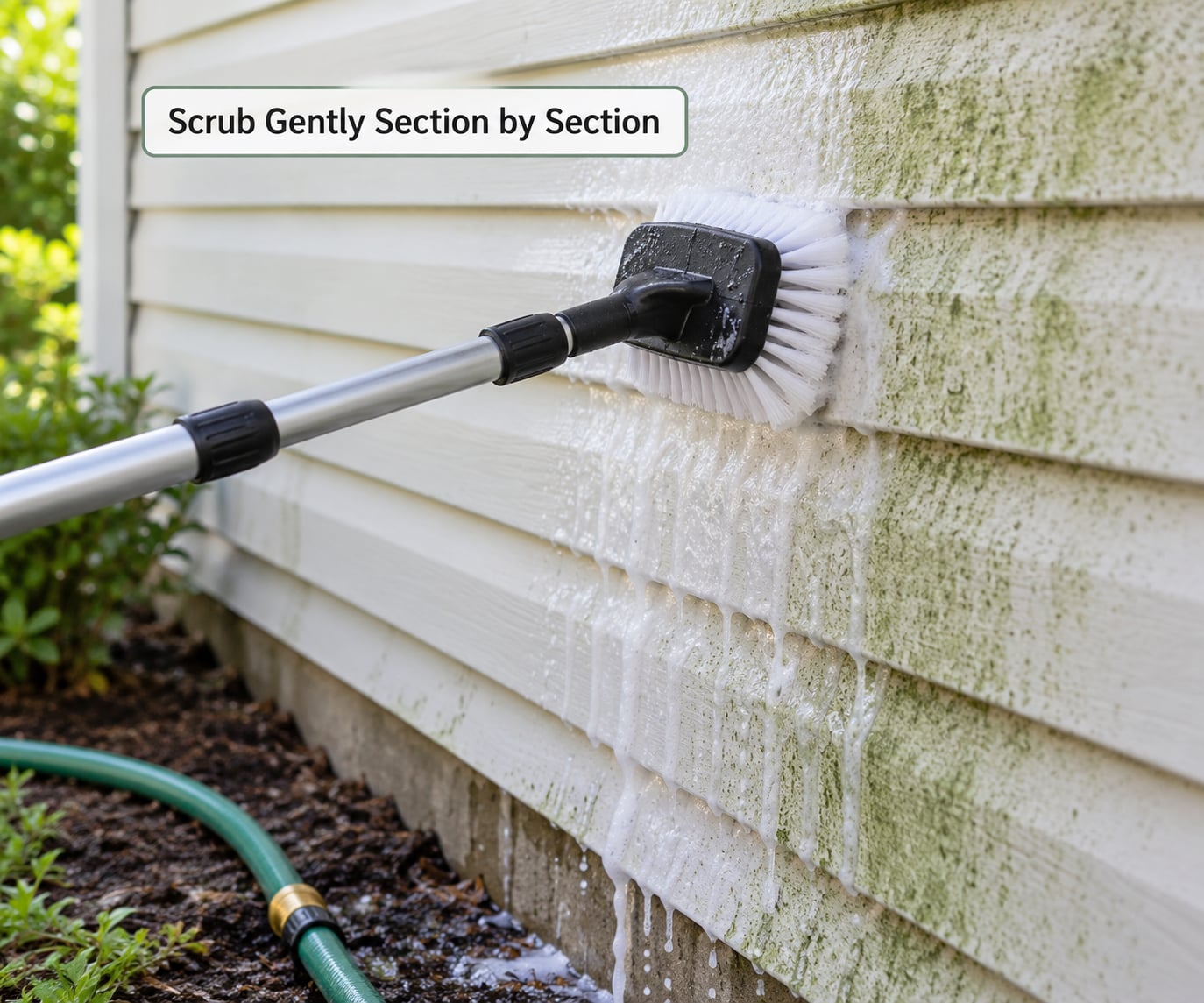
Use the soft brush in short, overlapping strokes and let the bristles do the work. You want the pressure of the brush, not of your arm. If the bristles are splayed flat and the panel flexes under your palm, you are pressing too hard.
Spend your time where the problems are: algae on north-facing walls, black mildew under eaves and porch enclosures, mud splash along the bottom course, and the brown or orange runoff marks below roof valleys and near downspouts. On a house with a lot of green, expect the north and east walls to take twice as long as the south.
Wire brushes, metal scouring pads and abrasive sponges leave scratch patterns that never fully disappear, and those scratches are where future algae takes hold.
On two-story walls, resist the ladder and work from the ground with a telescoping brush or a pump sprayer. That approach is slower and far safer than leaning a ladder on uneven ground with a wet bucket in your hand, and it is what people in home-maintenance forums reach for once they decide they are done climbing.
If algae comes back within a few weeks, the panel is the same but the conditions are not. North-facing walls sit in shade, hold moisture longer and give algae a better surface than a south wall in full sun. Shorten your cleaning interval to every six months there, and look for the actual cause first: a downspout dumping water onto one wall, a dripping hose bib, or shrubs holding moisture against the panels.
Two housekeeping jobs are worth doing while the siding is wet and clean. Rinse out the weep holes at the bottom of each panel so trapped moisture can escape, and check that every piece of window and door trim is still sealed to the wall. Those ten-minute checks prevent most of the moisture intrusion people blame on cleaning.
Rinse Thoroughly and Let the Siding Dry
Rinse from the top down, again at low pressure, until the water runs clear and no suds remain. Residue is the number one reason a clean house still looks streaky the next day, and it also attracts dirt straight back.
Let the siding air-dry, then walk the wall and look. You are checking for faded patches that contrast with the panels around them, dents, bowed edges, lifted seams and any panel that moves when you press it. Fill small gaps behind loosened panels with exterior-grade sealant while they are clean and dry, because that is the cheapest moisture-intrusion repair you will ever make.
Common Mistakes
These are the errors that actually damage siding, in rough order of how often they happen.
Using a pressure washer at full force
A surface cleaner head held a foot off the wall can etch vinyl in minutes. The safer fix is the hose and brush, or if you must use a washer, keep it under about 1,500 PSI, at least 18 inches out, angled down or across, and test a hidden panel first. Check the manufacturer’s warranty before you start.
Bleaching faded or oxidized panels
Sun-faded siding has a chalky film of oxidized PVC that no cleaner removes. Bleach strips that layer unevenly and makes the contrast between washed and unwashed panels obvious. Use soap and vinegar on oxidized siding and accept that the color will not come back.
Using abrasive tools
Wire brushes, steel wool and green scrub pads scratch. Swap them for a nylon-bristle brush and a microfiber cloth, then keep them for detail work around vents and windows where the soiling is light.
Letting the solution dry on the siding
Dried soap leaves a hazy film that needs a second full wash to remove. Work in sections you can rinse within a few minutes, keep the wall wet with a light mist from the hose, and start early enough to finish before the sun hits that wall.
Cleaning hot, dry siding in direct sun
Wet vinyl in direct sun and the water evaporates on contact, leaving cleaner behind. Choose an overcast day or work the shaded side first, and re-wet any panel that has started to dry out.
Skipping the window, door and outlet zones
Those are the risk areas on any house. Mask or keep solution off light fixtures and electrical outlets, watch the caulk lines around trim, and never spray directly into a window opening. A soft cloth dipped in the bucket handles trim better than any spray.
Frequently Asked Questions
Can a power washer damage vinyl siding?
Yes. A high-pressure jet can crack brittle panels, loosen fasteners, drive water behind the siding and strip the oxidized surface, which leaves faded panels looking blotchy. Most vinyl siding manufacturers do not recommend power washing at all. If you use one anyway, stay under about 1,500 PSI, keep a 25- to 40-degree nozzle at least 18 inches from the wall, angle the spray down or across, and spot test first.
What PSI will damage vinyl siding?
Anything above roughly 1,500 PSI held close to the panel can etch or gouge vinyl, and older, faded or brittle siding can be damaged well below that. Electric pressure washers meant for light cleaning generally run in the 1,000-2,000 PSI range. For vinyl, treat the wide spray setting as your ceiling rather than the maximum on the dial.
Can vinegar ruin vinyl siding?
No. White vinegar diluted to about 30 percent with water is one of the safest cleaners for vinyl, and it will not dull or etch the surface the way harsh alkaline or abrasive products can. The two things to watch are concentration and dwell time. Never use straight vinegar, and never leave a strong solution sitting in the sun for more than 15 minutes.
Is Dawn dish soap good to clean vinyl siding?
Diluted dish soap works well for ordinary dirt, and many manufacturers list it as an acceptable cleaner. A small amount, about one tablespoon per gallon of warm water, is enough. Too much leaves a film that causes streaking and attracts dust, and some dish detergents carry dyes or thickeners that settle into the panel texture. Rinse until the water runs clear.
What should you not clean vinyl siding with?
Avoid wire brushes, steel wool and abrasive pads, which scratch the surface permanently. Skip undiluted bleach, trisodium phosphate at high concentration and any solvent or degreaser, especially on faded siding. Laundry detergent is a poor choice because of its thickeners and enzymes. And never spray water or cleaner upward into seams, around windows or behind loose panels.
Why does my siding look worse after cleaning?
On older vinyl, cleaning removes dirt but not the chalky film of oxidized PVC that sun has burned into the surface. Clean panels next to untouched panels then show a sharp difference, which is why the result looks blotchy rather than better. It is not a sign of damage from the wash. If the contrast bothers you, the answer is a fresh panel on the worst areas, not a stronger cleaner.
Start With the Bottom Panels
Read the manufacturer’s bulletin, mix a mild solution, test it somewhere hidden, then wet the siding and work from the top down in sections you can rinse before the soap dries. That routine alone is enough to clean vinyl siding without damage, and it costs you a weekend afternoon rather than a repair bill.