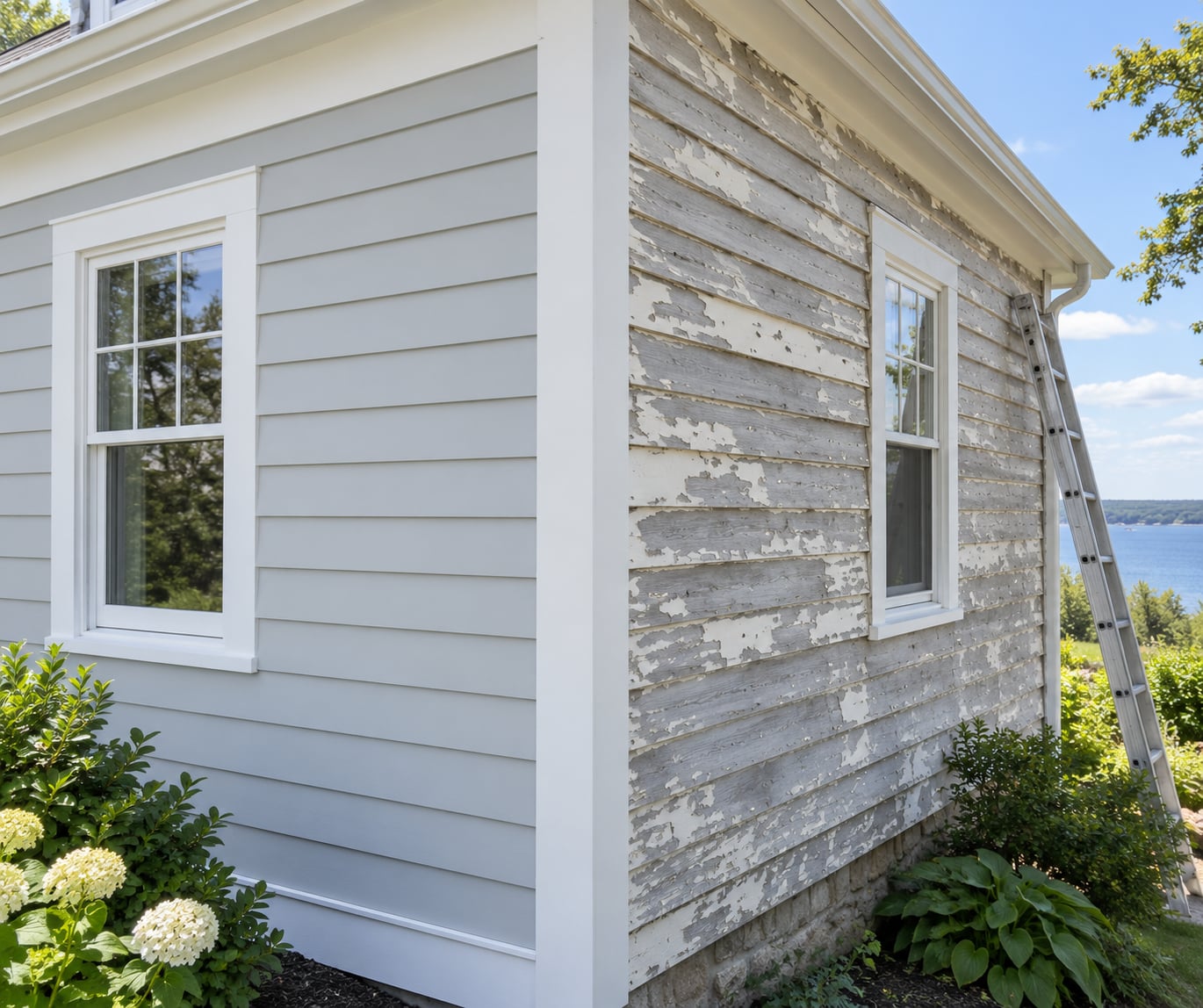
Most home exteriors need repainting every 5 to 10 years, and wood siding can go 3 to 7 years in a harsh climate. But the calendar is the weakest signal you have. When to repaint exterior of house surfaces really depends on what the coating is doing: whether it is chalking, peeling or cracking, whether water is getting behind it, and which side of the house you are looking at. A wall that fades evenly usually just looks tired. A wall that peels on one elevation is telling you something else entirely.
This guide walks through repaint intervals by material, the seven signs that mean the paint has stopped protecting the house, and a ten-minute inspection you can do before you call anyone.
Table of Contents
- How Often Should You Repaint the Exterior of a House?
- 7 Clear Signs It’s Time to Repaint
- When to Repaint Exterior of House Based on Surface Condition
- Cosmetic fading is not a failure
- Moisture-driven failure looks completely different
- When widespread damage beats spot-fixing
- How Climate and Sun Exposure Change Repaint Timing
- Which Exterior Surfaces Need Repainting First?
- How to Test Whether Existing Paint Is Still Usable
- Should You Repair the Exterior Before Repainting?
- Can You Repaint the Exterior Yourself?
- Frequently Asked Questions
- How do I know if my house needs a fresh exterior paint job?
- How often should exterior house paint be replaced?
- What time of year is best to repaint a house exterior?
- Do I need to prime the entire house before painting?
- Can I paint over peeling or chalking exterior paint?
- Should I repaint the house before selling it?
- Conclusion
How Often Should You Repaint the Exterior of a House?
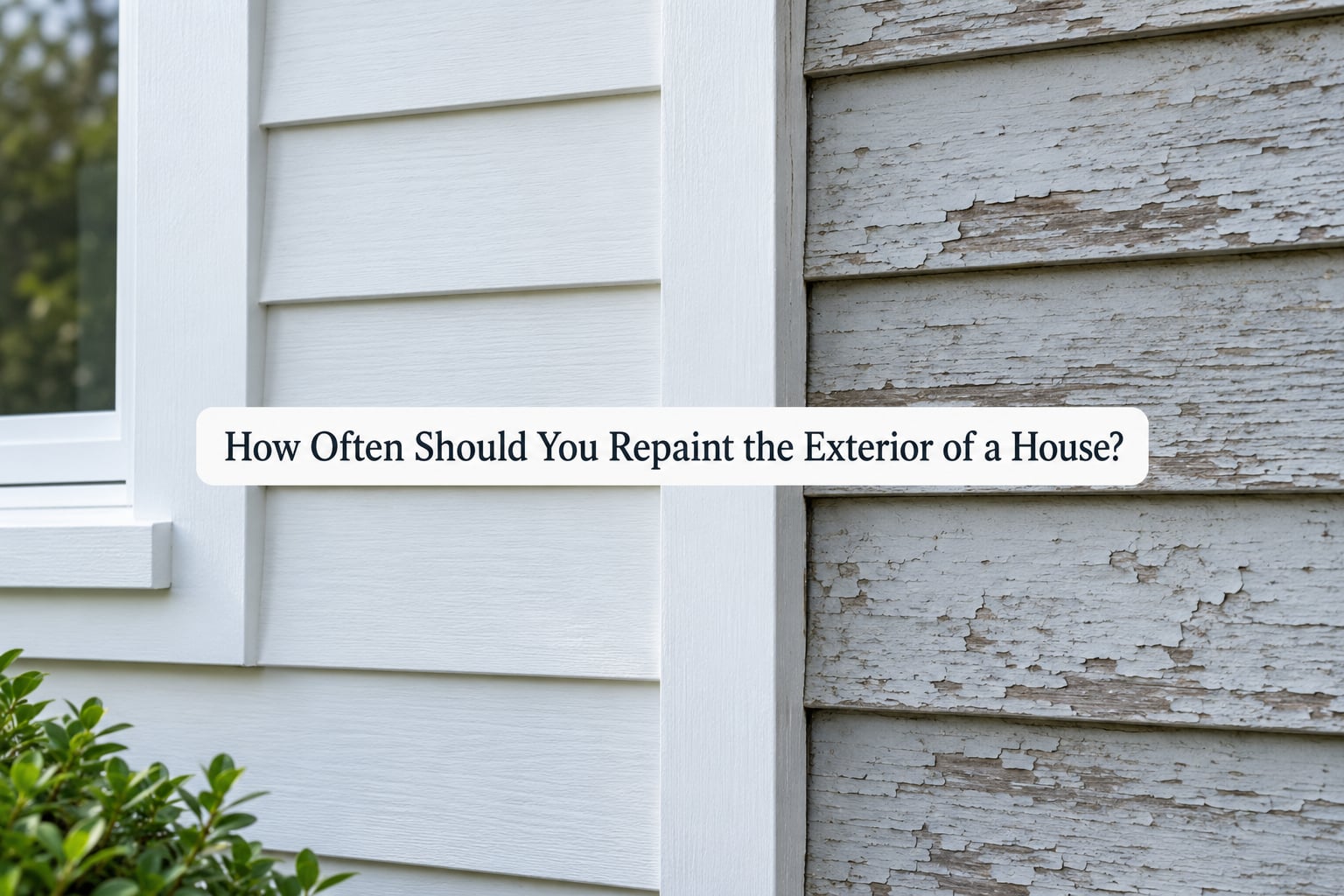
Most exteriors hold their finish for 5 to 10 years. The range is wide because paint life depends on the substrate, the paint itself, and how hard the surface works. Here is how often to repaint house exterior by material, based on manufacturer guidance and what painters report in practice.
| Exterior surface | Typical repaint interval | What shortens it |
|---|---|---|
| Wood siding | 3 to 7 years | Full sun, wet climate, poor prep |
| Vinyl siding | 5 to 10 years | UV exposure; dark colors fade faster |
| Aluminum siding | 5 to 10 years | Chalking, oxidation |
| Stucco | 5 to 10 years | Cracking, water at the base of walls |
| Brick | 10 to 15 years | Efflorescence and powdery salt deposits |
| Fiber cement or Hardie board | 7 to 15 years | Factory finish degrades slowly; edges chip first |
| Trim, doors, shutters | 3 to 5 years | High-visibility surfaces, constant touch |
You will see different numbers quoted for wood siding, sometimes 3 to 7 years and sometimes 5 to 10. That is not a contradiction. The 3-year end describes a south-facing wall in the Southeast that was painted with a cheap flat. The 10-year end describes quality 100% acrylic paint over sound wood in a moderate climate. Climate, orientation and paint quality move the answer more than any other three factors.
The wrong number to plan around is the one your neighbor got. Inspect your own exterior once a year, in daylight, walking the walls from about 20 feet back and then up close.
7 Clear Signs It’s Time to Repaint
Here is the short list. If you see one of these across a large area rather than in a single spot, start planning a repaint.
| Sign | What it means |
|---|---|
| 1. Peeling or flaking | Edges lifting or sheets coming off. Water is already getting under the coat. |
| 2. Cracking | Alligator cracking means the coating is brittle and no longer flexible enough to move with the surface. |
| 3. Fading and uneven color | One side no longer matches after a repair. Mostly cosmetic until it is paired with chalking. |
| 4. Chalking | Chalky residue on your hand after a swipe. UV has broken down the binder in the top layer. |
| 5. Blistering or bubbling | Trapped moisture pushing paint out from underneath. A repair issue, not a paint issue. |
| 6. Mold, mildew or algae streaks | Dark or green staining, usually on the north wall or under trees. |
| 7. Exposed substrate | Bare wood, gray fiber cement or masonry showing through. The finish is gone, not just dull. |
Two more things worth naming even though they are not paint: white powdery salt on brick called efflorescence, and gaps in the caulk around windows and trim. Both mean water is moving through the wall. Painting over them without a fix buys you a season at best.
When to Repaint Exterior of House Based on Surface Condition
The single most useful distinction you can make is between a finish that is losing its looks and a finish that is losing its protection. Owners get stuck because both look like dull paint from the street.
Cosmetic fading is not a failure
Even color loss with no texture change, no lifting and no residue on your hand is cosmetic. You can stretch the schedule. Homeowners on r/homeowners argue about this constantly, and they are right to: plenty of houses hold 12 years of quality paint with nothing more than a faded south wall. If you want the color back, repainting is fine. If you want the house protected, it may not be needed yet.
Moisture-driven failure looks completely different
Peeling, blistering and soft spots are not a paint problem. Paint does not spontaneously detach from a dry, sound surface. When new paint peels off within months, the cause is almost always water behind the siding, a failed window wrap, a leaking gutter, or exterior hose bibs that weep into the wall. Owners in r/Housepainting101 describe this pattern over and over: one elevation goes bad while the rest of the house looks fine, and the paint keeps peeling no matter what they do on top. Repainting first just hides the problem for one wet season.
When widespread damage beats spot-fixing
Touch-up painting makes sense when damage covers a small area, under roughly 10 percent of a wall, on the same elevation and in the same color. Once peeling spreads across several walls, the fix is a full repaint. You cannot match an aged color exactly, and a wall that looks patchy from the curb usually looks worse than a wall that was simply cleaned up and painted once.
There is one more case worth knowing. Power washing alone sometimes resets the clock on dirty or mildewed vinyl, and owners report it pushing a repaint out by a year or more. Wash first, look again the next morning, then decide.
How Climate and Sun Exposure Change Repaint Timing
Two houses on the same street can be five years apart in their paint schedule. Mostly that is orientation and weather.
South- and west-facing walls take the most ultraviolet light and fade first. Freeze-thaw cycles in the Northeast drive water into cracks that then widen. Salt air along the coast chews through coatings faster than inland air. Persistent humidity in the South holds moisture against siding overnight, and freeze-thaw plus road salt in the northern states is a brutal combination. Shaded, damp corners with dense shrubs growing against the wall stay wet long enough to grow mildew.
Climate also decides when you can paint, not just how long the paint lasts. The working window is daytime temperatures between 50 and 85 degrees Fahrenheit, with the surface itself staying under about 90. Below roughly 40 the paint will not cure properly and adhesion suffers. Above 90 on the surface it skins over too fast, so you get lap marks and a weaker film. You want a 24 to 48 hour stretch with no rain, and starting around 10 a.m. once dew has dried beats starting at dawn. Late spring and early fall are the safest seasons in most of the country. October can work in the South and Southwest but is genuinely too late in New England and the Midwest if a freeze follows before the paint cures.
Which Exterior Surfaces Need Repainting First?
Not all surfaces weather at the same rate, so start where failure shows up soonest.
Trim, doors, window frames and shutters usually go first. They take the handling, they face outward, and most homeowners notice them daily. Behind trim sits a bigger risk: a peeling fascia board or a rotted window sill lets water into the framing, and that repair costs far more than paint.
Soffits and the underside of eaves deserve attention too, especially on north walls. They stay damp because nothing dries them out. Wide wall surfaces fade and chalk before they peel, which means they often look acceptable while the trim around them has already failed. If you handle the small, high-visibility surfaces first and the broad walls are still sound, you may get several more years out of the house.
How to Test Whether Existing Paint Is Still Usable
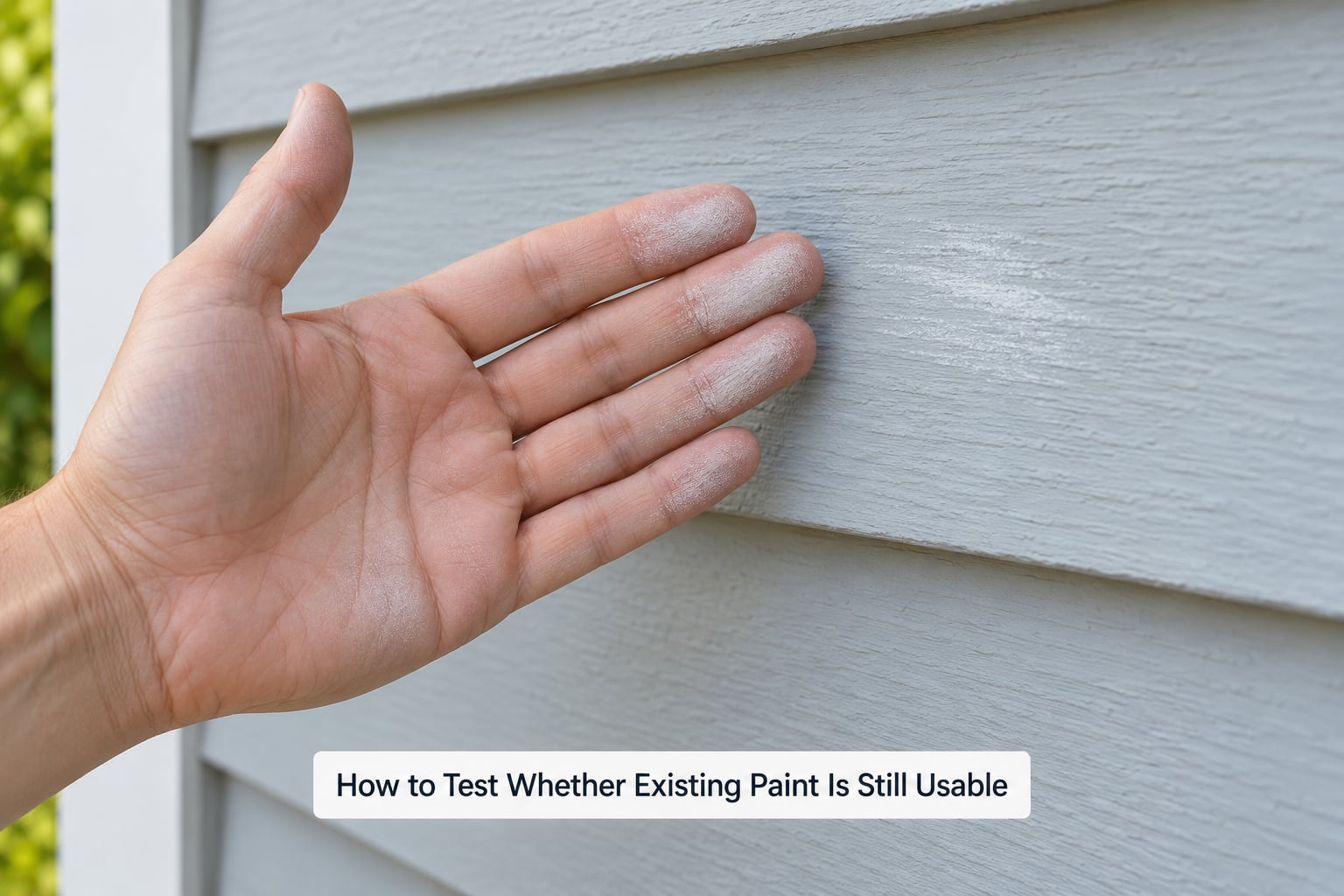
This takes about ten minutes with a flashlight and a utility knife.
Wash a two-foot section with a hose and let it dry overnight. The next morning, run your palm firmly across the paint. Chalking shows up as a chalky film on your skin, and that film means the top layer of binder has broken down. Next, score the paint with a knife and try to lift an edge. If it comes off in sheets instead of breaking at the score line, adhesion has failed and no amount of washing will fix it.
Check for moisture with a pin-type or pinless moisture meter under window edges, around roof valleys and near the base of walls. Anything above roughly 12 to 15 percent wood moisture content means stop and find the leak. Finally, run your fingers along the caulk at window and door perimeters. Caulk that has hardened, cracked or pulled away is letting water in, and it gets replaced before paint goes on.
What your results mean for when to repaint exterior of house surfaces: chalk plus intact adhesion is a cosmetic job you can defer. Failed adhesion means a full repaint. Active moisture, blistering or soft substrate means repair the wall first, then paint.
Should You Repair the Exterior Before Repainting?
Always. Paint over a problem and you will be doing the job twice.
Fix roof and gutter leaks and clean out downspouts. Replace rotted boards and trim, since paint will not save decayed wood. Scrape or sand loose and peeling paint, feather the edges and prime bare areas. Remove mildew with an appropriate cleaner, not just pressure. Recut and replace failed caulk around windows, doors, trim joints and where siding meets trim. Let everything dry fully before the first coat. A moisture meter reading on bare wood is more reliable than waiting, and it protects the new finish from the start.
One safety note for older houses. If your home was built before 1978, assume lead paint may be present until a certified test says otherwise. Disturbing it during scraping or sanding puts lead dust in the air. The EPA Renovation, Repair and Painting rule requires lead-safe work practices and a certified firm for renovation on pre-1978 housing, and testing options exist that take about an hour. If you are not sure what era your house is, get it tested before you scrape anything.
Can You Repaint the Exterior Yourself?
Yes, on a single-story home in good condition with steady weather. The job is mostly preparation, which is why homeowners underestimate the time.
Plan on a full day for prep plus two to three days of painting for a typical single-story house. You need a pressure washer or garden hose and scrub brush, scrapers, a random orbital sander, stiff brushes, roll frames, masking tape, drop cloths, exterior caulk, primer and 100% acrylic exterior paint. A ladder you can work from without overreaching is non-negotiable; extension platforms beat climbing for anything above the first story.
Some jobs are worth handing to a pro: two-story walls or anything needing a ladder platform, steep or tall geometry, surfaces with widespread peeling that need scraping to bare material, stucco or brick that needs patching first, and any pre-1978 house where lead testing is unresolved. Painters also carry insurance for damage in a way a weekend DIY does not.
Get two or three quotes and compare them per square foot of wall area rather than as a lump sum. A quote that itemizes prep, repairs and materials separately tells you far more than a single number on a page.
Frequently Asked Questions
How do I know if my house needs a fresh exterior paint job?
Judge by condition, not by date. Wash a section, swipe your palm across it for chalking and score it with a knife to test adhesion. Chalky film with paint still attached is cosmetic and can wait. Paint lifting in sheets, blistering, exposed wood or gray fiber cement means the coating has stopped protecting the house and should be replaced.
How often should exterior house paint be replaced?
Most exteriors hold 5 to 10 years. Wood siding runs shorter at 3 to 7 years in harsh climates, while brick and fiber cement often last 10 to 15. Trim, doors and shutters often need attention in 3 to 5 years because they face outward and take handling. Orientation and climate can move those numbers by several years either way.
What time of year is best to repaint a house exterior?
Late spring and early fall, when daytime temperatures sit between 50 and 85 degrees Fahrenheit and the surface stays under about 90. You need 24 to 48 hours without rain for the paint to cure, and starting around 10 a.m. after dew dries avoids lap marks. October still works in the South and Southwest but is too late in New England and the Midwest once freezes approach.
Do I need to prime the entire house before painting?
Not the whole house, but prime every bare spot you create. Scrape or sand back to sound paint, feather the edges and coat exposed wood, bare masonry and repaired areas with an exterior primer first. Over a sound existing coating, a good 100% acrylic exterior paint usually bonds without primer as long as the surface is clean, dry and not chalking heavily.
Can I paint over peeling or chalking exterior paint?
Not the peeling kind. Paint that lifts in sheets has lost adhesion, so it has to come off back to sound material before a new coat will hold. Chalking is different: wash or scrub the surface and use a bonding primer or a paint formulated for chalky substrates, otherwise the new topcoat can peel off with the chalk. Fix the source of the moisture first in either case.
Should I repaint the house before selling it?
Repaint the obvious parts. Fresh trim, a clean front door and uniform siding on the street-facing elevations fix the first impression buyers form from the curb. Full repainting only pays off if the coating is actually failing or the color change is worth the money. Sellers often spend that budget on a new roof or entry instead, which buyers notice just as much.
Conclusion
Start with a walk around the house, one elevation at a time. Note where paint is peeling versus merely faded, and check trim, soffits and caulk lines first because they fail earliest and cost the most to leave alone. Fix leaks and rot before anything goes on a wall. When the answer to when to repaint exterior of house surfaces is that water can reach the wood or the sheathing, paint is no longer a cosmetic question, and the repaint has earned its place.