You need new windows when the problems stop being about a seal and start being about the window itself: drafts that weatherstripping cannot fix, fog that sits permanently between panes, a frame that crumbles when you press it, or a heating bill that climbs every winter even after the furnace has been serviced. Most drafty windows only need a repair, so the trick is telling the two apart.
Here is the honest split. Repair makes sense when the frame and glass are sound and something specific has failed, like a hinge, a seal strip, or a clogged drain hole. Replacement makes sense when the unit has several of the signs below at once, when water has reached the wood, or when the window is a single-pane unit from an era that never had an insulating glass unit to begin with.
I have walked through enough of these calls that the pattern is always the same: the homeowner notices one thing, and the inspection turns up four. Below is what each sign looks like, what usually causes it, and whether a repair has a real chance.
Table of Contents
- Signs You Need New Windows at a Glance
- 1. Persistent Cold Drafts Near the Glass or Frame
- 2. Noticeable Condensation or Fogging Between Panes
- Can Foggy Glass Be Repaired, or Is It a Sign You Need New Windows?
- 3. Rot, Cracks, or Swelling in the Window Frame or Sill
- 4. Windows That Stay Open or Closed With Difficulty
- 5. Increased Street, Traffic, or Neighborhood Noise
- 6. Water Leaks During Rain or Washing the Windows
- 7. Worn-Out Weatherstripping and Visible Daylight Gaps
- 8. Rising Energy Bills With Uneven Rooms
- 9. Peeling Paint, Soft Sill Boards, or Exterior Wood Damage
- 10. The Window Is Old, Inefficient, or No Longer Repairable
- How to Test Whether the Problem Is Serious
- When Repair Is Better Than Replacement
- When a Professional Window Contractor Is Needed
- Frequently Asked Questions
- How do I know if my windows need replacement or just repair?
- Is foggy glass between the panes a sign the window needs replacing?
- What type of window is easiest to replace for energy efficiency?
- Can I replace just one broken window in my house?
- How long do replacement windows typically last?
- Should I replace all my windows at the same time?
- Conclusion
Signs You Need New Windows at a Glance
| Visible symptom | Likely cause | May repair work? | Strongest replacement case |
|---|---|---|---|
| Cold air moving around the glass or frame | Failed weatherstripping, sash gap, deteriorated frame | Often, if the frame is intact | Draft plus warped sash plus age over 25 years |
| Fog or moisture trapped between panes | Broken insulating glass unit seal | Sometimes, by reglazing the unit | Multiple units fogged at once |
| Soft wood, cracks, or swelling at the sill | Moisture reaching the frame from outside | Only if decay is shallow and localized | Decay across the sill or jamb |
| Sash will not hold open or slides badly | Worn hardware, swollen wood, sagging frame | Often for hardware alone | Frame has sagged and no longer squares up |
| Traffic noise indoors | Thin glass, air gaps, single-pane construction | Rarely | Single-pane glass on a street-facing wall |
| Water entering during heavy rain | Failed perimeter sealant, clogged drainage, bad flashing | Often, if the frame is sound | Recurring leaks with rot behind them |
| Daylight visible around a closed sash | Compressed weatherstripping no longer compresses | Yes, resealing is often enough | Every seal on the unit has hardened |
| Bills climbing with uneven room temperatures | Air leakage and weak thermal performance | Sometimes, by sealing air gaps | Single-pane units across the house |
| Peeling paint near the window trim | Repeated moisture intrusion | No, not until the water stops | Paint fails again within a year of repainting |
| Window is decades old with obsolete parts | Manufacturing standards and parts availability changed | No | Repeated repairs over the years, no parts left |
1. Persistent Cold Drafts Near the Glass or Frame
Drafts are the reason most people first go looking for new windows, and also the reason most people end up disappointed. A draft has three possible sources: air moving through a gap around the sash, air moving through a gap between the sash and the frame, or radiation from a cold glass surface that pulls heat out of the room even when no air is moving at all.
Test it safely from inside. Close the window, turn off the room’s airflow so the air is still, and hold a lit incense stick or a thin strip of rolled tissue near the top edge, then the sides, then the bottom. Movement in the smoke or paper points at the leak. Hold the paper flat against the glass for several seconds; warmth on one side and cool on the other tells you the heat is leaving through the pane itself rather than through a gap.
A radiant cold spot means the glass itself is the problem, which is a replacement sign, because you cannot add insulating value to a single sheet of glass. A gap at the sash means resealing is still on the table. What makes drafts a strong replacement case is having them alongside an old window: if the sash is heavy, the frame is soft at the corners, and the unit is past its service life, resealing buys you a season of comfort at best.
2. Noticeable Condensation or Fogging Between Panes
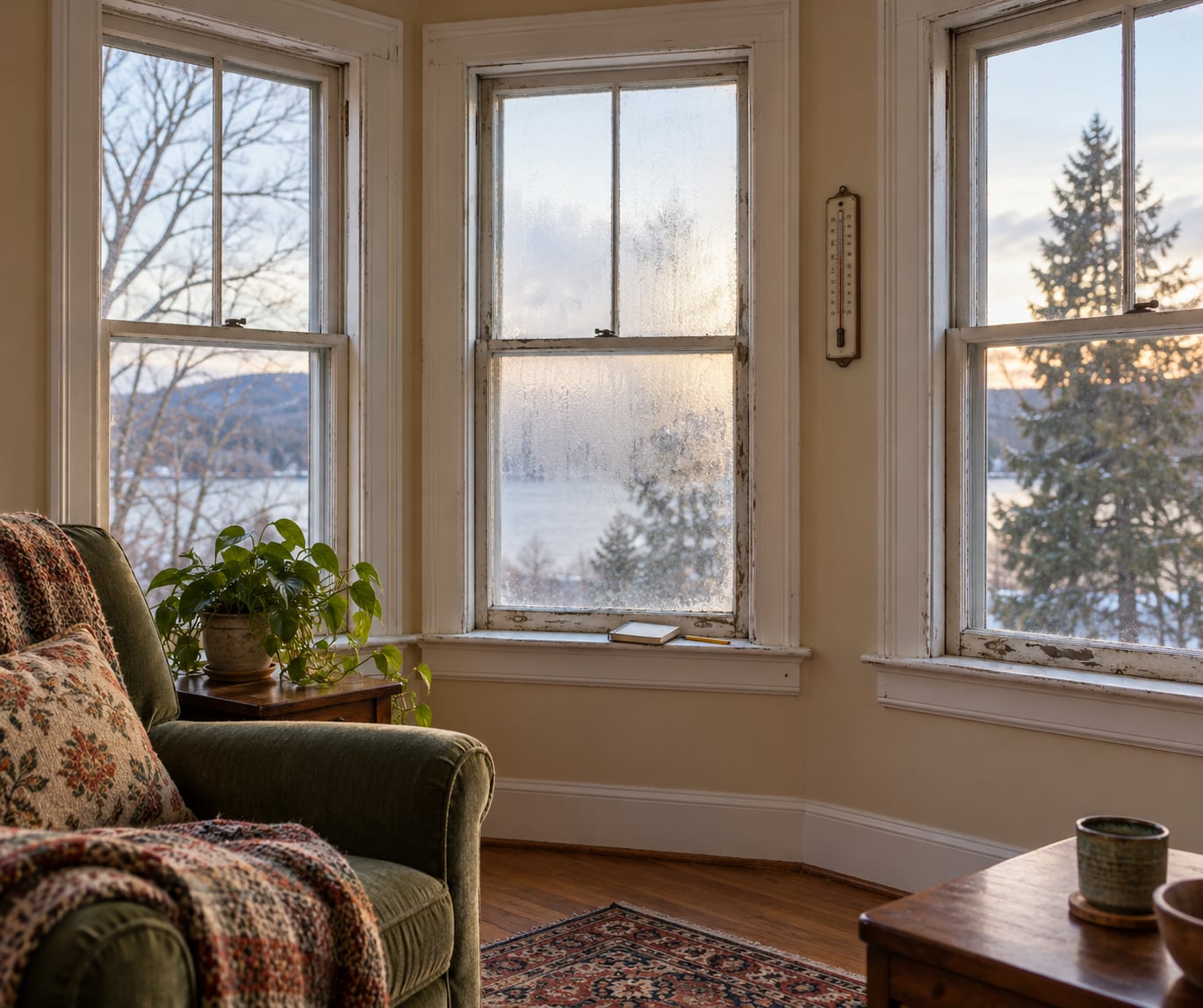
Fogging between panes means the insulating glass unit has lost its seal. Modern units are two or three panes of glass separated by a spacer and filled with argon or krypton, and that assembly is a sealed envelope. When the seal breaks, ordinary room air gets in, and the humidity in it condenses on the inside faces.
The test is simple: fog that lives inside the spacer, between the panes, and never wipes off means a failed seal. Condensation on the inside face of the glass, on the room side, means your indoor humidity is too high for that window’s surface temperature, which is a ventilation and moisture problem rather than a window defect.
Noise between the panes and a faint white haze along the spacer edge are both companions of a failing seal. If only one unit in the house has fogged, many owners replace just that unit or reglaze it. If half the windows have gone cloudy within a couple of years of each other, you are looking at a manufacturing era that failed across the board.
Can Foggy Glass Be Repaired, or Is It a Sign You Need New Windows?
A single fogged unit can often be reglazed by a shop that replaces the spacer and reseals the same glass, which costs less than a new window and keeps the original frame. That repair makes sense when the frame, sash, and hardware are all still good. It stops making sense when the frame is warped, when the glass is cracked, or when the fog is spreading across many units in a short period.
3. Rot, Cracks, or Swelling in the Window Frame or Sill
Wood that is soft, punky, or dark is not a cosmetic problem. It means water got past the exterior seal and stayed there long enough to eat the cellulose in the wood. Press a screwdriver into the suspect area; if it sinks in without resistance, the interior of the member is already gone.
Sills take the worst of it because they sit where water runs off the roof line and drains toward the exterior. Swelling that pushes the sash out of square, a sill that has warped into a curve, and cracks that run from a corner toward the center are all symptoms of the same thing: the frame has been wet from the outside for longer than wood likes.
Shallow surface rot on a hidden edge can sometimes be scraped, treated, and sealed. Once decay reaches the sill or a structural jamb, filling it is guesswork, and a new window that has to be fitted to softened wood will fail too. That is the clearest replacement case on this list.
4. Windows That Stay Open or Closed With Difficulty
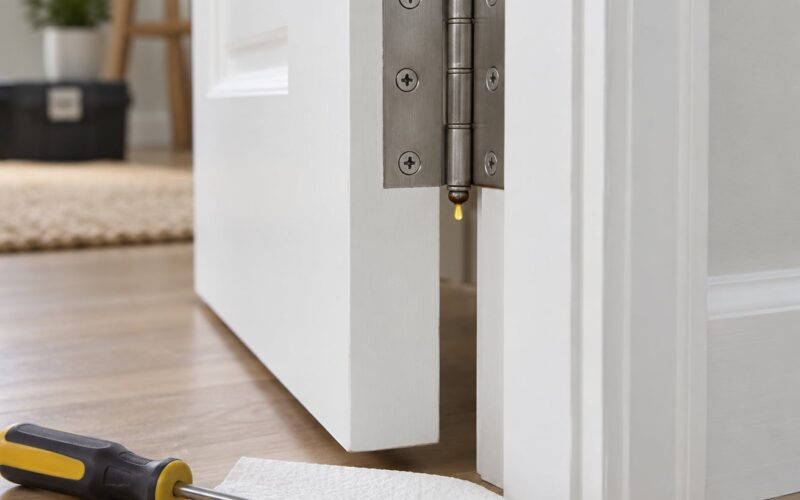
Most stuck windows are hardware, not decay. A sash that has swollen with humidity, worn rollers or hinges, a track full of dried paint, or a lock that no longer lines up with the strike can usually be corrected for far less than a new unit.
The replacement signals here are about geometry. A sash that has to be lifted and shoved to close, a window that slams or drops and will not stay where you put it, and a frame that visibly leans out of square all point at a frame that has lost its shape. Once the shape is gone, the seals cannot do their job no matter what you do to them.
A window that will not latch is also a security issue, which changes the calculation. If the unit is the only reachable opening on that wall and it does not lock, treat that as an upgrade rather than a convenience item.
5. Increased Street, Traffic, or Neighborhood Noise
Sound gets into a room through glass and through gaps. Single-pane glass is a thin membrane with a low sound rating, and gaps around an old sash act as a channel, so noise arrives twice over. If you can hear a conversation in the next room and your windows are single-pane, the glass is doing almost nothing for you acoustically.
Weatherstripping and new glazing help a little, mostly by closing the gap channel. Real noise reduction needs mass and asymmetry, which is why laminated or thicker glass in a sealed unit performs far better than a seal strip. Products carrying an STC rating quantify it: higher numbers mean less sound transmitted, and the difference between a low single-digit glass and a unit in the high 30s or 40s is noticeable on a street-facing wall.
The strongest noise replacement case is a bedroom or living room facing a busy road, with single-pane glass. That combination rarely responds to repair.
6. Water Leaks During Rain or Washing the Windows
Watch the window during a heavy rain rather than guessing. Water at the top corners usually means the perimeter sealant around the exterior trim has failed. Water along the bottom edge points to drainage, and the most common culprit is a weep hole blocked with old paint, debris, or insect nests.
Other causes include flashing that was tucked behind siding and cannot drain, a window set too high in the rough opening so the sill sheds water inward, and trim that was caulked instead of flashed during a repaint. All of those are worth fixing before you decide anything about the unit itself.
The replacement case is a leak that comes back after being corrected, especially with damp insulation or staining in the wall you can see through the interior trim. Repeated entry means the water path is in the structure, not just the sealant.
7. Worn-Out Weatherstripping and Visible Daylight Gaps
You should not be able to see daylight around a closed sash. If you can, the compression seal has hardened or pulled away from the frame, and it has stopped doing its only job, which is stopping air and dust while keeping insects out. Insects along the interior trim in summer are the tell that the seal path is open.
Reshimming a window with new compression or sill weatherstripping is a genuinely effective repair, and I would always try it before replacing a unit whose glass and frame are fine. The point at which resealing stops being rational is when the same seal keeps failing, when the hardware channel that holds the strip has rusted or broken, or when the frame is warped so no strip will compress evenly along its length.
Repeated resealing on a unit that keeps failing tells you the window is at the end of its useful life, and the next repair will not be the last one.
8. Rising Energy Bills With Uneven Rooms
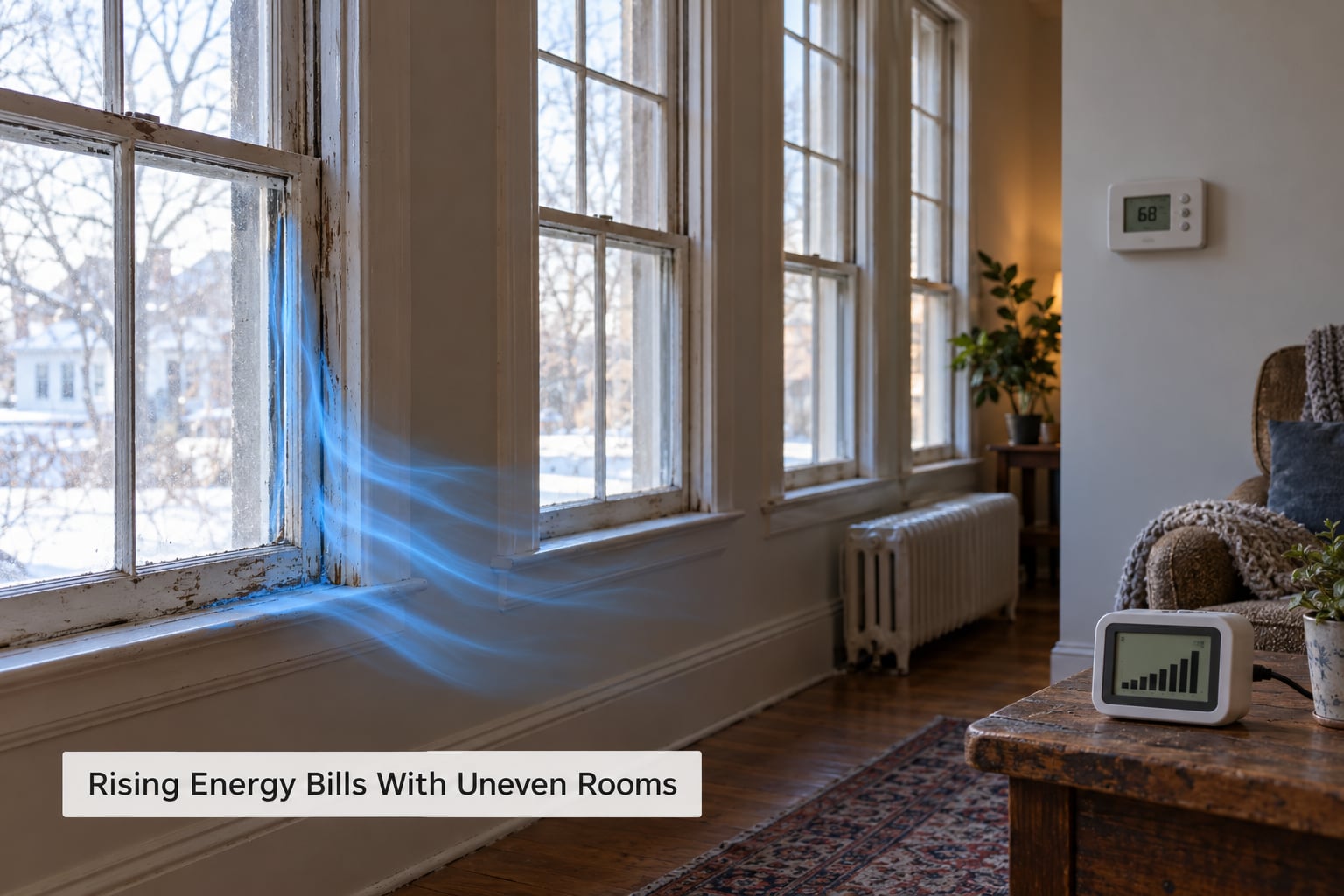
Leaky and thermally weak windows raise heating and cooling demand, and owners across forums like r/HomeImprovement report the more noticeable effect being comfort rather than savings, with drafty rooms feeling wrong long before the meter shows much.
Rule out the cheaper explanations before blaming the windows. Have the furnace or air conditioner serviced, check the thermostat and the air filter, and look at attic or wall insulation from the same time of year. If the house is tight except around one wall, that wall has windows in it, and the pattern is fairly clear.
Homeowners on r/homeowners often report that a single-pane to double-pane upgrade cut their bills by 20 to 30 percent, though real results depend on climate, glass area, and how many other leaks the house has. Treat that as a reasonable range rather than a promise.
Single-pane glass in a cold or mixed climate is the strongest energy replacement case there is. What the labels mean is worth understanding before you shop: the U-factor measures how much heat passes through, and lower is better, while SHGC measures solar heat gain, where lower is better for cooling a southern room and moderate is better for a northern one. ENERGY STAR certification ties those numbers to a climate zone, which is a fair way to compare two units without trusting a sales sheet.
9. Peeling Paint, Soft Sill Boards, or Exterior Wood Damage
Exterior paint fails in sheets and flakes when moisture gets behind it. If you repaint the trim around a window and the new coat blisters or peels within a year, water is still arriving from somewhere, and painting over the symptom buys nothing.
Check the sill end and the underside of the trim, which are the least visible and most commonly wet. Cracks that follow the grain, a board that feels spongy, and bare wood that has gone grey or fibrous all describe wood that has taken on water repeatedly. Wicking and staining on the interior trim beneath the sill point to the same thing from the inside.
You do not need a ladder to start. Inspect from the ground with binoculars, look at the sill end from a step stool, and note whether the peeling follows a pattern. If the paint damage lines up with the window opening rather than the whole wall, the window is the source and that is worth a professional assessment.
If your home was built before 1978, disturbing that paint needs care. Federal lead rules require lead-safe practices when paint is disturbed in a pre-1978 home, and the EPA’s Renovation, Repair and Painting program covers what a contractor must do. Mention this before anyone starts scraping.
10. The Window Is Old, Inefficient, or No Longer Repairable
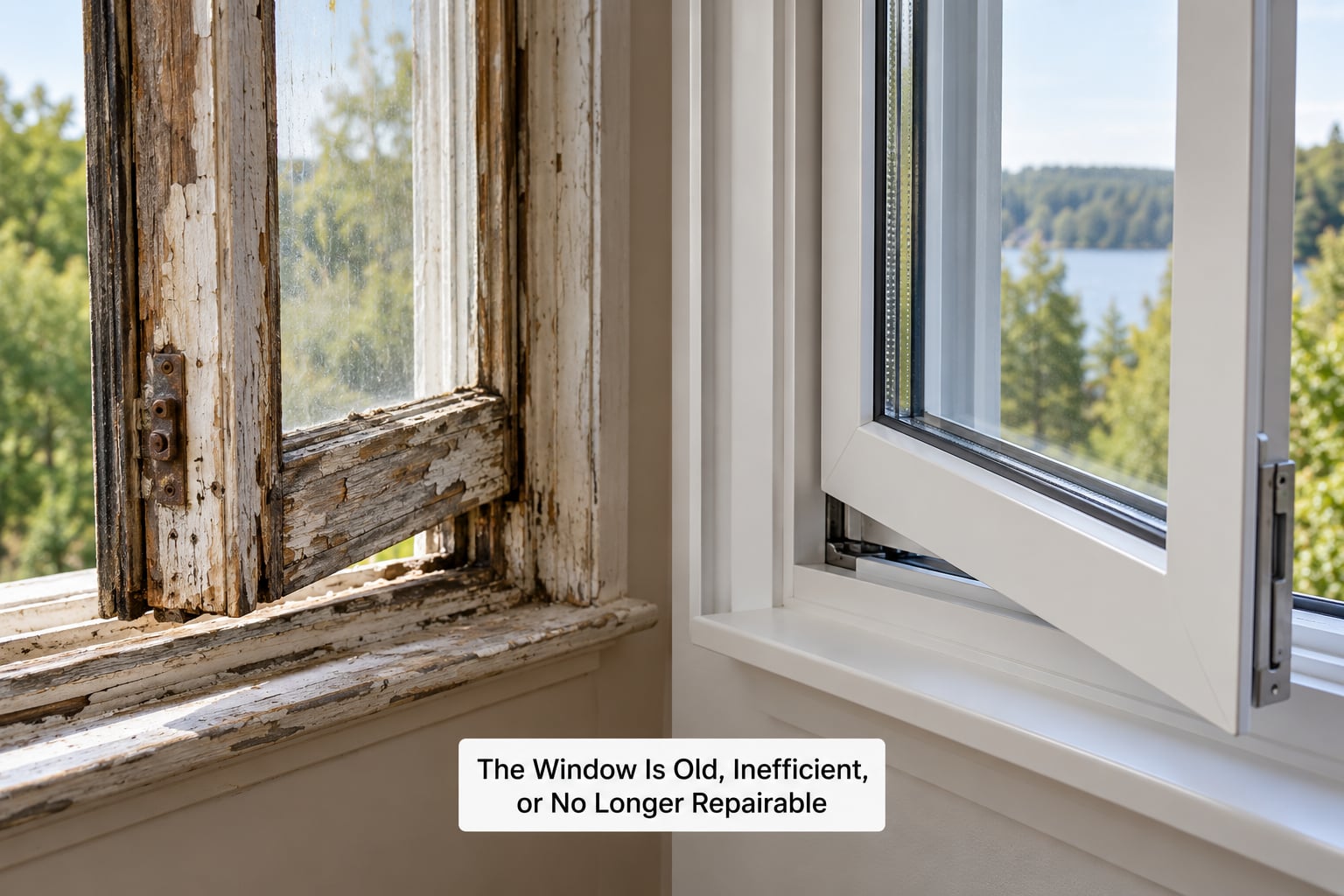
Age by itself is not a defect. Plenty of well-made windows from forty years ago perform well and keep working, and plenty of fifteen-year-old windows are already ruined. What matters is the combination of age, condition, and what is still available.
Use five filters. Physical condition: rot, corrosion, or warping anywhere in the unit. Energy performance: single-pane glass, no low-e coating, and no inert gas fill mean you are heating and cooling through a sheet of glass. Parts availability: once the manufacturer stops making a hardware profile, every future repair becomes a custom job or a no. Repair history: three fixes in five years on the same unit is a pattern, not bad luck. And expected life: if the best case is a handful of seasons, you are renting from the window.
Ask the vendor for the NFRC label on any unit you consider, which lets you compare thermal performance across manufacturers rather than across adjectives.
How to Test Whether the Problem Is Serious
Run through this before deciding anything, and stay off ladders. Window work above the first floor belongs to someone with the right equipment.
- Look at the wood. Press the sill, jambs, and corners with a screwdriver. Firm wood is fine; wood that gives way is not.
- Check the seals. Run a finger along the sash and the sill. Compression seals should feel springy, not hard and chalky.
- Smoke test for air. Still air, lit incense or tissue, all four edges. Note where it moves.
- Watch it in rain. Note the timing and the location of any water on the sill and on the interior trim.
- Open and close it fully. Note any lifting, shoving, bouncing, or a sash that will not hold position.
- Look between the panes. Fog, a haze along the spacer, or a water stain that has dried white means the seal is gone.
- Look for daylight. With the sash closed and lights off, any visible line of light means an open air path.
Never remove a sash, take apart a frame, or cut an old window out yourself. Beyond the injury risk, an unassembled window can fall, and pulling on a rotted frame can take the surrounding trim with it.
When Repair Is Better Than Replacement
Some things are genuinely cheap to fix, and doing them first keeps you from buying a window you did not need.
- Minor drafts at the sash that respond to new weatherstripping.
- Blocked weep holes cleared of paint and debris.
- Loose or broken hinges, rollers, and locks.
- Failing perimeter sealant on a sound frame.
- A single failed pane in an otherwise good unit, reglazed or replaced as a unit.
Repairs stay cost-effective when the frame and glass are in good shape, the part is still available, and the fix addresses the actual source. Keep receipts and dates for anything you have done, because a documented history of repeat failures is evidence when you decide later.
One caution on scope: an insert, where a new sash drops into the existing frame, is faster and leaves the surrounding trim intact, but it does nothing for a rotted sill or a frame that is out of square. A full-frame replacement addresses rot and water management. Homeowners debating the two usually find the deciding question is simple: is the existing wood sound?
When a Professional Window Contractor Is Needed
Some situations are not homeowner territory, and getting them wrong costs more than the inspection would have.
- Structural decay in the sill or jamb, especially anything soft enough to dent with a fingernail.
- Recurring leaks that returned after a previous repair, which points at flashing or the wall itself.
- Unsafe access, including anything above the first floor, steep slopes, or a second-story opening without proper equipment.
- Widespread seal failure, where many units failed at once and you are dealing with a systemic problem.
- Electrical concerns near the opening, such as damaged wiring at a nearby fixture or a receptacle in a wet area.
- Pre-1978 homes, where paint disturbance requires lead-safe work practices.
- Historic or HOA restrictions, where an approval process may dictate what can be installed.
When you do hire, ask whether the crews are in-house or subcontracted, ask for a workmanship warranty separate from the product warranty, and ask for recent local references. Get written quotes that separate materials, labor, and permits so you can compare them line by line. A company willing to explain why repair is enough tells you more about how the sale will go than any sample window ever will.
Frequently Asked Questions
How do I know if my windows need replacement or just repair?
Repair makes sense when the frame and glass are sound and one thing failed, such as a hinge, a seal strip, or a clogged weep hole. Replacement makes sense when several signs show up together, when the sill or jamb has rot, or when the window is single-pane. If you can press a screwdriver into the wood, that is not a repair item.
Is foggy glass between the panes a sign the window needs replacing?
Fog between panes means the insulating glass unit lost its seal, but that alone does not condemn the window. A single unit can often be reglazed with a new spacer and reseal, which costs less than a new window and keeps the frame. If many units fogged within the same year or two, treat the whole batch as one replacement decision.
What type of window is easiest to replace for energy efficiency?
Double-pane insulating glass units with a low-e coating and an argon or krypton fill make the largest difference for most homes, and triple pane helps further in cold climates. Compare units by the NFRC label and the U-factor rather than by glass thickness alone. Keeping exterior storm windows over an existing unit is a lower-cost alternative in milder climates.
Can I replace just one broken window in my house?
Yes, single replacements are routine, and matching a later batch is often easier than the homeowner expects because color and finish options are broad. The tradeoffs are that you may pay a mobilization charge for a small job and that the new unit may not match a discontinued profile exactly. If the old frame is rotted, a single replacement means dealing with the decay twice.
How long do replacement windows typically last?
Quality windows commonly last 30 to 40 years, and the frame material matters more than the brand. Vinyl and fiberglass generally need the least maintenance, wood needs regular painting and sealing, and aluminum-clad wood sits in between. Installation quality is often the deciding factor, since a unit fitted out of square wears its seals out far sooner than its warranty suggests.
Should I replace all my windows at the same time?
Doing them together usually costs less per window because the crew is already set up, and it gives you one consistent appearance and a single project timeline. Replacing them in stages spreads the expense and lets you learn from the first installation. If money is the constraint, start with the worst units rather than the most visible ones.
Conclusion
The signs that point to replacement cluster together: a window that is drafty, fogged, hard to operate, noisy, leaking, and losing paint is one window telling you the same thing several ways. A single symptom, on an otherwise sound unit, is usually a repair, and repairing first keeps money on the ones that truly need replacing.
Write down what you see and when you see it, run the smoke and rain tests, and then get a qualified assessment before you buy anything. That record is what makes the decision easy six months from now.