Most people start at the fabric sample and end up with the wrong window covering. Start at the window instead: measure the glass, note which direction it faces, decide whether you are fighting summer heat gain or winter heat loss, and then pick a covering built for that job. That is how to pick energy efficient window coverings without paying for features a room never uses.
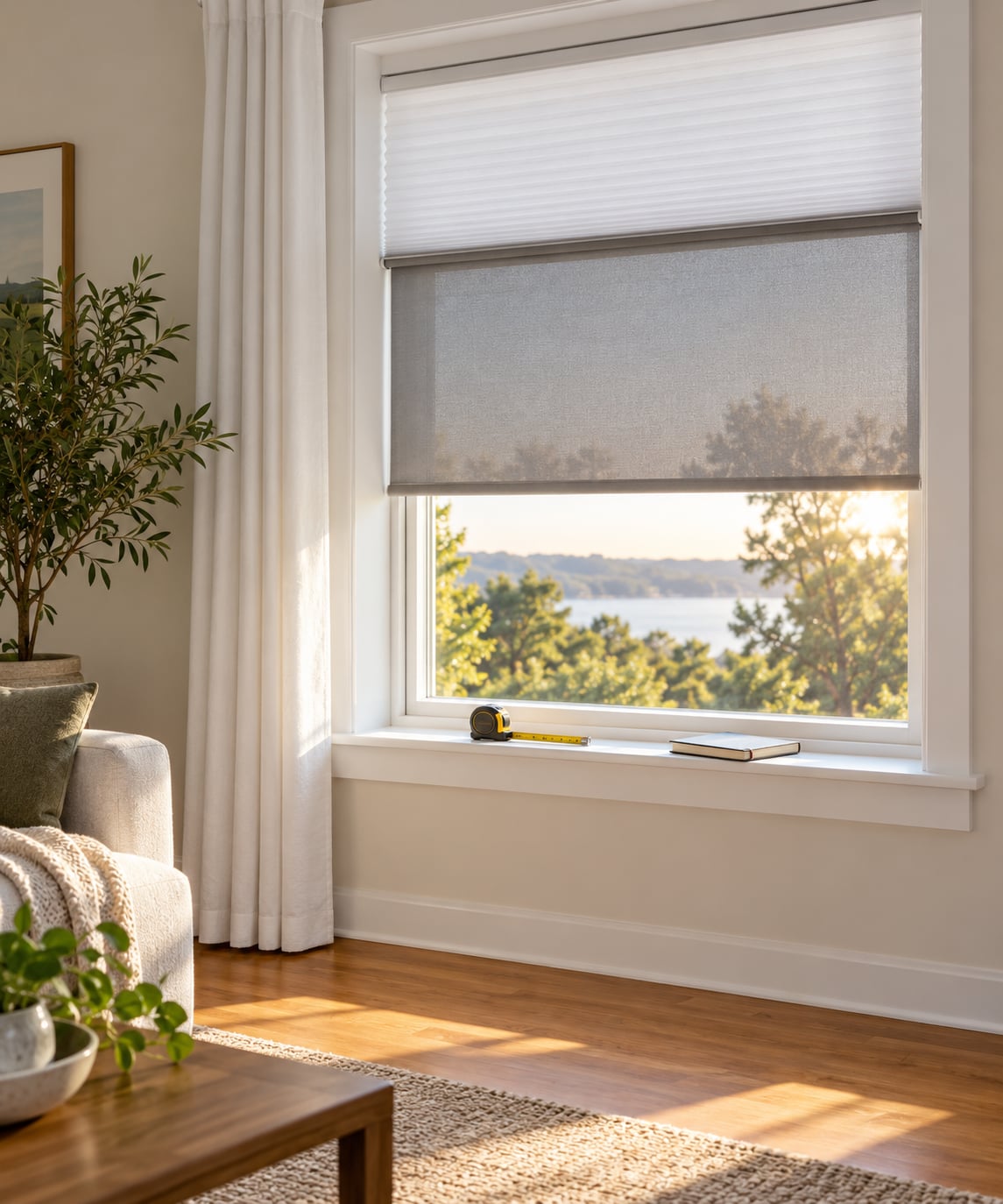
Quick answer: cellular (honeycomb) shades are the most energy efficient all-round window covering, because the trapped air inside the cells slows heat moving through the glass in both directions. On large west- or south-facing windows, solar-shade fabric blocks more solar heat. On cold nights, a thermal curtain hung over cellular shades adds real insulation.
The whole selection takes an afternoon of measuring and thinking, then one short order form. You need to know four things before fabric matters: the window’s direction, its glazing, the room’s job, and how the covering will be operated every day.
Last reviewed: October 2026
Table of Contents
- What You Need
- Step-by-Step: How to Pick Energy Efficient Window Coverings
- 1. Identify the window’s energy problem
- 2. Choose the right insulating structure
- 3. Match light control to the room
- 4. Check fit, installation, and seal quality
- 5. Compare operating costs and durability
- Where window coverings sit against glass upgrades
- Common Mistakes
- Frequently Asked Questions
- What is the most energy efficient window covering?
- What type of blinds are most energy-efficient?
- Is it better to put shades inside or outside the window?
- What colour blinds block the most heat, and should they match the walls?
- Do motorized shades actually save energy?
- How do I know if my blinds are energy efficient?
What You Need
Gather this list before you open a single product page. It takes about an hour and it prevents the two expensive mistakes: the wrong structure, and the wrong size.
- Two sets of measurements. The visible glass width and height, then the full opening including the frame and the depth of the recess. Insulating performance depends on the headrail covering the glass, so both numbers matter.
- Direction the glass faces. North, south, east, or west. This single fact drives more of the decision than any other.
- Glazing details. Single pane, double pane, or triple pane, and whether there is a Low-E coating. The sticker on the frame spacer or the original build documents carry the NFRC rating, which lists the U-factor and the solar heat gain coefficient.
- Climate and seasons. Typical peak summer temperature and typical winter low, plus which direction the dominant weather comes from.
- Room use and light needs. Bedroom, home office, kitchen, living room, sunroom, or rental. Note where glare lands on a screen and where furniture fades.
- Operation preference. Manual pull, cordless lift, or motorized. If motorized, decide whether you can run a low-voltage line at the window head or you want battery power.
The glazing number is the one people skip. The solar heat gain coefficient, or SHGC, is the fraction of solar energy that passes through the glass, so a window with a high SHGC on a west wall is asking for solar-control fabric, not a pretty drape.
Step-by-Step: How to Pick Energy Efficient Window Coverings
1. Identify the window’s energy problem
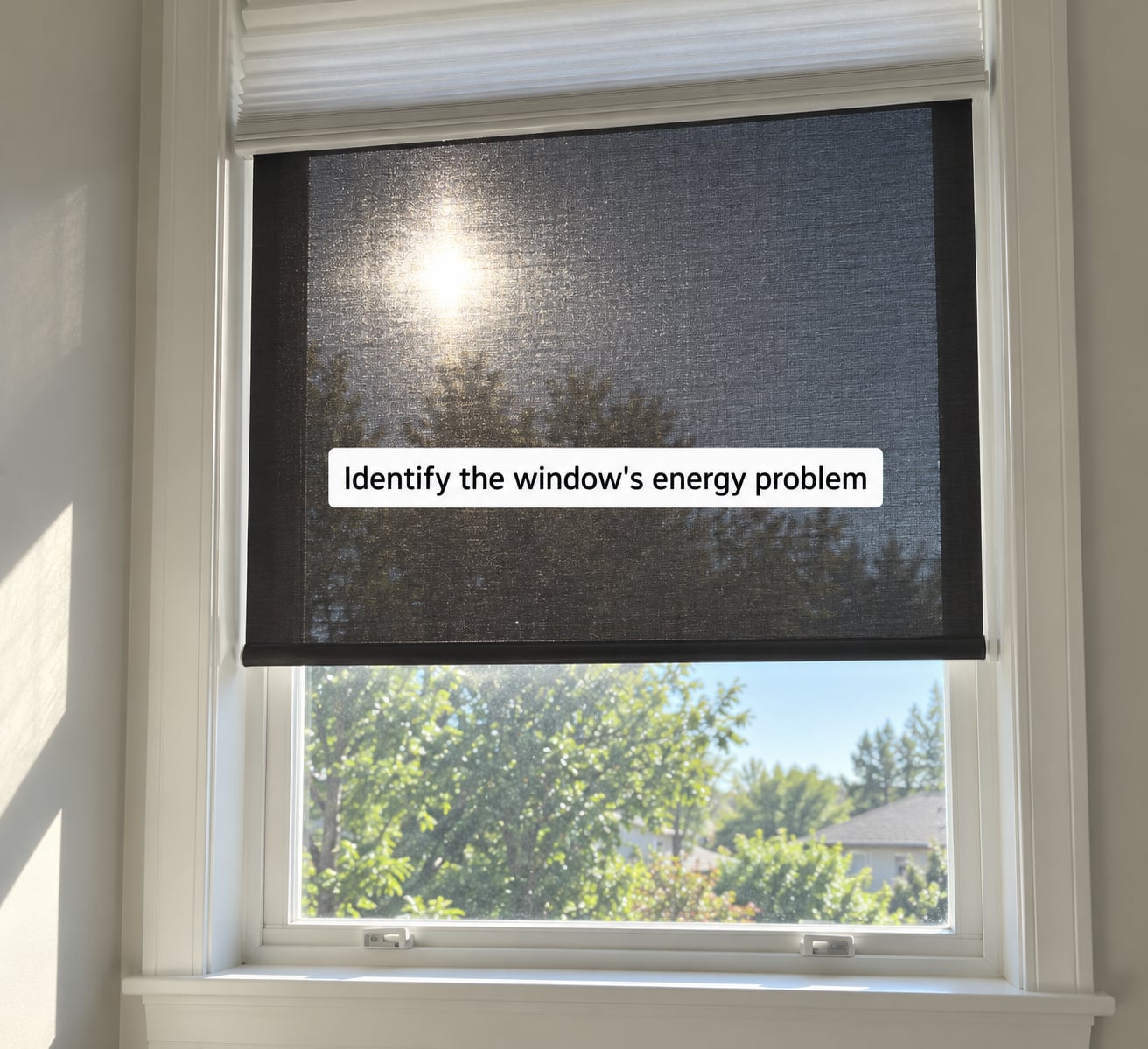
Decide first whether the problem is heat coming in or heat going out. Warm air rising inside a room means you are losing heat, which points to cell structure, thick fabric, and side channels. Direct sun on the glass means heat gain, which points to reflectance, dark or opaque fabric, and exterior mounting.
| Direction | What reaches the glass | Best covering choice |
|---|---|---|
| North | Diffuse light, almost no direct sun | Light-filtering cellular or a sheer plus cellular for privacy; insulation matters more than solar control |
| South | Steady high sun through the middle of the day | Solar-shade or dual-cell blackout cellular; outside mount so nothing reflects onto the glass |
| East | Direct low sun in the morning, shade by afternoon | Blackout cellular or solar-shade roller closed on a morning schedule |
| West | Low-angle afternoon sun landing straight on the glass | Exterior shade first; solar-shade blackout cellular or a solar roller inside, plus a thermal curtain at night |
West glass is the hardest case and the one most people give up on. Owners with big west-facing windows report that even good interior shades let late-afternoon heat through, and that adding an exterior shade helped far more than expected. On tall glass or a second-floor window, exterior is usually the only real answer.
2. Choose the right insulating structure
Insulation in a covering comes from trapped air, not from fabric weight. A double-cell honeycomb shade holds two layers of still air inside an accordion fold; a single-cell holds one. Thermal roller shades add a foam or aluminised backing. Anything lined, backed, or multi-layered outperforms a flat decorative panel of similar thickness.
| Covering | What it does | Best for | Watch out for |
|---|---|---|---|
| Cellular (honeycomb) shades | Trapped air cells slow heat both ways; the best all-round performer | Every room, all directions, all climates | Single-cell versions are thinner than dual-cell; light still leaks at the sides |
| Solar-shade roller shades | Dense fabric or open mesh blocks solar radiation before it reaches the glass | South and west glass in hot climates | Mesh openness trades heat control for a view; solid versions go dark |
| Thermal roller shades | Foam or aluminised backing adds conductance resistance | Cold rooms, older single-pane homes, drafty bedrooms | Heavier hardware and a stiffer hand-feel |
| Blackout cellular | Cell structure plus an opaque liner: heat control and darkness together | Bedrooms, nurseries, shift-sleepers, home theatres | A halo of light leaks around the headrail and side channels |
| Lined Roman shades | Good-looking folds with a foam or thermal liner behind them | Living rooms where appearance leads | Cleaning is harder; the lift cord is exposed on most models |
| Vertical blinds | Slats redirect light and can be tilted away from the glass | Sliding glass doors, tall windows, glare control | Wide slats shed less heat than a full fabric panel; hard to keep dust-free |
| Plantation shutters | Adjustable louvered panels that create a still air chamber when closed | South-facing rooms, rooms that need privacy with partial light | Wide, heavy panels; high cost per window in large openings |
| Thermal curtains | Layered, often white-backed fabric hung outside a shade | Cold climates, old drafty houses, bedrooms at night | Takes floor space; layering looks busier in a small room |
| Exterior awnings and roller screens | Stop solar energy before it reaches the glass | West-facing sunrooms, second-floor glass, hot climates | Wind and storm durability; motors and fabric need service |
The Department of Energy has long recommended light-coloured drapes with a white backing, which can cut heat gain by roughly a third. White or silver backing on the room side of the fabric reflects solar radiation back outside, which is why a pale backing outperforms a dark one even when the face fabric looks the same. Retailers also market solar shades as cutting heat gain by up to 70 percent and awnings by more than that; treat those as marketing ceilings rather than guarantees.
Read labels for cell count, opacity rating, backing type, and any published solar reflectance. If a brand publishes none of those, you are buying on adjectives.
3. Match light control to the room
Light control is where most energy claims fall apart, because a covering only saves energy when it is closed and it is closed where it needs to be. Match the opacity to the room instead of picking one fabric house-wide.
Bedrooms and nurseries want blackout, and the honest version of that promise stops at the headrail. Forum threads about window coverings keep coming back to the same complaint: a halo of light around the edges in direct afternoon sun. The fix is a blackout shade with side channels or a light-blocking liner that extends past the glass, mounted so the fabric sits past the glass edge on every side.
Home offices want light-filtering, not blackout. Solid fabric kills glare at the cost of a dark room all day. A dual-cell or light-filtering shade aimed at a laptop is usually enough, and in a north-facing office it is all you ever need.
Living rooms benefit most from layering: a sheer or light-filtering shade for the daytime view, with a thermal curtain or blackout liner drawn at night. Members of an insulation forum described stacking thermal curtains over cellular shades in an old drafty house and noticing the drafts stop, which is exactly the two-layer air chamber you would design on paper.
Kitchens, bathrooms, and laundry rooms want wipeable, light fabric, not insulation. Sunrooms, skylights, and cathedral glass need their own covering systems designed for a slope, because a standard horizontal shade mounted on a tilted window leaks light along every edge.
4. Check fit, installation, and seal quality
Airtightness at the edges is most of the story. Air moving between the covering and the glass by convection undoes whatever the fabric was supposed to stop, and the gap between shade and glass should stay small and consistent.
Inside mount looks clean and needs a recess deep enough to hide the headrail above the glass. If your window is shallow, an outside mount above the opening gives you more headroom and a larger shade, at the cost of stacking the fabric where you can see it. Decide before you order, because the mount changes the finished width.
Measure twice, in three places: left, middle, and right, and top, middle, and bottom. Older windows are often out of square, and a single tape reading gives you a shade that binds on one side. On double-hung windows, remember the glass moves and the covering must clear the sash and the tilt.
Exterior shades work best when mounted with a gap above the glass so air moves over the top rather than trapping against the frame. Their weakness is durability. Homeowners weighing exterior awnings raise wind and storm damage as the deciding factor, and that concern is legitimate in areas with severe weather, so check the wind rating and whether the fabric can be retracted before a storm.
Where light and air both matter, sealing the window itself sometimes beats covering it. Low-E film on the glass, weatherstripping around the sash, and a plastic film insert added for winter all reduce the load directly at the opening. A magnetic window insert came up in window forums as a cheap alternative to replacement, and for a single leaky window it is a reasonable first move.
5. Compare operating costs and durability
The operating part of a covering is simple to compare once you list it: the lift mechanism, the power source if it is motorized, the parts that wear out, and how it gets cleaned.
Cordless lifts remove the cords entirely, which settles the safety question in homes with kids and pets and also keeps the fabric from snagging. Standard manual operation costs nothing and does nothing for you after installation, though. Repeated forum complaints about shades that were never closed point at the same root cause: efficiency depends on daily behaviour, and nobody changes a shade before they think about it.
Motorized systems solve that by closing on a schedule, or from a wall switch, or from a phone. The real-world version of this is well documented: schedule the shades and the energy savings follow automatically. Decide how they will be powered. Hardwiring at the window head is cleaner and invisible, but running a line in an older plaster-and-lath house can cost more than the shades themselves. Battery motors avoid that job and add a maintenance chore; owners complain the compartments are awkward to reach, and batteries need checking every few months. In a vacation rental or an Airbnb, hardwiring usually pays for itself through turnover, since nobody has to walk the property and close anything.
Durability shows up in details: replaceable cords and slats, hardware you can order in five years rather than a fabric panel you cannot, a headrail rated for the weight of the fabric you chose, and a warranty measured in years rather than months. Cellular shades trap dust in the folds, so a soft brush or a low-suction vacuum matters more here than with flat roller shades.
Where window coverings sit against glass upgrades
Worth being clear about the limits. Coverings sit on the room side of the glass, so they intercept energy only after it has passed through the window. Low-E coatings, better gas fills, and a lower U-factor reduce the load at the source and out-perform anything hung on the inside. When a window is badly performing, especially single pane in a cold climate, fixing the window usually wins first and the covering complements it afterwards. When the glazing is already decent and the problem is one hot orientation, coverings are the cheap, reversible, room-by-room fix.
Common Mistakes
Trusting an energy claim with no number behind it. Fix: ask for cell count, backing type, opacity rating, and solar reflectance, or a published R-value with a standard attached. Percentages without a source are decoration.
Choosing colour before direction. Fix: pick the structure for the orientation first, then pick the colour inside that category. A beautiful drape on west glass loses to a plain solar shade every time.
Ordering from one measurement. Fix: measure the glass and the opening, in three places each, and confirm the mount type before you pick the size.
Expecting true blackout. Fix: look for side channels or a light-blocking liner that overlaps the glass on all four sides, and accept a small halo if the headrail sits far outside the opening.
Ignoring the edge gaps. Fix: check that the headrail fully covers the glass and that the side channels meet the window frame. Light leaking around a shade is heat leaking around a shade.
Judging by purchase price alone. Fix: price the whole life: mount hardware, a motor and its power source, cleaning, replacement cords, and whether the fabric can be swapped without replacing the headrail.
Forgetting whether anyone will close it. Fix: if the shade has to be drawn daily for the numbers to mean anything, plan on a motor or a habit hook by the door. An unused shade saves nothing.
Frequently Asked Questions
What is the most energy efficient window covering?
Cellular (honeycomb) shades are the most energy efficient all-round option, especially dual-cell or blackout-lined versions. The folded cells trap still air at the glass, which slows heat transfer in both directions, and light colours with a white backing reflect solar radiation outward. Solar-shade roller fabrics block more heat on large south- and west-facing windows, but they do less for winter insulation.
What type of blinds are most energy-efficient?
Among blinds, cellular shades win because the honeycomb structure creates an insulating air pocket that slats cannot. Outside that category, lined Roman shades and closed plantation shutters come next, since each forms a still air chamber across the whole opening. Anything with a foam or aluminised backing ranks above a standard vinyl or aluminium blind. Measure for an R-value if a dealer publishes one, and treat the number as a comparison rather than a promise.
Is it better to put shades inside or outside the window?
Outside, if it is practical. An exterior shade stops solar energy before it reaches the glass, so less of it is conducted and radiated into the room. Interior coverings work on the room side of the glass and are far cheaper and easier to replace. West-facing glass, second-floor windows, sunrooms, and sliding doors are the cases where exterior is worth the extra cost and the weather exposure.
What colour blinds block the most heat, and should they match the walls?
A light colour blocks more heat than a dark one because it reflects more solar radiation, and a white or silver backing on the room side matters more than the face colour. Matching the walls is a decor question with no bearing on performance. If you want a dark fabric, pair it with a reflective backing, and remember that an opaque fabric blocks more heat than a light-filtering one regardless of colour.
Do motorized shades actually save energy?
They save energy only because they get closed. A covering that stays open does nothing, and homeowners repeatedly report buying shades they never bother to draw. Scheduling a motor to close at the hottest part of the afternoon, or tying it to a thermostat or sensor, turns the efficiency of the fabric into a habit. Hardwiring at the window head is tidier, while battery motors avoid wiring but need checking every few months.
How do I know if my blinds are energy efficient?
Look for four things: cell count or fabric layers, an insulating or reflective backing, a published opacity rating, and a stated solar reflectance or R-value with a test standard attached. Ask the dealer to name the standard rather than the percentage. If the only claim is that the product saves energy, treat it as unverified and compare on structure instead, since a lined multi-layer build outperforms an unlined one every time.
Start with the window that causes the most discomfort, not the room with the emptiest wall. Measure the glass, note the direction, and pick the structure: dual-cell cellular for year-round insulation, solar-shade fabric for hot west or south glass, a blackout liner plus side channels for bedrooms, and an exterior shade where the exposure is severe. Then decide how it will be closed, because an unused covering saves nothing.