Asbestos in older homes is usually not a problem while the material stays intact. The risk appears when asbestos-containing material (ACM) is cut, drilled, sanded, broken or crushed, which sends microscopic fibers into the air where people breathe them in. So the practical question for a homeowner is not “is asbestos in my house” but “is anyone about to disturb it.”
This guide explains where asbestos hides, why you cannot confirm it by looking, how testing and abatement actually work, and what to do before a renovation. It is general information, not a licensed assessment, and rules vary by state and change over time. For decisions about your own property, talk to a state-licensed asbestos professional.
Table of Contents
- Asbestos in Older Homes: What to Know
- Where Asbestos May Be Found in an Older Home
- What Asbestos Looks Like and What It Does
- How to Find Out Whether Your Home Has Asbestos
- Asbestos in Older Homes: What to Do Before Renovating
- Do Not Disturb, Drill, Sand, or Scrape Suspect Materials
- How Professional Asbestos Testing and Abatement Work
- How to Hire an Asbestos Inspector or Abatement Contractor
- What Is Safe to Leave in Place?
- Asbestos Exposure Warning Signs and When to Leave the Area
- Costs, Timing, and Disruption of Asbestos Work
- Frequently Asked Questions
- Does every older home contain asbestos?
- Can I identify asbestos just by looking at the material?
- Do I need asbestos testing before a normal home renovation?
- Can a general contractor remove asbestos for me?
- What should I do if I accidentally disturb suspected asbestos-containing material?
- Do I need a written clearance report after asbestos removal?
- Conclusion
Asbestos in Older Homes: What to Know
Asbestos is a naturally occurring mineral fiber that was milled into building products for decades. It resists heat, holds up under fire, strengthens materials and insulates, which is exactly why it ended up in pipe wrap, boiler insulation, floor tile, joint compound and sprayed ceilings.
Federal bans came in stages. The EPA banned asbestos in most consumer products in the 1970s and prohibited most uses in building materials in 1980, while some uses lingered under later restrictions. The practical rule homeowners use: assume materials in a home built before 1980 may contain asbestos until a qualified person has tested them.
Intact material is not releasing fibers. Asbestos-containing materials are generally safe as long as they remain undisturbed and undamaged, which is why a great deal of older material is managed in place rather than torn out.
Where Asbestos May Be Found in an Older Home
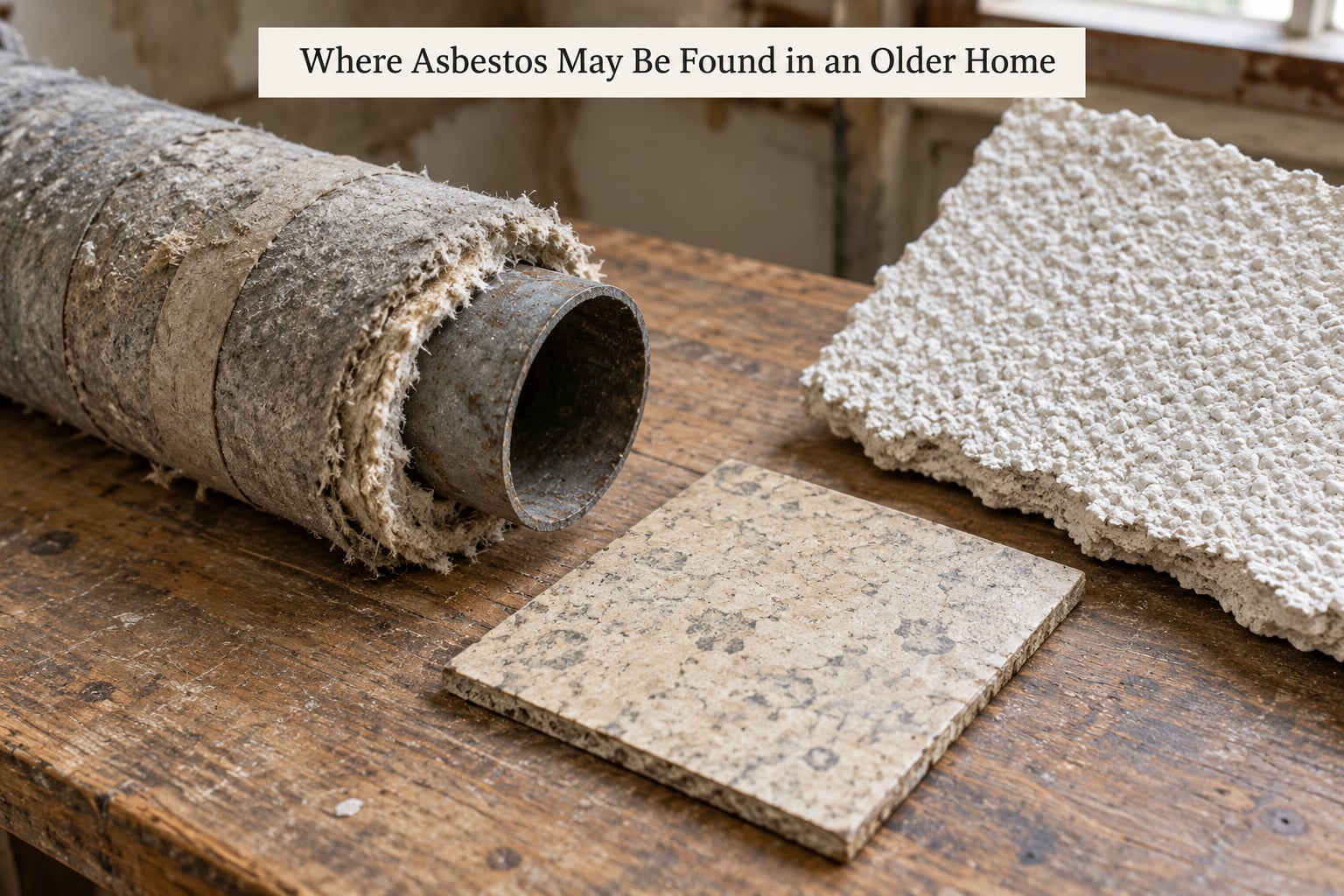
Asbestos in older homes shows up in predictable places, mostly products that needed heat resistance or fire protection. Appearance alone cannot confirm asbestos in any of these.
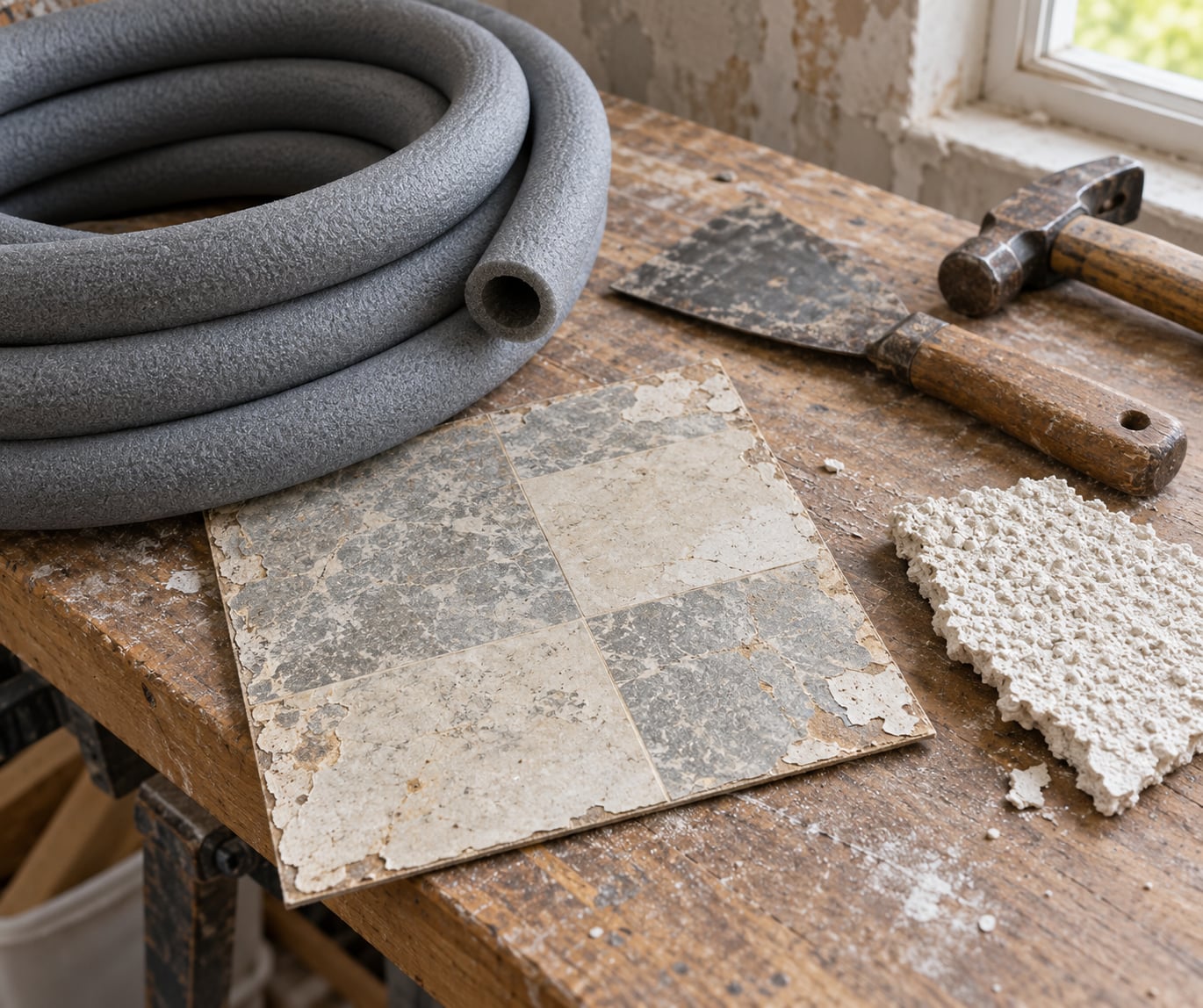
Pipe and boiler insulation. The grey, rag-like wrap or hard molded jacket around steam and hot water lines, and insulation on older boilers and furnaces, is among the most common finds in homes from the 1920s through the 1950s. It is also among the most friable.
Sprayed and blown insulation. Applied attic and wall insulation, including vermiculite-based material, was common before the mid-1970s. Vermiculite itself is not asbestos, but some grades were contaminated with asbestos fibers from the source mine.
Popcorn and textured ceiling coatings. Sprayed textured coatings from the 1950s through the 1970s frequently contained asbestos, though not every one did. Acoustic ceiling tile installed in the same era is another candidate.
Floor tile and mastic. Vinyl and linoleum floor tile from the 1950s through the 1980s, along with the black mastic adhesive underneath it, often contains asbestos. Tile is usually non-friable and stays put well.
Joint compound and drywall. Some older drywall compounds used asbestos, particularly in the 1950s and 1960s, as did a small number of textured wall products.
Roofing, shingles and exterior trim. Asbestos roofing and asbestos-cement shingles, along with soffits, fascia and some exterior siding products from the mid-century period, may contain it.
Duct and HVAC wrap. Duct insulation tape, mastic and wrap on older heating ducts are a common finding, especially in homes where a previous owner added central air to an older forced-air system.
Sealants and gaskets. Boiler gaskets, pipe seals and some high-temperature rope used around older mechanical equipment.
Older appliances. Some window and appliance pads, heat-resistant gaskets and door seals in appliances built before the late 1970s may contain asbestos.
What Asbestos Looks Like and What It Does
Nobody can look at a material and say with confidence that it is asbestos. Grey, fibrous pipe lagging resembles fibrous insulation that contains no asbestos at all, and textured ceiling coating looks nearly identical with or without it. The only reliable method is laboratory analysis of a sample taken by someone trained to take it.
The danger is the fiber, not the solid material. Asbestos-containing materials are generally safe while intact and undisturbed. Risk only appears when the material is cut, drilled, sanded, broken, crushed or sandblasted, which releases microscopic fibers into the air that can be inhaled or swallowed. Those fibers can lodge deep in the lungs and remain there for decades.
That latency is why asbestos-related disease is so disorienting. Exposure of thirty minutes does not produce a symptom you can feel that day. Asbestosis, pleural plaques, lung cancer and mesothelioma can appear 10 to 40 years later, which is why a single afternoon of sanding in a 1970s house deserves more respect than it feels like it should.
Routine living around sealed tile or an undisturbed ceiling is a different situation from a work area with visible dust. If material in your home is friable, crumbling, water-damaged or already torn up, treat it as a reason to call a professional rather than a reason to clean it up this weekend.
How to Find Out Whether Your Home Has Asbestos
Inspection and testing are different services. An inspector looks at the building and identifies materials that look like ACM. A tester takes samples and sends them to an accredited laboratory for analysis. Only a laboratory result confirms or rules out asbestos.
Hire the inspector and the tester as separate parties where you can. A contractor who both inspects and removes has an incentive to find something worth removing, which is the conflict-of-interest question most homeowners never ask about. An independent assessment gives you a document you can rely on.
Ask what the report contains. You want a written, dated document that names each sampled location, the material, the lab method and the result, plus which areas were not sampled. An accredited lab uses polarized light microscopy for bulk samples, with transmission electron microscopy where finer fibers need more resolution.
One note on standard home inspections. A general home inspector is checking for a broad list of defects in a short visit, and asbestos testing requires sampling and lab time, so most standard inspections do not include it. If asbestos matters to your decision, request it in writing as a separate item before you close.
Asbestos in Older Homes: What to Do Before Renovating
Most asbestos exposure happens during ordinary renovation, not during living. A pre-renovation checklist is short:
Stop demolition where you are. If a contractor is cutting into a wall, ceiling or floor, they need to pause until testing exists for anything suspect.
Document the work area. Photograph existing conditions before work starts so you can show what was disturbed and when.
Avoid cutting or sanding suspect materials, including drilling for anchors, cutting holes for plumbing or electrical, and scraping surfaces during prep.
Arrange testing for anything the scope touches, and get results in writing before the crew resumes.
Confirm what happens after removal, including containment, cleanup and clearance, before work continues.
Do Not Disturb, Drill, Sand, or Scrape Suspect Materials
These are the actions that turn a contained material into a fiber source. None of them are safe on a material that might be ACM:
Cutting, sawing or routing through a wall or ceiling to run a new wire or pipe.
Drilling for anchors, screws or nail plates in older drywall.
Sanding textured ceilings or walls before repainting, including using a pole sander.
Breaking or prying up floor tile, which can crack the tile and free dust from the mastic underneath.
Removing duct wrap, pipe lagging or boiler insulation by hand.
Sweeping, shop-vacuuming or dry-mopping debris, which spreads fine fibers rather than capturing them.
Bagging the material and putting it in an ordinary trash bin, which exposes waste handlers and can contaminate a load.
Spraying ordinary paint over a suspect surface to “seal it.” Paint on a friable surface does not reliably encapsulate it, and prep work for painting often sands the surface first.
Small household repairs do sometimes involve regulated material, particularly in kitchens, bathrooms, basements and attics. Rather than removal instructions, the right move is a phone call to a licensed asbestos contractor who can tell you whether the material is regulated and who should touch it.
How Professional Asbestos Testing and Abatement Work
The process is more methodical than most people expect, and knowing the steps makes the quote easier to read.
Inspection and sampling. The inspector identifies homogeneous areas of the same material, then samples them. The AHERA bulk sampling rule of thumb is three samples for a homogeneous area under 160 square feet, five for 160 to 1,000 square feet, and seven above 1,000 square feet. The rule originated in federal school rules under AHERA and is a useful yardstick for homeowners too, since it reduces the chance of missing a spot.
Laboratory analysis. An accredited lab analyzes each sample by polarized light microscopy and reports asbestos content by percentage.
Risk assessment. If ACM is confirmed, the assessor evaluates condition, friability and the planned work to determine what class of work the project involves.
Removal or encapsulation. Abatement means removing the material inside containment with negative air pressure and worker protection. Encapsulation means sealing it in place behind a coating system. Removal is more disruptive and more thorough; encapsulation suits stable material that will not be disturbed again.
Containment and cleanup. The work area is sealed off, debris is bagged and labeled for regulated transport and disposal, and the area is cleaned under containment.
Clearance. Before the space is reopened, visual inspection and often air monitoring confirm that fibers are back to background levels, and the contractor hands you the documentation.
How to Hire an Asbestos Inspector or Abatement Contractor
Most homeowners choose a contractor the way they choose a plumber, by reputation alone. Asbestos is a licensed trade in many states, so verify it:
State licensing. Ask for the license number and look it up in your state licensing database yourself. Confirm it is current and that the company, not an individual who left, holds it.
Insurance. Ask for certificates of general liability and, where required, pollution liability coverage.
Written scope. You should get a document describing what will be sampled or removed, what will be encapsulated, who handles containment, disposal and clearance, and the cost of each line.
Independent assessment. If the contractor who will remove the material also did the testing, ask who reviewed the results and why.
Disposal practices. Ask how debris is bagged, labeled and transported. Regulated transport and disposal are regulated and are a legitimate line item.
Workplace protection. Contractors performing regulated work need required training, respirators and protective clothing, and must handle lead paint and other hazards that often accompany asbestos in the same wall cavity.
Documentation. A final report and clearance result are things you will want in a folder, especially if you plan to sell.
What Is Safe to Leave in Place?
Plenty of it. Asbestos-containing materials are generally safe while intact and undisturbed, and removing them can cost more, create more exposure risk and add structural or moisture problems if a wall or floor is opened up unnecessarily.
Material that is intact, sealed and not going to be worked on is a candidate for leaving in place. So is material that has been professionally encapsulated and will stay undisturbed. The decision shifts when the material is deteriorating, already damaged, wet or fire-exposed, sitting where it will be disturbed by planned renovation, or easy for a child or pet to reach.
Two situations change the calculation quickly. If you are opening a wall or pulling up a floor for any reason, ACM in the way usually has to be handled before work continues. And after a fire, flood or storm, materials that were once sealed can be cracked and crumbling, which moves them out of the safe category without anyone touching them.
A credible contractor should be willing to tell you that you do not need removal. That answer is worth as much as the ones they sell you.
Asbestos Exposure Warning Signs and When to Leave the Area
Signs worth acting on include visible dust or debris that you cannot attribute to dust, material that is crumbling or shedding, torn or hanging pipe insulation, water-soaked or fire-damaged material, and dust that appeared while walls, ceilings or floors were being worked on.
If you release fibers accidentally, stop the work. Move people and pets out of the area and keep others from entering. Do not sweep, vacuum or dry-mop the debris, and do not bag it in household trash. Keep the area closed and contact your local environmental or health authority and a licensed asbestos contractor for direction on containment, cleanup and clearance.
Airborne fibers settle, so the area that needs attention is usually the room where the work happened and adjoining spaces. If the release was significant or the material was heavily degraded, an air test before anyone reoccupies the space is the sensible step.
Distress after a small exposure is common and worth taking seriously, and talking to a doctor about what happened is reasonable. There is no home test for asbestos exposure, and symptoms from a short, low-level exposure generally do not appear for decades.
Costs, Timing, and Disruption of Asbestos Work
Quoted costs for asbestos work vary widely by region, material, quantity, access and the testing that has to happen first, so any number you find online is only a rough anchor rather than a quote.
What drives the number:
Location. Labor rates and regulatory requirements differ by state and city.
Material type and quantity. Friable pipe insulation and sprayed coating are more labor-intensive to contain and remove than sealed floor tile.
Access. A material reachable from a stairwell costs less than the same material behind finished walls in a finished basement.
Testing. Sample counts follow the 3-5-7 rule and the size of each homogeneous area, and a full survey costs more than a few targeted samples.
Containment and work class. Class I removal, which strips the material, needs a regulated enclosure; lighter classes do not.
Disposal. Labeled bags, regulated transport and a permitted disposal facility are real line items in the quote.
Co-hazards. Lead paint, mold and deteriorated wiring often sit in the same cavity and change the scope.
On timing and disruption: testing turnaround is measured in days. Removal is measured in days to weeks depending on the scope, and you generally cannot occupy the work area until clearance is done. Expect furniture out of the room, blocked doorways, and a construction fence or the like in place. That disruption, plus the cost, is exactly why testing before you start is the cheaper decision.
Frequently Asked Questions
Does every older home contain asbestos?
No. Most older homes do not contain asbestos everywhere, and many contain none at all. A home built before 1980 is more likely to have asbestos-containing materials than a newer one, but building age is a risk factor, not a diagnosis. Materials only matter when they are disturbed, and only qualified laboratory testing can confirm presence. That is why testing a specific material beats guessing about the whole house.
Can I identify asbestos just by looking at the material?
No. Asbestos-bearing and asbestos-free materials often look identical, because grey fibrous pipe lagging resembles insulation with no asbestos in it, and textured ceiling coating looks the same either way. Color, texture and age are clues for a professional, not proof for a homeowner. Confirmation requires a bulk sample taken by someone trained to take it and analyzed by an accredited laboratory using polarized light microscopy.
Do I need asbestos testing before a normal home renovation?
Yes, if the renovation touches anything built before 1980 that could be asbestos-containing, such as walls, ceilings, floors, ducts or pipe insulation. Most residential asbestos exposure happens during renovation, because that is when material gets cut or torn. A standard home inspection usually does not include asbestos sampling, so request testing in writing as a separate item. A few targeted samples are cheap compared with discovering ACM mid-demolition.
Can a general contractor remove asbestos for me?
Only where that contractor is licensed for asbestos abatement in your state. General contracting and asbestos abatement are separate regulated trades in many states, and regulated removal work has containment, worker protection, training, disposal and clearance requirements. Ask for the license number and verify it yourself in your state licensing database. If the contractor will not say who handles containment, disposal and clearance air testing, that is a warning sign.
What should I do if I accidentally disturb suspected asbestos-containing material?
Stop work and leave the area. Move people and pets out, keep others from entering, and do not sweep, vacuum or dry-mop the debris. Do not put it in household trash. Keep the area closed and contact your local environmental or health authority plus a licensed asbestos contractor for direction on cleanup and clearance. If the material was heavily degraded or the release was large, have the space air-tested before anyone moves back in.
Do I need a written clearance report after asbestos removal?
Yes, and you should expect it before anyone reoccupies the work area. Clearance typically means a visual inspection confirming the area was cleaned, plus air monitoring showing fiber levels back to background, with a written report from the contractor or an independent industrial hygienist. Keep the sampling results, the work scope, any asbestos affidavit and the clearance report together in one folder. You may want that file again at sale or when a lender or insurer asks about the property.
Conclusion
The safest first action is simple and free: pause any work that could disturb suspect material. Find out whether the materials your project touches contain asbestos, get it tested by an independent professional, and then decide with accurate information whether to leave it, encapsulate it or have it removed by a licensed contractor.