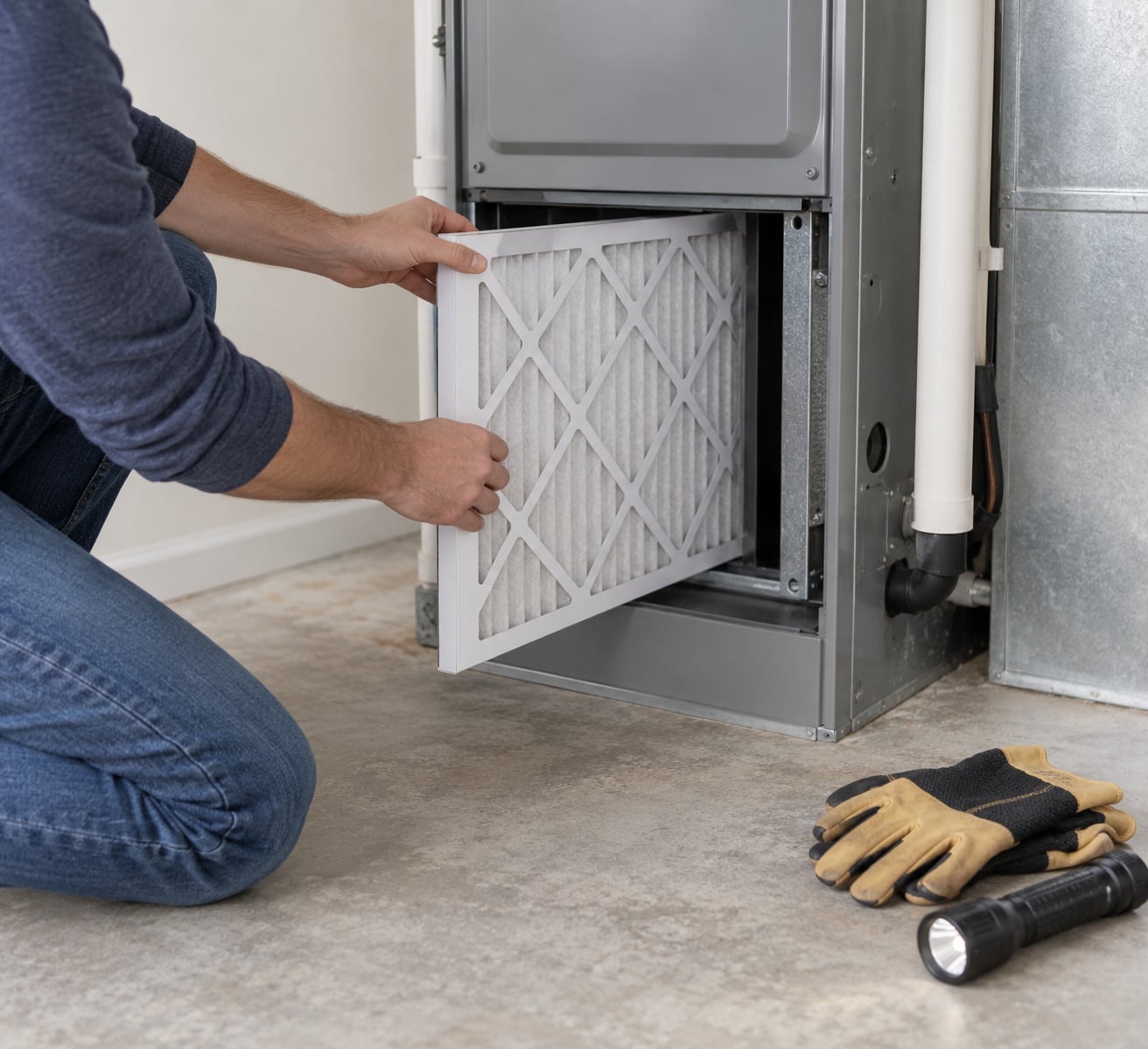
Changing a furnace filter takes about five minutes and almost no tools: turn the system off, slide out the old filter, slide in a new one with the airflow arrow pointing toward the furnace, then close the panel. That is the whole job, and any homeowner can do it without calling an HVAC company.
The part that catches people out is not the physical swap. It is matching the exact size and knowing which way the filter faces. Get either one wrong and you are wasting money on a filter that leaks air around its edges or fights the blower.
A filter that is past due does more than let dust through your house. A restricted filter chokes airflow, which makes the furnace work harder, can ice up the coil in summer, and wears out the blower motor sooner than it should. Ten minutes now saves a technician visit later.
Table of Contents
- What You Need to Change a Furnace Filter
- How to Change a Furnace Filter: Step by Step
- How to Find the Correct Furnace Filter
- Turn Off the Furnace and Prepare
- Remove the Old Filter
- Clean the Filter Compartment
- Install the New Furnace Filter
- Replace the Cover and Restart the Furnace
- Check That the New Furnace Filter Is Working
- Common Mistakes
- Safety Tips for Changing a Furnace Filter
- Frequently Asked Questions
- How often should I change my furnace filter?
- What size furnace filter do I need?
- Which way should the filter arrows face?
- Can I change a furnace filter myself?
- What happens if the furnace filter is dirty?
- When should I call an HVAC professional instead of changing the filter?
- Conclusion
What You Need to Change a Furnace Filter
- The replacement filter in the exact size printed on the old filter or the cabinet frame
- A flashlight for a dark cabinet or basement
- Work gloves, since a neglected filter can be grimy
- A screwdriver if the access panel or filter cover is screwed in place
- A vacuum with a brush attachment or a soft brush for the empty compartment
- A trash bag to seal the old filter before it goes in the bin
Your owner’s manual takes priority over anything here. If your furnace has an unusual filter cabinet, a dirty-filter pre-filter, or a filter mounted somewhere unusual, the manual shows where that unit keeps it and what the manufacturer allows.
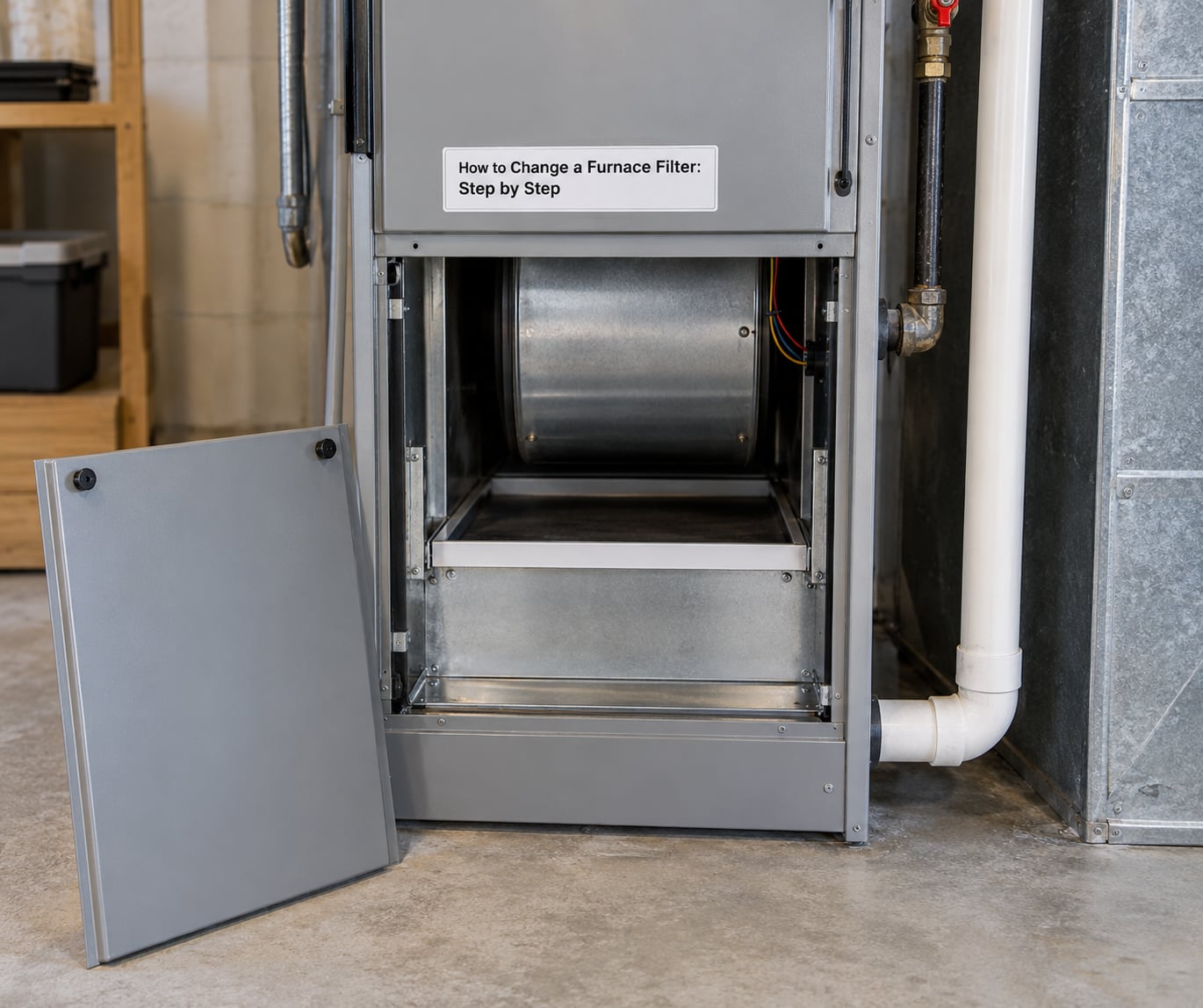
How to Change a Furnace Filter: Step by Step
How to Find the Correct Furnace Filter
Read the size off the frame of the filter already in the unit. Sizes are written as width by length by thickness in inches, so 16x25x1 is 16 inches wide, 25 inches long and 1 inch thick, while 20x25x4 is the same footprint with a 4-inch depth for a media cabinet.
The first two numbers are the ones that matter most. If nothing is printed anywhere, measure the opening of the slot itself, not the cabinet door, and round down slightly so the new filter slides in freely.
Exact fit matters more than most people expect. A filter that is undersized leaves gaps around the frame, and air finds those gaps instead of passing through the media. That unfiltered bypass air carries dust straight into the blower and the heat exchanger.
Turn Off the Furnace and Prepare
Start at the thermostat and set the system to off, then flip the furnace switch to off. That switch is usually a red or blue toggle on the side of the cabinet near the plenum, which is the biggest box the ductwork comes out of.
For a deeper job, or if you plan to reach near the blower compartment, switch off the breaker in the panel and confirm the power is dead with a non-contact voltage tester. A furnace in the off position is not the same as a furnace with no power, and the blower can start from a tripped limit switch or a control board reset.
Never put your hands inside an operating furnace. If you cannot reach the switch or the breaker, that is the point to stop and read the manual.
Remove the Old Filter
Open the filter access door or unscrew the filter cover and set it aside where it will not get stepped on. Put a trash bag over your hand and slide the old filter straight out.
Bagging it before it is fully clear of the slot matters. A loaded filter sheds a surprising amount of fine dust, and with the system running that dust gets pulled straight into the return and back onto the blower wheel.
Hold the old filter up to a bright window or lamp. If you cannot see light through the media, it was well past due. Also look at whether the frame is warped, cracked or frayed, because a filter that is torn at the edge has been letting air around itself for a while.
Clean the Filter Compartment
With the slot empty, run a vacuum with a brush attachment around the rack, the channel and the edges of the opening. Loose lint and grit collect right where the filter seats.
Do not blow it out with compressed air. That just pushes the dust past the filter into the ductwork and the blower wheel, which is the opposite of the point. And keep the vacuum nozzle outside the furnace cabinet so nothing gets sucked into the blower housing.
Install the New Furnace Filter
Unwrap the new filter and look for the airflow arrow printed on the frame. It points in the direction the air is meant to travel, which is toward the furnace and away from the return duct. On an upflow furnace with a front-return cabinet, that usually means the arrow points up and into the unit; on a horizontal furnace in an attic, the arrow points toward the blower compartment.
For a pleated filter, the pleats open toward the air side, so the pointed ridges face the same way as the arrow. If there is no arrow anywhere on the filter, buy a different one rather than guessing.
Slide the filter in until it sits flat against the rack with no gap and no force behind it. Forcing it usually means it is the wrong size. A filter that bows in the middle is being compressed and will not seal properly.
Replace the Cover and Restart the Furnace
Put the access panel or filter cover back on and make sure it is seated and any screws are snug. A cover that is not fully closed can restrict airflow and, on a furnace with a pressure switch, keep the system from starting at all.
Turn the furnace switch back on and set the thermostat back to its normal setting. If your manual describes a specific reset procedure, follow it instead of cycling power repeatedly.
Check That the New Furnace Filter Is Working
Stand at a supply vent and listen. Normal airflow after a change sounds like a steady rush of air, the same as it did before you started.
Then watch what happens over the next heating call. If the furnace starts, runs steadily and blows warm air through the vents, the change is good. If a strong burning or dusty smell shows up on the first run, that is usually dust that was sitting on the heat exchanger catching heat for the first time, and a couple more cycles clear it out.
Write the date on the new filter frame with a marker and set a recurring reminder on your phone. Homeowners who forget consistently end up with a filter that is a museum of pet hair, and the whole point of the five-minute job is doing it on a schedule rather than on a bad day.
Common Mistakes
Wrong size. Buying the nearest size instead of the printed one creates bypass air around the frame. The fix is to measure the slot opening and match width and length exactly.
Filter installed backwards. A reversed pleated filter still catches some dust, but it can carry a heavy load of debris down toward the fan wheel. Check the arrow before the panel goes back on.
Forced or loose fit. A bowed filter is not sealed. If it will not slide in by hand, it is the wrong thickness or the wrong size.
Cover left off or ajar. An open or cracked access panel can stop the system from starting and can pull unfiltered air in. Seat it fully.
Skipping the compartment clean. Dirt left in the empty slot reduces airflow even with a brand-new filter. Vacuum it while it is open.
Changing a filter the system does not use. Some homes have a furnace filter, an air handler filter and a humidifier pad, and they are not interchangeable. Confirm which one your system actually has before ordering.
Running the furnace with no filter at all. Even for a short run, dust coats the heat exchanger and blower, and the first restart can produce a noticeable burning smell.
Safety Tips for Changing a Furnace Filter
Read the owner’s manual first, and follow it over any general instruction. Keep your hands and tools out of the burner compartment, the gas valve, the wiring and the blower wheel; those are not part of a filter change.
Keep children and pets away from an open furnace cabinet, especially in a basement or closet where a curious kid can reach the burner area.
Call an HVAC professional if the access panel is damaged or will not close, if the furnace makes a new or unusual noise, if you see water or a leak near the cabinet, or if airflow stays weak after a correct-size filter is installed. A system that will not start right after a change may have tripped a high-limit or float switch from a long-neglected filter, and that is a technician’s job to reset safely.
For anyone who has just moved into a home, it is worth having a professional confirm the filter size and location once. After that you have a reliable routine for the rest of the years you own the house.
Frequently Asked Questions
How often should I change my furnace filter?
Most one-inch pleated or fiberglass filters need replacing every 30 to 90 days, and one-inch electrostatic filters can usually run 60 to 90 days. Four-inch media filters last considerably longer, often 3 to 6 months and sometimes up to a year in a low-dust home. Your owner’s manual lists the manufacturer’s interval, and pet owners, allergy households and homes with ongoing construction dust should stay near the short end of the range. Check the filter monthly with the light test.
What size furnace filter do I need?
Match the size printed on the frame of the filter currently in your furnace, such as 16x25x1 or 20x25x4. If the printing is gone, measure the filter slot opening rather than the cabinet door, and match width and length exactly. An undersized filter lets unfiltered air bypass the media. If your furnace has a 4-inch media cabinet, it is a different style of filter from the 1-inch slide-in type and is not interchangeable.
Which way should the filter arrows face?
The airflow arrow points toward the furnace and away from the return duct, because that is the direction air travels through the system. On an upflow furnace with a front-return cabinet the arrow points up into the unit, and on a horizontal furnace in an attic it points toward the blower compartment. On a pleated filter, the pleats open in that same direction. If your filter has no arrow at all, pick a different one rather than guessing.
Can I change a furnace filter myself?
Yes. Replacing the filter is basic homeowner maintenance with no tools required beyond a flashlight and maybe a screwdriver for the access panel. Set the thermostat to off, flip the furnace switch to off, slide out the old filter, vacuum the empty compartment and slide in the new filter with the arrow pointing toward the furnace. The manual for your specific model always takes priority over general instructions.
What happens if the furnace filter is dirty?
A loaded filter restricts airflow, so the blower has to work harder to move air through the system. That raises energy use, reduces heating and cooling output, can cause the AC coil to ice over, and puts extra strain on the blower motor and other components. Dust that gets past a failing filter settles on the heat exchanger and blower wheel, which is why a strong burning smell can appear on the first run after a very overdue change.
When should I call an HVAC professional instead of changing the filter?
Call a technician if the access panel or filter cabinet is damaged, if the furnace makes a new noise, if you see water or a leak near the unit, or if airflow stays weak after installing a correct-size filter. A system that will not start right after a change may have tripped a high-limit or float switch, and resetting those safely is a technician’s job. Never reach into a running furnace, and never open the burner compartment for a filter change.
Conclusion
Start at the current filter: read the size off its frame, and check the owner’s manual for anything unusual about your cabinet. Then work through the steps in order, keeping the airflow arrow pointed toward the furnace, and follow the manufacturer’s replacement interval rather than waiting until the system sounds tired.
If airflow is weak even with a fresh, correctly sized filter, find out why instead of forcing the furnace to run. That is a problem worth a technician’s visit, not a filter problem.