Furnace short cycling means the system starts and stops before it finishes a heating cycle, running two or three minutes instead of a full ten to fifteen. In most homes the trigger is restricted airflow that lets the heat exchanger get too hot, which trips the high-limit switch and shuts the burner down early. A new filter or a cleared vent often fixes it in ten minutes. A dirty flame sensor, a clogged condensate line or a cracked heat exchanger take longer.
The confusing part is that short cycling on its own is a symptom, not a diagnosis. Two furnaces that behave identically in the living room can have completely different faults behind the cabinet door, which is why the fastest route is to match what the furnace is doing, and for how long, to the most likely cause.
Table of Contents
- What Does Furnace Short Cycling Mean?
- Furnace Short Cycling Causes and Fixes: Quick Diagnosis Guide
- What Causes a Furnace to Short Cycle?
- Restricted airflow and a clogged air filter
- Closed vents, closed registers and undersized ductwork
- A dirty evaporator coil
- Thermostat placement, settings and calibration
- Flame sensor and ignition problems
- Blocked or restricted venting and combustion problems
- Condensate drainage and control faults
- Oversized furnace
- How to Fix a Furnace That Keeps Turning On and Off
- Thermostat Problems That Look Like Furnace Short Cycling
- Airflow and Filter Problems
- Burner, Igniter, and Flame Sensor Issues
- Condensate, Pressure Switch, and Control Problems
- When to Call an HVAC Technician for Furnace Short Cycling
- How to Prevent Furnace Short Cycling in the Future
- Frequently Asked Questions
- Is furnace short cycling dangerous?
- What is the most common cause of furnace short cycling?
- How do I get my furnace to stop short cycling?
- Why is my furnace cycling every 5 minutes?
- Why does my heat pump cycle on and off quickly?
- Can low refrigerant cause short cycling?
- What to Do First
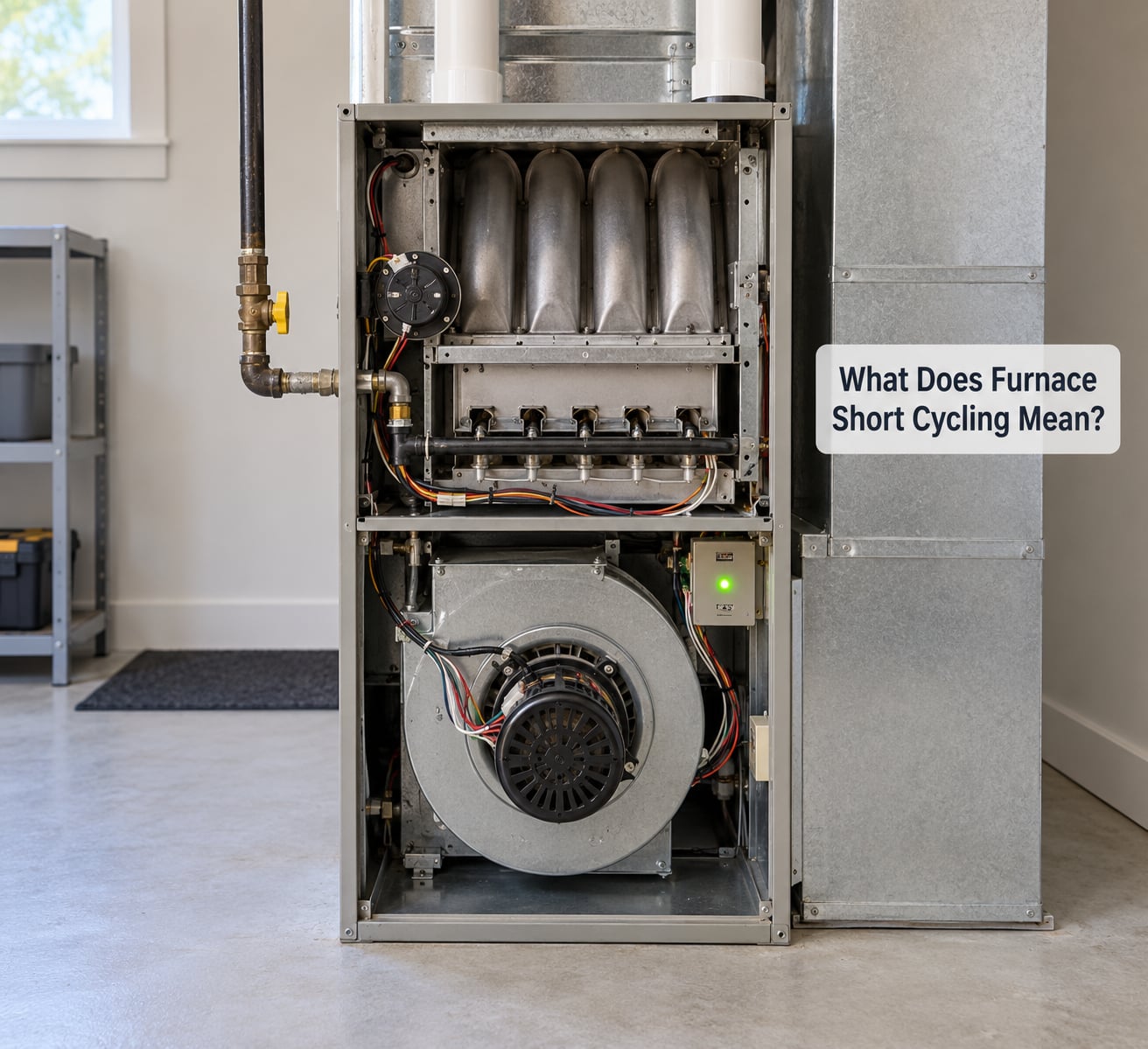
What Does Furnace Short Cycling Mean?
Furnace short cycling is when a furnace starts and stops before completing a full heating cycle, running two to three minutes instead of the normal ten to fifteen, so the home never reaches the thermostat setpoint. A healthy furnace typically runs three to eight cycles per hour. The most common cause is restricted airflow from a dirty filter tripping the high-limit switch.
A healthy gas furnace follows a predictable sequence. The thermostat calls for heat, the control board starts the blower first so air is moving across the heat exchanger, the burner ignites, and the system runs until the air at the registers reaches the temperature the thermostat asked for. That normally takes ten to fifteen minutes in a reasonably insulated house. Then the burner shuts off, the blower coasts down, and the whole sequence starts again later.
Common warning signs are pretty easy to recognize once you know what to listen for:
- The furnace runs two to three minutes, then goes quiet, and repeats all evening.
- The burner lights and drops out within three to seven seconds, sometimes over and over in a row.
- The blower comes on, runs briefly, and stops before the house feels any warmer.
- You hear a click, nothing else, then silence.
- Some rooms stay cold while others are warm, or the furnace never reaches the setpoint.
One thing worth separating out: a furnace that cycles every few minutes while pulling a very cold house up to temperature is not always broken. On the first cold morning after a long stretch of mild weather, the air starts far below setpoint, so each cycle makes real progress. That pattern fades as the house warms. The same goes for heat pumps running a defrost cycle, which deliberately shuts the outdoor unit down for several minutes to melt ice.
Furnace Short Cycling Causes and Fixes: Quick Diagnosis Guide
The table below matches what the furnace is doing to the cause that fits it best. Start with the row that describes your timing, do the first fix only if it falls in the homeowner column, and stop there if it does not.
| What you notice | Likely cause | First fix | Who does it |
|---|---|---|---|
| Runs two to three minutes, stops, repeats every five minutes or so all night | High-limit switch tripping on restricted airflow, or an oversized furnace | Replace or clean the filter, confirm supply and return vents are open | You first, then a technician if it returns |
| Burner lights, runs three to seven seconds, then shuts off and relights | Dirty flame sensor or a weak igniter | Nothing safe to do inside the cabinet; listen and note the timing | Technician |
| Clicks, no ignition at all, repeats every few minutes | Failed igniter, gas valve supply issue or control board fault | Check the thermostat calls for heat, listen for the blower | Technician |
| Blower runs, no heat at the registers, cycles normally | Burner not lighting, or a closed gas supply valve | Nothing beyond listening and recording | Technician |
| Shuts down shortly after a rainstorm or after roofing work | Debris or a nest blocking the exhaust flue or vent termination | Look from the ground for obvious blockage near the exterior termination | Technician clears it from the roof |
| Water or a wet patch on the floor beside the furnace | Clogged condensate drain line or failed float switch | Nothing; a full line can flood the cabinet | Technician |
| Heating is fine most of the season, then cycles badly only on very cold days | Marginal airflow or combustion problem that only shows under full load | Keep the filter fresh through the coldest weeks | Technician before the next cold snap |
| New furnace installed in the past season, short cycles from day one | MERV filter too high for the return plenum, undersized return, or dirty evaporator coil | Check that the installed filter matches what the manual specifies | Installer or technician |
What Causes a Furnace to Short Cycle?
The mechanism is nearly always the same: a safety device decides the furnace is unsafe to run and cuts the burner. Once the part cools or resets, the control board starts the sequence again immediately, which is where the rapid on-off pattern comes from.
Restricted airflow and a clogged air filter
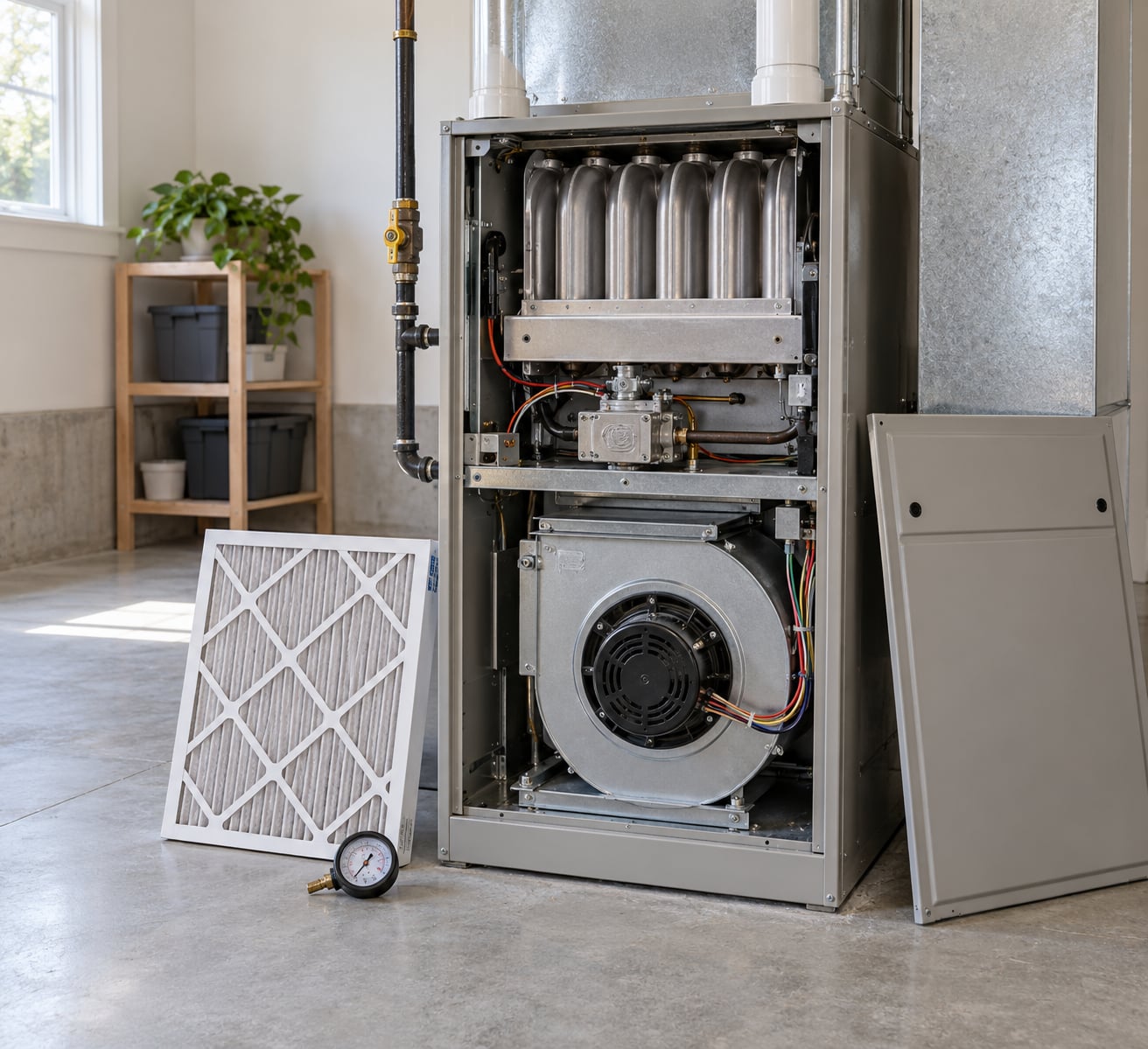
A dirty filter is the first thing to check, and the most common culprit. The blower pushes air across the heat exchanger to carry heat into the duct system. When the filter blocks that path, the air moving past the heat exchanger drops below the volume it was designed for, the metal gets hotter than the high-limit switch allows, and the switch opens. The furnace shuts down, cools for a few minutes, and starts again on the same overheated condition.
Closed vents, closed registers and undersized ductwork
Supply and return vents get shut off during renovation, blocked by furniture or covered for painting, and people forget. Return grilles are the ones that matter most, because the furnace can only pull in the air it returns. Ductwork that is too small for the furnace does the same job as a closed return, which is why a furnace in a tight, poorly ducted house can short cycle with a brand new filter in it.
A dirty evaporator coil
The evaporator coil is the cold side of the furnace, and it sits directly downstream of the filter. A dirty filter loads it with dust, the coil holds that dust, and airflow across the coil drops even though the filter itself looks clean. This one is regularly missed after a furnace replacement, when leftover construction dust settles on the new coil. Heat pumps are more exposed because the outdoor coil is exposed to the same dust.
Thermostat placement, settings and calibration
A thermostat that sits near a supply register reads the supply air temperature instead of the room temperature. The furnace heats the house, the register blows warm air across the sensor, the thermostat thinks the setpoint is reached, and it shuts the burner down. Minutes later the room cools and it fires again. Wrong settings, a dead battery on a gas valve, or a smart thermostat with aggressive scheduling can all produce a similar pattern.
Flame sensor and ignition problems
The flame sensor is a small rod that confirms to the control board that the burner is actually lit. A thin layer of carbon on it, or corrosion, makes the board think the flame went out, so it shuts the gas valve seconds after ignition. Igniters wear out too, and a weak one manages a click without producing a spark strong enough to light the gas reliably. Both of these produce the classic ignite-then-drop-out signature.
Blocked or restricted venting and combustion problems
A furnace has to exhaust combustion gases and pull in replacement air. A blocked or crushed exhaust flue, a vent pitched incorrectly, a bird nest at the exterior termination, or a closed return all starve the burner of air. That trips the induced-draft pressure switch, or in a worse case the rollout switch, which exists to close the gas valve before heat spills into the cabinet. A closed vent on a sealed-combustion unit is usually the trigger for this on very cold days, when the burner runs longest.
Condensate drainage and control faults
High-efficiency furnaces produce water as a byproduct, and it drains through a small line to a floor drain or pump. When that line clogs, water backs up into the cabinet and a float switch shuts the furnace down for safety. Loose wiring, a corroded connector or a failing control board will also do it, and repeated faults can push the board into a lockout state where nothing happens until you reset it.
Oversized furnace
An oversized furnace fires, dumps its full heat output into the house, overshoots the setpoint, and shuts down within a couple of minutes. It never settles into a steady cycle. No homeowner fix corrects this one; it comes back to the sizing of the equipment and the duct design it was matched to.
How to Fix a Furnace That Keeps Turning On and Off
Work through these in order and stop as soon as the pattern changes. Most cases end in the first three steps.
- Look at the filter. Take it out and hold it up to a light. If you cannot see daylight through it, replace it. If it is clean, put it back and move on rather than assuming the filter is always the answer.
- Check the vents and returns. Walk the house and confirm every supply register is open and every return grille is clear. Rugs, furniture, boxes and freshly painted registers all restrict return air without anyone noticing.
- Look at the thermostat. Confirm it is set to heat, the fan is on auto, and the schedule matches when you are home. Move it away from any nearby supply register if it is within a few feet of one, and on a programmable model add a delay between cycles if the equipment supports one.
- Watch one full cycle. Sit near the furnace and time it. Note the length of the run, the gap before the next start, whether the burner lights, and whether the blower is still running after the burner shuts off. Write the numbers down. Two minutes with the blower still running points to airflow; seven seconds with the blower still running points to the flame circuit.
- Reset it once. Most furnaces have a reset button or a breaker. Cut power to the furnace, wait a minute, restore it and see whether the behaviour changes. One reset is fine. Repeated resets train the control board into a lockout, which is why a unit that will not stay running after a reset needs a technician rather than more resetting.
- Look for water and debris. Check the floor of the cabinet and the area around the furnace for water, corrosion or a puddle. If there is water or a sweet chemical smell near the condensate line, stop and call for service.
From there, the homeowner boundary is clear. Filters, vents, thermostat placement and a single reset are yours. Anything that requires opening the burner compartment, touching the gas valve, cleaning the flame sensor, clearing the flue or working on wiring belongs to a licensed technician. Gas and electrical work is not a learning opportunity.
Thermostat Problems That Look Like Furnace Short Cycling
A thermostat fault is easy to mistake for a furnace fault because the furnace is doing exactly what it was told. These are the versions that come up most often.
- Placed too close to a supply register or a sunny window. This is the placement mistake that comes up most often on homeowner forums. The sensor reads supply air or direct sun, hits setpoint early, and stops the burner before the room is warm.
- Aggressive schedule. A schedule set for a busy household can call for heat, reach setpoint, and call again minutes later as the temperature sags. Widening the deadband and setting a longer minimum on-time where the thermostat allows it smooths this out.
- Dead batteries in a gas valve or a powered smart thermostat. Many gas valves use batteries to hold the valve open. When they fail, the furnace may not hold a call for heat, or the board loses power.
- Calibration drift. A sensor that reads a few degrees high will shut the burner down early every cycle.
- Wi-Fi and hub problems. A smart thermostat that drops off its hub falls back to a schedule or a default setting, sometimes to a much lower setpoint than you expect.
If you change one thing and the pattern does not change, the thermostat is probably not the problem. That is a useful test in itself.
Airflow and Filter Problems
Airflow is the first suspect in most short cycling complaints, and it is also the cheapest to check. The furnace moves air through two separate paths: return air coming in through the grilles, and supply air going out to the rooms. Break either path and the heat exchanger overheats.
Set a reasonable filter interval based on how the home actually runs. A house with pets, a lot of construction dust, or a filter larger than the cabinet can clog in six to eight weeks. The manufacturer usually prints a size and a MERV rating inside the filter door frame, and matching that specification matters more than the brand of filter you buy. A filter rated far higher than the design allows adds resistance the return plenum was not built to handle, and a new furnace with that mismatch is a known cause of short cycling in its first winter.
Technicians measure airflow as static pressure, which is the resistance the duct system creates to the blower. A gauge hooked into the suction or discharge plenum gives a number that says whether the system is within range. You cannot do this yourself without the equipment, but knowing the term helps when a technician explains what they found.
Two warnings. Do not close supply vents to balance the airflow; that pushes the problem downstream into the heat exchanger. And coil cleaning is technician work, whether the coil is the evaporator inside the cabinet or the outdoor coil on a heat pump, because reaching either one means taking the furnace apart.
Burner, Igniter, and Flame Sensor Issues
If the burner lights and then stops within a few seconds, the problem is in the flame detection circuit or the ignition circuit, not the airflow.
The flame sensor is the usual answer. It is a thin metal rod held near the burner, and the control board runs a small current through it to verify flame. Any carbon deposit, a bent rod from a previous repair, or a loose connector interrupts that current, and the board closes the gas valve. Cleaning the rod with fine abrasive paper is a known homeowner fix and works often, but it means reaching into a live burner compartment, and it treats the symptom rather than a gas pressure problem or a burner assembly that is out of adjustment.
A weak igniter fails the same way, only before the gas opens. You hear rapid clicking and nothing lights. Igniters typically last somewhere in the range of a few years, and hard water and corrosion shorten that. Other causes in this family include a gas supply valve that is closed or partly closed, low gas pressure, a burner that is not receiving fuel because of a supply problem upstream of the furnace, and incomplete combustion that leaves a sooty, unstable flame.
What you can safely observe from outside the cabinet: whether you hear the blower, whether you hear clicking, whether the burner lights at all, how long it runs before stopping, and whether the flame that is visible through the viewing port looks steady or is lifting and dropping. Do not disassemble the burner, do not touch the gas valve, and do not clean the sensor yourself unless your manual specifically describes the procedure and you are confident doing it with the power off. That work is on a gas system, and the mistake costs far more than the service call.
Condensate, Pressure Switch, and Control Problems
These are the less obvious causes, and all of them are technician territory. Homeowners mostly recognize them by the symptom.
- Clogged condensate line. A blocked drain backs water up into the cabinet, and a float switch shuts the furnace down to prevent an overflow. Signs include water on the floor, corrosion around the base, a musty smell, and a unit that starts then stops with the blower running.
- Pressure switch fault. This proves the induced-draft blower is moving enough air to exhaust combustion gases. A failed switch, a disconnected hose or a blocked flue causes an immediate shutdown after the draft blower starts.
- Rollout switch. A heat-sensitive switch near the heat exchanger opens if combustion gases spill into the cabinet. It is a carbon monoxide protection, and it should never be jumpered.
- Loose wiring or a failed control board. Corroded connectors, chewed wires from an animal, or a board with failed relays produces clicks, silence, error codes and repeated lockouts.
Error codes and status lights help here. The board’s own diagnostic record tells a technician whether the fault was a limit trip, a flame failure or a pressure switch opening, and that single detail removes most of the guesswork. Record the code before you reset anything, because it clears.
When to Call an HVAC Technician for Furnace Short Cycling
Some symptoms are homeowner problems. These are not, and they are worth a call the same day.
- You smell gas, or a carbon monoxide alarm sounds. Leave the building, do not operate switches or flames, and call the gas utility or emergency services from outside. Do not try to diagnose it.
- Soot or a black powder around the burner compartment, or yellow staining on the burner.
- A visible crack, warping or corrosion on the heat exchanger.
- Water pooling inside or beside the cabinet, or a condensate line that keeps refilling and backing up.
- A flame that looks ragged, lifts off the burner, or changes color repeatedly.
- Error codes that reappear after a reset, or a furnace that will not respond to a reset at all.
- Rattling, grinding or squealing from the blower, particularly a belt-driven blower where the belt slips and the airflow drops.
- Short cycling that returns every time you fix the filter, which points at ducts, a dirty coil, an oversized furnace or a combustion problem.
Short cycling itself is not dangerous in the way a gas leak is. The risk is that it is a symptom of a blocked flue or a cracked heat exchanger, both of which involve carbon monoxide, so detectors on every level outside the sleeping areas are worth having working before the next cold snap.
How to Prevent Furnace Short Cycling in the Future
Once the fault is repaired, a short maintenance routine keeps it from coming back.
- Check the filter on a schedule tied to your home. Monthly in a dusty home or one with pets, every six to eight weeks otherwise. A filter you can see light through is a filter that is still working.
- Keep returns clear. Furniture against a return grille is the same as closing it partway.
- Leave the thermostat where air moves around it but not on top of it. Repeat visits after a schedule change is a good reminder to check placement.
- Leave supply and return vents open year-round. Ducts with dampers should be set so every room gets air.
- Keep the exterior vent termination clear. Leaves, ice and nests cause shutdowns that often appear only after a storm or in deep cold.
- Have an annual service visit before heating season. The technician checks static pressure, gas pressure, combustion, the flame and the heat exchanger, and clears the condensate line.
- Keep carbon monoxide detectors working. Test them twice a year and replace the batteries on the schedule the manual gives you.
- Treat recurring short cycling as a real fault. Repeated trips wear out the igniter, the blower motor and the control board, and they are often the first sign of a furnace nearing the end of its service life.
Frequently Asked Questions
Is furnace short cycling dangerous?
Short cycling on its own is not an emergency, but it is often a symptom of a serious fault. A blocked flue or a cracked heat exchanger lets carbon monoxide into the home, so if you smell gas, see soot near the burner, or a carbon monoxide alarm sounds, leave the building and call the gas utility or emergency services. Otherwise the furnace is usually safe to keep running at lower efficiency while you arrange service.
What is the most common cause of furnace short cycling?
Restricted airflow is the most common cause, and a dirty or clogged air filter is the usual reason behind it. The blower cannot move enough air across the heat exchanger, the metal gets too hot, and the high-limit switch shuts the burner down before the cycle finishes. Closed return vents, an undersized return or a dirty evaporator coil produce the same symptom.
How do I get my furnace to stop short cycling?
Start with the filter: take it out, hold it up to a light and replace it if you cannot see through it. Next confirm every supply and return vent is open and clear, then check the thermostat is set to heat, its schedule is right, and it is not sitting next to a supply register. Time one full cycle and write down how long it runs and how long it stays off. If the behaviour does not change, call a technician.
Why is my furnace cycling every 5 minutes?
A repeat pattern of a few minutes on and a few minutes off usually means the high-limit switch is tripping, which points back to airflow, a dirty coil, closed returns or an oversized furnace. It can also be the control board cycling through lockouts after repeated flame or pressure switch faults. Replace the filter, open the vents, and if the exact five-minute pattern continues, have static pressure and combustion checked.
Why does my heat pump cycle on and off quickly?
A heat pump short cycles for different reasons than a gas furnace. Defrost cycles shut the outdoor unit down for several minutes by design while ice melts. Frequent cycling can also come from a low refrigerant charge, which trips the low-pressure cutout, a failing outdoor fan motor, or a refrigerant line that is too narrow or too long for the unit. Reversing valves and metering devices fail similarly, so a technician needs to check pressures and the charge.
Can low refrigerant cause short cycling?
Yes, in a heat pump. Many systems use a low-pressure cutout that shuts the compressor down when refrigerant pressure drops, and the control starts it back up as soon as the pressure recovers, producing rapid cycling with no heat. In a gas furnace, refrigerant is not involved, though a related shortage of combustion air or low gas pressure produces a similar rapid on-off pattern through a different safety switch.
What to Do First
Start at the filter, then the vents, then the thermostat. Those three checks take fifteen minutes and cost almost nothing, and they resolve the majority of short cycling calls before a technician ever has to pull up a ladder. Time one cycle and write down the run length and the gap between starts, because that single detail narrows the fault faster than anything else.
If the pattern survives those checks, the fix has moved into the furnace cabinet, and that is where a licensed technician takes over. Get the burner, the flame sensor, the pressure switch, the condensate line and the flue inspected, and ask for the reading rather than just the verdict.