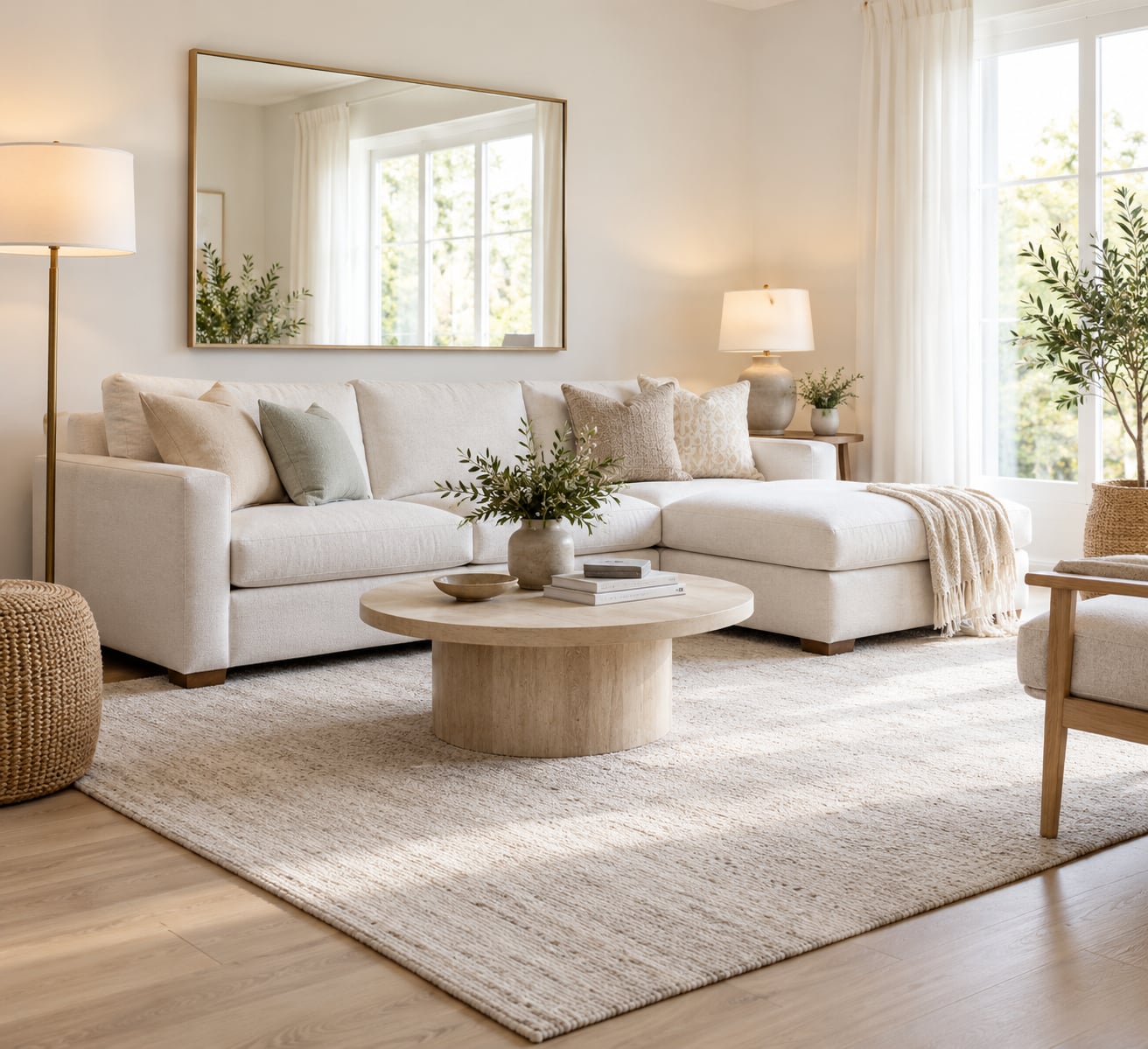
A dark room rarely needs new walls, new windows or a contractor. To brighten a dark room without renovating, you change three things: how much light gets in, how many sources spread that light around the room, and how much of it bounces back off the surfaces instead of dying in a dark corner.
The order matters more than any single item. Clean the windows first, fix the lighting second, then decide about paint. Do those in the wrong sequence and you paint a room that still feels dim because the one harsh ceiling fixture is still doing all the work. Most people see a real difference in a weekend, and a few can be undone in ten minutes.
Table of Contents
- What You Need
- Step-by-Step: How to Brighten a Dark Room Without Renovating
- How to Brighten a Dark Room Without Renovating: Start With a Plan
- Maximize Existing Light
- Upgrade the Room’s Lighting
- Use Light and Reflective Colors
- Add Mirrors and Reflective Decor
- Reduce Heavy Furniture and Textures
- Finish With a Cohesive, Lighter Look
- Common Mistakes
- Frequently Asked Questions
- What is the fastest way to brighten a dark room without renovating?
- What colors make a dark room look brighter?
- Can I brighten a rented room without painting or installing fixtures?
- Where should I place a mirror in a dark room?
- How many lamps should I use in a dark room?
- When should I hire an electrician to brighten a room?
- Conclusion
What You Need
Before you buy anything, work out three things: which room it is, what you are allowed to change, and how much time you have.
- Pick the room and the moment. Stand in the doorway in the morning, at midday and again after dark. A room that is gloomy at noon has a window problem. A room that is only gloomy at night has a bulb problem.
- Check your restrictions. Renters need to know whether painting, drilling and adhesive hooks are banned, because that changes the whole list. Assume you cannot touch paint, wiring or fixtures until a landlord confirms otherwise in writing.
- Count your light sources. Walk around and note every existing bulb and fixture, plus the wattage and colour on the label. Most dark rooms have exactly one source, and it is in the ceiling.
- Optional supplies: glass cleaner and a microfibre cloth, a step ladder, a tape measure, painter’s tape and a dust sheet, low-tack adhesive mounting strips for renter-friendly fixes, and a couple of warm white LED bulbs to test.
- A light meter app. Free phone apps estimate brightness in lux at floor level and near the ceiling. Two readings, before and after, turn a guess into something you can check.
Step-by-Step: How to Brighten a Dark Room Without Renovating
How to Brighten a Dark Room Without Renovating: Start With a Plan
You can brighten a dark room without renovating by working through the room in this order: get rid of what blocks light, add light sources, lighten the surfaces, then lighten the contents. Follow that sequence and each step makes the next one work harder.
Start by identifying the real culprit rather than the surface that annoys you most. A room can feel dim because of one blocked window, one 60-watt bulb, or dark flooring you cannot change. Cover the windows with paper one at a time and note which removal changes the brightness most. Photograph the room from the same spot before you start, so you are not relying on memory later.
If you are choosing paint, sample four or five light colours on a sample board and look at them at the darkest time of day in that room. Paint that looks warm and inviting under a store’s fluorescent lights can look grey at night in a north-facing bedroom.
Maximize Existing Light
This is the free part, and on many rooms it does more than everything else combined.
- Clean the glass inside and out. A season of grime on both panes can cut daylight noticeably, and you will feel the difference the same afternoon.
- Push curtains and blinds fully open and tie drapes back. Anything you can remove from the window area is daylight you keep.
- Move furniture that stands in front of a window. A tall cabinet two feet from the glass can cost you more light than a new bulb buys you.
- Trim or thin back branches and hedges that shade the lowest window. Check seasonally, because the sun path changes and so does what blocks it.
- Replace any frosted, tinted or privacy film on glass if it is yours to remove. Heavy film is one of the most common reasons a room stays dim in broad daylight.
How do you know it worked? Take a lux reading in the middle of the floor before and after. Anything above a 15 to 20 percent gain means you kept that gain when you move on to the lighting step.
Upgrade the Room’s Lighting
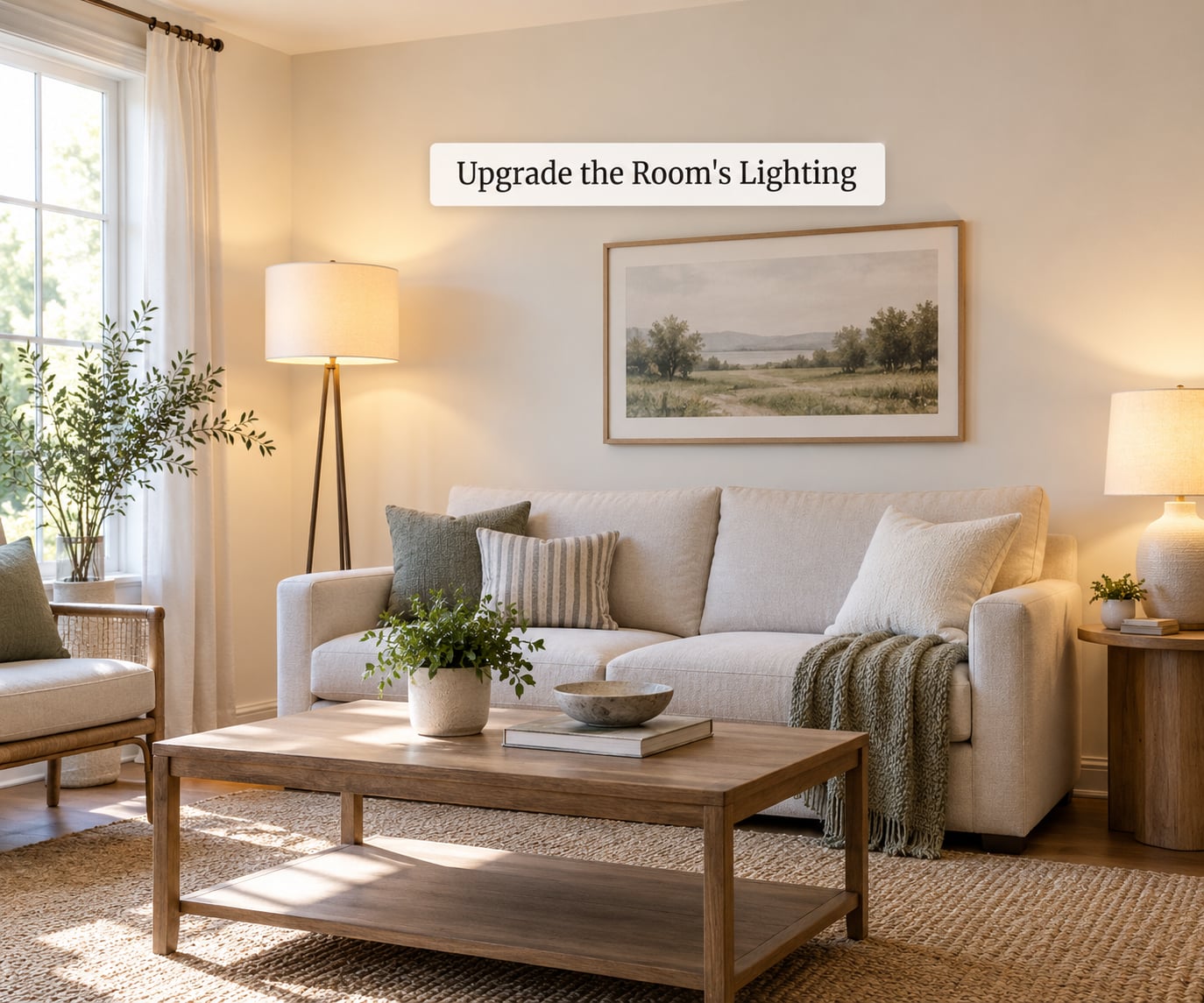
One overhead fixture makes a room look flat because it lights the ceiling as much as the floor. Layered lighting fixes that by splitting light into three jobs: ambient light for general fill, task light for reading and working, and accent light for the things you want people to look at.
- Ambient. Fit a diffuser or shade over a bare bulb so you get soft, spread light instead of a hotspot. Ceiling fixtures with frosted glass or a fabric drum shade do this well.
- Task. A floor lamp beside the sofa and a desk or table lamp at the work surface put light exactly where hands and eyes need it, and leave the ceiling dimmer on purpose.
- Accent. A small picture light or a lamp aimed at a wall washes that surface and makes it glow.
On colour temperature, warm white sits around 2700K, warm-neutral near 3000K, neutral white around 4000K and cool daylight near 5000K. For a dim room, 2700K to 3000K is the comfortable range because warm light reads as soft rather than clinical. Going cooler to make a room look brighter usually backfires: blue-heavy light makes skin and walls look grey. Match the range rather than chasing brightness. For output, aim for roughly 100 lumens per square foot of floor for general lighting, so a 12 by 12 foot room wants around 1400 lumens spread across more than one source.
Swap a bulb, close the curtains and stand back. If the room looks warm and even, the Kelvin is right. If faces look grey or you notice flicker in your peripheral vision, drop about 500K.
Use Light and Reflective Colors
Light colours return more of the light that hits them. Paint makers rate this as light reflectance value, where 100 is pure white. Moving a wall from a mid-tone to a pale colour can raise its reflectance several times over, which is why ceilings make such a difference: they take the bounce from your lamps and send it back down.
Start with the ceiling, then the walls, then trim and doors. White, cream, pale grey, soft blue and light warm neutral all work. If you are worried about white feeling clinical, pick a white with a warm undertone or move to a pale greige instead of a flat bright white. Sheen matters too: matte and eggshell diffuse light softly, while satin has a slight gloss that adds a hint of reflection without looking wet.
For renters who cannot paint, the same effect comes from large pale surfaces. Light bedding, a linen sofa, a cream rug and a white-painted piece of storage furniture raise the average reflectance of everything the lamps hit.
Add Mirrors and Reflective Decor
A mirror does not add light. It redirects light that is already there, so placement matters more than size.
- Hang it where it can see a window, a lamp or a light wall. A mirror facing a dark corner reflects darkness and does nothing for you.
- On an opposite or adjacent wall to the window, angled so it catches the daylight and bounces it deeper into the room.
- Aim for the bottom edge 6 to 8 inches above a console, dresser or bed, and roughly two thirds of the way up the wall. Hanging it higher than eye level usually looks worse and reflects less.
- Match the width to the wall. A mirror around two thirds the width of the wall it hangs on reads as intentional; a small mirror on a big wall reads as an afterthought.
- Keep furniture clear of it. A shelf standing in front of a mirror cuts the reflection and is the most common reason people think mirrors do not work.
Smaller reflective accents help in the same way: glass-topped tables, mirrored or metallic picture frames, a chrome or glass lamp base, glossy ceramic vases and open shelving that lets light pass through instead of stopping at a solid cabinet door.
Reduce Heavy Furniture and Textures
A dark room reads as smaller when big dark shapes fill it. So replace or relocate the heaviest items first.
Start with what sits in the main sightline, usually straight through the doorway. A deep charcoal sectional in a small living room does more damage than any colour on the walls. Swap it for a light or mid-tone piece with exposed legs, which lets light pass underneath so the floor keeps glowing instead of going black.
The same logic applies to the rest of the room: thin out bulky window treatments for sheers or light blinds, replace a heavy dark rug with a large light one, and drop oversized accessories that crowd a surface. If you cannot replace a dark dresser, keep the dark wood concentrated in one zone and lighten everything around it. That reads as a deliberate contrast instead of a room that is uniformly dim.
Finish With a Cohesive, Lighter Look
Once the light and surfaces are fixed, the last pass is what makes it feel finished rather than patched.
Hang curtains so they extend well past the window frame on both sides and start high, near the ceiling. Wider and higher curtains make the window look bigger and stop the wall around it reading as dead space. Keep textiles in a narrow range of light tones so the eye moves around the room instead of stopping on a dark cushion.
Add low-light plants such as pothos, snake plant or a ZZ plant. They soften hard corners and add green without adding weight. Then stand back in the doorway, where you first judged the room, and check that the space looks lighter, less crowded and consistent from the entrance. Take the second lux reading here. If the number has not moved, the problem is almost always a single dark object in your sightline.
Common Mistakes
These are the fixes that look productive and change almost nothing.
- Painting only one wall. If you paint a single accent wall while the other three stay dark, the contrast makes the dark walls look darker. Lighten the ceiling first, then the walls that face your main light source.
- Adding one very bright bulb. More lumens in a single overhead just flattens the room and creates glare. Spread the output across two or three sources instead.
- Hanging a mirror opposite another mirror. You get glare and a busy effect rather than useful daylight. Face one mirror toward a window or a lamp.
- Choosing a cool white bulb. Anything above about 4000K reads blue and makes warm walls look grey.
- Parking furniture against the window. Tall pieces block the daylight you just worked to let in.
- Hanging a heavy pendant or chandelier. Dark metal fixtures in a dim room pull the eye to the ceiling and darken the middle of the space.
- Changing fixtures or wiring without permission. Swapping a bulb is fine. Anything past that needs a licensed electrician and, in a rental, the landlord’s approval.
Make one change, live with it for a day, then judge it. Stacking every change at once means you never know which one worked or which one to undo.
Frequently Asked Questions
What is the fastest way to brighten a dark room without renovating?
Clean the windows and open every covering first, then replace the single overhead bulb with a warmer, higher-lumen LED and add one floor or table lamp. Those three changes cost little, need no tools and are fully reversible, and they usually show more difference than any decor change. Paint and furniture decisions come after.
What colors make a dark room look brighter?
Light, low-saturation colours return more light than dark or highly saturated ones. White, cream, pale grey, soft blue and light warm neutrals all work well on walls and ceilings. Pair them with light textiles and a large light rug so the average reflectance of the room rises. A warm undertone keeps white from looking clinical.
Can I brighten a rented room without painting or installing fixtures?
Yes, and most of the useful changes are reversible. Use adhesive mounting strips instead of screws for a mirror or a light shelf, swap bulbs in the fixtures you already own, and add freestanding floor and table lamps. Paint the trim and doors with removable wallpaper, or skip colour changes and raise brightness with light textiles and reflective decor instead.
Where should I place a mirror in a dark room?
Place it where it can see a window, a lamp or a pale wall, since a mirror only redirects light that already reaches it. On the wall opposite or beside the window, angle it so daylight travels deeper into the room. Hang it with the bottom edge 6 to 8 inches above furniture, keep furniture clear of the glass, and skip facing it toward another mirror.
How many lamps should I use in a dark room?
Aim for at least three light points so no part of the room depends on a single overhead fixture. One floor lamp for general fill, one table or desk lamp for reading and working, and one low accent light aimed at a wall or artwork will spread roughly 100 lumens per square foot of floor far more evenly than one bright ceiling fitting.
When should I hire an electrician to brighten a room?
Hire a licensed electrician when a room has no usable light fitting, when the existing wiring is old or scorched, when outlets are needed in new places, or when you want to add a ceiling fan, track lighting or a new circuit. Swapping bulbs, shades and plug-in lamps is safe on your own. In a rental, get the landlord’s written approval before any fixture changes.
Conclusion
To brighten a dark room without renovating, start at the window and work outward: clean the glass, open the coverings fully, clear the furniture away from it, then replace the single overhead bulb with a warmer 2700K to 3000K LED and add a floor lamp and a table lamp. Only then decide about paint or furniture.
Pick one change this weekend, live with it overnight, and check the room from the doorway the next morning. That is usually where people stop worrying the room will still look dark. It only does, when one dark object is sitting in the main sightline or one harsh bulb is doing all the work.