To prepare a yard for winter, work through a short fall checklist before the first hard freeze: clear leaves and debris, cut back perennials, drain every hose and water line, protect tender plants and young trees, give the lawn one final mow, then store tools and outdoor equipment. Most of the list takes a weekend, and the payoff shows up in spring as a yard that thaws out green instead of patchy.
Timing matters more than technique here. Work backward from your area’s average first frost date and aim to finish the big jobs two to three weeks ahead of it. Anything to do with water needs a longer runway, because a hose left connected when temperatures drop is the one mistake that reliably costs you a replacement.
Wave2011 readers who own the house rather than rent it usually think of this as a once-a-year chore alongside furnace filters and gutter cleaning. It is the same category of work, and it deserves the same weekend.
Table of Contents
- What You Need
- How to Prepare a Yard for Winter Step by Step
- How to Prepare a Yard for Winter Before the First Frost
- Cut Back Perennials and Clean Flower Beds
- Protect Plants, Shrubs, and Young Trees
- Drain and Disconnect Outdoor Water Features
- Rake, Mow, and Clear the Final Layers of Leaves
- Store Tools and Outdoor Equipment Properly
- Complete a Final Walkthrough
- Common Mistakes
- Winter Tips for a Healthier Yard
- Frequently Asked Questions
- When should I prepare my yard for winter?
- Should I leave leaves on my lawn over winter?
- Do I need to water my plants before winter?
- Should I wrap shrubs and trees for winter?
- What yard tasks should I do after the first snowfall?
- Conclusion
What You Need
Gather this before you start. Nothing on the list is exotic, and most households already own three quarters of it.
- Hand tools: a rake, garden fork or tiller for soil work, pruners or loppers for stems, and a shovel for moving mulch and soil.
- Leaf options: a rake, a leaf blower, or a mower set up for mulching. A tarp or collection bag speeds up pile disposal.
- Mower with a sharp blade, plus a fuel can or battery charger if yours is not cordless.
- Mulch, shredded bark, leaf mold, compost or straw, roughly 2 to 3 inches deep for beds and tree rings.
- Protective gear: work gloves, eye protection, sturdy boots and a dust mask if you are handling dusty mulch or compost.
- Water service key or adjustable wrench to reach outdoor spigots, plus a garden hose and a flathead screwdriver for draining lines.
- Broom and storage space for patio furniture, planters, hoses and small tools.
Two optional services are worth considering. An irrigation winterization visit from a plumber or landscape company runs a blowout through the lines before hard freezes reach them. An arborist handles large tree limb removal, which is genuinely dangerous work if the branches are over head height. Everything else here is safe for a homeowner with a weekend and a ladder they trust.
How to Prepare a Yard for Winter Step by Step
Work through these in order. The early tasks are the ones with deadlines, and the later ones are the ones that benefit from the soil already being cleared.
How to Prepare a Yard for Winter Before the First Frost
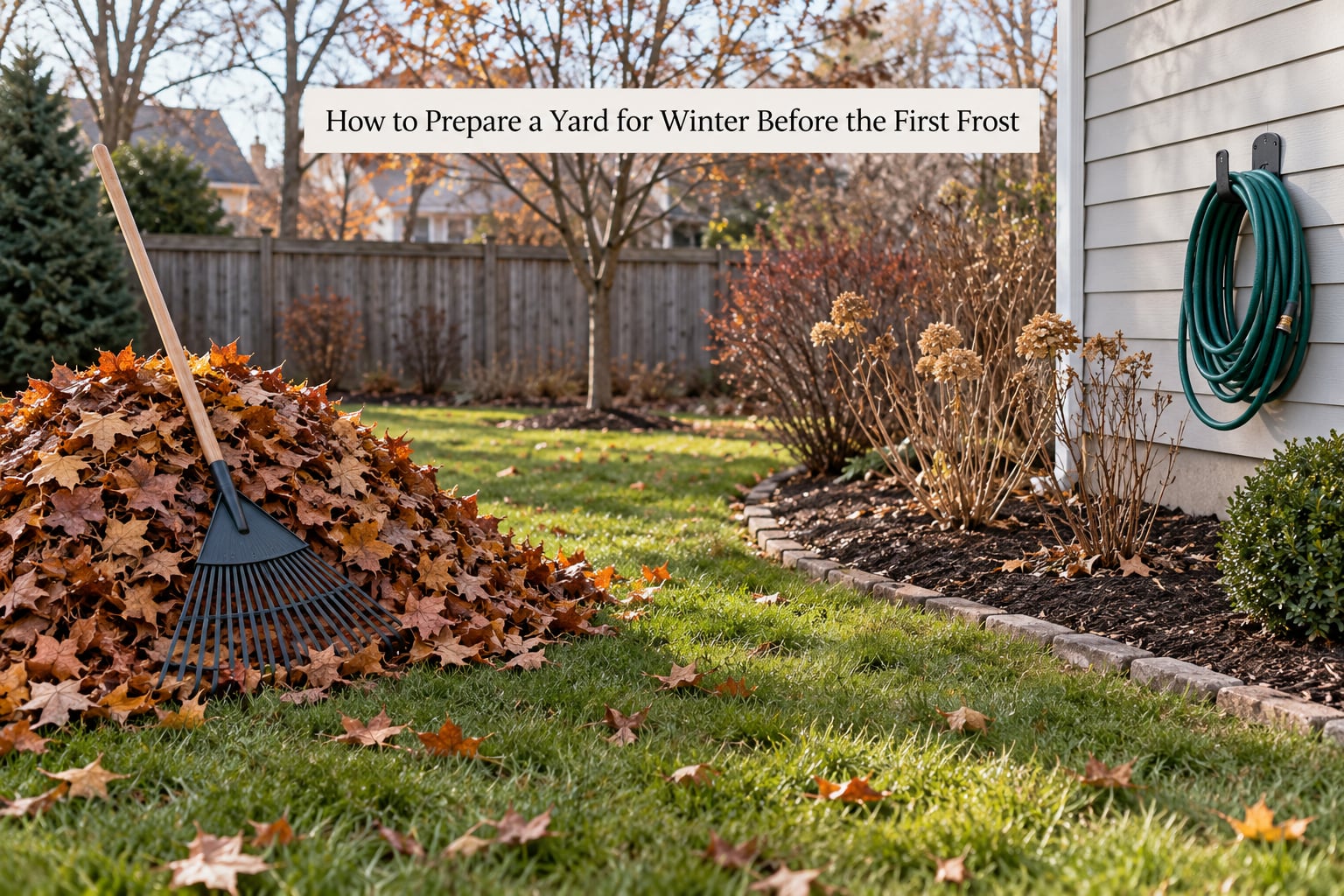
Start with a survey, not a project. Walk the property on a dry day and write down what needs attention before you touch anything.
Look for five specific things: standing water that will freeze into a sheet of ice, branches hanging low or split after storms, dead growth in beds, containers still holding soil and water, and any outdoor faucet, hose or irrigation component you have not checked since spring. Make a list with two columns, tasks you own and tasks that need a professional.
Remove fallen debris from low spots and downspout extensions, because anything trapped under ice can tear siding or crack a foundation wall. Confirm that every downspout actually pushes water away from the house rather than dumping it at the foundation.
Check your local first frost date and count back from it. Seeding, fertilizing and irrigation shutdown all lose value as soil cools, so those go first on the calendar.
Cut Back Perennials and Clean Flower Beds
Some perennials should be cut back and others should stay standing all winter, so decide plant by plant rather than bed by bed.
Leave upright stems of bee balm, coneflower, blazing star, ornamental grasses and sedum standing. They hold seeds that birds eat through the cold months, and hollow stems host overwintering insects that garden predators find in spring. Cut down diseased material, spent annuals, iris and daylily foliage, and anything soft that would collapse into a wet mat.
Cut stems to 2 to 3 inches above the soil line with clean, sharp pruners. Leave a light layer of leaf litter over empty beds, since bare soil in freezing weather loses organic matter and erodes under winter rain.
Bag anything diseased rather than composting it. Black spot on roses, mildew on phlox and clubroot on brassicas all overwinter in infected debris, and a pile that looks fine in November will spread spores into next year’s bed.
Top-dress bare beds with 2 to 3 inches of compost or shredded bark once the soil has cooled. Mulching late is fine because it insulates roots rather than feeding them, so the window is wide.
Protect Plants, Shrubs, and Young Trees
Mark anything tender before you forget it. Drive a bamboo stake or a flag beside each rose, hydrangea, clematis and young tree, then decide which of those actually need covering.
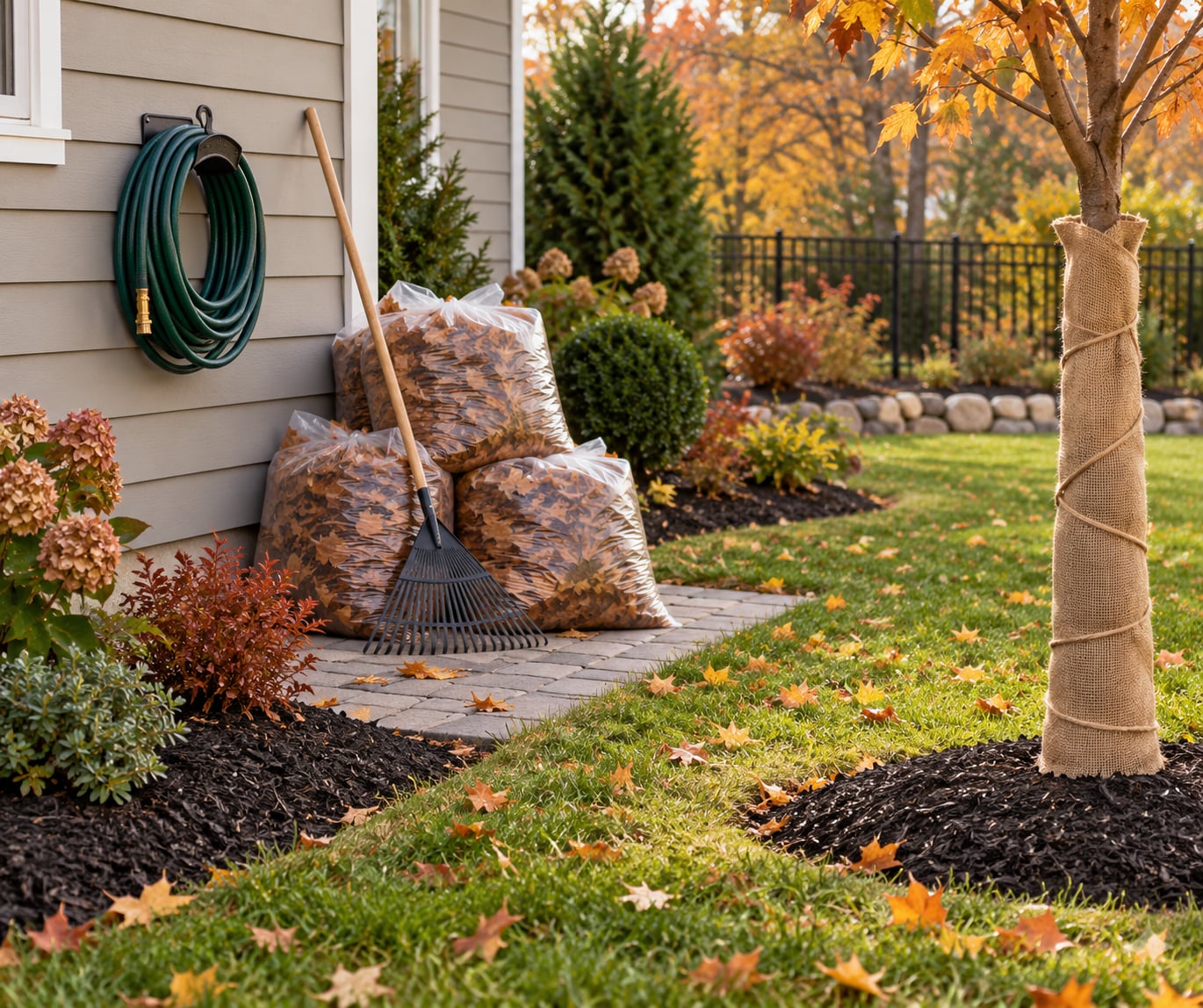
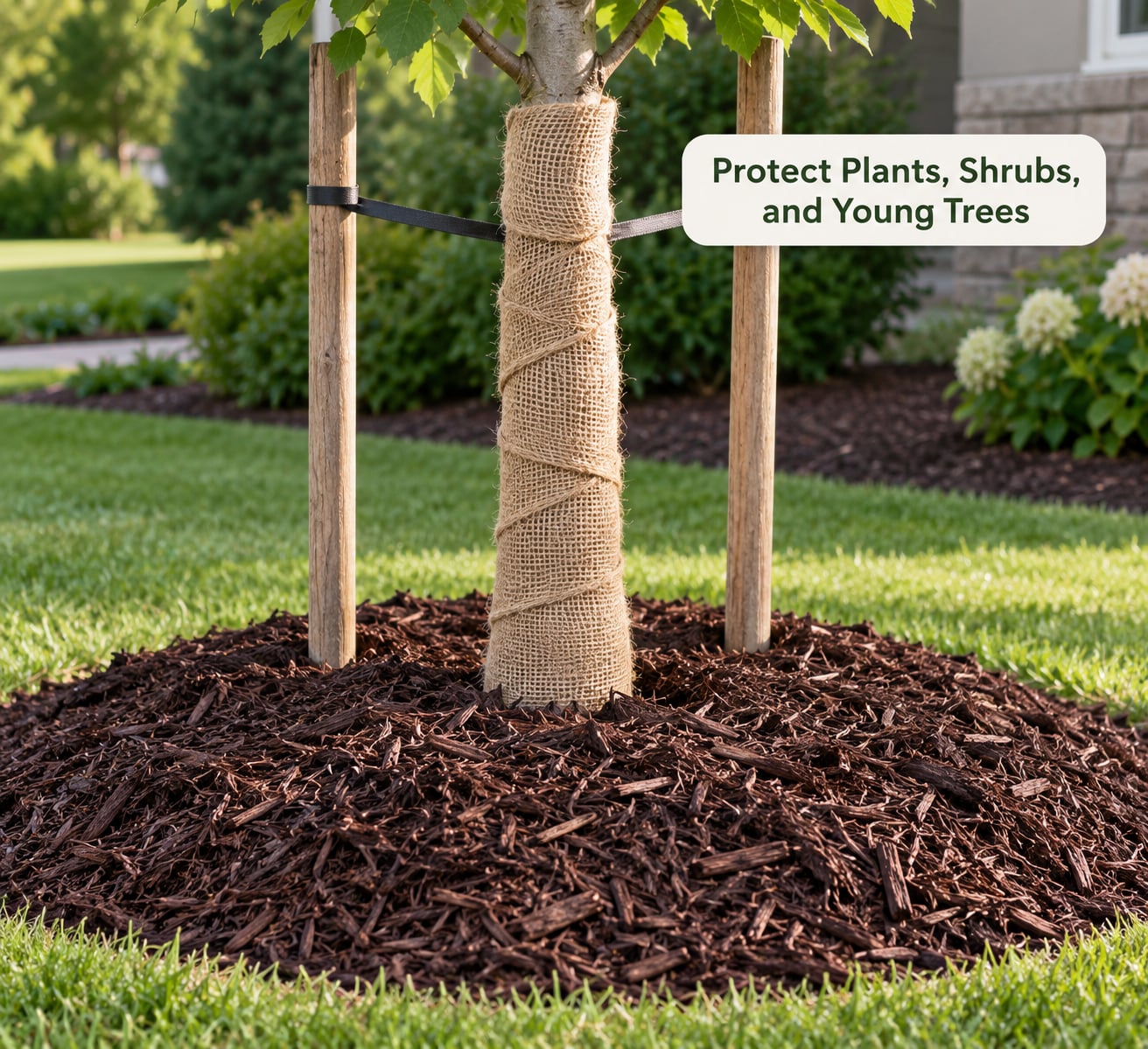
Most established shrubs and trees need nothing at all. Wrapping is only worthwhile for evergreens losing moisture from wind and frozen ground, newly planted trees that have not rooted in yet, and rose graft unions in harsh regions. Burlap wrapped in October traps moisture against the bark and invites rot, so wait until the ground has frozen before you wrap, and always wrap above the graft union.
Give shrubs and young trees a slow, deep watering right before the ground freezes. Frozen soil means roots cannot drink, so a tree that goes into winter dry comes out in spring with dead branch tips. Ten gallons per tree is a reasonable target.
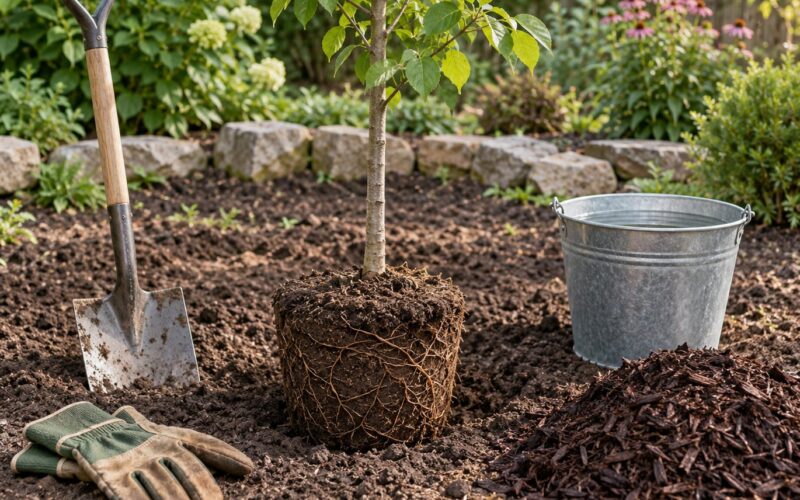
Spread a 2 to 3 inch mulch ring over root zones, keeping it a few inches away from trunks and stems so it does not hold moisture against the bark. Keep grass and weeds away from trunks with a ring at least 12 inches wide, since that mulch circle also protects against string trimmer and mower damage next season.
Drain and Disconnect Outdoor Water Features
This is the highest-stakes step and the one to schedule first, because a split hose bib inside a frozen wall is a repair bill you do not need.
Close the interior shutoff valve feeding your outdoor faucet, then open every outdoor faucet to bleed the line. Unhook the hose, coil it and store it in a dry spot where it will not freeze. Unscrew the spigot entirely if it is not frost-proof, because an empty faucet can still split at the valve when the water inside it freezes.
For in-ground irrigation, schedule a blowout before the first freeze rather than a simple drain. Attach an air compressor to the system and run each zone until water sprays from every head. A garden hose at full pressure does not clear the lines thoroughly, so hiring a company for this one job is a reasonable call in cold regions.
Turn off the controller or put it on a winter mode schedule, and remove or unplug the battery if your model stores settings in it. Do the same for any pump, and open the drain valve on the bottom of fountains and water features.
Birdbaths, planters and ceramic pots hold enough water to crack from expansion. Empty them, wash them, and flip them upside down so rain and snow cannot pool inside all winter.
Rake, Mow, and Clear the Final Layers of Leaves
Leaf management has three legitimate answers, and the right one depends on your tree species and how much lawn you have.
Rake and remove leaves from fine-leaved shade trees like maples and elms, and from anywhere grass is thin or already struggling. A thick wet mat blocks sunlight and traps moisture against the crown, which is the main route to snow mold in spring.
Mulch leaves on lawns with healthy thick turf. Run the mower over dry leaves and let the blades shred them, then clear what the mower cannot process. Chopped leaves break down fast, add organic matter, and give insects a place to overwinter.
Shred leaves directly into garden beds instead. It costs nothing, and the resulting leaf mold is a garden input rather than a bag of trash. Skip the mower on wet leaves, since clumping causes scalping and ruts.
Make the final mow late in the season, once growth has slowed. Leave cool-season grass 2.5 to 3 inches tall going into winter, since taller blades hold moisture in the crown and shade the soil, while mowing low invites sun and wind damage. Warm-season lawns that go dormant need no final mow at all. Clear grass clippings as you finish, since matted clippings block light and hold moisture against the crown.
Store Tools and Outdoor Equipment Properly
Drain gas tanks or run the engine out completely, run the mower blade off against a block or the ground to clear fuel, and disconnect the spark plug lead before working near the engine. Wipe the deck, remove grass buildup from the underside, and store the machine in a dry garage or under a cover with the fuel valve closed.
Clean and dry cutting tools, then sharpen shears, loppers and mower blades. Rust and dull edges do more damage to stems than any weather event, and sharp tools are the difference between a clean cut and a ragged one that invites disease.
Charge battery-powered equipment fully, then store batteries indoors at room temperature. Lithium batteries lose capacity when left in a cold shed, and a dead battery in December means a dead mower in March.
Store hoses, planters, decorative pots, statuary and cushions where they cannot freeze. A simple trick for large pots is to nest them inside each other and drop a few empty plastic bottles into the bottom pot for support, so a stack of five does not topple the first time the wind picks up.
Complete a Final Walkthrough
Before you call it done, walk the property once more with a checklist and confirm each item physically. It takes twenty minutes and it catches the tasks you forgot while focused on the yard.
Confirm that every hose is disconnected and coiled, spigots are drained, the irrigation controller is off, and no water feature still holds water. Confirm tools and the mower are stored, containers are empty, beds are mulched, tender plants are flagged and covered, and downed branches are gone.
Check downspouts and gutters are clear, since frozen gutters bend and pull away from fascia. Then look for anything weather-sensitive you left open: a gate that needs to close on a spring, a hose bib cover missing, a lamp or outlet on the patio without a weatherproof cover.
Common Mistakes
Pruning too aggressively in fall. Cutting shrubs hard in autumn pushes soft new growth that the first cold snap kills. Do major structural pruning in late winter or early spring instead, and limit fall work to dead, diseased and crossing wood.
Wrapping plants too early. Burlap and plastic wrap applied in autumn trap dampness against bark and invite rot and rodents. Wrap after the ground has frozen, keep the wrap above the graft union on roses, and remove it as soon as growth starts in spring.
Burying plant crowns under mulch. A deep mulch layer against stems and crowns holds moisture and can rot them. Keep mulch to 2 to 3 inches and pull it back a few inches from every crown and trunk.
Leaving hoses connected to the spigot. Even with the faucet closed, the trapped water between the valve and the hose expands and splits the line. Disconnect and store every hose, and remove non-frost-proof spigots.
Composting diseased leaves. Infected rose leaves, blighted phlox and mildewed perennials carry spores through winter. Bag them and take them with the household waste instead.
Working alone around unstable trees. Split branches and ice-laden limbs are the most dangerous part of winter prep. If a branch is above head height or hangs over a structure, call a tree service and stay out of the drop zone.
Testing irrigation in February. A leak that shows up at the worst time is a repair that could have been caught in November. Run the system for a few minutes mid-autumn and look for wet spots along the lines before the ground gets cold.
Waiting on the first hard freeze. Soil needs to be workable and seed needs warm days to germinate. Ground that has frozen hard rejects fertilizer and seed no matter how good your intentions are.
Winter Tips for a Healthier Yard
Winter is not a no-work season, it is a low-work season with a few high-value tasks.
Stay off frozen or waterlogged grass. Repeated traffic on brittle or saturated turf causes rutting and root damage that shows up as bare patches in April, and recovering from that costs far more effort than any fall task on this list.
Shovel snow, but push it to the edges of walkways rather than piling it on beds and crowns. Heavy snow on shrubs bends and snaps branches, so break up drifts over perennials after a storm.
Be deliberate about de-icers. Rock salt damages nearby shrubs and lawns, so use it only where needed, sweep up excess, and choose a calcium-based or pet-friendly product on paths near dog runs. Keep grit swept off the lawn so it does not work into the soil and compact it.
Water during dry winter spells when there is no snow cover and the ground is not frozen. Deep, infrequent watering in a warm, dry January prevents root loss in trees and shrubs better than anything you can do next spring.
Leave a few patches of stems and leaf litter undisturbed for wildlife, but keep bird feeders stocked and clean through the cold months. If you have pets or small children, store fertilizers, pre-emergents and de-icers in a locked or high cabinet rather than on the garage shelf.
Frequently Asked Questions
When should I prepare my yard for winter?
Start your yard winterization two to three weeks before your area’s average first frost date. That gives seeding and fertilizing time to work while soil is still warm and unfrozen. Water shutdown should happen first, since a connected hose that freezes is the costliest mistake. Work backward from the frost date and put the irrigation, seeding and fertilizer tasks at the top of the list.
Should I leave leaves on my lawn over winter?
It depends on the tree and the condition of the turf. Mulch chopped leaves on a thick, healthy lawn so they break down and feed the soil. Remove or shred whole leaves under fine-leaved maples and elms, or anywhere grass is thin, since a wet mat blocks light and holds moisture against the crown. Leaf mold in your beds is the best outcome of all.
Do I need to water my plants before winter?
Yes, especially before the ground freezes. Frozen soil locks out water, so plants that go into winter dry lose roots and come back in spring with dead tips. Give shrubs and young trees a slow, deep watering in late autumn, roughly ten gallons per tree. Avoid a quick sprinkler pass, which wets only the surface, and stop routine irrigation once the ground starts to freeze.
Should I wrap shrubs and trees for winter?
Most established shrubs and trees need no wrapping at all. Burlap or wrap is only worth the effort for evergreens exposed to drying wind, trees planted the previous season that have not rooted in, and rose graft unions in harsh regions. Wrap after the ground has frozen rather than in autumn, keep the wrap above the graft union, and take it off as soon as growth starts.
What yard tasks should I do after the first snowfall?
Shovel and spread snow rather than piling it on beds, crowns and shrub branches, which bends and breaks them. Break up heavy drifts sitting on perennials. Sweep excess de-icer and grit off lawns and walkways so it does not compact the soil or burn nearby shrubs. Once temperatures drop below freezing, get irrigation lines blown out if that job is still open.
Conclusion
Preparing a yard for winter comes down to five things in order: shut off and drain the water, cut back what needs cutting back, protect what needs protection, clear the debris and mow once more at the right height, then store everything else. Do the water work first because it has the hardest deadline, and mulch last because it works on frozen ground just as well.
Begin with a full walkthrough several weeks before your first expected frost, and adjust the schedule for your climate and your grass type. A yard that was prepared in October thaws out ready to mow in April, and that is the whole reason for the weekend of work.