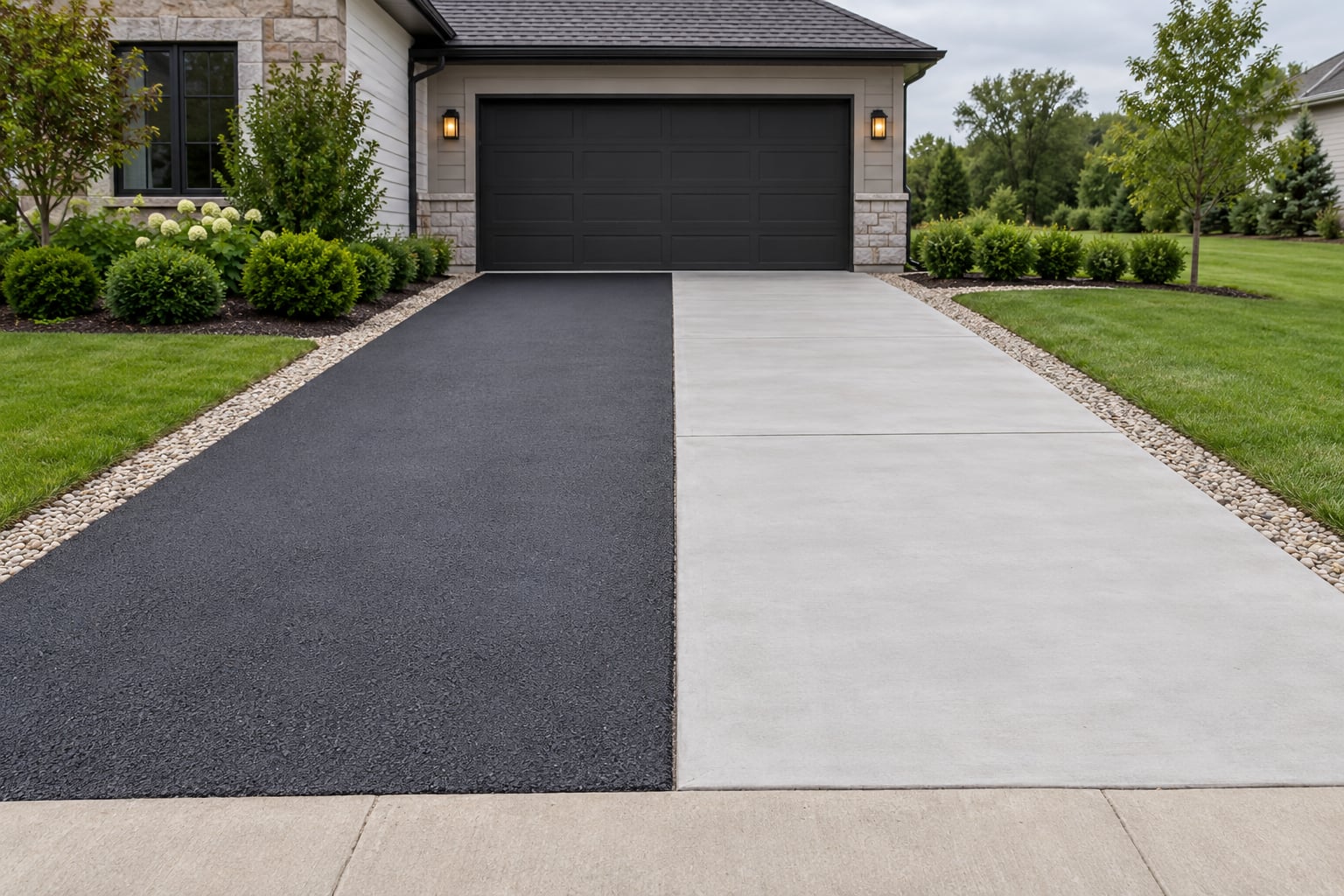
Short version: asphalt wins on upfront cost, install speed and cheap DIY repairs, while concrete wins on lifespan, appearance and heat tolerance. Most homeowners pick asphalt because it costs materially less and can be refreshed with a sealcoat or a new surface layer instead of a full replacement. Concrete makes more sense when the look matters, the driveway carries heavy vehicles, or you expect to stay put for the full 25 to 40 years a good pour delivers.
Either material can last a long time or fail early. What decides that is the subbase underneath it, the drainage, and the installer, not the label on the truck. That last point is the one most homeowners learn the expensive way.
Table of Contents
- Asphalt vs Concrete Driveway Compared at a Glance
- Upfront Cost and Installation
- Why concrete costs more per square foot
- How driveway size changes the math
- Durability and Lifespan
- Appearance and Design Options
- Maintenance, Cracks, and Repairs
- What asphalt maintenance actually involves
- What concrete repair actually involves
- Climate, Drainage, and Installation Conditions
- Which Driveway Is Best for Your Home?
- Frequently Asked Questions
- Is asphalt or concrete cheaper for a driveway?
- Which driveway lasts longer, asphalt or concrete?
- Can an asphalt driveway be painted or stained?
- Do concrete driveways crack, and are those cracks serious?
- How often should an asphalt driveway be sealcoated?
- Which driveway material is better in cold or wet climates?
- Conclusion
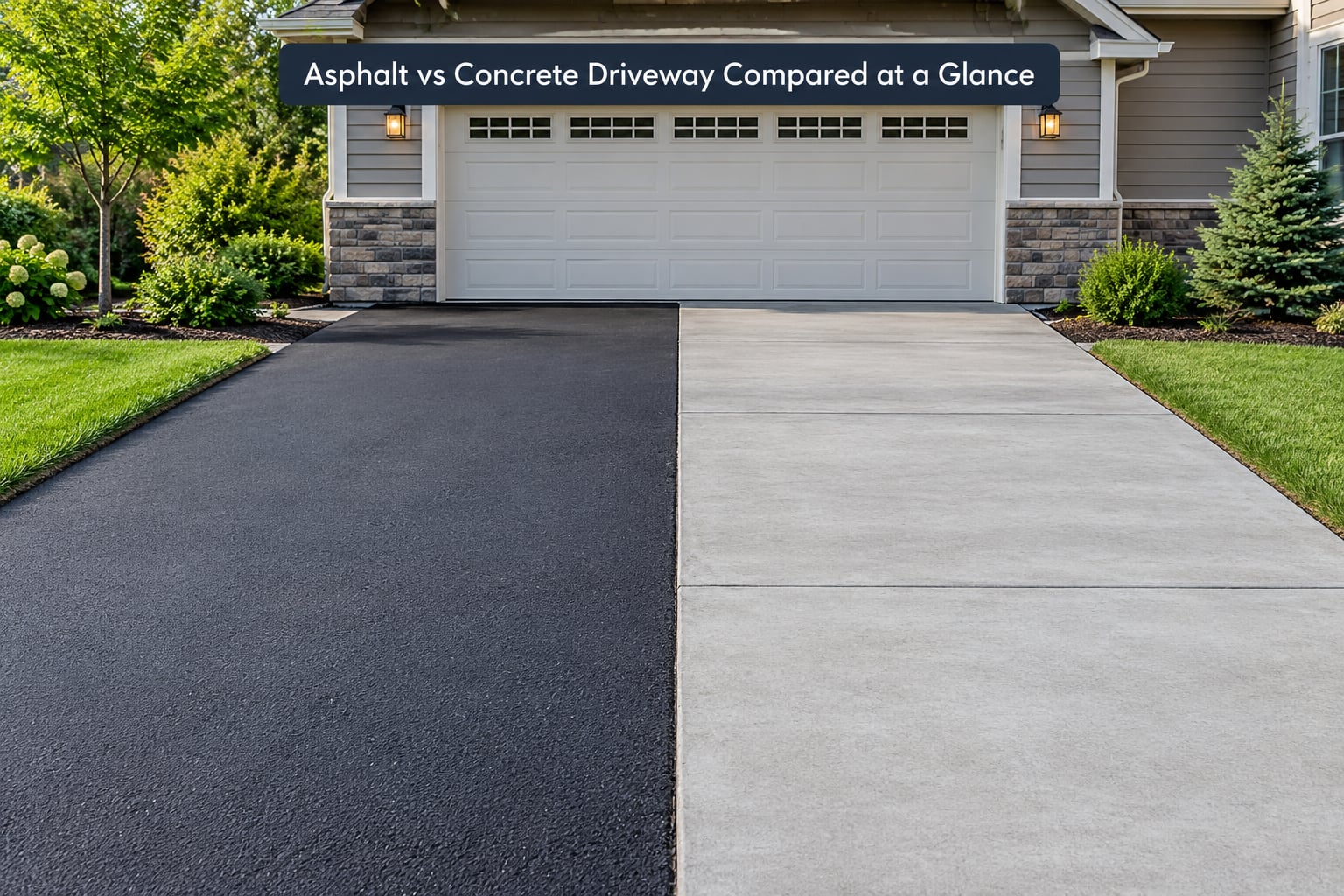
Asphalt vs Concrete Driveway Compared at a Glance
| Factor | Asphalt | Concrete |
|---|---|---|
| Upfront cost | Lower, often a third to a half less | Higher; labor is the biggest share |
| Time to drive on it | 2 to 4 days | 7 days for foot traffic, up to 28 for vehicles |
| Typical lifespan | 15 to 25 years, longer with sealcoating | 25 to 40 years |
| Appearance | Uniform matte black or gray, fades over time | Stamped, stained, colored, broomed or exposed aggregate |
| Routine upkeep | Sealcoat every 3 to 5 years, watch for weeds and oil | Little upkeep; joint sealing every few years |
| Repairs | Patching and resurfacing are easy and cheap | Cracks are permanent; matching a repair is hard |
| Best climate | Cold and freeze-thaw regions | Hot, sunny and dry regions |
| Sloped or steep site | Good fit, but needs solid edge restraint | Needs careful forming to stop creep |
One line to keep: asphalt is a flexible pavement that moves with the ground, and concrete is a rigid pavement that cracks when the ground moves. Nearly every difference below traces back to that single fact.
Upfront Cost and Installation
Concrete almost always costs more per square foot, and the gap widens on large drives. As a rough guide, asphalt lands in the low single digits per square foot while concrete sits several times higher, and the spread you get depends on your region, excavation needs and how much base work the site requires.
Why concrete costs more per square foot
The material itself is not the expensive part. Concrete is poured in a day or two and needs forms, reinforcement, finishing work and a curing period during which nobody can park on it, so labor and scheduling carry most of the bill. Asphalt arrives hot, gets raked and rolled, and the crew is usually gone in a couple of days.
Concrete also carries more failure risk during the pour. If a batch is bad, the section has to come out. Asphalt that looks wrong can often be rolled differently the next morning.
How driveway size changes the math
Size punishes concrete and flatters asphalt because fixed costs, such as mobilization, forms and equipment, spread over more square feet. A short driveway with awkward access makes the gap narrow; a long drive or a wide four-car pad makes the difference large.
Ask every bidder for the same square footage, the same removal scope and the same base thickness. Quotes that look far apart are usually quoting different things, not different materials.
Durability and Lifespan
A well-installed concrete driveway commonly reaches 25 to 40 years. Asphalt typically gives 15 to 25 years, and homeowners who sealcoat on a steady schedule push past 20 years comfortably. In the asphalt vs concrete driveway compared debate, lifespan is where concrete takes the clearest win.
Asphalt tolerates heavy vehicles and shifting soils because it flexes. A heavy truck that would leave a permanent scar in concrete is less likely to crack an asphalt surface, though repeated static loads in one spot can still rut it.
Concrete handles point loads better. It resists creep, holds up under a heavy recreational vehicle parked in the same spot for months, and shrugs off heat without softening.
Five variables decide how long either one lasts, and installation quality tops the list every time:
- Base preparation. A compacted, well-drained aggregate base supports both materials. Skip it and asphalt deforms while concrete cracks across the whole slab.
- Drainage. Water that sits on the surface or drains through the base shortens the life of both materials.
- Climate. Freeze-thaw cycles punish un-entrained concrete and weaken oxidized asphalt.
- Traffic load. Daily vehicle weight adds up faster than occasional use.
- Maintenance. Sealcoating and timely patching keep asphalt going for decades.
Appearance and Design Options
Asphalt gives you one look: a uniform dark surface that grays and dusts as the binder oxidizes. It cannot be meaningfully customized, and any patch is a slightly different black than the surrounding surface.
Concrete starts with a plain gray slab and goes much further. Stamped concrete, stained concrete, colored concrete, broomed finishes and exposed aggregate all change the look without changing the structure, and the final result reads more like a designed entrance than a parking pad.
Two honest notes. A textured stamped surface can be slick when wet, which matters on a slope or where kids walk. And repairs to concrete are hard to match, so decide the finish before the pour, not after the first crack.
Maintenance, Cracks, and Repairs
What asphalt maintenance actually involves
Asphalt needs attention on a schedule. Most crews recommend a sealcoat every 3 to 5 years, which blocks oil, gas and UV damage and keeps the surface from turning gray and brittle. Crack filling is straightforward, and potholes can be patched and rolled without touching the rest of the drive.
When the surface wears out but the base is still solid, a resurfacing layer gives you most of a new driveway at a fraction of the cost of tearing it out. That recoverability is the quiet advantage of asphalt and the reason owners like its repairability.
Watch the edges. Asphalt that was paved without edge restraint tends to crumble along the sides, and that failure is cheap to prevent and annoying to rebuild.
What concrete repair actually involves
Concrete asks for less. Crack sealing every few years, and a good rinse when oil or rust stains appear, is usually enough for a well-placed slab.
What you cannot do is fix a crack so it disappears. A filled concrete crack is a cosmetic repair, and a broken or settled section usually gets replaced or covered with an overlay. Stamped surfaces complicate that further, because the patch rarely matches the pattern. Sinking slabs from poor base prep are the failure homeowners on forums complain about most, and it is a base problem, not a surface one.
Climate, Drainage, and Installation Conditions
Cold regions favor asphalt. It tolerates freeze-thaw cycles, flexes with frost heave, and melts snow faster because the dark surface absorbs sunlight. That flexibility is why homeowners in northern climates tend to stay with asphalt, and why spring is the practical season to install it.
Hot regions favor concrete. Asphalt softens in sustained heat, can rut under a parked vehicle and tracks into the house on a hot day. Concrete is dense and stays cool, which matters for tire grip and for the comfort of anyone walking across it.
Wet and coastal areas need attention either way. Salt damages concrete over time, and puddles break down both surfaces, so drainage grade matters more than material preference. Snow removal is easier on asphalt; metal edges that scrape concrete will scar it.
On the technical side, air-entrained concrete is designed for freeze-thaw regions, and control or expansion joints are what keep a slab from cracking randomly. The pour needs proper curing, typically covered and moist for the first several days.
Which Driveway Is Best for Your Home?
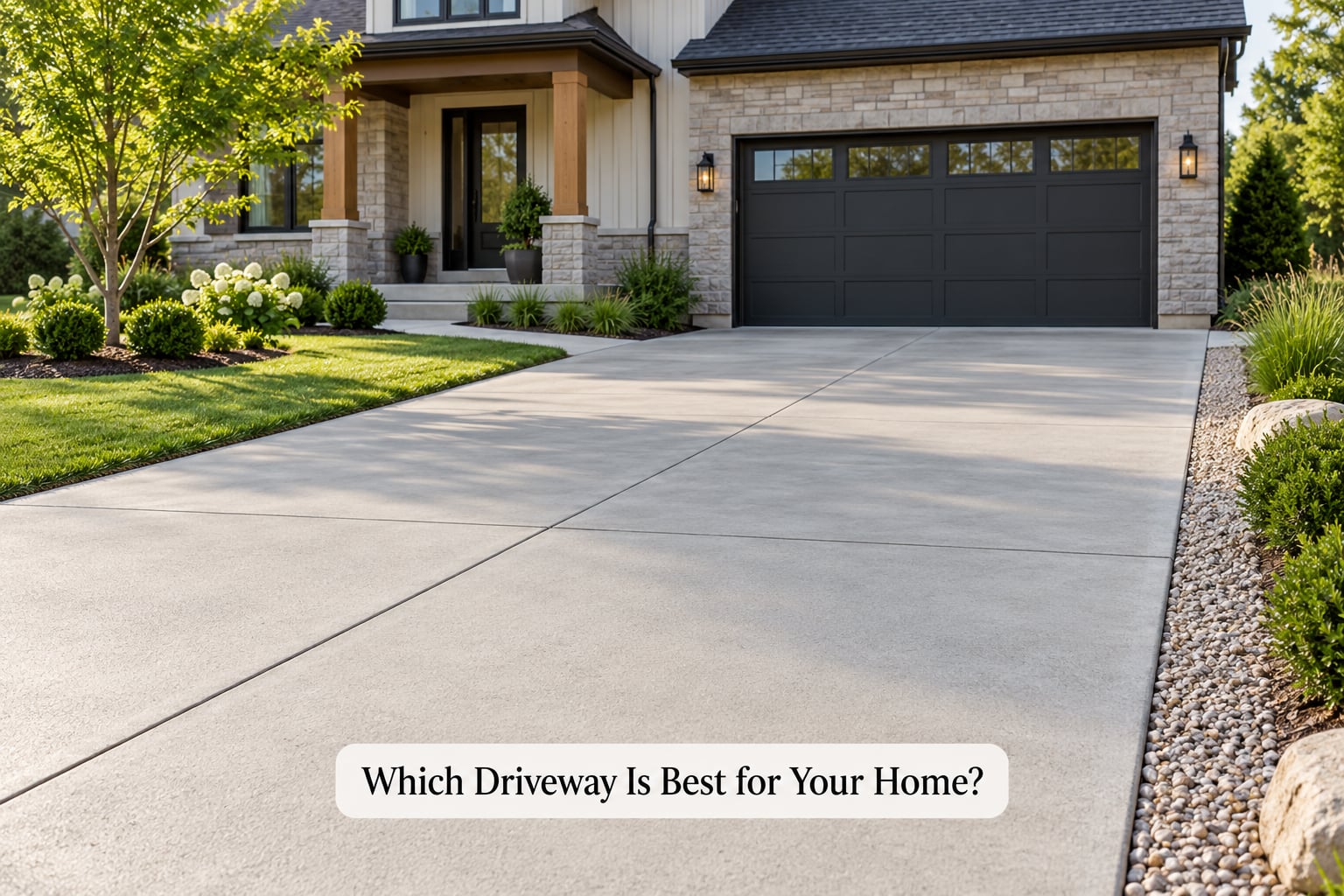
Pick asphalt when the budget is the deciding factor, the driveway is long, you want it usable within days, or you would rather handle crack filling yourself. Pick concrete when curb appeal is the priority, the surface bakes in summer sun, you park heavy equipment in one spot, or you simply do not want to think about upkeep for 30 years.
A few use cases worth naming. New construction and long narrow driveways favor asphalt for cost. Upscale neighborhoods where appearance sells the house favor decorative concrete. Steep slopes can work in either material but need proper edge restraint and drainage. DIY-friendly repairs favor asphalt. Plans to move within ten years favor whichever is already in place, since buyers notice the condition, not the material.
Whichever way you lean, installer quality outweighs material choice. Ask for the base thickness and compaction in writing, the concrete PSI and air entrainment, the asphalt PG binder grade, a written timeline with weather contingencies and a warranty that names what it covers. Check local licensing and insurance, and ask for references from a recent job, not last decade. If you are in an HOA, check the material rules before signing anything.
Frequently Asked Questions
Is asphalt or concrete cheaper for a driveway?
Asphalt is cheaper to install in almost every US market, typically a third to a half less per square foot, and the gap grows on large drives. Concrete earns back some of that difference through a longer life and less upkeep, so the honest comparison is life-cycle cost rather than the invoice. Get all quotes on the same square footage and base spec.
Which driveway lasts longer, asphalt or concrete?
Concrete usually lasts 25 to 40 years, asphalt usually 15 to 25. Asphalt can reach 20-plus years when it is sealcoated every 3 to 5 years and cracks are filled early. Concrete does not crack if the base is properly compacted, joints are placed correctly and drainage is graded away, but the cracks that do appear cannot be undone.
Can an asphalt driveway be painted or stained?
Yes, but with care. Asphalt can be coated with driveway paint or an acrylic sealer, and specialty asphalt stain products exist for patching faded areas. Painting seals the surface rather than restoring it, so it is a cosmetic option best used on an otherwise solid drive. Standard asphalt sealer is the more common choice because it also protects the surface underneath.
Do concrete driveways crack, and are those cracks serious?
Some cracking is normal on a concrete driveway, especially at control joints. A crack that is only hairline and stable is cosmetic. Cracks that are widening, offset, or that run diagonally across the whole slab point to base movement or settlement and deserve an inspection. Small cracks can be routed and sealed, but a settled section usually means a repair or an overlay.
How often should an asphalt driveway be sealcoated?
Every 3 to 5 years is the usual recommendation, and more often on hot, sunny driveways where the binder oxidizes faster. Sealcoating blocks oil and gas stains and slows UV damage. Do not sealcoat a badly cracked or crumbling surface, since the new coat will bridge the damage and peel. Ask for full prep, cleaning and edging in the quote.
Which driveway material is better in cold or wet climates?
Asphalt is the better pick for cold climates because it flexes through freeze-thaw cycles and melts snow faster than concrete. Wet regions matter less about material and more about drainage, since standing water damages both. In cold areas, air-entrained concrete with properly placed joints can also perform very well, as long as salt use is limited in the first years.
Conclusion
Start by measuring the driveway properly and watching where water wants to run, because that answer shapes the base spec every bid depends on. Then get three installed quotes that name the same square footage, base thickness and material specs, and compare them line by line.
Asphalt wins when cost, speed and repairability lead your list. Concrete wins when longevity, appearance and heat tolerance lead yours. Whichever you pick in this asphalt vs concrete driveway compared, the installer matters more than the material, so put the base work in writing and hold the crew to it.