Short version: a gazebo gives you full, fixed overhead shade and keeps rain off your patio, while a pergola gives you partial shade you can adjust, costs less, and takes up less visual space. Pick the gazebo when your main problem is sun and rain; pick the pergola when you want shade that changes with the season, an open view, and a lighter structure in the yard.
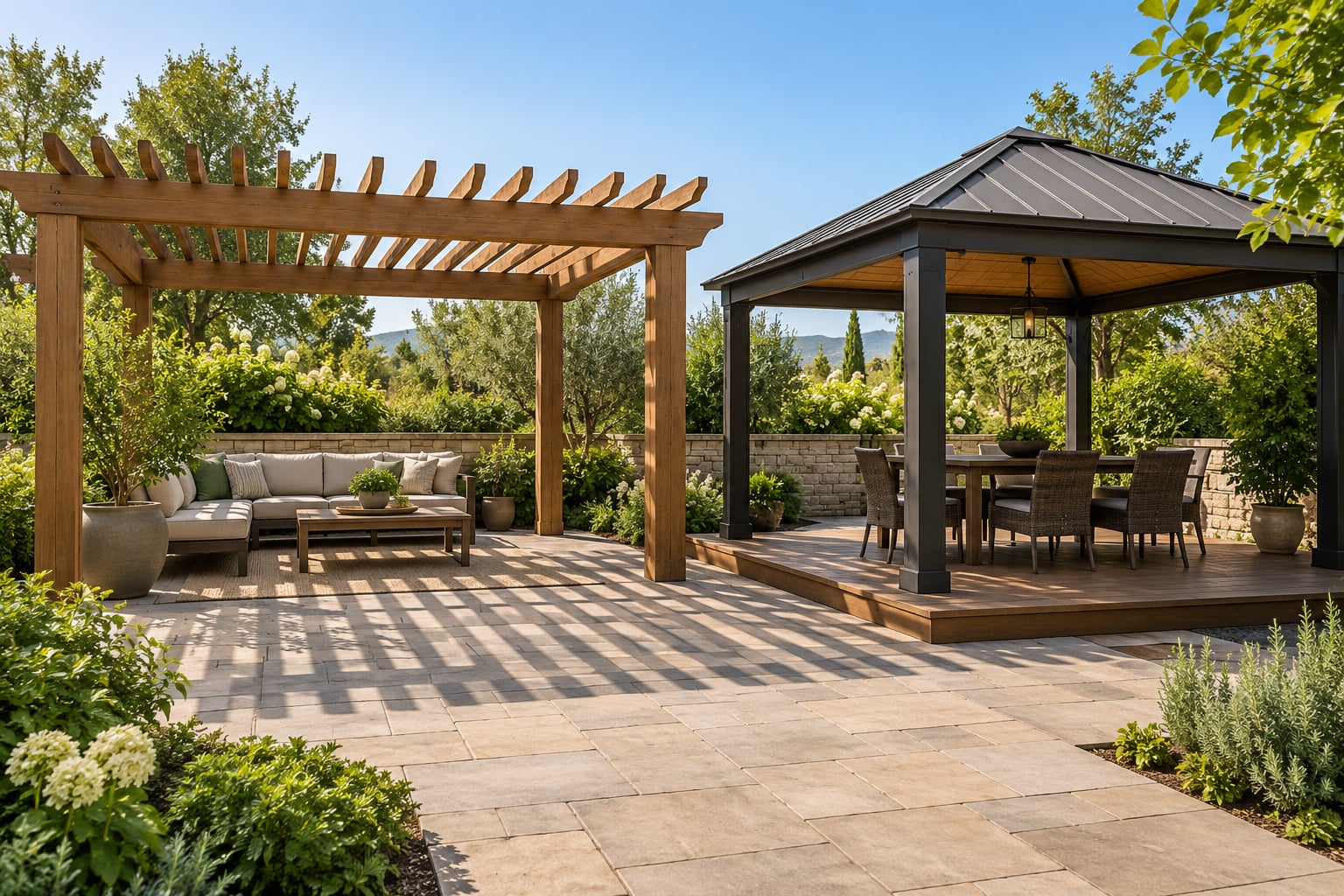
This is a decision about shade first and everything else second, so here is how the two differ in plain terms. A pergola is a post-and-beam frame with spaced rafters or slats across the top. A gazebo is a mostly enclosed structure, usually hexagonal or octagonal, with a solid roof and often a raised deck floor. One filters light, the other blocks it.
We looked at what homeowners actually ask about the two, including the parts vendor pages tend to skip: wind ratings, insect screening, upkeep over fifteen years, and what a structure looks like from inside your house. No product is being sold here, and we do not build either one.
Table of Contents
- Pergola vs Gazebo for Shade at a Glance
- How Much Shade Does Each Structure Provide?
- When a pergola does not shade the space
- Louvers and retractable canopies close the gap
- Pergola vs Gazebo for Rain and Wind Protection
- How much rain each one actually keeps out
- Wind is where poorly built structures fail
- Privacy, Ventilation, and Outdoor Comfort
- Design, Size, and Customization Options
- Freestanding or attached to the house
- Wood, vinyl, aluminum, or fiberglass
- Small yards and sightlines
- Installation, Maintenance, and Safety
- Permits, HOA rules, and load ratings
- Maintenance and lifespan by material
- What DIY gets wrong
- Which Should You Choose?
- Frequently Asked Questions
- Which is better for shade, a pergola or a gazebo?
- Do pergolas provide enough shade on a hot patio?
- Are gazebos better than pergolas for rain?
- Which structure gives more privacy outdoors?
- Is a pergola cheaper to install than a gazebo?
- Can a pergola or gazebo be attached to a house?
- Conclusion
Pergola vs Gazebo for Shade at a Glance
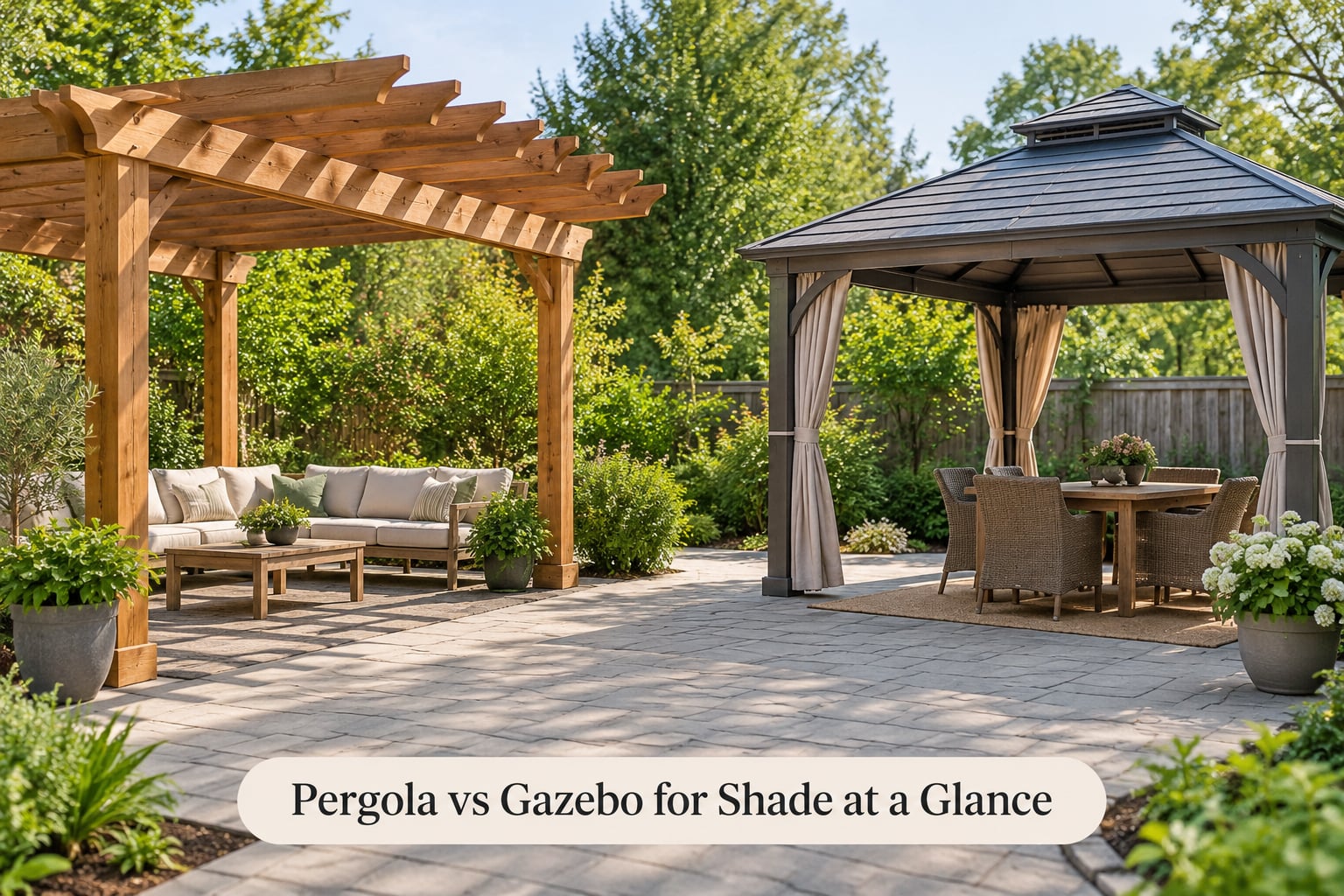
The table below is the fastest way to see where each structure wins. If your patio is already too hot at three in the afternoon and stays wet when it rains, look at the top two rows first.
| Criterion | Pergola | Gazebo |
|---|---|---|
| Shade coverage | Partial and filtered; more with tighter slats or louvers | Full and solid overhead coverage |
| Rain protection | Light drizzle only, unless a canopy or roof is added | Keeps out most rain over the covered footprint |
| Privacy | None on its own; add curtains or screens | Higher, especially with walls or lattice |
| Ventilation | Excellent; air moves right through it | Lower; needs screens or an open side to breathe |
| Customization | High; lighting, fans, vines, fabric all common | More options, but changes mean more work |
| Installation | Simpler; many kits are straightforward builds | More involved; foundation and roof work add steps |
| Maintenance | Depends on material; wood needs sealing, metal needs little | Roof, gutters, screens, and floor all need attention |
| Relative cost | Lower; far less material in the frame and roof | Higher; solid roof, walls, and floor add cost |
| Best for | Warm evenings, climbing plants, open sightlines, small yards | All-weather dining, bug-heavy months, privacy |
One row deserves emphasis before anything else. A pergola is an open frame, so how much shade you get depends entirely on slat spacing, slat width, and how high the sun is. A gazebo is not adjustable in that way. Once it is built, the shade is what it is.
How Much Shade Does Each Structure Provide?
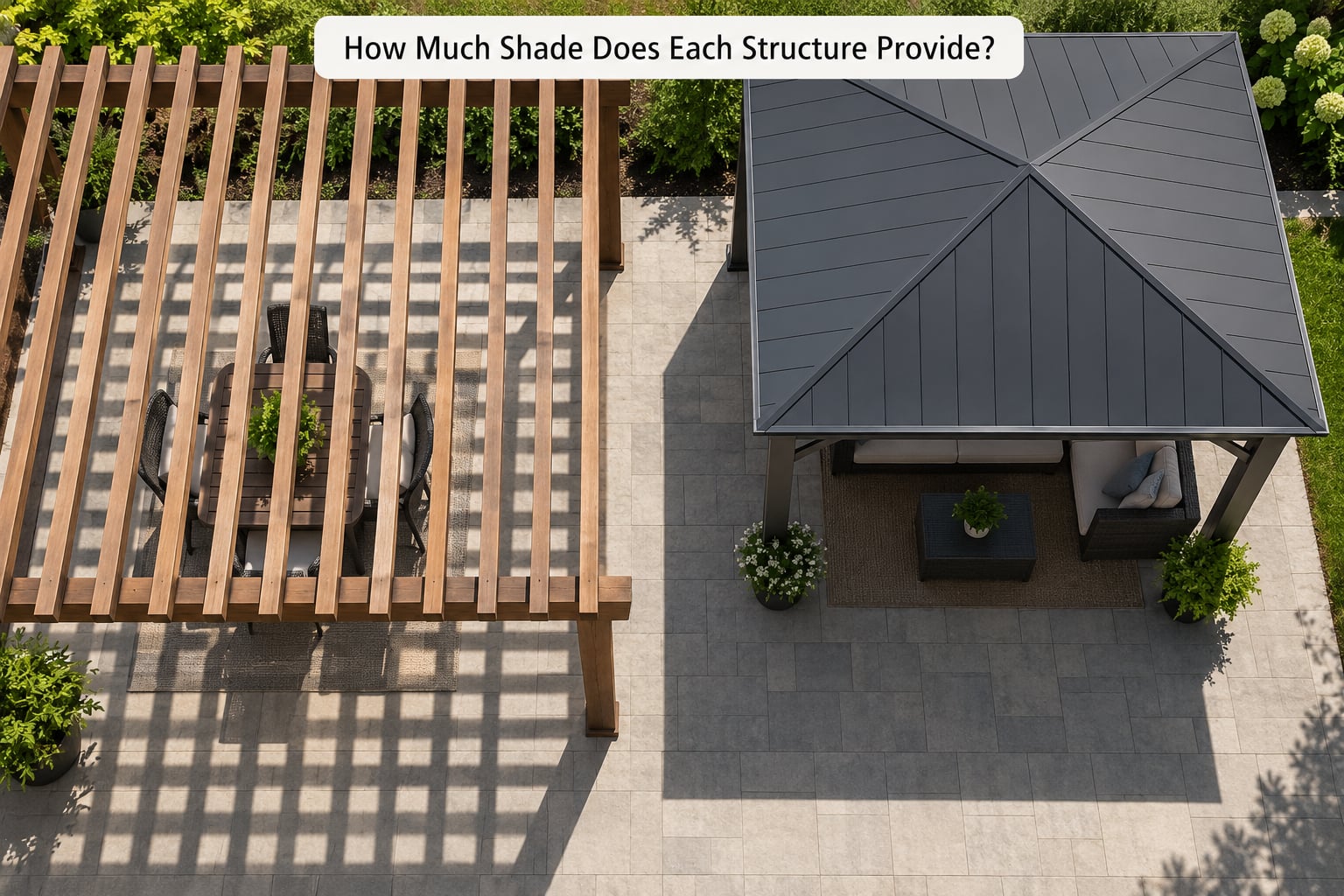
A pergola works by breaking sunlight into scattered light. Rafters spaced a few inches apart let some sun through in stripes, which cuts glare and UV exposure without creating a dark box under the structure. Tight slat spacing, thicker slats, and lower overall roof height all increase the shade percentage. Most home-scale pergolas land somewhere in the range of partial to mostly shaded rather than fully shaded.
When a pergola does not shade the space
Low sun is the problem case. When the sun sits near the horizon in early morning and late afternoon, its rays travel almost horizontally and slip under the roof from the side, hitting the patio even when the slats overhead look solid from a distance. A west-facing patio in summer can receive more direct sun at 7 p.m. than at noon.
That is the honest answer to the question of whether a pergola actually gives shade: usually yes, but the effect is uneven across the day. Homeowners in landscaping forums describe abandoning a pergola plan after realizing the roof would block their view from two back windows, which is a sizing mistake rather than a shade failure. Check the sightline before you commit.
Louvers and retractable canopies close the gap
This is where the modern middle ground lives. Adjustable louvers are slats on a motor that rotate, so you close them for full shade and open them when you want sky or warmth. A retractable fabric canopy does the same thing with a sliding panel, and it can pull back entirely for clear views and open-air evenings.
Owners of louvered aluminum pergolas frequently say the adjustability is the whole reason they chose one over a fixed-roof gazebo, because they can block the low evening sun when it hits the deck and open the roof at midday when they want the heat to escape. Homeowners discussing the choice on r/homeowners frame it the same way: less about price, more about control.
A gazebo, by contrast, delivers consistent full shade across the entire footprint at any hour. There is nothing to adjust and nothing to open up. That predictability is the reason to buy one.
Pergola vs Gazebo for Rain and Wind Protection
A pergola keeps out whatever happens to fall straight down through the gaps between rafters, which in practice means very little. Even tight slats drip along their edges in a light rain, and wind-driven rain comes in from the side under the roof. A pergola with a solid or retractable roof is a different structure at that point, and one you should price as a roof, not as a frame.
A gazebo with a pitched or domed solid roof keeps out most ordinary rain over the covered area. The roof slope matters more than the roofing material, because water needs somewhere to run off. Homeowners in coastal and northern climates talk more about wind than rain, and they have reason to.
How much rain each one actually keeps out
For a gazebo, rain protection covers the footprint plus a small drip zone at the eaves. Gutters and a proper pitch handle the runoff. For a pergola, think of it as a shade device that happens to slow down a light shower, and plan on seating cushions that get damp in a real storm.
Wind is where poorly built structures fail
An open frame catches less wind in a gust but also has nothing keeping it rigid, so long spans twist at the connections. A solid roof acts like a sail. Either way, the number that matters is the published wind load rating, not the appearance of the frame. Posts anchored in concrete footings and bolted at the base beat surface-mounted brackets every time.
Homeowners on r/longisland describe gazebo frames twisting and blowing over in windy areas, which is why high wind ratings matter more than looks. If your site is exposed or coastal, ask any installer for the wind rating in writing before you sign anything.
Privacy, Ventilation, and Outdoor Comfort
A pergola gives you airflow for free. There are no walls, so breeze moves through the space and heat rises out. In humid summers that matters as much as the sun does, because shade without ventilation can feel like sitting under a warm blanket.
A gazebo trades some of that airflow for shelter. Walls, half walls, lattice, zip screens, and roll-down curtains all raise the comfort level, and screens solve the insect problem that open beams cannot. Bug-heavy months are where gazebos pull ahead clearly. A screened gazebo in July is a genuinely different experience from a slatted pergola in July.
For evening use, a pergola takes lighting and a ceiling fan easily. Gazebos do too, but the fan and light wiring has to run within a more enclosed frame, so a licensed electrician handles more of it. Do not plan to run electrical work into a structure you built without checking what your local code requires.
Design, Size, and Customization Options
Both structures come in essentially two placement types, and the choice affects cost, shade, and how the yard reads from inside the house.
Freestanding or attached to the house
A freestanding pergola or gazebo stands on its own posts anywhere in the yard, which keeps placement flexible. An attached structure bolts to the house, usually with one side of the roof running against the wall, which gives it a larger footprint for less material and makes it read as part of the home. Attached structures often carry more weight in a resale listing because they look like a room you added.
Wood, vinyl, aluminum, or fiberglass
Wood looks traditional and takes stain well, but it needs sealing every couple of years and can check, twist, or gray in sun and humidity. Vinyl needs almost nothing and will not rot, though it can fade and gets brittle in cold weather. Aluminum is light, strong, and corrosion resistant, and it is what most louvered systems use because the motor and linkages need a rigid frame. Fiberglass is light and will not corrode, with less color choice.
For a gazebo, the roofing and the floor matter more than the frame material. A hardtop roof on an aluminum frame lasts longer than a canvas roof on anything, and a raised deck floor needs the same care as any deck you own.
Small yards and sightlines
A gazebo is a bigger visual object. In a small backyard, a solid-roofed structure can make the whole space feel tighter, which is a common complaint from owners who wish they had gone with an open frame. A pergola defines an area without blocking the view.
Before you build, stand at your main back window and look out. Mark where the roof edge will land. People build first and regret sightlines later, and the fix after the fact is expensive.
Installation, Maintenance, and Safety
A pergola kit from a hardware store is a real weekend project for a handy homeowner with a level and a drill. A gazebo is usually a two-person job at minimum, because roof panels and a full frame are awkward to hold square while you fasten them.
Permits, HOA rules, and load ratings
Permit rules vary by municipality and change, so call your local building department rather than assuming. In many jurisdictions a low attached pergola is exempt while a freestanding structure over a certain height or with a solid roof needs a permit and a footing plan. HOAs often have their own rules on color, height, distance from the property line, and roof-mounted structures. Check both before the first post goes in.
Ask for two numbers in writing: wind load rating and snow load rating, if you are in a region that gets snow. A structure that survives a season is not the same as one that survives five, and the rating is what tells you which you are buying.
Maintenance and lifespan by material
Wood with a proper sealer, kept clear of standing water and given airflow on all sides, commonly lasts a couple of decades before major repairs. Aluminum and vinyl outlast wood in most climates with less attention, since there is nothing to rot or warp. A hardtop gazebo roof typically outlasts a fabric or canvas roof by a wide margin, and a raised floor ages at the rate of any deck.
The unglamorous tasks are the ones that matter. Clean gutters and clear roof debris twice a year, check bolts and fasteners annually, keep screens free of tears, and never let a fabric canopy sit wet and folded for months. None of it is difficult, all of it gets skipped.
What DIY gets wrong
The common failures are levelness, anchorage, and post height buried too shallow. A post set too shallow moves in the first hard wind. Footings that skip the frost line cause settling. And in most places, anything structural, plus anything electrical, belongs to a licensed contractor. For anything above a basic kit, hire one and ask for a written scope.
Which Should You Choose?
Work down this list and the answer usually falls out on its own.
- Your main problem is afternoon sun and you want it solved every day, including when it rains. Choose a gazebo.
- Mosquitoes and humidity decide whether you can sit outside at all. Choose a screened gazebo.
- You want shade you can turn off, and you like seeing the sky. Choose a pergola, ideally with louvers or a retractable canopy.
- The patio is small or your sightlines matter. Choose a pergola, or a small attached structure.
- You are in the desert or a hot inland climate with strong UV. Choose a gazebo, or a pergola with very tight slat spacing.
- You get snow or live somewhere windy. Ask about load ratings before choosing either, and lean toward a properly engineered pergola frame.
- You want the space to read as part of the house. Choose an attached structure.
- You want vines, string lights, and an outdoor kitchen with a view. Choose a pergola.
If shade is adjustable, a louvered pergola gives you the most control over the year. If shade must be reliable and total, a gazebo is the better tool. Plenty of owners end up with a pergola over the grill and a small covered spot for the table, and that is a perfectly good answer too.
Frequently Asked Questions
Which is better for shade, a pergola or a gazebo?
A gazebo gives more shade. Its solid roof blocks direct sun across the whole footprint at any hour, while a pergola filters light through gaps between rafters and produces partial shade. If shade coverage is your top priority, a gazebo wins. If you want shade you can open up on mild days, or you like seeing sky and climbing plants overhead, a louvered pergola is the better fit.
Do pergolas provide enough shade on a hot patio?
Often yes, but it depends on slat spacing, slat width, roof height, and the angle of the sun. Tightly spaced slats shade more, and low evening sun can slip in under the roof from the side when you would expect full shade. For very hot climates, tighter slats, a lower roof, or adjustable louvers close the gap. A retractable canopy gives you rain protection too.
Are gazebos better than pergolas for rain?
Yes, because a gazebo has a continuous roof surface while a pergola is an open frame. Light rain runs off a pitched gazebo roof and gutters handle the rest. A pergola only slows droplets that fall straight down, and wind-driven rain comes in from the side. If staying dry matters, choose a gazebo, or add a canopy or solid roof to a pergola and price it as a roof project.
Which structure gives more privacy outdoors?
A gazebo, by a wide margin. Side walls, half walls, lattice panels, and zip screens block sightlines from the street and from neighboring properties, and screens keep insects out at the same time. A pergola offers no privacy on its own. Curtains, outdoor blinds, and climbing vines can add some, but you have to install them separately.
Is a pergola cheaper to install than a gazebo?
Generally yes. A pergola uses less material because there is no solid roof, no walls, and usually no raised floor, and simpler frames are quicker to assemble. A gazebo adds a roof, footings, often a deck platform, and screens or walls, so both the materials and the labor go up. Compare two or three written quotes for your actual size before assuming the gap.
Can a pergola or gazebo be attached to a house?
Yes, both can. An attached pergola is common and simple, usually fixed to the wall with a ledger board and supported posts on the far side. Attached gazebos are possible but heavier and more involved because of the roof and any walls. Attached structures need proper flashing at the wall and secure footings, and structural or electrical work belongs to a licensed contractor.
Conclusion
Whichever way you go, do four things first. Measure the patio and the clear space around it, including how far you can build from the property line. Name the actual problem, whether it is low evening sun, mosquitoes, or staying dry in a storm. Check your local permit rules and any HOA rules before the design is finished. Then get two or three written quotes for the total installed cost at your size, not a kit price.
After that the choice is simple. Total, reliable shade and rain protection point to a gazebo. Adjustable shade, open views, and lighter costs point to a pergola, ideally with louvers if you want the flexibility.